
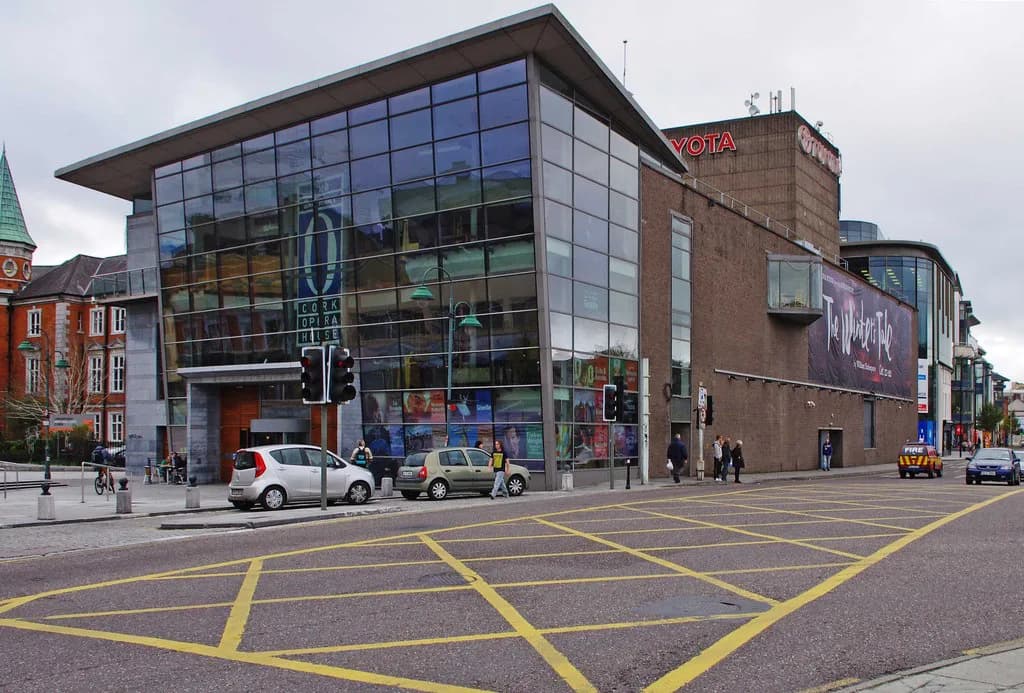
Cork Opera House: Visiting Cork's Civic Theatre on Emmet Place

Cork Opera House is a working theatre on Emmet Place in Cork city centre, so the way to see it is to book a performance rather than turn up expecting a museum or a backstage tour. The operator's own contact page gives the full address as Emmet Place, Cork City, T12 DW6P, with the box office on +353 (0)21 427 0022. National tourism listing Discover Ireland describes it as roughly a 1,000-seat venue, which tells you the scale of the auditorium you are booking into.
Its pulled-together identity is civic rather than commercial. The About page states that the house is a non-profit DAC with charitable status and that Cork City Council is the largest shareholder, having acquired the controlling block of shares from a now-dissolved theatre trust. That structure helps explain why a city this size supports a venue with its own orchestra and residencies rather than a touring-only stage.
Where Cork Opera House Sits on Emmet Place
The theatre faces Emmet Place, a short walk from the heart of Cork city centre, and the Eircode T12 DW6P is the one to hand to a taxi driver or drop into a map. Because it is an active performance venue rather than an all-day attraction, you plan a visit around a curtain-up time, and the box office is the correct place for any query about a specific production or seat. The publisher's own contact page lists the main phone line and the boxoffice email address, so routine questions can be settled before you travel.
One practical quirk: the nearest accessible parking, as noted in the venue's accessibility information, is on Emmett Place alongside the Crawford Art Gallery, which places the gallery in the immediate area. That makes a daytime gallery stop and an evening show a plausible pairing without any extra journey. If you want to broaden a Cork city break beyond the theatre, the wider Cork Attractions: 5 Visitor Guides collection is a sensible starting point for comparing places to see while you are in the city.
Main House and Half Moon: Two Rooms, Two Kinds of Night
Discover Ireland's listing distinguishes the main auditorium, at roughly 1,000 seats, from the 100-seat Half Moon Theatre, which it describes as hosting live music gigs and small-scale drama. That difference matters when you book: a name you recognise might be playing the big room or the intimate one, and the experience and sightlines differ accordingly. Check the current listing for a given production to see which space it uses before choosing seats.
The same listing sets out the programme breadth in plain terms: concerts, comedy, drama, musicals, contemporary and classical dance, family shows, an annual Christmas pantomime, and opera. For a first-time visitor that range is the useful fact, because it means the venue is not purely an opera house despite the name. If your dates are fixed, scan the full what's-on rather than assuming a particular genre will be playing.
A Theatre With Several Lives: Origins and Naming
The About page traces the house to the 1850s, when the original structure was designed by Sir John Benson on Anglesea Street to house the National Exhibition. When the decision was made to move to Nelson Place, now Emmet Place, the building was taken down brick by brick and rebuilt on the new site. Read that as the venue's own published history rather than a precise construction timeline, since no exact opening day is given.
The same history records the building's changing names: it began as the Athenaeum, then became the Munster Hall and the Great & Royal Opera House Company, before taking the Cork Opera House name in 1877. The venue also describes itself as a Cork cultural institution for 170 years, phrasing that is its own characterisation rather than an external ranking. Treat those names as the thread that makes the current building legible as the latest chapter of a long civic story.
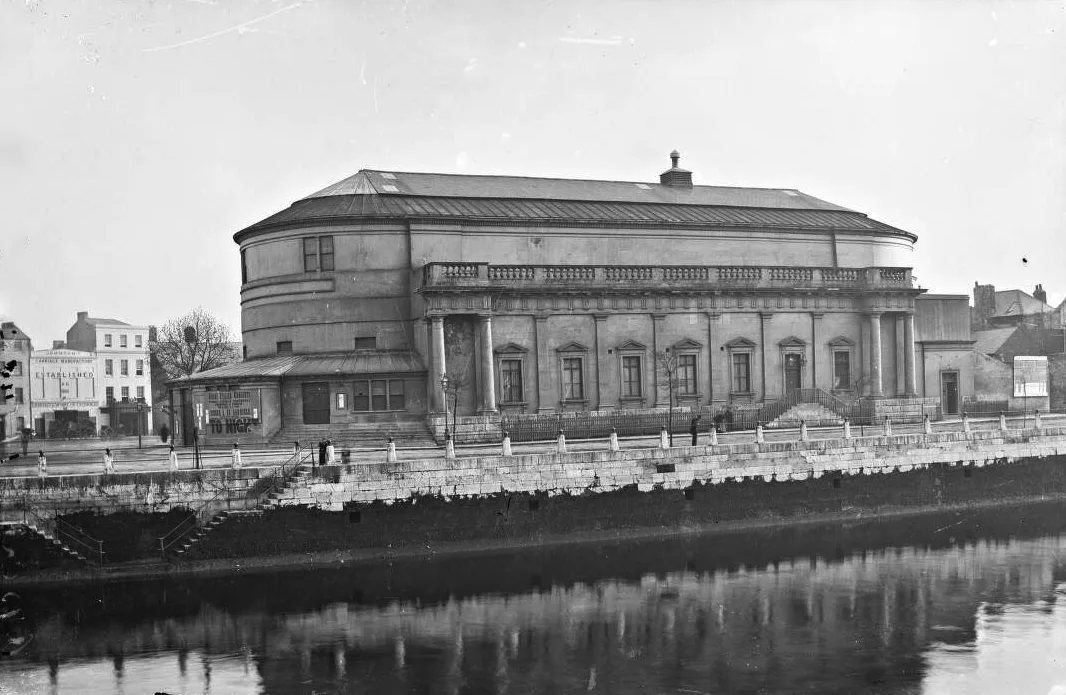

Fire, Fundraising and the 1965 Rebuild
A fire in December 1955 destroyed most of the structure, according to the operator's history, and a ten-year fundraising campaign followed. The modern theatre designed by Scott Tallon Walker was completed on the same site in 1965, which is the building most audiences would recognise today. Keeping those dates straight matters: the 1850s refers to the original design, while 1965 marks the post-fire theatre.
Later work included a front-of-house redesign by Murray Ó Laoire Architects, completed in 2000, and subsequent upgrades to seating, acoustics and sightlines described on the same page. For visitors, the useful takeaway is that the auditorium has been progressively modernised rather than left as a period piece. If architecture is your interest, the Emmet Place exterior is the thing to look at on arrival, since no public tour or archive is advertised.

What You Might See
The musical-theatre category shows the kind of touring shows the venue books, listing titles such as SIX – The Musical, Dirty Dancing, The Sound of Music and The Rocky Horror Show, alongside school and community performing-arts shows. Individual pages carry their own age guidance and effects warnings, for example a recommended age of 10 and over for SIX, with strobe, haze and adult themes flagged. Read those notices before booking if you are bringing children or are sensitive to flashing light.
Beyond touring musicals, the house produces its own concert work. The annual Christmas Concert, for instance, features the Cork Opera House Concert Orchestra under conductor John O'Brien, mixing carols, holiday songs and orchestral pieces. That event page also publishes its own ticket tiers and states that booking fees apply, which is a useful reminder that prices are set per event rather than as a single venue admission charge.
The House's Own Artistic Life
The About page explains that the Cork Opera House Concert Orchestra was founded in November 2015 to strengthen the venue's musical offering and now forms a significant part of its programme. The same page describes the Cara O'Sullivan Associate Artists Programme, launched in 2021 in memory of the Cork soprano and naming a cohort of singers who have performed on the main stage and in the foyer. Together these show a producing house that builds its own ensembles rather than only hosting tours.
The venue also runs residencies, including a New-Irish Theatre Artist-in-Residence role and a Creative Producer-in-Residence for opera, both described on that page. These are behind-the-scenes artistic appointments, so you will not visit them as attractions, but they help explain why the programme includes new and Irish work alongside familiar titles.
The University Partnership
In 2018 Cork Opera House and University College Cork launched an eight-year partnership called Creating Together, which the venue describes as establishing it as a Learning Theatre. Under the arrangement, students in the School of Film, Music and Theatre gain professional experience through productions, workshops and projects at the house. It is a working relationship rather than a visitor attraction, but it explains the educational strand running through the venue's activity.
The About page adds that the partnership also funds a Theatre Artist-in-Residence programme, launched in 2019 and jointly funded with UCC. Past residents have developed work that reached the main stage, which is the kind of detail that makes the residency more than a title. If you follow Irish theatre, keep an eye on the what's-on for productions carrying that connection.
Box Office Hours and Booking
The contact page publishes box office hours as Monday to Friday 10.00am to 5.30pm and Saturday 12pm to 5pm, with Sunday closed. On days with an evening performance, hours are extended to 8pm Monday to Saturday and 5pm to 8pm on Sunday, though the venue notes these arrangements are subject to change. Those are ticketing hours, not general access to the auditorium, so do not plan to walk the building outside a booked performance.
Internet and telephone bookings carry a handling fee per ticket, as stated on the same page, so compare that with buying in person if the fee matters to you. If your plans are flexible, the sensible sequence is to check the current what's-on first, then confirm a performance date, then book. Programme dates, times and prices are declared subject to change, so confirm close to your visit rather than relying on an old listing.
Access and Comfort
Accessible tickets, including wheelchair spaces, must be booked directly through the box office in advance, and the accessibility page states that up to five wheelchair users and their companions can be accommodated in prime positions in the auditorium. There is a wheelchair lift on the ground floor and an elevator to the left of the main entrance serving the bar, hospitality suite, corporate boxes and the back row of the Dress Circle. Note the caveat that Rows A to K of the Dress Circle are reached by stairs from the first-floor bar, so choose seats knowingly.
An induction loop operates for hearing-aid users, who should set aids to 'T', and the venue advises buying in Stalls Rows D to G to use it. Trained assistance dogs are welcome, relaxed performances of the annual panto are offered, and there is free buggy parking for family shows plus baby-changing on the ground floor. Ask questions before you arrive or speak to a duty manager on the night if something needs sorting.
Nearby: Crawford Art Gallery and Emmet Place
The Crawford Art Gallery stands next to the accessible parking on Emmett Place noted by the theatre, so an afternoon there and an evening performance are easy to combine. Build the day that way if you are coming into the city specifically for a show, since the theatre itself has no general visiting hours to fill. For other indoor collections, the Museums in Cork collection is a helpful comparison if a rainy day changes your plans.
If you are extending your stay, Cork's other heritage sights sit within a wider city picture. The Cork City Gaol on Convent Avenue in Sunday's Well and Elizabeth Fort are both separately documented places to add to a longer trip, each with its own access arrangements. None of these substitutes for a theatre ticket, but together they make a fuller cultural day around the city centre. To decide where to base yourself between shows and sights, weigh the options in these Cork Neighborhoods: 4 Area Guides.
Plan Your Visit
Cork Opera House rewards planning rather than wandering in. Decide which production and which room you are booking, check the age guidance and effects warnings for that show, and confirm box office hours before travelling, since the published schedule includes a Sunday closure and performance-day extensions that can change. Book accessible seats directly with the box office if you need them.
Allow an evening for the performance itself and, if you arrive early, use the Emmet Place setting for a look at the exterior and the neighbouring gallery. The venue's value is as a living theatre with its own orchestra and residencies, not a static monument, so the show you choose is the visit. Check the venue's own programme close to your date, because listings and prices are updated per event.
Explore more Cork guides
Frequently Asked Questions
Do you need a ticket to go inside Cork Opera House?
Yes. Cork Opera House is a working theatre, not a museum, so you see it by booking a performance in the main auditorium or the Half Moon Theatre. The published box office hours cover ticketing and enquiries, not general building access, so plan around a show rather than a walk-in visit.
How long should you allow for a visit to Cork Opera House?
Allow an evening for a performance, plus time to arrive, collect tickets and find your seat. There is no separate visitor route through the building, so the show's running time and any interval define your visit. Check the individual production page for its length and any age or effects guidance.
Is Cork Opera House accessible for wheelchair users?
Yes, with advance booking. Accessible tickets, including up to five wheelchair spaces with companions, are booked directly through the box office. There is a ground-floor wheelchair lift and a main-entrance elevator, but Rows A to K of the Dress Circle are reached by stairs, so confirm your seats when booking.
What kinds of shows does Cork Opera House stage?
Its programme spans opera, concerts, comedy, drama, musicals, contemporary and classical dance, family shows and an annual Christmas panto, across a main auditorium and the smaller Half Moon Theatre. Individual productions carry their own age guidance and warnings, so check the listing before booking.
When was Cork Opera House built and rebuilt?
The venue's published history traces the building to the 1850s, when Sir John Benson designed the original structure, later moved brick by brick to Emmet Place. A fire in December 1955 destroyed most of it, and the Scott Tallon Walker theatre was completed on the same site in 1965.