
St Stephen's Green: Dublin's Victorian City Park

St Stephen's Green is the park to aim for when you want a green pause in the middle of central Dublin. It sits beside Grafton Street, is bordered by four streets named after the compass points, and is laid out as a formal Victorian garden rather than an open meadow. This guide explains where it is, what is worth looking for inside it, and how to shape a visit around its scale and its published hours.
Where St Stephen's Green sits
The park occupies a rectangle bounded by St Stephen's Green North, South, East and West, and it adjoins Grafton Street as well as a shopping centre that takes the park's name. Public bodies have offices on the surrounding streets, so the Green reads as a civic space as much as a visitor sight. Traffic on these encircling streets was reduced considerably after tram works in 2004, which makes the approach on foot calmer than the old street pattern suggests.
A Luas tram stop stands on the surrounding streets, which makes the park easy to fold into a day spent in the centre on foot or by tram. At roughly 22 acres, or 8.9 hectares, it is the largest of Dublin's main Georgian garden squares; Merrion Square and Fitzwilliam Square are the other named comparisons in the same group. If you are comparing garden squares, the Merrion Square page covers a neighbouring example in more detail.
How the park came to look this way
The landscape you walk through today was designed by William Sheppard, and the park was officially re-opened to the city's citizens on 27 July 1880 by Lord Ardilaun. The official park page records the same 1880 opening by Lord Ardilaun and stresses that the grounds have been kept in their original Victorian layout. Knowing this helps you read the park correctly: the formal beds, shrub planting and defined walks are a designed nineteenth-century composition, not later landscaping.

Reading the Victorian layout and planting
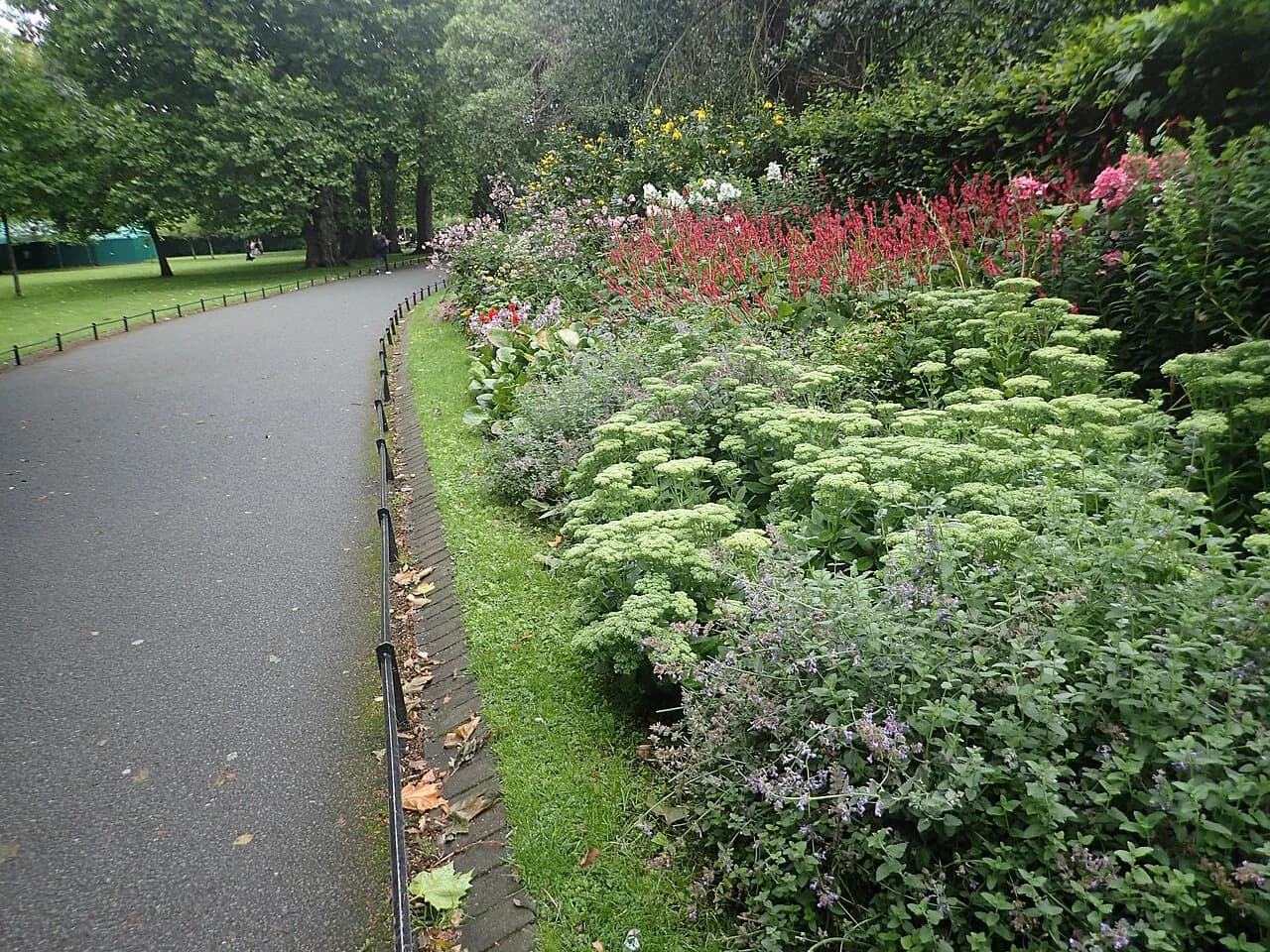
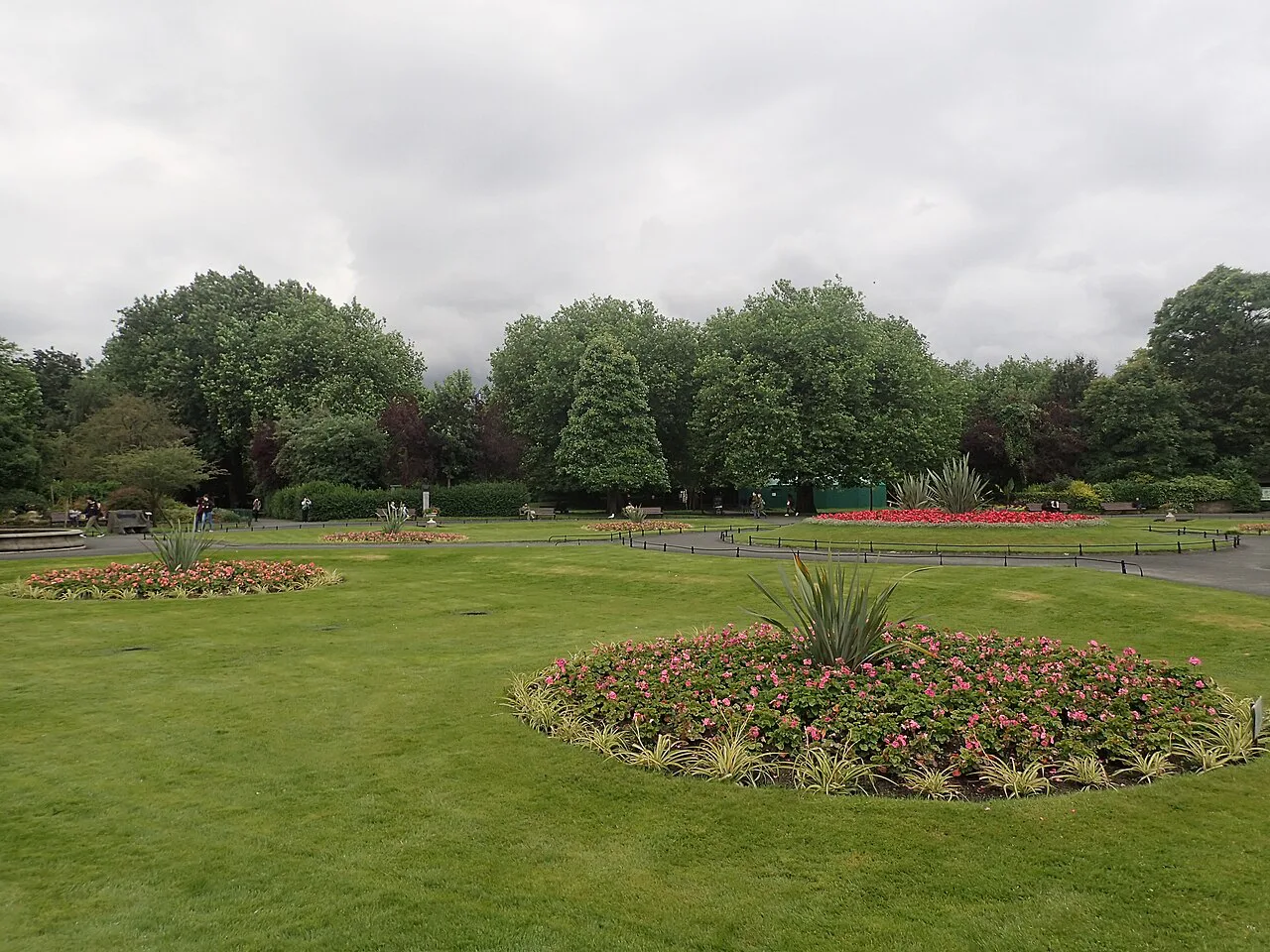
The park is maintained in its original Victorian plan, with heavy tree and shrub planting and spectacular spring and summer bedding. The herbaceous border keeps colour going from early spring to late autumn, so the planting interest lasts well beyond the peak bedding season. Walk slowly along the borders if you care about plants; the formal structure of the garden is the reason the Green feels enclosed rather than open to the surrounding streets.
More than 3.5 kilometres of pathways are described as accessible to all users, which is enough to make a circuit a real walk rather than a quick cut-through. If your time is short, treat the Green as a deliberate loop of a particular quarter rather than a route across the city. The paths give you a way to see the beds, the water and the sculpture without retracing your steps too often.
The lake, waterfall and western rockwork
The ornamental lake provides a home for waterfowl, and on the western side of the Green you can see the waterfall and Pulham rockwork, which the official page names as a feature worth seeking out. These are the elements that give the park its Victorian picturesque character, so they reward a slower look rather than a passing glance from the path. Keep the rockwork and waterfall as a western-side destination when you plan your route around the park.
An independent travel write-up describes a large lake fed by an artificial waterfall, with ducks and other waterfowl, and notes a garden for the blind planted with scented species that can withstand handling and are labelled in Braille. That garden is described only in that independent account rather than on the official park page, so treat it as a planted feature worth finding if you are interested in how Victorian parks were adapted for different visitors, not as a separate staffed visitor attraction.
Sculpture and monuments
Several sculptures stand throughout the Green, and two are specifically named: the James Joyce Memorial Sculpture and a fine specimen by Henry Moore. A college history article also describes the park as holding a large number of sculptural monuments to Irish history, which explains why the Green repays attention even when the beds are between seasons. Look for the named pieces rather than assuming every monument carries a well-documented story on site.
The park in 1916 and in civic life
The park was caught up in the 1916 Easter Rising, and it has long functioned as a walking place in the middle of the city. The college history article reports an association with Arthur Guinness and Countess Constance Markievicz as people who walked here, which is best read as testimony to the park's place in Dublin life rather than a formal residence claim. For the wider story of the city around the park, a broader Dublin history overview gives useful background, and the Irish History: Seven Places That Explain the Past guide sets that story in a national frame.
Walking the Green: paths and access
With over 3.5 kilometres of accessible pathways, the park suits a full circuit of roughly an hour at an unhurried pace that includes stops at the lake and the sculpture. Anyone with limited time can choose a shorter loop towards the western side for the waterfall and rockwork, or stay near the Grafton Street entrances for the beds alone. The Green is maintained by the Office of Public Works, as the official page and the college source both state, and the official Heritage Ireland page is the place to confirm current conditions before travelling.

Family and dog notes
A children's playground in the park is always popular, according to the official page, and it sits within the wider landscape rather than as a separate attraction you need to book. Dogs are not allowed in the playground or around the lake and fountains, a rule to know before you arrive with a pet. The rest of the park's paths remain the shared space for ordinary walking, so plan your route with those restrictions in mind.
Timing a visit
Published opening times are Monday to Saturday from 07:30, Sunday and Bank Holidays from 09:30, and Christmas Day from 09:30 to 12:30; check the official page for confirmation before a holiday visit. The park page also mentions that a visitor at lunchtime in summer might catch a free concert, which is an occasional pleasure rather than a published programme. Treat the concert as a bonus if it happens, not as a reason to time your trip around it.
What else is near the Green
Government Buildings, Iveagh Gardens and Dublin Castle are all listed by Heritage Ireland as nearby sites to visit, so the Green works well as one stop on a short walk through this part of the city. Each of those places has its own entry arrangements, and the Green's page is not the place to confirm them. If your interests run to collections indoors, the National Gallery of Ireland is a separate option covered on its own page.
For a change of register after the park, Dublinia covers the city's medieval story, and the Chester Beatty Dublin holds a quite different collection of manuscripts and rare books. Neither replaces the Green as a place to walk, but together they let you pair an outdoor Victorian landscape with indoor museum time. The Dublin Attractions: 5 Visitor Guides page helps you choose among them without turning the Green into an itinerary.
Plan Your Visit
St Stephen's Green is best approached as a designed Victorian park rather than a shortcut between streets. Give it an hour for a full circuit that takes in the beds, the lake and the western waterfall, or a shorter loop if you only want a pause near Grafton Street. The official page publishes the park's opening times, and you should check it for current notices before you set out.
Frequently Asked Questions
Is St Stephen's Green worth visiting in Dublin?
Yes, if you want a Victorian public park in the middle of the city rather than a rural escape. It combines formal bedding and long herbaceous borders with a lake, waterfowl, a waterfall and Pulham rockwork on the western side, plus named sculpture including the James Joyce Memorial Sculpture and a Henry Moore piece. It is also the largest of Dublin's main Georgian garden squares.
Where is St Stephen's Green in relation to Grafton Street?
The park is adjacent to Grafton Street and to a shopping centre of the same name, and it is bordered by St Stephen's Green North, South, East and West. A Luas stop is on the surrounding streets, so you can reach the park by tram or on foot from the shopping district.
How long does it take to walk around St Stephen's Green?
Allow about an hour for an unhurried full circuit. The park has more than 3.5 kilometres of pathways accessible to all users, so a complete loop with stops at the lake and sculpture takes longer than a quick crossing, while a short loop towards the western side takes less.
What can you see inside St Stephen's Green?
Expect formal Victorian planting with spring and summer bedding and a herbaceous border that holds colour from early spring to late autumn. On the western side are the waterfall and Pulham rockwork, and the ornamental lake attracts waterfowl. Sculpture includes the James Joyce Memorial Sculpture and a Henry Moore specimen, and there is a children's playground; an independent account also describes a garden for the blind with scented plants labelled in Braille.
Who opened St Stephen's Green to the public?
Lord Ardilaun opened the park for the citizens of Dublin in 1880, on 27 July according to the photographic record. The current landscape was designed by William Sheppard, and the park is kept in its original Victorian layout.
Can you bring a dog to St Stephen's Green?
Dogs are not allowed in the playground or around the lake and fountains, so plan your route with those exclusions in mind. The park's paths are otherwise available to walkers during the published opening times.
What is on the western side of St Stephen's Green?
The western side holds the waterfall and the Pulham rockwork, which the official park page singles out as worth a visit. The ornamental lake, home to waterfowl, is the other main water feature to look for as you walk the paths.
What else is near St Stephen's Green?
Heritage Ireland lists Government Buildings, Iveagh Gardens and Dublin Castle as nearby sites, and Merrion Square and Fitzwilliam Square are other Georgian garden squares in the same part of the city. Each has its own arrangements, so check separately before you go.