
Lynch's Castle, Galway: A Medieval Fortified House in the City Centre

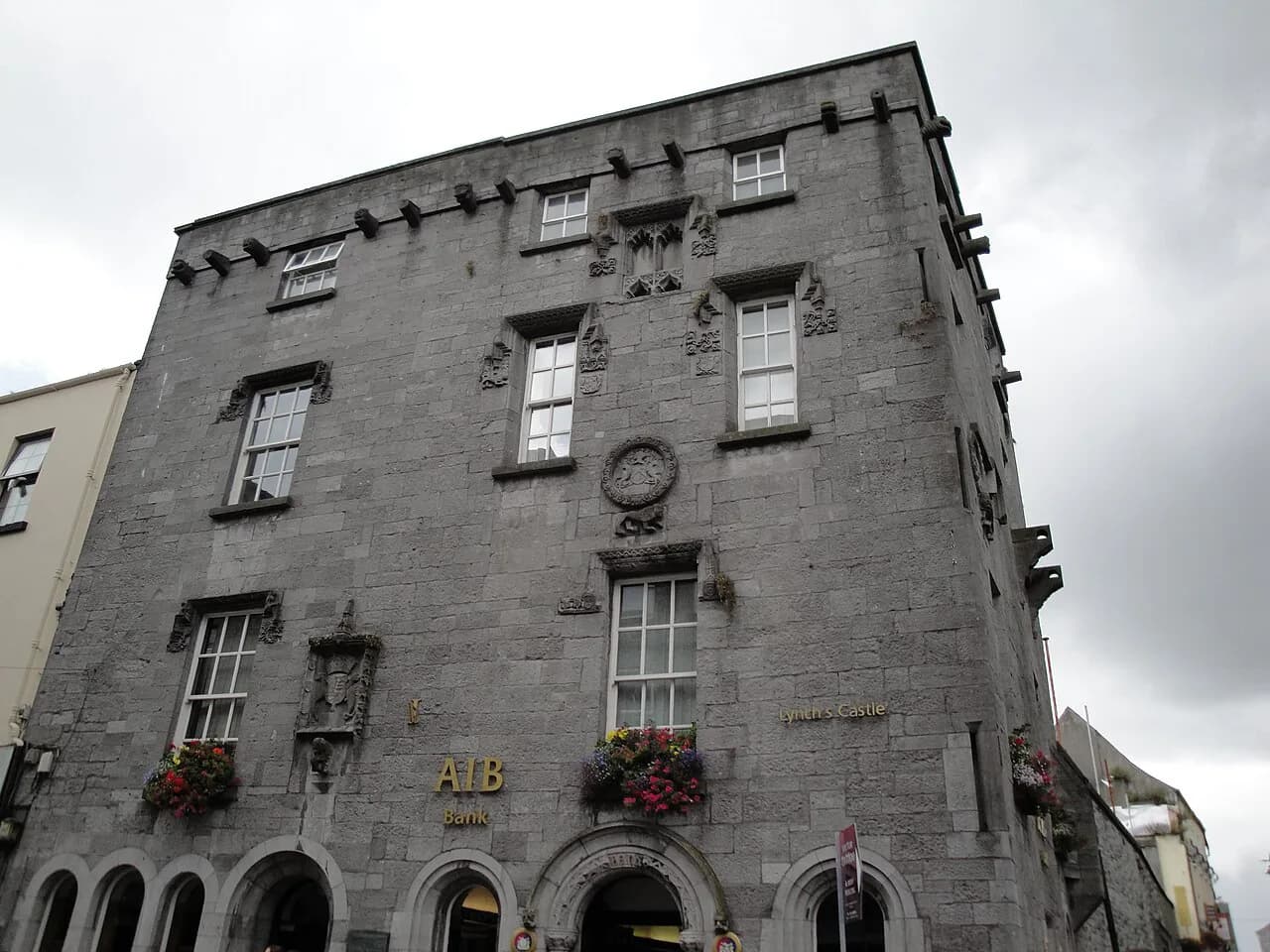
Lynch's Castle is a medieval fortified townhouse at the junction of Shop Street and Upper Abbeygate Street in the middle of Galway. It is not a castle in the ruined-tower sense: the building was heavily altered in 1966 when it was converted into a bank, so the reliable visitor experience is the exterior, read closely. Allow around fifteen to twenty minutes on the pavement, more if you stop to work out the carved detail.
Getting There and Viewing the Building
Because the building sits on a busy shopping corner, most people meet it from Shop Street, where modern frontages crowd close on either side. Walk to the crossroads with Abbeygate Street and stand back far enough to see the upper storeys; the four-storey mass and carved windows only make sense when you take in the whole façade rather than the bank frontage at eye level. Approaching from the Abbeygate Street side gives a second angle on the stonework, and the wider Galway streetscape is worth reading at the same time. If you want to compare how the rest of the old town is laid out around this corner, the Galway Neighborhoods: 5 Area Guides is a useful companion.
There is no ticket desk or booking system for the exterior, and no admission charge applies to looking at a building from a public street. The trade-off is that the street is busy and constantly in use, so early or quieter hours suit anyone who wants to study the carvings without a crowd. Pair the stop with the wider Galway Attractions: 9 Visitor Guides rather than treating it as a destination in itself.

Reading the Façade
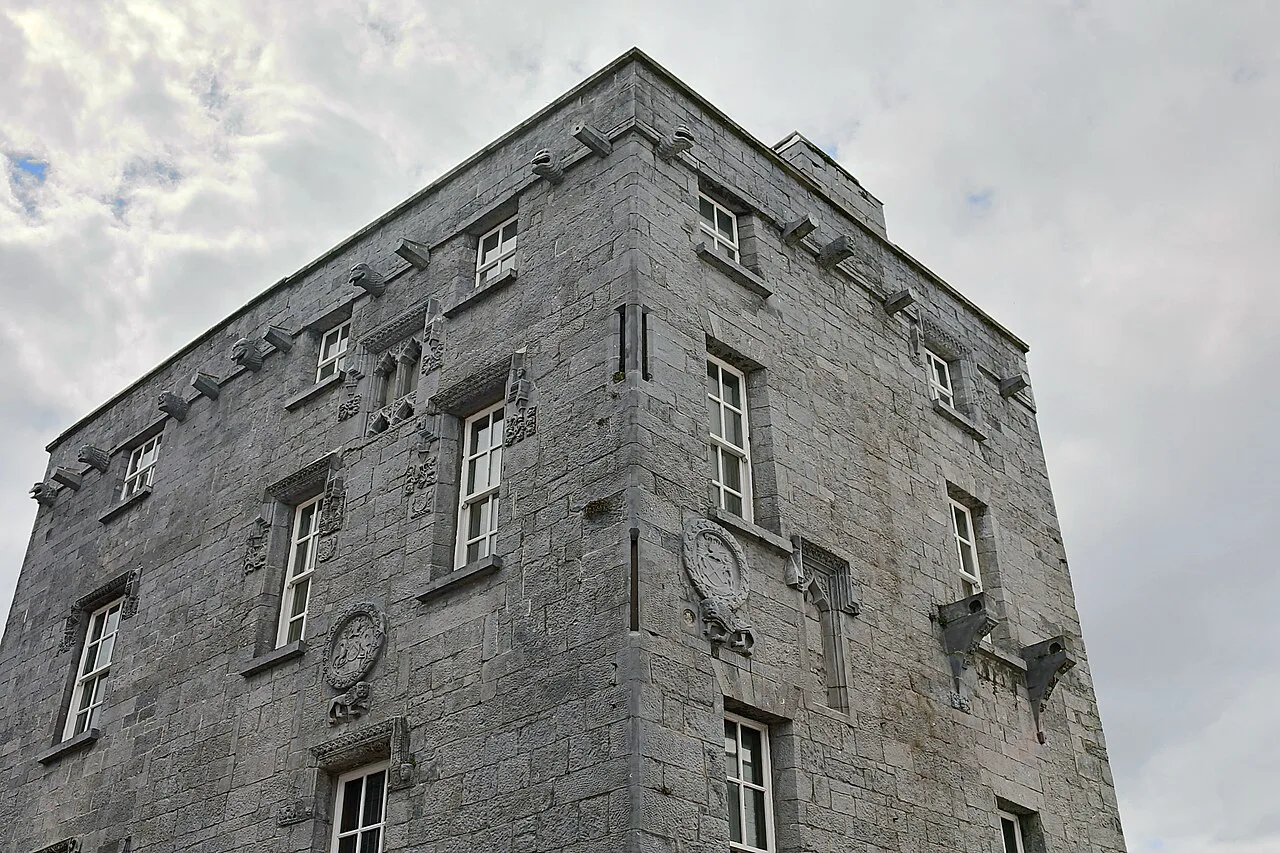
Look first at the windows: the quality of the carved stone surrounds is one of the building's real strengths, and they sit alongside gargoyles and ornamental mouldings and cornices that reward close attention. The exterior preserves some of the few surviving Irish gargoyles, which is the sort of detail easily missed at walking pace.
Above the openings, the heraldry carries the building's political message. The arms of Henry VII, the Lynch family and the Fitzgeralds of Kildare are displayed on the façade, signalling the patrons and alliances behind a merchant house that needed to look defended. Treat the coats of arms as evidence of self-presentation rather than as a family tree.

Whose Castle? The Lynch Family and the Tribes
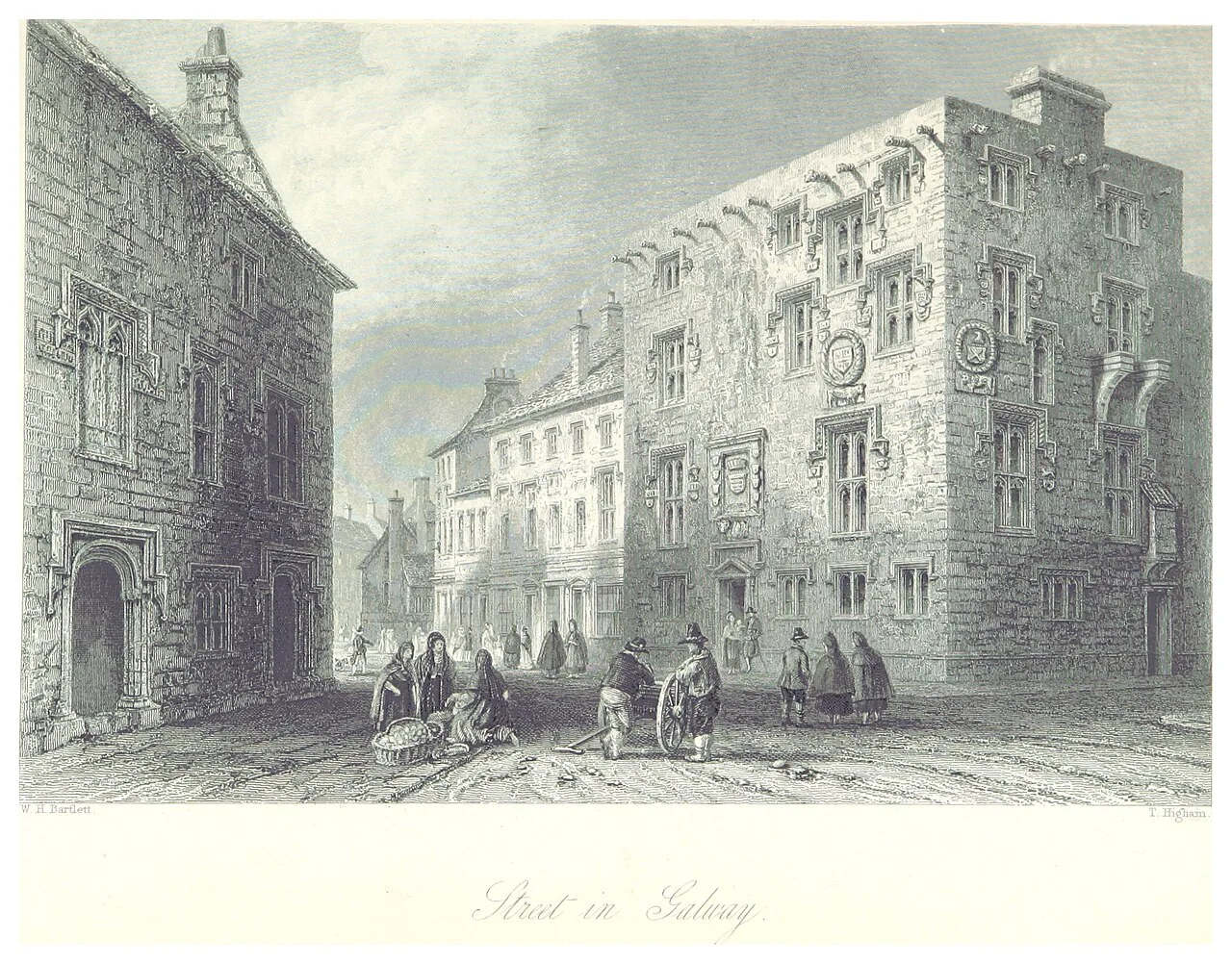
The Lynches, of Anglo-Norman descent, were one of the fourteen families known as the Tribes of Galway, and their name dominates the building's story. The word castle in the name should not conjure a royal fortress: this was a fortified townhouse built by a powerful merchant family for protection from raids, set within a commercial city rather than on a frontier.
Family legend attaches the story of James Lynch Fitzstephen, mayor of Galway in 1493, who is said to have hanged his own son for the murder of a Spanish sailor. It is a piece of Lynch lore rather than an event established as having happened in this building, and it is worth hearing as storytelling attached to a prominent family. The masonry stays the more reliable witness.
Dating a Building That Resists Dating
The building is generally assumed to have been constructed in the late fifteenth or early sixteenth century, though much of the dating rests on inference. Galway Civic Trust notes that it is missing from the Barnaby Gooch map and from the Speed maps of 1583 and 1610, yet appears on a map of 1651, which suggests it may have begun as a lower, less conspicuous structure and grown over time.
In a 1935 article, archaeologist John Hynes proposed that the castle might have been built under James Lynch Fitz Stephen and also observed that some slabs are clearly not original to the structure. Parts of the limestone building may reach back to the fourteenth century, though the bulk belongs to the sixteenth. Treat a precise construction year with caution: none is securely established.
Galway Civic Trust goes further and describes Lynch's Castle as the only non-religious building of its period still standing in Galway. That is the trust's assertion rather than a settled inventory fact, and it is best read as an argument about survival and preservation.
From Merchant House to Bank
The building's later history explains why so little of the interior reads as medieval. A large extension was added in 1808 and a carved doorway followed in 1933, changes that reshaped the structure long before the twentieth-century bank conversion. Title deeds traced by Hynes record a run of nineteenth-century owners, including George Stainforth in 1859 and Mary Hall by 1880, before Nellie Burke née Kirwan rented the premises to the Munster and Leinster Bank in 1918 and sold the property to the bank in 1920.
With the bank came change: the two shops in the house were removed to make way for the bank's office, and the property took the AIB name after the 1966 amalgamation. That same year the castle was heavily altered in its conversion into a bank, which is why the façade rather than the rooms carries the historic fabric. Reading the exterior as a surviving shell is more accurate than imagining a medieval interior behind the doors.
Preservation and the Ground-Floor Display
Preservation here was not automatic. Around 1903 or 1904 Matilda Redington, honorary secretary of the Galway Archaeological and Historical Society, wrote to the owners about the poor state of the house, and the society pressed for its protection, a campaign that fed into the bank's eventual acquisition. Local historians cited by the Civic Trust broadly agree that maintenance under bank ownership has been successful.
On the ground floor, historical material dealing with the castle is displayed, and information panels set out the building's history and architecture. Access to that space is tied to bank opening hours rather than to a museum timetable, and no fixed hours are published here, so check at the door or with the bank before relying on seeing it. The exterior remains the part you can count on.
Nearby Places to Continue the Walk
The castle's position makes it a natural first or last stop on a walk through old Galway. From the junction you can work downhill toward the river and the spanish arch, where the medieval city met the water, then cross toward the galway cathedral on the far bank for a complete change of period and scale; if you would instead rather compare how Galway's historic quarters are laid out, browse the Galway Neighborhoods: 5 Area Guides.
If the weather turns, the city museum is an obvious indoor follow-on, and eyre square gives a green pause with its own fragment of sixteenth- or seventeenth-century stonework re-erected in isolation. For other wet-day options, see these museums in galway. The Discover Ireland listing notes that the doorway and first-floor window relocated to the square's north side came from a Browne family house on Lower Abbeygate Street, a useful reminder that old Galway survives in pieces.
Plan Your Visit
Lynch's Castle rewards a deliberate stop rather than a passing photo. Budget fifteen to twenty minutes for the exterior, stand back to read the storeys and carved windows, and look for the heraldic arms that record the Lynch family's alliances. If the ground floor is open when you pass, the panels add context; if not, the building's story is legible from the pavement.
Explore more Galway guides
Frequently Asked Questions
What is Lynch's Castle and can you go inside?
Lynch's Castle is a medieval fortified townhouse at the junction of Shop Street and Upper Abbeygate Street in Galway, now incorporated into a bank. The building was heavily altered during its conversion into a bank, so the exterior is the reliable experience. A ground-floor display of historical material exists, but access depends on bank opening hours, which are not published here; check at the door or with the bank.
Where exactly is Lynch's Castle in Galway?
It stands on the corner where Shop Street meets Upper Abbeygate Street and Abbeygate Street, in the commercial core of the city. Most visitors arrive on foot along Shop Street and should step back to see the upper storeys above the modern shopfronts.
How old is Lynch's Castle?
The dating is debated. The building is assumed to date from the late fifteenth or early sixteenth century, and parts of the limestone may go back to the fourteenth century, but no precise construction year is securely established. Galway Civic Trust notes the building's absence from sixteenth- and early seventeenth-century maps and its appearance on a map of 1651.
Why does a castle house a bank?
The property was rented to the Munster and Leinster Bank in 1918 and sold to the bank in 1920, the two shops in the house were removed, and the building took the AIB name after the 1966 amalgamation. Its conversion into a bank that year involved heavy alterations, which is why the historic fabric is concentrated on the façade.
How much time should I allow at Lynch's Castle?
Fifteen to twenty minutes is enough to read the façade carefully from both street approaches, longer if the ground-floor display is accessible. It works best as one stop within a longer walk through central Galway rather than a standalone outing.
Is there an admission fee?
No admission is charged for viewing the building from the public street, and no ticketing or booking is involved. The ground-floor display sits within a working bank, so its availability follows the bank's own opening arrangements rather than a visitor attraction schedule.