
Latin Quarter Galway: Walking the City's Medieval Core

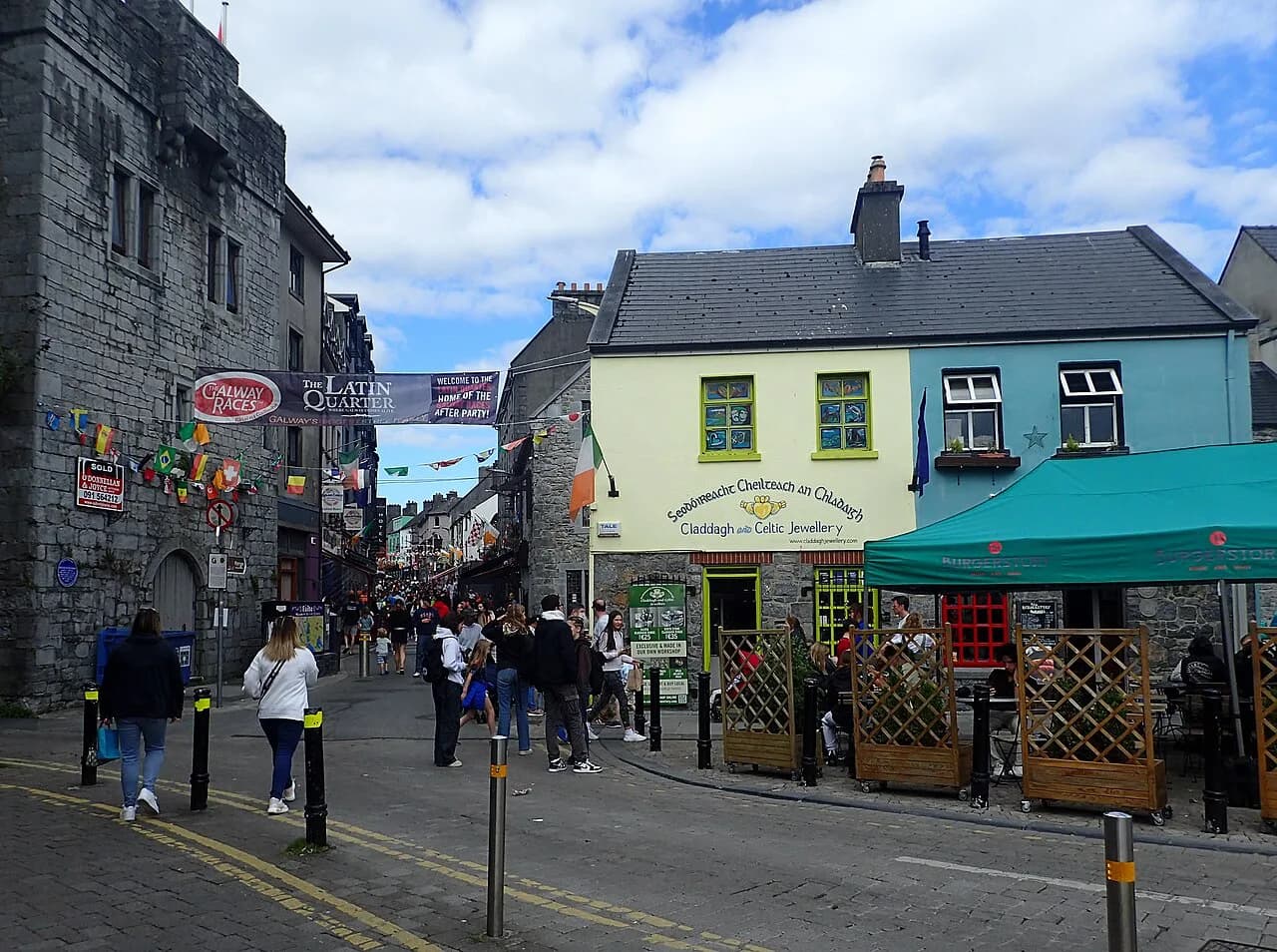
The Latin Quarter is the historic centre of Galway city, a compact and walkable district of cobbled, largely pedestrianised streets running from the Spanish Arch and Long Walk through Quay Street, High Street, Cross Street and Middle Street to St Nicholas' Collegiate Church, with Kirwan's Lane and Buttermilk Lane folded in between. Most of what makes it distinctive is visible from the street rather than behind a door, so it rewards a slow walk rather than a checklist.
Two things surprise first-time visitors. The name is not medieval at all: local accounts describe it as a community-led label adopted in the early 2000s, chosen to evoke a European quarter of learning and craft rather than to record an old title. And the district is a working city centre, not a preserved set, with heritage buildings standing among ordinary shops and offices.
Where the Latin Quarter Begins and Ends
The clearest definition is a street one. One city guide sets the quarter between the Spanish Arch, O'Brien's Bridge, St Nicholas' Church and Middle Street, with High Street's short cobbled stretch at its centre. A regional hotel account stretches it from the Spanish Arch and Long Walk through Quay Street, High Street, Cross Street and Middle Street, taking in Kirwan's Lane, Buttermilk Lane and the streets around the church.
Both descriptions agree on the essentials: a small area, bounded by the River Corrib and the wider city centre, that can be crossed on foot in a few minutes. Treat those street names as your map rather than any formal boundary, because this is a district defined by its medieval street plan and its commercial life rather than by an administrative line. Compare it with the neighbouring quarters in these Galway Neighborhoods: 5 Area Guides, where the Claddagh sits across the water and the seaside edge at salthill galway begins further west along the coast. If you enjoy tracing a medieval street plan on foot, Limerick's Medieval Quarter: A King's Island Walking Guide covers a comparable walk in another Irish city.

Why a Medieval Quarter Carries a Modern Name
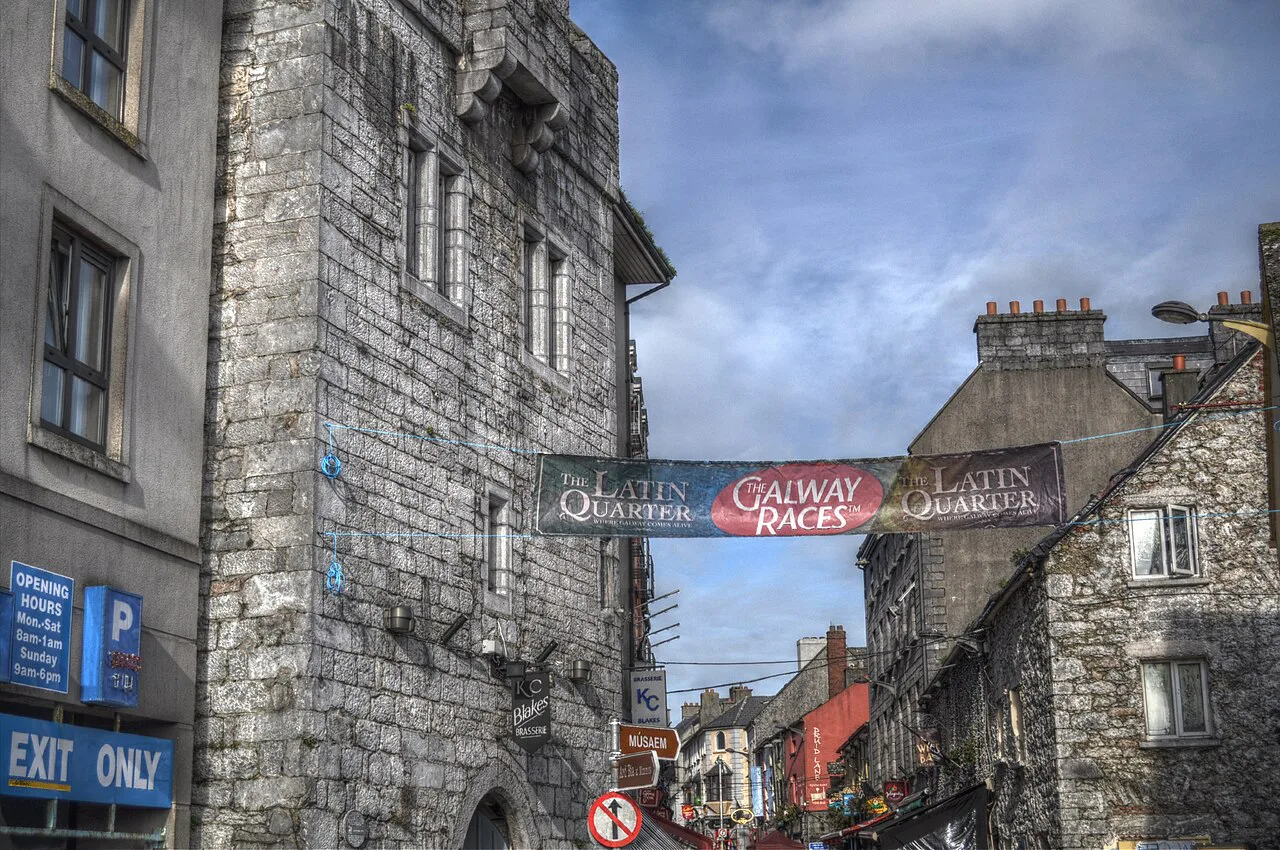
The label Latin Quarter was adopted in the early 2000s through a community-led initiative intended to celebrate the area's historic and cultural character, drawing on the bohemian associations of Paris's quarter of the same name. That makes it a marketing and identity term of recent origin, not a name in use in the Middle Ages, and reading it as a medieval label will mislead you.
What the name does point to is a genuine concentration of small independent businesses, historic buildings and cultural activity in a few streets. Keep that distinction in mind as you walk: the label is modern, the fabric it describes is not.
The Walled Town Underneath
During the Middle Ages this was the commercial and political centre of Galway, and much of the original street layout survives even though individual buildings have been rebuilt and adapted over the centuries. That survival is what lets you read the older town beneath the shopfronts: the lanes still run where they ran, and the main streets still follow the medieval plan.
The Tribes of Galway: A Later Label
Galway is often called the City of Tribes, a reference to fourteen merchant families, names such as Lynch, Blake, Bodkin and French, who dominated the town's trade and government across several centuries according to a local walking guide. The term itself is a later descriptor rather than a medieval title, and the families were of Norman origin, trading hides, wool and fish with Europe in exchange for wine, spices and luxury goods.
For the walker, the practical value is in the fabric: family crests and merchant houses appear above and around the streets, which is why it helps to know the names before you look up.
St Nicholas' Collegiate Church
St Nicholas' Collegiate Church is the anchor of the district, and the commonly cited foundation date is 1320, given by regional guides; treat it as the area's conventional dating rather than a verified primary record. Local tradition also links Christopher Columbus to the church, holding that he prayed there while investigating the voyages of St Brendan; that association is tradition, not established fact.
The church sits at the heart of the quarter, and its presence explains why the surrounding lanes feel like the centre of an old town rather than a shopping street. What you can see from outside is the building's long-standing place in the street pattern; for what lies within, check current visitor arrangements before you plan around it.
The Spanish Arch and the River Edge
The Spanish Arch is one of the surviving sections of Galway's old defensive walls, built in 1584 according to a local walking guide. Its name is the misleading part: it appears to refer to the city's extensive medieval trade with Spain rather than to any Spanish building, and the arch today marks the district's river edge at the Long Walk, with the old fishing village of the Claddagh just across the water.
Galway City Museum sits just behind the arch, which makes it the obvious interpretive starting point for the city's history before you walk the streets themselves; its admission is free and its exhibits are hands-on, which suits families. Confirm current opening arrangements before you go, since those can change seasonally.

Kirwan's Lane
Kirwan's Lane, just off Cross Street, holds the best of the district's medieval heritage and has been restored after years in ruins. It once held a late-eighteenth-century theatre built by Richard Martin for his wife, and two nunneries also stood on the lane, a reminder that this was a residential and religious street as well as a commercial one.
Today the lane is lined with small craft and antique shops, so the medieval plan is visible even where the frontage is modern. Walk it for the shape of the street and the surviving buildings rather than for any single address.
Lynch's Castle and the Hall of the Red Earl
Two buildings reward close looking. Lynch's Castle on Shop Street is named by a local walking guide as the finest surviving medieval fortified townhouse in Ireland, its grey limestone fabric still readable beneath its present use. The Hall of the Red Earl, a ruin on Druid Lane, is the remains of a thirteenth-century municipal building, rediscovered in the 1990s when the Revenue Commissioners tried to expand their offices on the site; glass walkways let you cross the excavated foundations.
Legends, Clearly Labelled
The best-known Galway story is the hanging mayor. Local lore holds that in 1493 the Mayor of Galway, James Lynch FitzStephen, condemned his own son Walter for murder and hanged him himself from a window after the town executioner refused. The story is tradition rather than established record, and the related idea that it gave English the word lynching is disputed by linguists.
Hold such stories the way local guides present them, as legend attached to real places, and you will enjoy them without mistaking them for history. The window associated with the story, just behind St Nicholas' Church, is worth seeking out for that reason alone.
Who the Quarter Suits and Who It Does Not
This is a district for people who like reading a town on foot. It is compact, cobbled and pedestrianised, so the distances are short, but the surface is uneven and in high summer the main streets can be shoulder to shoulder. If you want space and quiet, come early in the morning rather than mid-afternoon.
It suits travellers interested in medieval street plans, merchant architecture and church history. It does not suit anyone expecting a single ticketed attraction or a museum-like set piece: the quarter is the exhibit, and much of it is seen from the pavement. Readers who want a wider shortlist of named city sites before settling on a route can start with these Galway Attractions and then return here for the medieval streets.
What to Look For on Foot
Look above the shopfronts. Crests, carved stone, window shapes and the occasional fortified facade show which buildings predate the modern frontage, and street names preserve the lanes of the old town. The cobbles themselves tell you where the pedestrian core sits.
Then follow the lanes rather than the main flow. Kirwan's Lane and Buttermilk Lane are short detours that show the medieval plan most clearly, and the area around St Nicholas' Church is where the older street layout is easiest to read.
Reading the Quarter Rather Than Ticking It Off
The Latin Quarter works best as a place to read rather than a list to complete. Start at the Spanish Arch and the museum behind it to fix the city's history in your mind, then walk up through Quay Street and High Street to the church, detouring into Kirwan's Lane and Druid Lane for the buildings that carry the medieval town in their stone.
Remember that the name is recent and the fabric is old, and that several of the best stories attached to these streets are legend rather than record. Walk it slowly, look up, and the district will explain itself. For another heritage guide, read about Woodquay Galway.
Explore more Galway guides
Frequently Asked Questions
What is the Latin Quarter in Galway?
It is the historic centre of the city: a compact, largely pedestrianised district of cobbled streets running from the Spanish Arch through Quay Street, High Street, Cross Street and Middle Street to St Nicholas' Collegiate Church, with Kirwan's Lane and Buttermilk Lane in between. Its appeal is the streetscape itself, so it works better as a slow walk than as a stop-by-stop itinerary.
Why is it called the Latin Quarter if the name is modern?
The label was adopted in the early 2000s as a community-led identity for the district, drawing on the artistic associations of Paris's Latin Quarter. It is not a medieval name, so do not read it as evidence of an old title. The medieval element is the street plan and the surviving buildings on either side of the lanes.
Is the Lynch hanging-mayor story true?
It is a local tradition rather than established record, and the proposed link between the episode and the English word lynching is disputed. The story attaches to real places in the quarter, so the useful approach is to treat it as legend attached to a site while you walk. Read it as the district's folklore, not as documented history.
Is the Latin Quarter walkable for a visitor?
Yes, but in a specific sense: the streets are short, cobbled and largely pedestrianised, and the quarter can be crossed on foot in a few minutes. The trade-off is surface and crowding, since the cobbles are uneven and the main streets fill up in high season, so earlier in the day is more comfortable. Many of the heritage features are seen from the pavement rather than from inside buildings.