
Athlumney Castle, Navan: A Visitor Guide to the Ruins
Athlumney Castle is an unguided National Monument in Navan, where a 15th-century Dowdall tower house meets a later fortified manor above the Boyne.
On this page
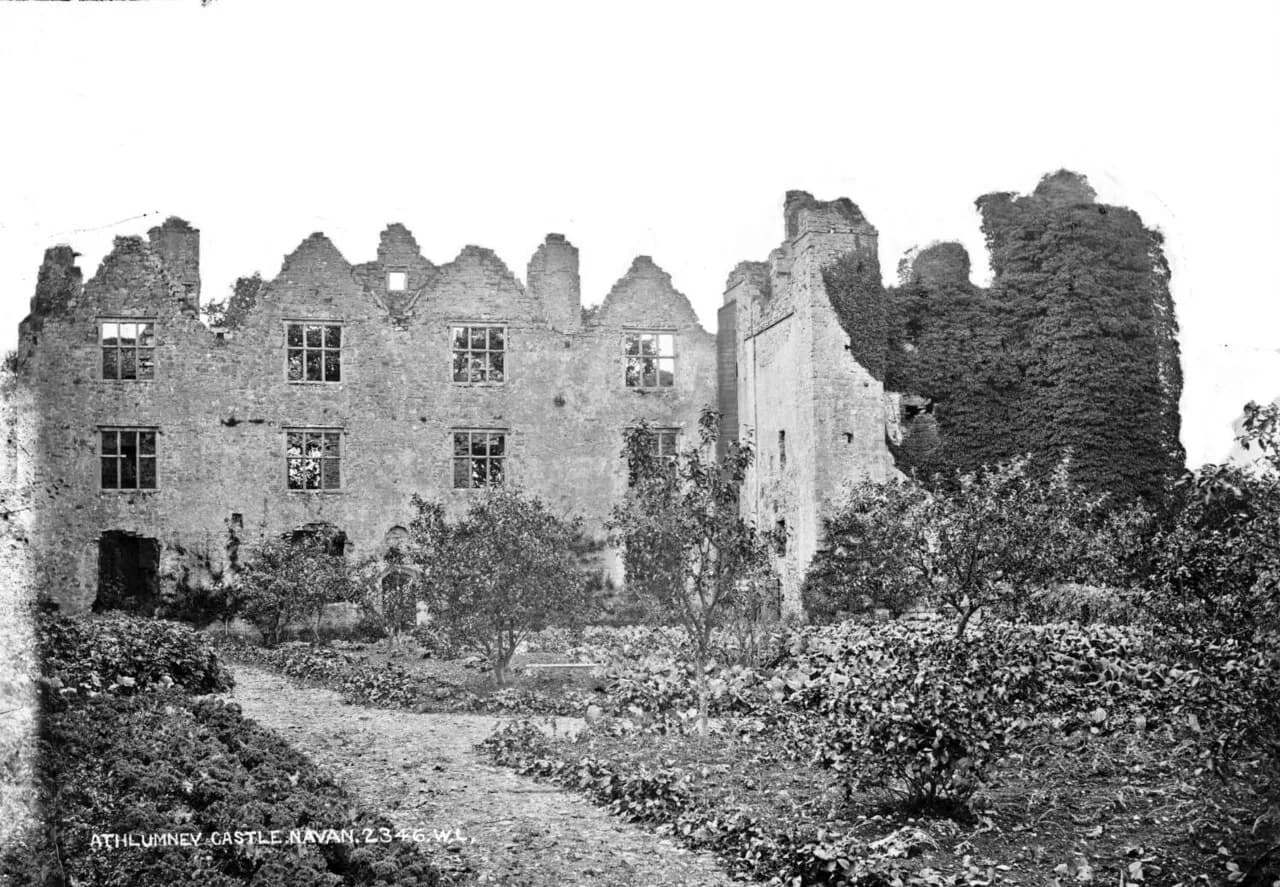
Athlumney Castle is a ruined 15th-century tower house with an attached Tudor manor, standing above the River Boyne on the eastern edge of Navan in County Meath. Heritage Ireland lists it as a National Monument in state guardianship and describes it as an unguided site, and the Office of Public Works cautions visitors to take care at every stage of a visit. This guide explains how the entrance works, what to look for in the two adjoining buildings, and how the ruin fits into the wider manorial landscape around it.
What Athlumney Castle Is and Where It Stands
The monument sits near the junction of Convent Road and Elm Park, tucked inside what Heritage Ireland describes as a quiet residential housing estate, high on the eastern bank of the River Boyne. It overlooks a strategic point where the Leinster Blackwater drains into the Boyne, which helps explain why a fortified site was placed here in the first place. The remains combine two different buildings in one footprint, and reading them as separate phases is the key to understanding what you are looking at.
Because it is a National Monument in state guardianship, the ruin is protected under the National Monuments Acts, and that status shapes the visit: you are walking through an archaeological site rather than a managed attraction. Expect rough, uneven ground and masonry that has been open to the weather for centuries. The upper floors of the tower are gone, so there is nothing to climb in the sense of a rooftop view, and no part of the structure should be treated as a safe platform.
Getting In: The Gate on Convent Road
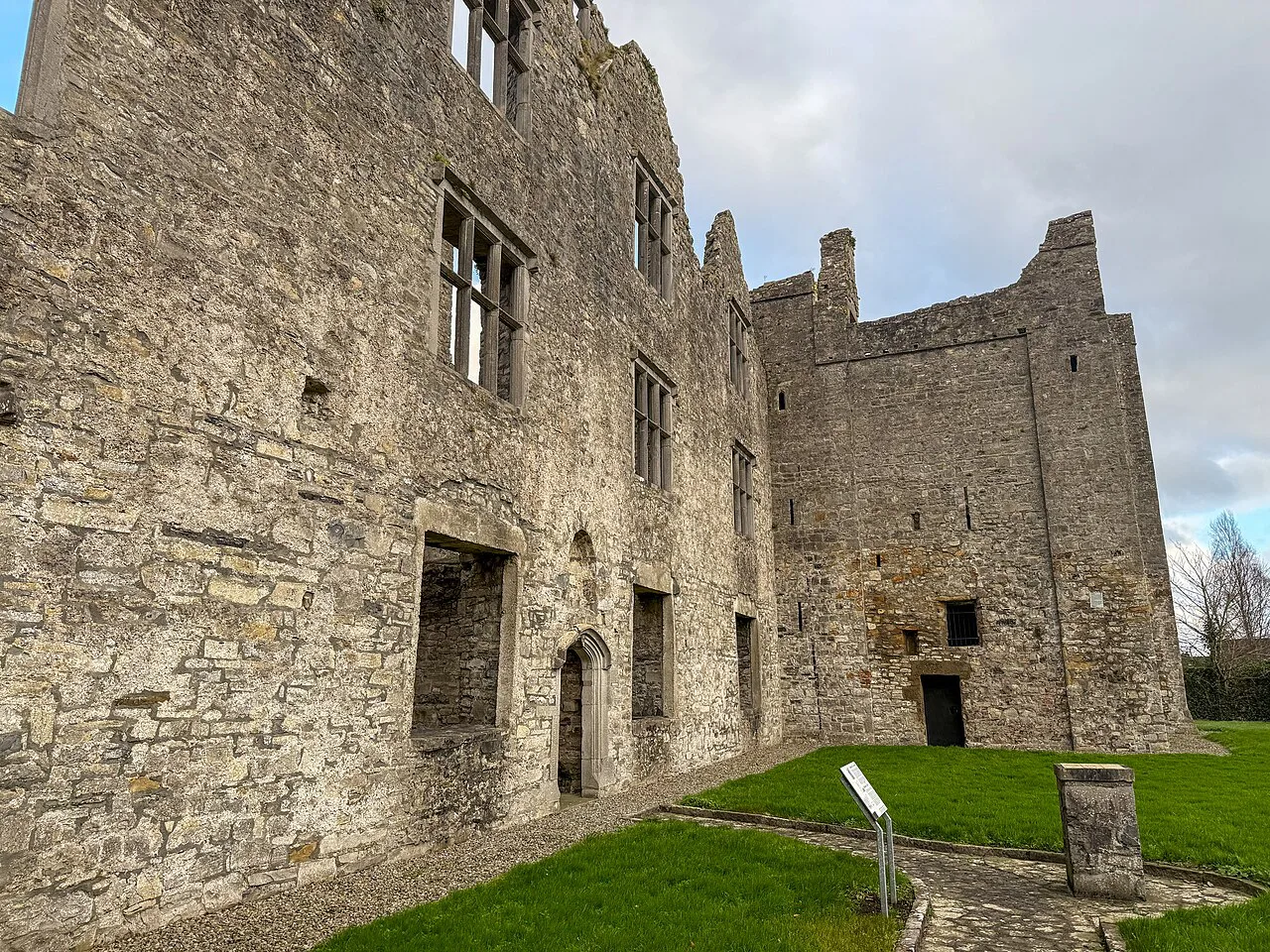
Heritage Ireland describes the site as reached through a small gate on Convent Road, passing through a tall wall that encloses a large garden. Most of that garden belongs to the Sisters of Mercy religious order, which still owns a portion of the enclosed ground. The gate is therefore an access route past privately owned land, not a public park entrance, and visitors should keep to the monument area rather than wandering across the garden.
Navan town centre is a short walk away, which makes the ruin easy to combine with a stroll out from the town. The Navan & District Historical Society notes that the first bridge over the Boyne linking Navan to Athlumney was built in 1756, so the relationship between town and castle across the river has a long history of its own. Check locally before setting out, since a gated National Monument can have access arrangements that change with maintenance or weather.
One access detail is worth passing on with a caveat. A Fáilte Ireland tourism listing for the neighbouring Athlumney Manor bed and breakfast states that its owners were appointed caretakers of the castle and grounds and can provide access for their guests. That is a listing-specific arrangement tied to one property's guests, not a public guided service, so do not treat it as a general tour offer for casual visitors.
Two Buildings, Two Eras
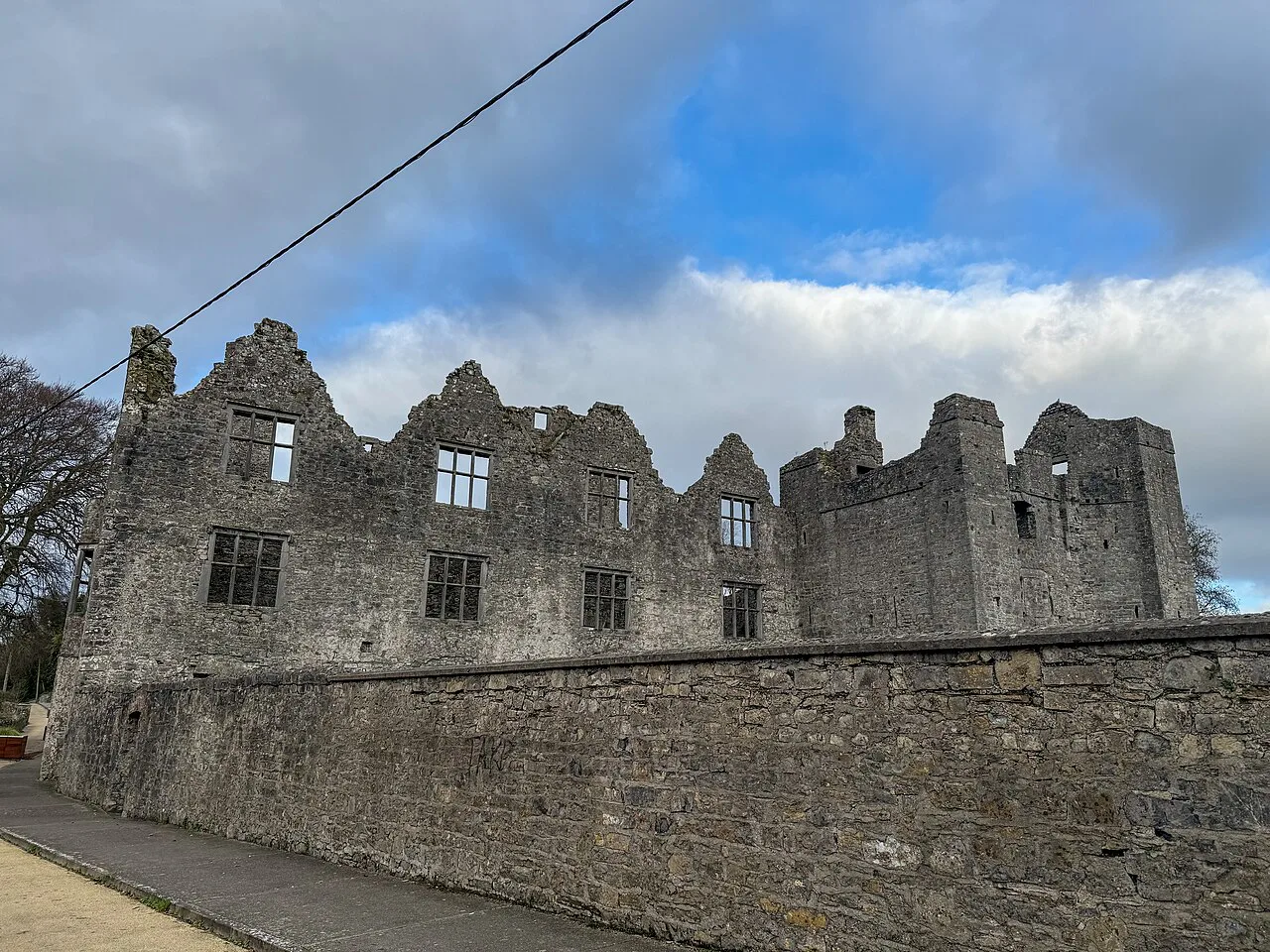
The older element is a four-storey tower house built by the Dowdall family, a powerful Catholic family originally from County Louth. Heritage Ireland describes it as lying on a north-east/south-west axis, with the fortified four-bay medieval manor added later against its south-west wall. The manor is dated to the 16th or early 17th century, and its domestic scale contrasts sharply with the defensive logic of the tower.
The two phases sit side by side in the same footprint. According to Heritage Ireland, the tower is the older building, while the manor adds large corridors and heated rooms, with four huge fireplaces and two ovens of its ground-floor kitchen heating the first floor where the family lived. Seeing them joined at the same wall helps make sense of why a defensive tower and a domestic house were built in one place.
For a wider sense of how Meath's castles developed across different periods, a survey of castles in meath sets Athlumney against better-known sites and earlier Norman fortification. Pacing the two chronologies side by side makes the Dowdall tower's late-medieval date easier to place.
Architectural Detail Worth Pausing For
Start with the tower's corners: projecting square turrets of varying sizes mark the four-storey block, and holes for floor beams are still visible at first-floor level. The ground floor is barrel-vaulted, and a murder hole once protected the original entrance. An internal spiral staircase survives and still leads up to the battlements, though the upper floors themselves are missing.
The manor side repays close looking at the openings. It is three storeys high, with eight sets of square six-paned stone-mullioned windows, four on the first floor and four directly above them. Inside, four huge fireplaces and two ovens on the ground-floor kitchen heated the first floor where the family lived, and the remains of elegant fireplaces are still visible upstairs. A modest limestone entrance doorway, apparently reduced in size at some point, opens beneath a stone-mullioned oriel window looking south-west toward the Boyne.
Look also at the outer ground-floor and garden walls, where several bricked-up entrances appear. Heritage Ireland notes they may have been closed for defensive or security reasons, or may indicate structures that no longer exist. That uncertainty is characteristic of a ruin without a written building record, and it is a reminder to read the fabric as evidence rather than as a finished picture.
The Mural Chamber Tradition
In the south wall of the first floor, a stairs of eleven steps leads from above into a secret mural chamber. Heritage Ireland says the chamber is assumed to be a priest's hole for hiding members of the Catholic clergy, and that word assumed is the important one: no source here proves the use. Treat the story as a tradition attached to the fabric rather than as established fact.
The detail matters because priest holes are usually associated with the travails of Catholic families after the Reformation, and the Dowdalls were a prominent Catholic family in Irish public life. The physical evidence, a hidden chamber reached by a narrow stair within the wall, supports the idea of concealment without settling who used it. Visitors should not attempt to enter or climb into the chamber.
The Name and the Wider Manorial Landscape
Athlumney takes its name from the Irish for Loman's ford, and Heritage Ireland records that the place is traditionally associated with St Loman, described as the first Bishop of Trim and reputedly a nephew of St Patrick, who is said to have crossed the river here. Label that as tradition rather than documented event; its value is in showing how the ford and river crossing shaped the site's identity long before the tower was raised.
The castle is only one element of a larger complex. The Navan & District Historical Society describes Athlumney as a manorial village whose remains include a motte, a 13th-century church and a graveyard. The motte, in their account, was built in the years after 1172, when Hugh de Lacy, lord of the liberty of Trim, had handed the barony of Skreen to Adam de Feipo, and it served as the centre of a manor.
The church and graveyard carry their own memorials, including the Chevers-Goff slab and the Metge table tomb, and the historical society records burial customs connected with the churchyard. These belong to the church ruins rather than to the castle itself, but they enlarge the picture of a settled estate around the ford. For another view of early ecclesiastical and defensive layers in the Irish landscape, ancient sites ireland offers useful context on how monuments of different periods sit together, as does a look at the castles in county galway for later fortified building.
The Dowdalls in Office
The tower's builders were not minor gentry. Heritage Ireland records that Robert Dowdall of Newtown Termonfeckin was appointed Chief Justice of the Common Pleas in Ireland in 1446, that his son Thomas became Master of the Rolls in 1488, and that James Dowdall was appointed Chief Justice of the Queen's Bench in 1583. Those offices explain the ambition behind a four-storey tower with a defended entrance and a private mural chamber.
The family's legal prominence also connects Athlumney to the wider network of Norman and later castles across the country. If you are following that thread into other regions, our guides to castles elsewhere in Ireland show how tower houses and later houses developed in different settings.
Two Burnings, Two Years
Athlumney was destroyed twice, and the two events should not be merged. During Oliver Cromwell's siege of Drogheda in 1649, the Maguire family, then living at Athlumney, burned the house and tower to prevent them falling into Cromwell's hands. Four decades later, after James II's defeat at the Battle of the Boyne in July 1690, the owner Sir Launcelot Dowdall burned the castle again before fleeing permanently to France, according to Heritage Ireland, and his Irish estates were confiscated in 1700.
The two accounts can be read together with care. Heritage Ireland gives the 1649 Maguire burning and the 1690 Dowdall burning as separate episodes, attributing the second to Sir Launcelot Dowdall's flight to France after James II's defeat. The historical society gives a similar sequence, describing a Dowdall burning before exile after the family had backed James II. Both point to a Catholic household on the losing side of a dynastic war, and the broad outline is consistent across the sources.
Both burnings explain the state of the fabric today: roofless, without upper floors, and preserved largely as walls and vaults. That is also why the site reads better as an archaeological document than as a picturesque shell, and why the caution about uneven ground is not a formality.
After the Dowdalls
The historical society records that the Dowdalls lost their land during the Cromwellian plantation and got it back under Charles II in the 1660s, before an ultimate forfeiture in 1700 after Sir Launcelot Dowdall's flight. Later owners included the Coddingtons of Oldbridge and the Somervilles. Heritage Ireland records that the property belonged to Sir William Somerville, chief secretary of state in Ireland from 1847 to 1852, who revived the title of Lord Athlumney in 1863.
When the Somerville estate was broken up, the land around the castle was bought by Bishop Nulty for the Sisters of Mercy, and the order still owns part of the enclosed garden. That transaction explains why a National Monument now sits within a religious and residential enclosure rather than open parkland. It also explains the gated approach described by Heritage Ireland.
Visiting on Foot from Navan
The ruin is best approached on foot from Navan, following Convent Road to the gate described by Heritage Ireland. The route is short, but the site itself demands care: ground inside the enclosure is uneven, masonry is exposed, and there are no staffed facilities. Wear sensible shoes and be prepared to read the ruin without labels or panels.
Respect the residential setting and the Sisters of Mercy ground that surrounds the enclosure. No source indicates that there are opening hours, admission charges, guided tours or on-site services, so the sensible step is to confirm current access with the local tourist office or with Heritage Ireland before travelling specifically to see it. Do not rely on claims of round-the-clock public access, which conflict with the gated, enclosed character of the site.
If your interest is in castle interiors presented with more interpretation, a slane castle tour in County Meath offers a contrasting experience of an occupied house rather than a ruin. The comparison makes clear what is unusual about Athlumney: it survives as fabric and evidence, with no furnishing or display to soften the encounter.
Wider Boyne Context
Heritage Ireland lists nearby sites including the Hill of Tara, Trim Castle, the Brú na Bóinne visitor centre for Newgrange and Knowth, the Old Mellifont Cistercian Abbey and the Battle of the Boyne centre at Oldbridge. These are convenient extensions of a Boyne valley day rather than historically linked to Athlumney. Grouping them lets you see how a late-medieval tower house fits into a landscape of prehistoric, monastic and early modern monuments.
Trim Castle is the obvious companion for anyone tracing the Norman history of Meath. Its scale and its riverside setting contrast with Athlumney's small, enclosed monument, and the walk between the two histories is instructive. Plan Trim as a separate stop with its own opening arrangements, since Athlumney's lack of facilities means you will not spend long on site. If you are extending that Norman trail westwards, the castles in county galway show how the same tower-house logic played out beyond Meath.
Dunsany Castle in County Meath offers another point of comparison within the same county. Together with Athlumney and Trim, it shows a different kind of castle experience closer to a residence than a bare ruin.
Plan Your Visit
Athlumney Castle rewards a short, deliberate stop rather than a long excursion. Approach it through the gate on Convent Road, read the tower house and the attached Tudor manor as two phases of one defended home, and look for the details Heritage Ireland describes: the turrets, the vaulted ground floor, the mullioned windows and the oriel facing the Boyne.
Before you go, confirm current access with the local tourist office or Heritage Ireland, since the site is unguided and enclosed, and combine it with Navan town and other Boyne valley monuments. Keep your expectations modest and your footing careful, and the ruin will give you more than a photograph of broken walls.
Frequently Asked Questions
Can you go inside Athlumney Castle?
The monument is a ruin, and Heritage Ireland describes it as an unguided site, asking visitors to take care throughout a visit given uneven ground and exposed masonry. Access is through a small gate on Convent Road into the enclosed grounds and the ruins. There is no staffed visitor facility.
Where is the entrance to Athlumney Castle?
The access route runs through a small gate on Convent Road, near the junction with Elm Park on the eastern side of Navan. The gate passes through a tall wall enclosing a large garden, most of which belongs to the Sisters of Mercy. Keep to the monument area and avoid crossing private ground.
What is the difference between the tower house and the manor at Athlumney?
The tower house is the older building, a four-storey Dowdall structure with corner turrets, a barrel-vaulted ground floor and a murder hole at the original entrance. The four-bay manor, dated to the 16th or early 17th century, was added to the tower's south-west wall, with mullioned windows, large corridors and a heated first floor.
Is the priest's hole at Athlumney Castle real?
Heritage Ireland describes a mural chamber reached by an eleven-step stair in the south wall of the first floor and says it is assumed to be a priest's hole. That is an interpretation, not a proven function. Treat the story as a tradition attached to the building, and do not attempt to enter the chamber.
Why was Athlumney Castle burned twice?
The two episodes are separate. In 1649, during Cromwell's siege of Drogheda, the Maguire family burned the house and tower to keep them from Cromwell's forces. In 1690, after the Battle of the Boyne, Sir Launcelot Dowdall burned the castle before leaving for France, according to Heritage Ireland, and his estates were confiscated in 1700.
Who built Athlumney Castle?
The tower house was built by the Dowdall family of County Louth, whose members held senior judicial offices in Ireland in 1446, 1488 and 1583 according to Heritage Ireland. The attached manor came later, in the 16th or early 17th century, and later owners included the Coddingtons and the Somervilles.
Is Athlumney Castle within walking distance of Navan?
Yes, it stands on the eastern edge of Navan and can be reached on foot from the town via Convent Road. Plan for uneven ground inside the enclosure and bring footwear suitable for rough surfaces.
Are there tours or visitor facilities at Athlumney Castle?
Heritage Ireland publishes no public tours, guides or on-site services for the monument. A tourism listing states that the owners of the nearby Athlumney Manor bed and breakfast act as caretakers and can arrange access for their own guests, but that is not a general public tour service. Confirm current arrangements locally before travelling.
Sources
You might also like



Continue reading
More guides you'll find useful





