Castles in Meath: Trim, Athlumney, Slane and Dunsany
Compare four castles in Meath by access: Trim's guided keep, Athlumney's unguided ruins, appointment-only Slane and seasonal Dunsany. Note Trim's closure.
On this page
The most useful way to plan around castles in Meath is not by age or size but by access model. This guide covers four documented properties: Trim Castle, Athlumney Castle near Navan, Slane Castle and Dunsany Castle. Each one opens to visitors on different terms, and one is about to close for works.
Trim is a staffed OPW monument with guided tours and a keep you can look into from modern walkways. Athlumney is an unguided National Monument in state guardianship. Slane is a 1785 country house on a Boyne estate, appointment-only. Dunsany is a private house of medieval origin, visited by written request.
Read each section as a decision aid rather than a ranking. Where a site publishes rules, dates or prices, they appear beside the official page so you can confirm them before setting out. Where availability is conditional, the text says so instead of promising entry.
What the Word Castle Covers in Meath
Trim and Athlumney are medieval structures: an Anglo-Norman fortress and a tower house with an attached fortified manor. Slane and Dunsany are country houses, remodelled across centuries and still tied to working estates. Treating all four as the same kind of attraction leads to mismatched expectations about tickets, guides and opening hours.
Access, not architecture, decides how you plan the day. A staffed monument needs a time slot and may crowd in summer; an unguided ruin needs care and no staff; a private house needs an appointment made in advance. Knowing which category a property falls into tells you what to organise first.
The Meath landscape rewards a wider look, too. Several of these estates sit beside earlier earthworks and church ruins, and the council's conservation text for the Dunsany demesne describes mottes, a ruined manorial church, a walled garden and an icehouse within one designed landscape. Those features belong to the setting, not to separate ticketed attractions.
Trim Castle: The Anglo-Norman Stronghold
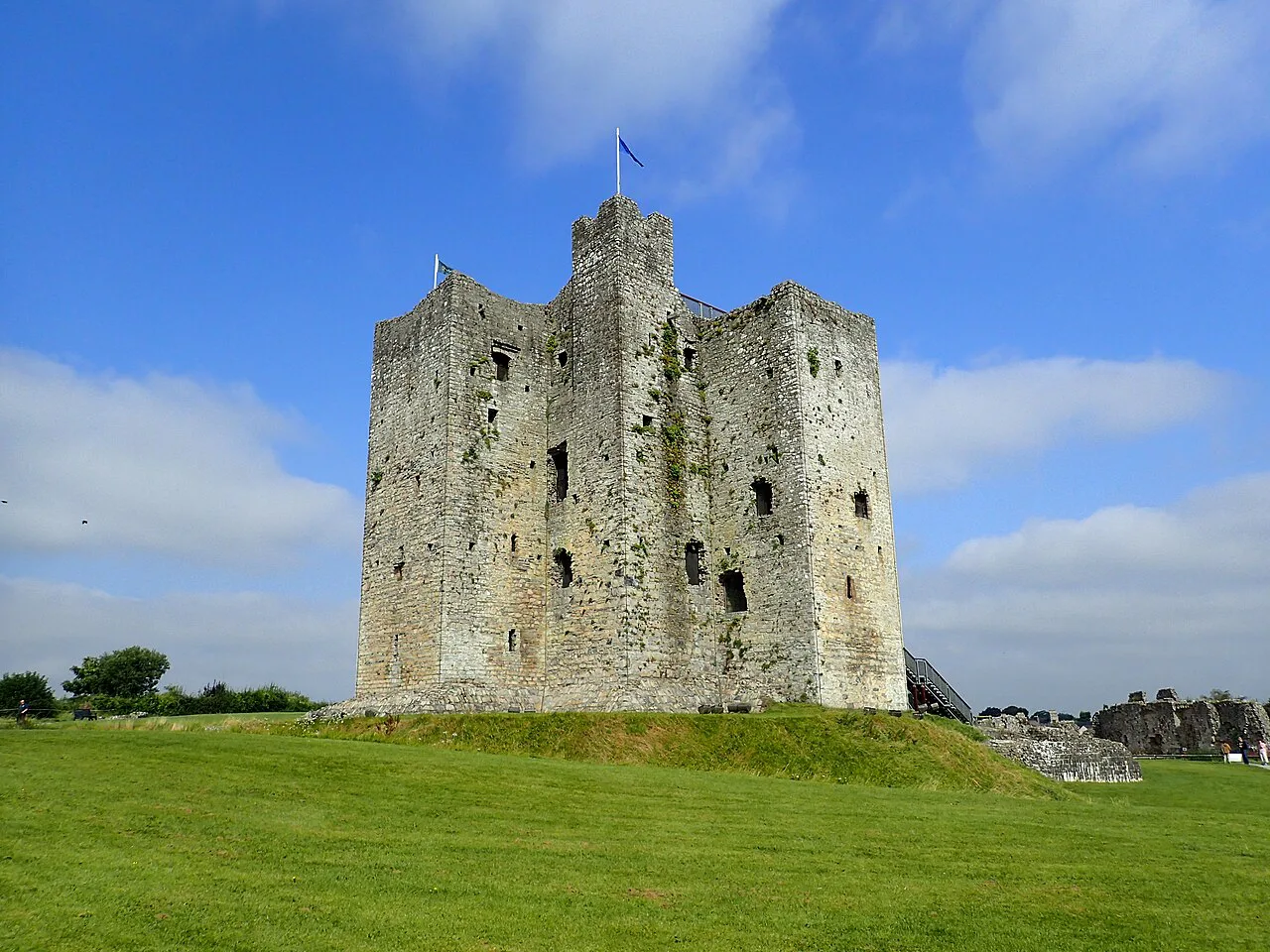
Trim Castle is described by Heritage Ireland as the largest Anglo-Norman fortification in Ireland. Hugh de Lacy and his successors took about 30 years to build it, and the central feature is a monumental three-storey keep of 20 sides, cruciform in plan. A ditch, curtain wall and water-filled moat once surrounded it.
The royal associations are more modest than the nickname suggests. The castle is often called King John's Castle, yet John preferred to stay in his tent on the other side of the river when he visited the town. Richard II came to Trim in 1399 and left Prince Hal, later Henry V, behind as a prisoner.
Inside the keep, modern walkways let you look down over the interior and grasp the thickness of the walls without climbing them. Visitors with disabilities face real limits here: the keep is not accessible to them, and access to the grounds is restricted, though interpretation panels support self-guiding around the site.
Trim Today: Tours, Restrictions and the Coming Closure
Trim runs on seasonal opening times, offers guided tours, accepts card payment and has toilets, but it is closed for works from 1 November 2026 to 1 April 2027. The operator warns that it is a very busy site in summer, that access cannot be guaranteed and that arriving early is advisable.
House rules are strict: assistance dogs only, no climbing and no picnics on site. Some stairs in the keep are very steep and narrow, which matters for anyone with mobility concerns or young children.
The timing catch overrides everything else for now. Trim Castle closes for works from 1 November 2026 to 1 April 2027, so a late-autumn or winter visit will not get you in. The page gives an end date for the works but does not promise how the site will operate afterwards, so confirm arrangements once the closure period is over.
Athlumney Castle: A Ruined Tower House Near Navan
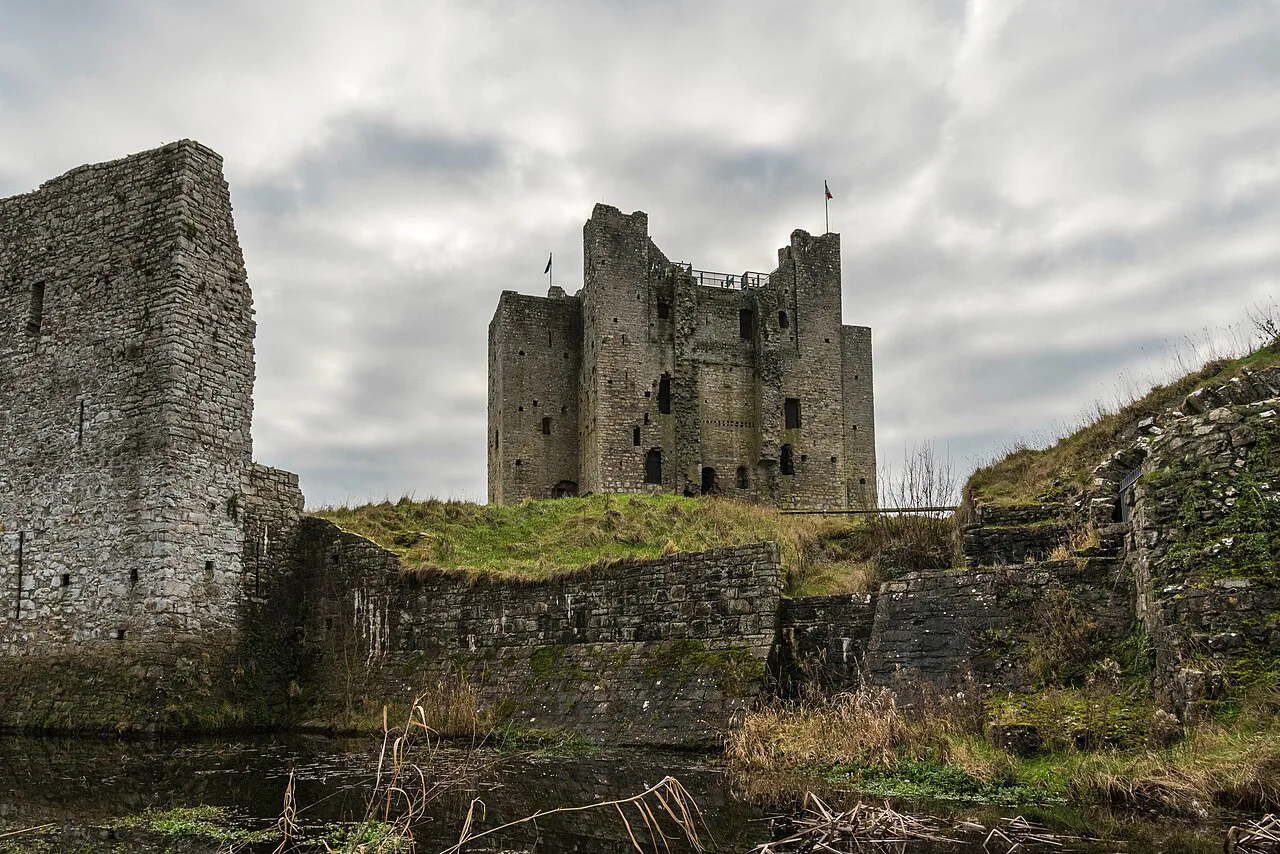
Athlumney combines a 15th-century tower house with an attached fortified Tudor manor house on the eastern bank of the Boyne near Navan. The four-storey tower was built by the Dowdall family and retains a spiral staircase, floor-beam holes, square corner turrets and a barrel-vaulted ground floor. A murder hole once protected the original entrance.
On the first floor, eleven steps lead to a secret mural chamber assumed to be a priest's hole for hiding Catholic clergy. The manor beside the tower is three storeys high, with eight sets of square stone-mullioned windows and the remains of elegant fireplaces above a ground-floor kitchen. Heritage Ireland compares its design to Ormond Castle in Carrick-on-Suir.
The upper floors of the tower are gone, but the staircase still reaches the battlements. That fragmentary state is part of the appeal and part of the risk: there is no roof, no furnished interior and no staff on hand to explain what you are looking at. Bring your own context.
Athlumney's History and Its Quiet Setting
The site was burned twice. During Cromwell's 1649 siege of Drogheda, the Maguire family living at Athlumney set fire to the house and tower to keep them from Cromwell's hands. After James II's defeat at the Boyne in July 1690, Sir Launcelot Dowdall burned the castle again before leaving for France, and his Irish estates were confiscated in 1700.
Ownership later passed to Sir William Somerville, who revived the Lord Athlumney title in 1863. After the estate was broken up, the land around the castle was bought by Bishop Nulty for the Sisters of Mercy, and the order still owns part of the enclosed garden.
Access is through a small gate on Convent Road, in a quiet residential area high above the river. The name derives from the Irish for Loman's ford, linked by tradition to St Loman, reputedly a nephew of St Patrick. The ruins stand within a walled garden, so keep to the documented entrance and paths rather than wandering into private ground.
Visiting Athlumney: Unguided and Unstaffed
Athlumney is a National Monument in state guardianship, protected under the National Monuments Acts, and it is explicitly unguided. The Office of Public Works asks visitors to maintain a level of care and caution and disclaims responsibility for damage, injury or loss during a visit. Plan for uneven ground, masonry and no supervision.
Nothing on the official page promises tickets, opening hours, toilets or guided tours, so do not build a day around facilities here. A short stop works well combined with other sites near Navan. If you want a broader sense of the region's medieval remains, other castles in Ireland offer comparable experiences under different access arrangements, and King John's Castle, Limerick: A Visitor Guide to the Riverside Fortress covers a staffed riverside fortress in another county.
Slane Castle: A 1785 Country House on a Boyne Estate
Slane is not a medieval fortress. The castle was built in 1785, principally the work of three architects: James Wyatt, James Gandon and Francis Johnston. It sits on a Boyne estate and functions today as a venue and a private tour destination, so place it in a castle-estate context rather than alongside Trim's Norman walls.
The operator says a castle tour covers the building's history, its architecture and the concerts held there over the years. That is a broad description, not a room-by-room itinerary, so treat concert content as part of the tour narrative rather than a guaranteed exhibit.
The estate has other strands. Rock Farm, a 90-acre organic farm, offers its own guided experiences with rare-breed livestock, and distillery enquiries are handled separately from castle tours. Combining a castle visit with a farm tour takes separate booking and separate correspondence.
Slane Access: Appointments, Prices and Group Limits
Slane Castle and its grounds are currently accessible by appointment only, and public guided castle tours run on select dates rather than daily. Scheduled tours open during Heritage Week each year. Anyone hoping to turn up and walk in should plan instead around a booked tour or a listed event.
Private guided tours can be booked year-round by request through the tours email address, subject to guide availability, with groups asked to pre-book one week ahead. The operator publishes a one-hour tour duration and a maximum of 25 people per tour.
On price, the operator publishes a minimum flat fee of 150 euros for up to six guests, with the seventh guest and above at a reduced rate of 12.50 euros per person. Those figures apply to Slane's private castle tour only and should not be read across to Trim, Athlumney or Dunsany. Confirm current rates when you book.
Dunsany Castle: Eight Centuries of One Family
Meath County Council's conservation-area text describes Dunsany Castle as one of Ireland's oldest surviving country houses and, in its assessment, probably the oldest in Ireland associated with a single family. It was built around 1181 by Hugh de Lacy and owned by the Plunkett family, with major remodelling in the 1840s under the architect James Shiel.
Because the house has been reshaped over more than 800 years, it reads as a record of changing country-house taste rather than a single-period building. That makes the interior tour a different proposition from Trim's bare medieval stone or Athlumney's roofless ruin.
The demesne around it is a group of structures rather than a single building: castle, gates, gate lodges, stables, outbuildings, a church, estate cottages, demesne walls and a bridge, with a wayside cross outside the Gothic gate. The parkland holds a ha-ha, a walled garden and an icehouse, and three mottes sit on the estate, the eastern one likely the site of the original Norman stronghold. None of these is presented as a separately ticketed attraction.
Dunsany Access: Written Requests and a Closed Season
Interior tours at Dunsany are arranged by writing to the estate office, which answers emails on weekday mornings. The owner's site lists a 2026 season from 20 June to 23 August for interior tours and National Heritage Week dates of 5 to 23 August 2026. That published window has now passed, so Dunsany should not be treated as currently open or as offering walk-in entry.
The owner also publishes tour prices: 25 euros for adults, 20 euros for pensioners, 15 euros for students and free entry for children aged 12 and under. Tours outside the published season are listed at 50 euros per person and offered only if a guide can accommodate them, so treat off-season access as conditional and confirm by email before making plans.
Rewilding tours on the estate are handled through a separate email address from interior tours. If your interest is the landscape rather than the rooms, ask about that strand specifically; the castle interior tour and the nature reserve are booked differently.
Before You Go: A Status Check for Each Property
Start with status, not scenery. Trim is closed for works from 1 November 2026 to 1 April 2027 by the operator's own notice, so a winter trip should route elsewhere. Check the official page again once that period ends, since the notice gives an end date without describing post-works arrangements.
Athlumney needs no booking but rewards preparation: it is unguided, unstaffed and entered through the Convent Road gate, so wear suitable footwear and accept that there are no facilities. Slane requires an appointment, made by email for a private tour or timed to a scheduled date. Dunsany requires a written request and, outside its published season, patience about availability.
Finally, decide what you want from the visit. For sheer medieval scale, Trim's keep and curtain wall are the draw. For atmosphere without supervision, Athlumney's burned tower and manor suit a short stop. For architecture and estate narrative, Slane and Dunsany are the country-house options, each with its own booking ritual.
Plan Around Access, Not Age
These four properties show how varied a castle visit in Meath can be. One is a staffed Norman fortress with guided tours and steep keep stairs, one is a roofless National Monument you explore alone, and two are appointment-driven country houses with published tour arrangements.
Book or check status first, then read the history. A closed Trim, an unbooked Slane or an out-of-season Dunsany will not open because you arrived with good intentions, and only the official pages carry the dates and prices that decide the trip.
Explore more Ireland guides
Frequently Asked Questions
Is Trim Castle open in late 2026?
Trim Castle closes for works from 1 November 2026 to 1 April 2027 according to Heritage Ireland, so it cannot be visited during that period — and with the closure only days away as of late October 2026, a winter visit is not possible. The notice gives an end date for the works but does not describe how the site will run afterwards, so check the official page again before planning a visit after the closure.
Do you need to book Slane Castle in advance?
Yes. Slane Castle and its grounds are accessible by appointment only. Public guided castle tours run on select dates, with scheduled tours during Heritage Week each year, and private guided tours can be requested year-round by email subject to guide availability, with groups asked to pre-book a week ahead. A maximum of 25 people applies per tour.
Can you visit Athlumney Castle without a guide?
Athlumney is unguided by design. It is a National Monument in state guardianship entered through a small gate on Convent Road, and the Office of Public Works asks visitors to maintain care and caution, disclaiming responsibility for damage or injury. No tickets, staff, toilets or tours are indicated for the site, so plan a short independent stop rather than a staffed attraction visit.
How do you arrange a Dunsany Castle interior tour?
Write to the estate office by email, which answers on weekday mornings. The owner's site lists a fixed summer season for interior tours with published ticket prices, and tours outside those dates at a higher per-person rate only if a guide is available. The published summer window has passed, so confirm current availability directly before travelling.
Which of these is a medieval castle and which is a country house?
Trim is a medieval Anglo-Norman fortress and Athlumney is a 15th-century tower house with an attached fortified Tudor manor. Slane was built in 1785 and is a country house on a Boyne estate, while Dunsany is a country house of medieval origin, founded around 1181 and substantially remodelled in the 1840s. Access arrangements differ accordingly, from guided tours to written requests.
How do I check access before making the trip?
Use the official page for each property as the deciding source. Heritage Ireland carries Trim's seasonal times and closure notice, Slane's own site states the appointment-only rule and tour arrangements, and Dunsany's owner site lists tour dates and prices. Athlumney has no booking system, but the Heritage Ireland page explains its unguided status and the Convent Road entrance.
Sources
You might also like



Continue reading
More guides you'll find useful