Castles in Ireland: Seven Heritage Sites and How They Differ
Compare seven Heritage Ireland castles by period, architecture and visitor access. See which are tour-only, which close for works, and what to check first.
On this page
The short answer for anyone planning around castles in Ireland is that these buildings are not one type. A thirteenth-century hall-keep, a tower-house raised around 1400 and an early-1600s house with formal gardens demand different things of a visitor: some interiors open only on guided tours, some grounds can be walked with panels, and a few carry dated closures.
This guide looks at seven publicly interpreted castles in the Republic, all published by Heritage Ireland, the visitor service of the Office of Public Works. They are used as worked examples of how castle-building changed across region and century, not as a ranking and not as a complete inventory of Irish castles.
What Counts as a Castle Here
The word covers several building traditions. Anglo-Norman power produced great fortifications with keeps and curtain walls, later medieval lords built compact tower-houses, and by the early seventeenth century families were raising houses that mixed medieval massing with Renaissance detail. Reading a site as one of these types tells you what to look for: defences, domestic comfort, or the seam between the two.
Each entry below follows what the operator publishes about architecture, history and present-day access. Where a site is shut, tour-only or awkward underfoot, that is stated rather than smoothed over, because those terms decide whether a detour is worthwhile.
Trim Castle: The Largest Anglo-Norman Fortification
Trim Castle is described as the largest Anglo-Norman fortification in Ireland, built over roughly 30 years by Hugh de Lacy and his successors. Its centrepiece is a monumental three-storey keep with 20 sides arranged on a cruciform plan, once protected by a ditch, curtain wall and water-filled moat. Modern walkways let you look down into the keep and grasp the thickness of its walls.
Practical guidance must lead with a closure: the castle shuts for works from 1 November 2026 to 1 April 2027. In summer it is a very busy site where entry cannot be guaranteed, so arriving early matters. The keep is not accessible for visitors with disabilities, grounds access is restricted, some stairs are steep and narrow, and there is no climbing or picnicking onsite.
Athenry Castle and the School of the West
Athenry Castle guards a ford on the Clareen River, and its three-storey hall-keep survives from the mid-thirteenth century. The battlements are original thirteenth-century work, and the deep cruciform arrow loops show how defence was engineered into the walls. A twenty-minute film in a modern third-floor room sets out the castle's history.
The detail worth seeking out is the carving around the Great Hall doorway, where the doorway and two window openings carry floral motifs in the local School of the West style, which the operator calls unique in Irish castles. Athenry's published season runs from 13 March to 5 November 2026, with earlier last admissions from 22 October; walkways are uneven and access is limited.
Cahir Castle: A Butler Stronghold on the Suir
Cahir Castle stands on a rocky island in the River Suir and ranks among Ireland's largest and best-preserved castles. It was built in the thirteenth century as the stronghold of the Butler family, and its defensive design was considered impregnable until the earl of Essex took it in 1599 using heavy artillery. It was besieged twice more during the Irish Confederate Wars.
For visitors the appeal is partly screen familiarity, since the castle has appeared in productions including Excalibur and The Tudors, but an audio-visual show gives the longer history in more depth. Its published calendar keeps it open through the year apart from a closure from 24 to 30 December, bus groups must pre-book, walkways are uneven and last admission shifts with the season, so check the current slot rather than assuming one closing time.
Barryscourt Castle: A Tower-House and Its Restoration
Barryscourt is presented as one of the finest examples of an Irish tower-house, built between 1392 and 1420 during the reign of the seventh Lord Barry, John Ciotach Barry. The Barrys later supported the Fitzgeralds of Desmond, and to keep the castle from Sir Walter Raleigh's army they partly destroyed it themselves. During the Confederate Wars it was attacked again, and cannonballs lodged in the wall above the entrance still mark that episode.
The Main Hall and Great Hall have been restored with fittings and furnishings, and the herb and knot garden and orchard have been returned to a sixteenth-century design. Be aware that the site is closed for the 2026 season, with a return anticipated in 2027 but no reopening date published. When it operates, upper chambers are guided-tour only with a maximum of 13 people, and spiral stairs and tight spaces make access challenging.
Donegal Castle: O'Donnell Fortress and Brooke Manor
Donegal Castle stands in the centre of Donegal town above the River Eske, built by Red Hugh O'Donnell as his personal fortress in the fifteenth century. The page recounts that, leaving for Spain after the Battle of Kinsale, he set the castle on fire to keep it from English hands, though Sir Basil Brooke became its lord in 1616. Brooke added a manor house beside the tower and commissioned a carved chimney-piece decorated with fruit and his own coat of arms.
Two building phases in one complex make Donegal useful for understanding how a medieval tower could be adapted rather than abandoned. The ruin of the twentieth century was reversed in 1990s restoration, and information panels now carry the story. It opens daily from 9:00 to 17:00 with last admission at 16:15, and access is limited, so plan the town stop around that afternoon cutoff.
Ross Castle on Lough Leane
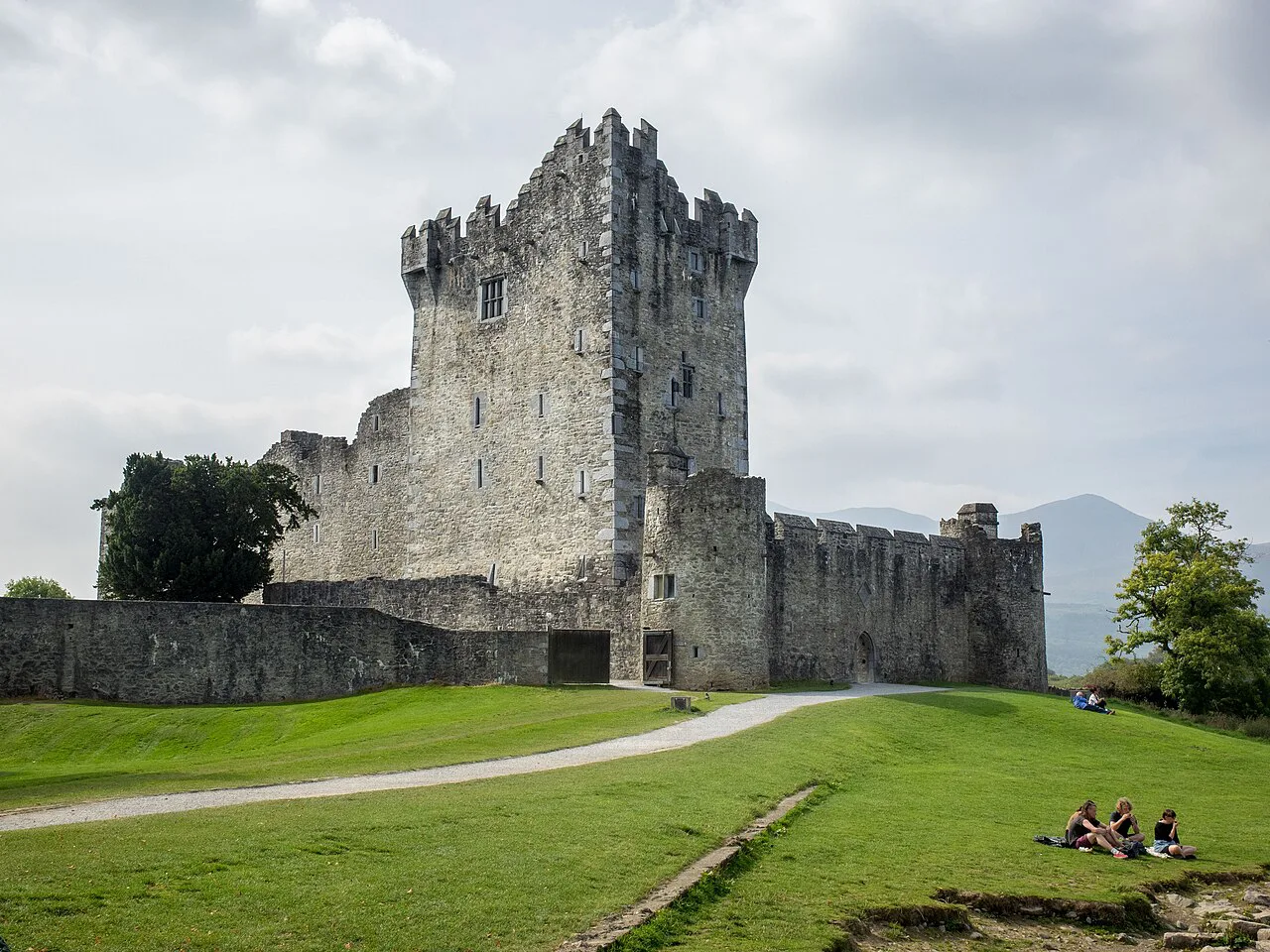
Ross Castle perches in an inlet of Lough Leane and was probably built in the fifteenth century by the Irish chieftain O'Donoghue Mór. A legend holds that O'Donoghue sleeps beneath the lake and rises on a white horse every seven years on the first morning of May, bringing good fortune to anyone who sees him. That is folklore attached to the site, not a recorded event.
Militarily, Ross was the last place in Munster to hold out against Cromwell, and its defenders under Lord Muskerry trusted a prophecy that the castle could only be taken by a ship. When the Cromwellian commander General Ludlow put a large boat on the lake, the sight hurried the surrender and the prophecy was fulfilled in an unexpected sense. The interior is guided-tour only on a first-come, first-served basis with a maximum of 15 people per tour, and the approach involves a very steep incline.
The published 2026 season runs from 5 March to 3 November, daily from 09:30 to 17:00, with the first tour of the day at 10:00 and the last at 16:55. Because tours fill on the day and capacity is small, arriving without a plan in high summer risks missing the interior. Dogs must be kept on a lead, and the lakeside setting has walking trails for a different castle-and-landscape pairing, Glenveagh Castle in County Donegal shows how a much later house sits within a national park setting.
Portumna Castle: Early-1600s Transitional Architecture
Portumna Castle was built by the fourth earl of Clanricarde and served as the de Burgo family power base for centuries. It is described as a unique example of transitional Irish architecture of the early 1600s, combining medieval and Renaissance elements in one bold design. A major fire in 1826 left it a roofless shell, and state restoration began in the 1960s and continues.
The ground floor is open and holds an exhibition on the castle and the de Burgo family, while the formal gardens and the walled kitchen garden give a sense of the seventeenth-century setting, with views over Lough Derg. The published 2026 season runs from 5 March to 11 November, with last admission at 17:15 until 28 October and 16:15 from 29 October; the tearooms close from 9 November 2026. Adult admission is listed at five euro.
Carlingford Castle and King John
Carlingford Castle dominates its town and overlooks the lough harbour, built around 1190 most likely by the Norman baron Hugh de Lacy. King John of England, uneasy at the family's power, forced them into rebellion and seized their property in 1210, and he reputedly stayed in his new castle himself; the site is still known as King John's Castle. The Jacobites fired on it in 1689, and William of Orange is said to have sheltered wounded soldiers there after the Battle of the Boyne. It shares its name with another riverside royal fortress, so compare this site with King John's Castle, Limerick: A Visitor Guide to the Riverside Fortress.
Slieve Foy above the town takes its name, in legend, from the body of the sleeping giant Finn MacCumhaill, which is a story rather than a historical record. Tours run at 2pm seven days a week from April to October and access is by guided tour only. The service is run by Carlingford Lough Heritage Trust rather than the Office of Public Works, and the page states that OPW Heritage Cards are not accepted here.
Comparing Access: Tour-Only Interiors and Self-Guided Grounds
The most useful distinction when choosing between these sites is how much you can see without a guide. Ross Castle opens its interior only on tours, capped at 15 people and allocated on the day. Carlingford is tour-only as well, at a fixed afternoon time. Barryscourt, when in season, restricts its upper chambers to guided groups of no more than 13.
Elsewhere you can move at your own pace. Trim has interpretation panels in the grounds that support self-guiding, though the keep itself is out of bounds for many visitors. Donegal uses information panels to tell its story, Athenry runs a short film, and Cahir and Portumna add audio-visual or exhibition elements indoors.
Physical access varies sharply and deserves honest weight. Trim reports very restricted access with steep, narrow keep stairs; Ross warns of a very steep incline; Barryscourt lists spiral staircases and uneven steps; Athenry and Cahir both flag uneven walkways. None of these pages promises step-free interiors, so visitors with mobility concerns should treat the grounds and exhibitions as the realistic core of a visit and confirm specifics with each site.
Anyone comparing these with later Irish houses will find a different scale of ambition at Huntington Castle, Clonegal, which is a separate family-house visit rather than a state-managed fortress.
Two Things to Check Before You Travel
First, dated closures override any general expectation that a site is open. Trim shuts for works from 1 November 2026 to 1 April 2027, and Barryscourt is already closed for the 2026 season with no reopening date stated beyond a 2027 return. Second, seasonal end dates matter in autumn: Ross finishes on 3 November 2026, Athenry on 5 November and Portumna on 11 November, after which those sites are not available on the published calendar.
Where a price is not shown on this page, treat it as unknown rather than free and check the individual Heritage Ireland listing before setting out. The same listings carry last-admission times, restrictions and any operational notices, which change more often than the buildings themselves. For travellers building a wider route, comparing these sites with castles in Roscommon or the towers of Kilkenny helps place the Irish castle landscape in a broader context.
Choosing Among Irish Castles
Pick by what you want from the building rather than by reputation. For sheer defensive scale, Trim's 20-sided cruciform keep and 30-year construction make it the most substantial of these sites, but its 2026–27 works closure and restricted access shape any visit. For continuous occupation and adaptation, Donegal's O'Donnell tower plus Brooke manor tells a clear two-phase story.
For a compact tower-house with restored interiors and gardens, Barryscourt rewards a return once it reopens; for a later house with gardens and lake views, Portumna is the outlier. Cahir suits travellers who value completeness and near year-round opening (closed only 24–30 December), while Ross and Carlingford reward those willing to build a day around a scheduled tour. For a more focused county comparison, read our guide to castles in Meath. For another heritage guide, read about Castle Ruins Ireland.
Explore more Ireland guides
- Castle Ruins in Ireland
- Castles in Roscommon
- Castles in Sligo
- Glenveagh Castle
- Haunted Castles in Ireland
- Huntington Castle
- Tullynally Castle
- Black Castle, Wicklow Town
- Castles in Carlow
- Castles in Cavan
- Castles in County Kerry
- Castles in County Mayo
- Castles in Louth
- Castles in Wexford
- County Clare Castles
- Forts in Ireland
- Norman Castles in Ireland
Frequently Asked Questions
What is the difference between a keep and a tower-house in Ireland?
A keep is the main defensive tower within a larger fortification, as at Trim, where a three-storey twenty-sided keep sat inside a ditch, curtain wall and moat. A tower-house is a compact fortified residence in which lordly living and defence share one building, as at Barryscourt, built between 1392 and 1420. Athenry's three-storey hall-keep, with a Great Hall inside the tower, shows a related arrangement from the mid-thirteenth century.
Which of these castles can you visit without a guided tour?
Several allow self-guided time in grounds or exhibitions. Trim has interpretation panels in the grounds, Donegal relies on information panels, Athenry shows a short film and Cahir has an audio-visual presentation. Interiors at Ross, Carlingford and Barryscourt's upper chambers are guided-tour only, so build those visits around tour times rather than arriving whenever suits.
Are the castle interiors accessible for visitors with mobility issues?
The published pages describe significant limits rather than guaranteed step-free access. Trim's keep is not accessible for visitors with disabilities and grounds access is restricted. Ross warns of a very steep incline, Barryscourt lists spiral staircases and tight spaces, and Athenry and Cahir note uneven walkways. Visitors with mobility concerns should treat grounds and exhibitions as the realistic core and confirm details directly with each site.
Which castles have dated closures I should plan around?
Trim closes for works from 1 November 2026 to 1 April 2027, which affects any winter or early-spring plan. Barryscourt is closed for the 2026 season, with a return expected in 2027 but no exact date published. Seasonal sites also end in autumn: Ross on 3 November 2026, Athenry on 5 November and Portumna on 11 November, while Cahir stays open all year apart from 24 to 30 December.
Is Ross Castle visited by tour only?
Yes, the interior is reached by guided tour only, allocated first come, first served, with a maximum of 15 people per tour. The first tour is at 10:00 and the last at 16:55 during the 5 March to 3 November 2026 season. Because capacity is small and the site is busy in summer, arriving early is the sensible approach.
How does Portumna Castle differ from the medieval castles here?
Portumna is an early-1600s house rather than a medieval fortress, built by the fourth earl of Clanricarde and described as transitional architecture that blends medieval and Renaissance elements. A fire in 1826 left it a roofless shell, and state restoration from the 1960s continues. Its formal gardens, walled kitchen garden and Lough Derg views give a visit a different character from keep-and-curtain-wall sites.
Sources
You might also like



Continue reading
More guides you'll find useful