
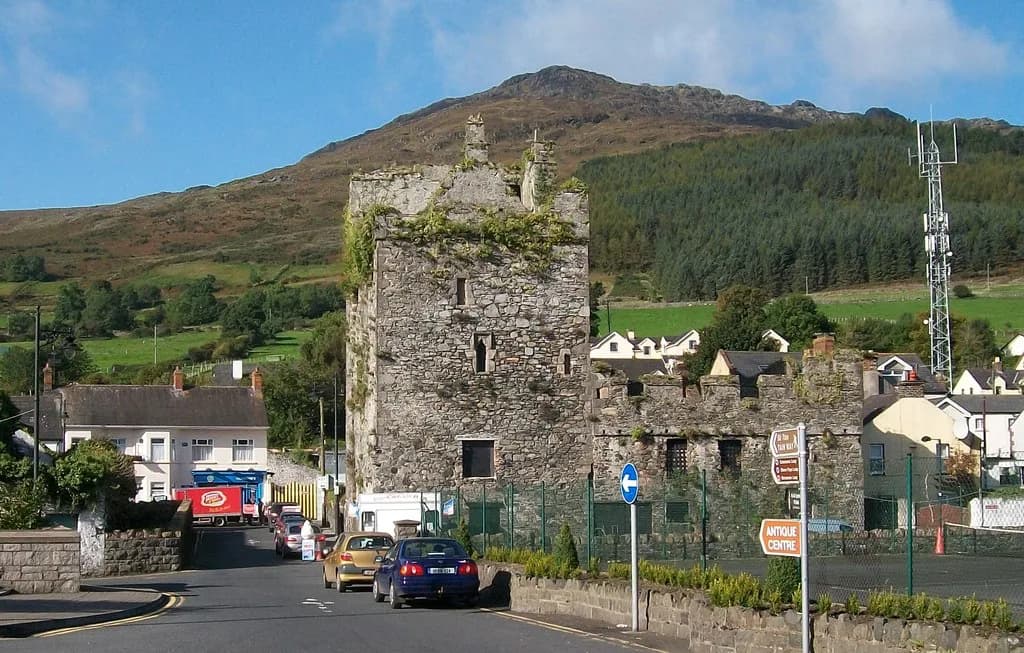
Castles in Louth: Carlingford Castle and Castle Roche
Compare County Louth's two contrasting castles: Carlingford Castle, seen on a guided tour, and Castle Roche, a rugged ruin on private farmland near Dundalk.
On this page
The two most instructive castle visits in County Louth sit at opposite ends of the access spectrum. Carlingford Castle is a managed monument entered only on a guided tour, while Castle Roche is an unmanaged Anglo-Norman ruin reached across private farmland. Choosing between them is really a question of how you like to meet a ruin — with interpretation and a set time, or alone on rough ground.
Quick answer: what a castle visit in Louth involves
Carlingford Castle gives you a defended medieval town wrapped around a castle above a lough, with tours run by Carlingford Lough Heritage Trust between March and October and a 2pm tour seven days a week from April to October. Castle Roche, near Dundalk, gives you surviving walls, a hall fragment and a twin-towered gatehouse on a rocky outcrop, with no ticket booth and no car park.
Neither site rewards a spur-of-the-moment arrival in the same way. At Carlingford you must work around a fixed tour departure, and at Roche you must manage roadside parking and gates on working farmland. If you only have time for one, pick by access style first and history second.
Carlingford Castle: setting above the lough
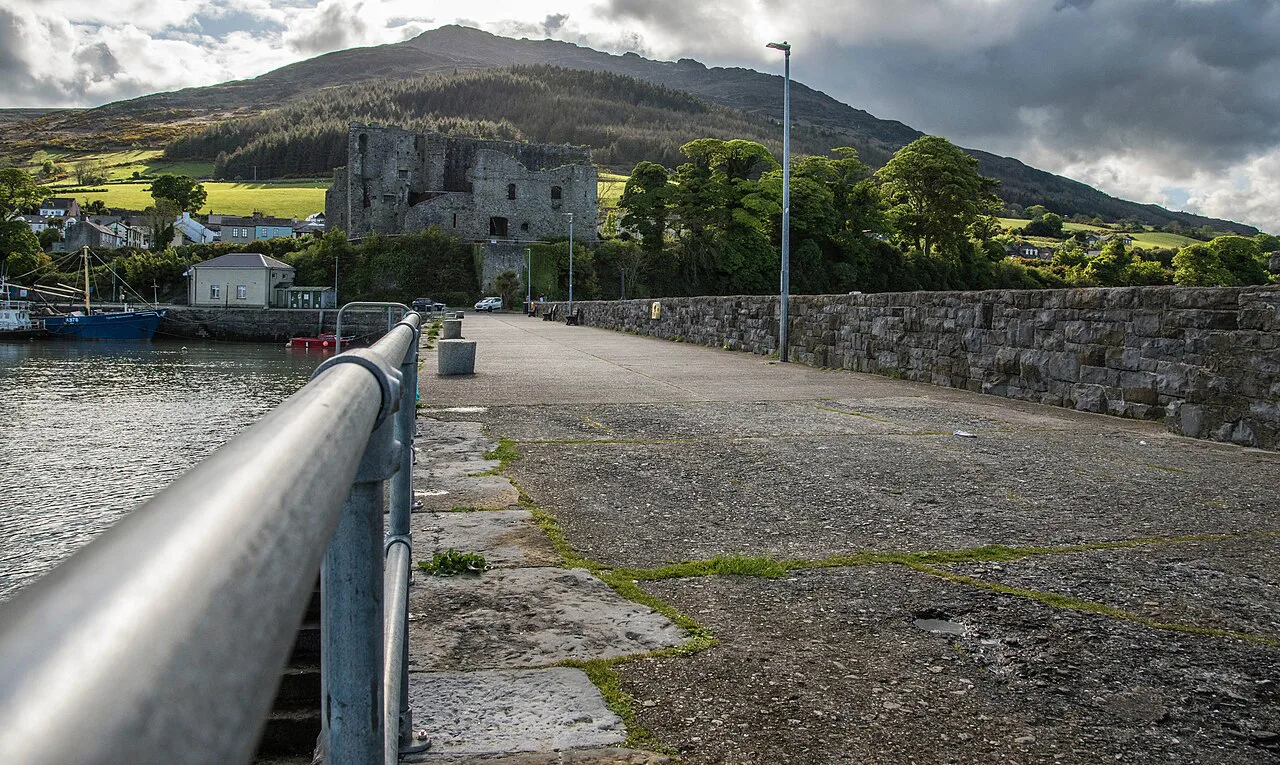
Carlingford sits beneath Slieve Foy, the mountain that, in legend, takes its name from the sleeping giant Finn MacCumhaill. The castle itself commands the town and looks out over the lough harbour, which explains its long role as a defensive point for the area.
That setting matters when you plan a visit, because the castle is part of a compact historic town rather than a standalone field monument. You are not driving to a remote tower; you are walking into a streetscape where the castle is the anchor.
Carlingford Castle's story: de Lacy, King John and 1689
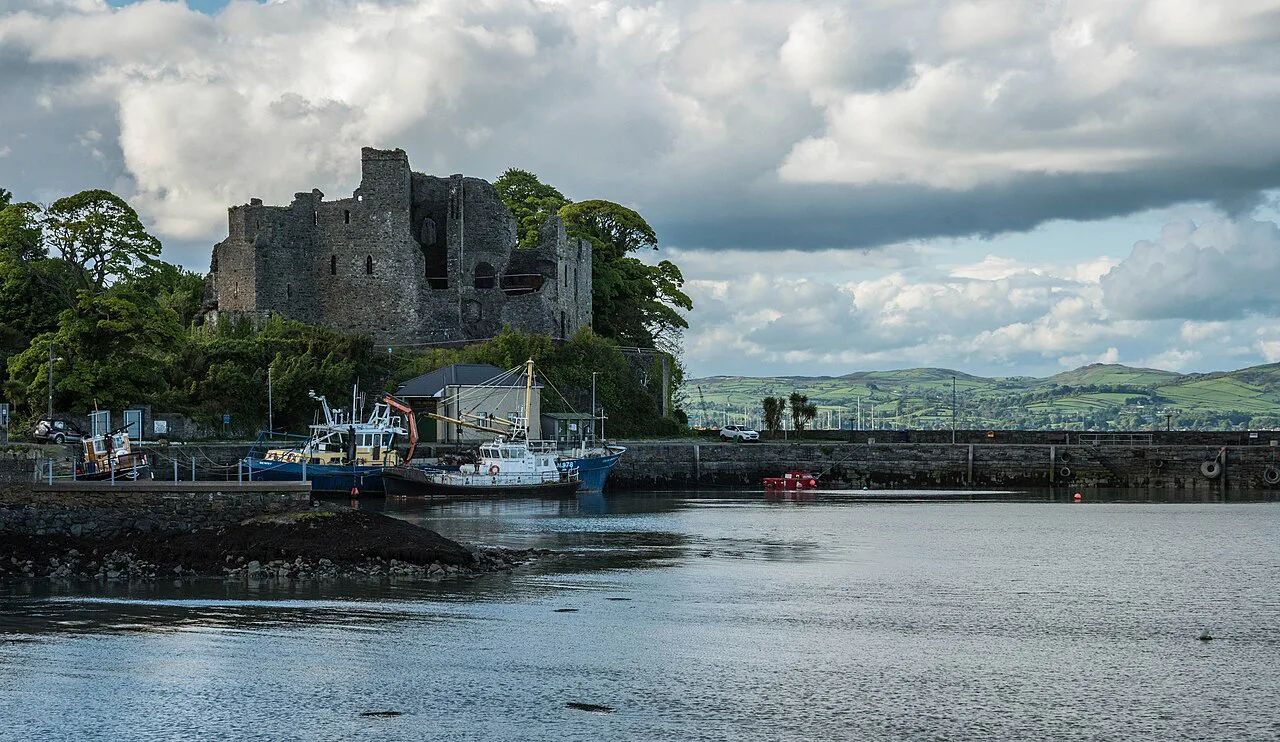
The castle was built around 1190, most likely by the Norman baron Hugh de Lacy, whose family had grown powerful enough to unsettle King John of England. John forced the family into rebellion and seized their property in 1210, and he reputedly stayed in the castle himself, which is why it is still known as King John's Castle; Limerick's riverside fortress carries the same royal name and is covered in this Limerick heritage guide.
Later conflict left its own marks: the Jacobites fired on the castle in 1689, and William of Orange is said to have accommodated wounded soldiers there after the Battle of the Boyne. Note the cautious wording — the wounded-soldiers episode is a tradition rather than a documented certainty, so treat it as part of the castle's received story.
Visiting Carlingford Castle: tours, tickets and the Heritage Card
Access to Carlingford Castle is by guided tour only, so there is no independent roaming of the structure. The published admission is €8.50 for an adult, €4.00 for a child and €20 for a family of four, and groups are advised to book in advance by phone or email. Tickets are also sold near the site at Visit Carlingford Tourist Office in Station House.
One trap catches holders of the OPW Heritage Card: it is not accepted here, because the visitor service is not OPW managed. Check the current tour time and price on the official page before travelling, since seasons and admission can change.
The medieval town around the castle
Carlingford keeps much of its medieval character, with buildings surviving from the thirteenth to the sixteenth century, and the streets are narrow, dark and hilly in places. The Tholsel is the only surviving town gate in Carlingford and one of the few of its type in Ireland; it formed part of the fifteenth-century walls, collected tolls, and in the eighteenth century served as a place of detention.
The building called the Mint is a good lesson in reading names sceptically. Carlingford gained the right to mint coinage in 1467, but this fifteenth- or sixteenth-century house was most likely a wealthy merchant's residence and probably never struck coins; look instead for its five decorated limestone windows. Taaffe's Castle nearby is another merchant building, built in two phases in the sixteenth century and home to the family who became earls of Carlingford in 1661.
Wider context: the Dominican Friary and the Heritage Centre
The friary dedicated to St Malachy was established in Carlingford in 1305 and dissolved in 1540 under Henry VIII, after which the Dominicans and Franciscans contested it; it was abandoned in the eighteenth century when the Dominican order moved to Dundalk. What remains — a nave and chancel divided by a tower, with mill works to the south-east — is worth seeing on foot as part of a walk through the town's medieval fabric.
For orientation before or after the castle tour, the Carlingford Heritage Centre holds an exhibition of historical records, maps and drawings on the town's history. The building itself is originally thirteenth-century, was later a Church of Ireland church, and was renovated in 1992 as a heritage, arts and community centre.
Castle Roche near Dundalk: foundation and frontier
Castle Roche was built in 1236 on a site that marked the boundary between Gaelic Ulster and the Anglo-Norman Pale around Dublin. Unusually for Ireland, it was erected by a woman, Lady Rohesia de Verdun, who settled there after her husband's death.
Ireland.com also tells the notorious story of the murder window: Lady Rohesia is said to have promised marriage to the man who would build her a great house, then pushed her new husband from the bedroom window after the wedding. That is legend attached to the site, not documented history, and it is worth keeping the distinction clear when you read about the castle elsewhere.
Castle Roche today: what survives
The castle was attacked and ruined by Cromwellian forces in 1641, and what you see today is the shell of that fortress. Surviving features include stretches of wall, remnants of the large hall and a twin-towered gatehouse.
The ruggedness is part of the appeal: there are no queues or ticket booths, and you may have the place to yourself. The trade-off is that you get no interpretation on site, so read up before you go if you want the history to mean anything. If you enjoy this kind of unmanaged ruin, the wider guide to castle ruins in Ireland covers comparable sites, and the castles in Ireland pillar puts both of Louth's examples in a national context.
Access at Castle Roche: parking, gates and rough ground
There is no car park at Castle Roche, so you park with care on the roadside near the castle. Access is through farm gates, and because the site stands on private farmland you should keep the gates clear of cars and close them after use.
The terrain is rough and rocky with steep drops, so caution matters more than at a managed monument. The site sits on private farmland reached through gates, so keep those gates clear of cars and close them after use on your way in and out.
Choosing between Carlingford and Castle Roche
Carlingford rewards a half-day: fix the tour time, walk the medieval streets, and use the friary and Heritage Centre to fill out the picture. Castle Roche suits a shorter stop where you accept a rough approach and roadside parking in exchange for solitude and an untouched frontier castle.
Together the two show how varied castles in Ireland can be as visitor experiences, from ticketed guided tours to farm-track ruins. Use the contrast to set expectations rather than ranking one above the other. For medieval townscapes rather than single towers, the guide to monasteries in Ireland covers another side of the same period. And for a very different, still-occupied house, look at Huntington Castle, Clonegal, in County Carlow.
Plan Your Visit
Decide first whether you want a guided monument in a living town or a rough, self-guided ruin in open country, then build the day around that choice. Carlingford needs a fixed tour time; Castle Roche needs careful parking and a tolerance for uneven ground.
For both, use the official and tourism pages to confirm current arrangements before you travel rather than relying on older guides. That is especially important for Carlingford's seasonal tour schedule and for the condition of the farmland approach at Castle Roche.
Explore more Ireland guides
Frequently Asked Questions
Do you need to book to visit Carlingford Castle?
Access is by guided tour only, run by Carlingford Lough Heritage Trust between March and October, with a 2pm tour daily from April to October. Groups are advised to book ahead by phone or email, and tickets are also sold at Visit Carlingford Tourist Office in Station House. Check the official Heritage Ireland page for the current schedule before you travel.
How much does Carlingford Castle cost?
Heritage Ireland publishes the admission rates on its Carlingford Castle page, including separate adult, child and family-of-four prices. Prices can be revised, so confirm the current figure on the official page or at the tourist office rather than relying on an older guidebook. OPW Heritage Cards are not accepted here.
Can you visit Castle Roche independently?
Yes. Castle Roche has no ticket booth and no guided tour, and you approach it through farm gates on private farmland. Keep the gates clear of cars and close them behind you, and take care on the rough, rocky ground with steep drops.
Is there parking at Castle Roche?
There is no car park. Visitors park with care on the roadside close to the castle, taking care not to block the farm gates that give access to the site. The approach is on private farmland, so treat the verges and gateways with respect.
Is the murder window at Castle Roche a true story?
No. The story of Lady Rohesia de Verdun pushing her new husband from the window is a legend told about the site, not documented history. What is recorded is that she built the castle in 1236 on the boundary between Gaelic Ulster and the Anglo-Norman Pale, and that it was ruined by Cromwellian forces in 1641.
When were Carlingford Castle and Castle Roche built?
Carlingford Castle was built around 1190, most likely by the Norman baron Hugh de Lacy, and was seized by King John in 1210. Castle Roche was built in 1236 by Lady Rohesia de Verdun. Both are medieval foundations, but their present state differs sharply: Carlingford is a managed monument and Roche an unmanaged ruin.
Sources
You might also like



Continue reading
More guides you'll find useful





