
Haunted Castles in Ireland: Folklore, History and Real Places
Haunted castles in Ireland are really a folklore story. See how Leap Castle's legends formed, which castles carry ghost traditions, and why access varies.
On this page
Haunted castles in Ireland are best understood as buildings with two histories running side by side: the documented record of who built, attacked and remodelled them, and the layered folklore of who is said to remain. Neither cancels the other, but keeping them apart is what makes a visit interesting rather than credulous. Leap Castle in County Offaly is the standard example because so much of its legend can be traced to specific tellers and specific moments.
This guide follows the whole tradition rather than a ranking of frights, so it covers why certain castles attract ghost stories, how one legend gets written down, and which other named sites carry similar reputations. Access is treated as uncertain throughout: several of these buildings are private homes or hotels, and a ghost story is never a guarantee of a welcome. If you are planning a wider sweep, the broader guide to castles in Ireland is the sensible starting point before committing to any single detour.
Why Ireland's Haunted Castles Are a Folklore Story First
A castle acquires a ghost reputation through repetition, usually after a real episode of violence, dispossession or sudden death has been remembered and retold. Tourism bodies and owners then keep the stories alive because they give a ruin or a tower house a narrative a visitor can hold on to. The practical consequence is that the label tells you about storytelling, not about verified hauntings.
That distinction matters when you decide where to go. A site with a documented architectural history and a clearly attributed legend rewards curiosity in a way a generic scare attraction cannot, because you can see the room or stair the story is pinned to. Read any haunted-castle claim as three separate questions: when was the building actually constructed, who owned it, and when was the ghost story first written down. Those answers do more to explain a site than any overnight ghost hunt.
Leap Castle, County Offaly: The Building Behind the Legend
The architectural dating is firmer but still cautious. As reported in an independent long-form account, the National Inventory of Architectural Heritage describes the surviving tower house as late fifteenth or early sixteenth century and identifies Leap as the principal seat of the O'Carrolls of Ely. The same account notes traditional attacks on the fortress in 1513 and 1516 and a burning in 1558 followed by rebuilding, which is a reminder that Leap's violent reputation rests partly on genuine military history rather than ghosts alone.
The interior described in the Tourism Ireland feature is a mixture rather than a single period: coats of arms, wooden beams and curious statues set against whitewashed stone walls and antique furniture. That layering is the point. The independent history notes Jonathan Darby's eighteenth-century alterations, including castellated extensions and Georgian Gothic windows, so what a visitor sees is a Gaelic stronghold remade as a country residence by a later family. Understanding that sequence makes the building legible before any ghost story is mentioned.
The Bloody Chapel and the Oubliette: Where Record Stops
The best-known Leap legend concerns the room called the Bloody Chapel. In the Tourism Ireland account, a brother killed his brother at the altar during Mass, and the room is reached by a dark, winding stone stair up the tower. The Midlands Ireland round-up tells the same story with the priest as victim during High Mass and adds that his apparition is said to wander the chapel and the stair below.
The independent history treats that killing as tradition attached to a real sixteenth-century succession struggle rather than an event provable from surviving records, and notes the chapel itself is unquestionably an old part of the castle. That is the honest position: the room is real, the family rivalry is real, and the precise murder scene has been retold for generations. When you stand in such a space, the gap between those statements is the most interesting thing in it.
Below the chapel is the oubliette, a hidden shaft of the kind the French name describes as a place to forget people. The Tourism Ireland feature presents it as a dungeon into which prisoners and double-crossers were thrown onto spikes, while the independent history reports that restoration work in the early twentieth century uncovered human remains in the pit. Treat the cartload figure that circulates as second-hand report, and treat the shaft as architectural evidence that terrible things happened here, not proof of a haunting.
Other Leap figures belong firmly to legend: the Red Lady, a Governess said to favour fair-haired visitors, and two children called Emily and Charlotte. The Midlands round-up adds a knife-carrying woman in scarlet who brings a sudden cold into a room. Keep these as named characters in a story tradition rather than as identified historical people, because no account establishes who any of them really were.
Mildred Darby and the Making of the Elemental
Leap's strangest reputation has a traceable author. As the independent history reports, Mildred Darby, wife of Jonathan Charles Darby, was absorbed in the spiritualism fashionable in the Victorian and Edwardian period, and writing under the pseudonym Andrew Merry she described a grey, distorted presence accompanied by an overpowering smell of decay. That account appeared in The Occult Review around 1908–1909, and later versions of the Elemental draw heavily on it.
The date explains a great deal. A séance-era readership hungry for mediumship and automatic writing was the audience for that kind of report, so the Elemental is as much a document of Edwardian taste as a castle ghost. The Tourism Ireland feature notes that the smell is the presence its owner discusses most cautiously, which shows how a written account from one generation becomes the inherited atmosphere of the next. Reading the legend this way is more rewarding than deciding whether to believe it.
If you want that kind of reading made easier elsewhere, a parallel case exists at Huntington Castle, Clonegal, in County Carlow, where generations of one family, a chapel and a long occult pedigree are woven into the visitor experience. Comparing how two houses present their legends is a good way to sharpen your ear for what is documented and what is performed. That is the real skill a haunted-castle trip develops.
Inside the Most-Haunted Label
Leap is routinely called Ireland's most haunted castle, and that phrase comes from the people with an interest in it: the owner in the Tourism Ireland interview, the regional tourism round-up, and popular retellings. Tourism Ireland's wider feature on scary experiences also names Leap among places where many murders make restless souls plausible, which is tourism framing rather than an assessment of evidence.
Use the label as a signpost, not a verdict. It tells you the castle has an unusually rich legend set and that its owners engage with that reputation, which is useful when deciding whether the detour appeals. It tells you nothing about which site is scarier, and any list that ranks haunted castles is arranging stories for effect. The better question is whether the building itself still shows its periods, and at Leap the tower house, the Georgian Gothic windows and the eighteenth-century door surround all do.
Beyond Offaly: Other Castles Carrying Ghost Traditions
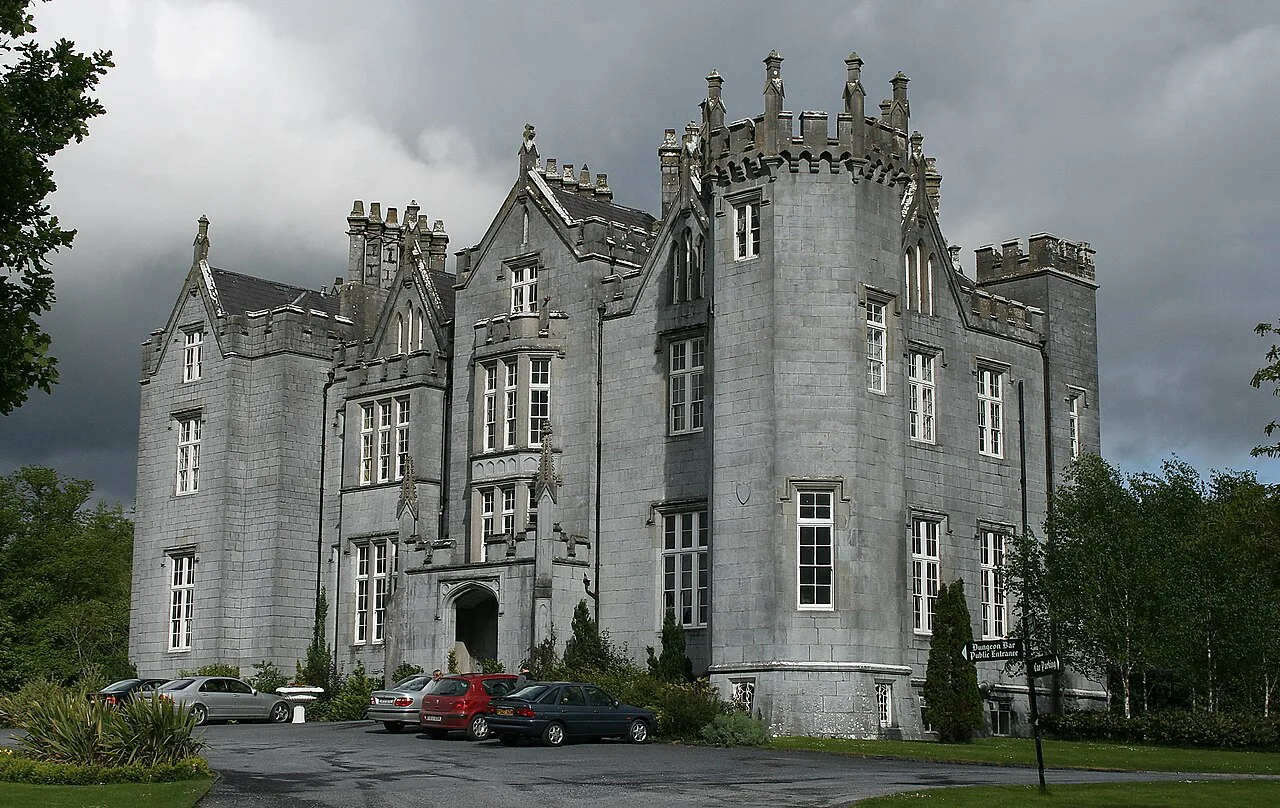
The Midlands round-up gathers several houses with legends, and it is worth noting what kind of property each one is. Kinnitty Castle, built on an Augustinian abbey site, is described as a working castle with guest rooms and a resident monk nicknamed Hugh, said to be friendly and fond of hiding cutlery. Castle Durrow, restored and now a hotel and wedding venue, carries a tale of the highwayman Jeremiah Grant and his gang guarding buried treasure in the surrounding woodlands.
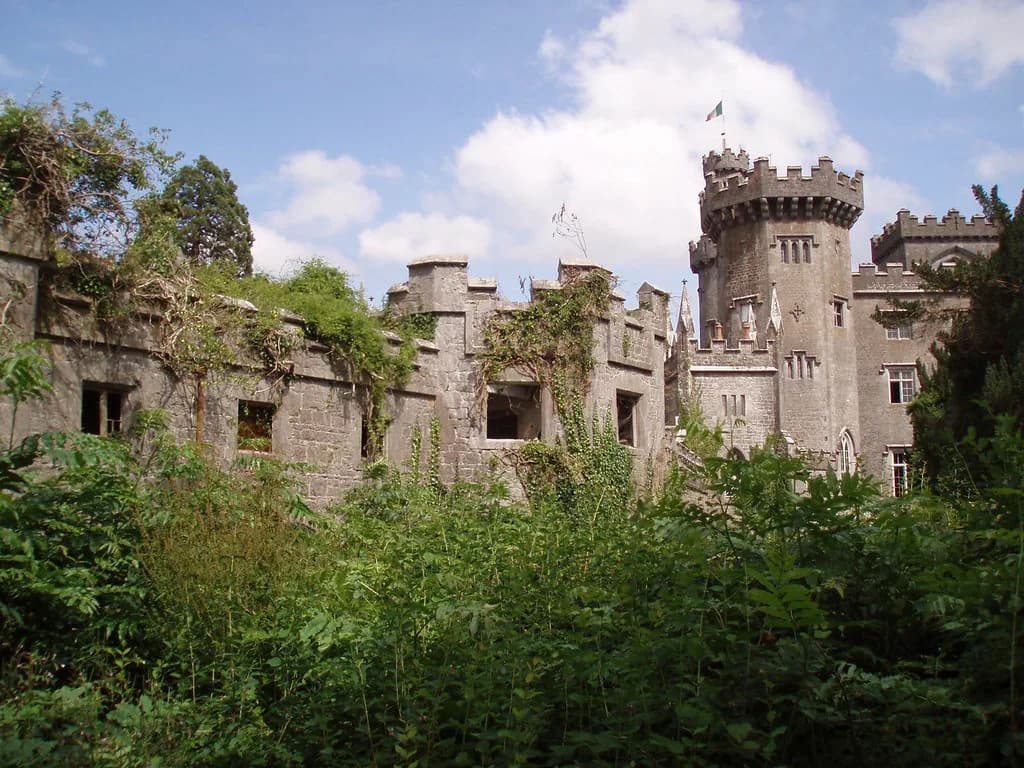
Tullynally Castle, home to the Pakenham family for generations, is described as a Gothic Revival house with a tradition of a butler who took his own life after unrequited love. Charleville Castle near Birr is singled out for a Gothic interior and the legend of Harriet Bury, a child said to have died falling from a banister and to be heard still in the stairwell. These are legends tied to family history, and a visit is a lesson in how folklore grows out of domestic detail rather than dungeons alone.
Other storied sites show the same pattern outside castle walls. The Midlands round-up also describes a Tudor castle with a three-storey tower and a skeletal Thin Man reported on the roof, while the tourism feature sets the White Lady tradition at Charles Fort in Kinsale and the ghost of Lady Isabella Shaw at Ballygally Castle on the Antrim coast. Carrickfergus Castle, an eight-hundred-year-old stronghold, carries tales of the Islandmagee witches tried in the area in the eighteenth century. For the Kinsale site, the Charles Fort Kinsale: Visitor Guide to the Star-Shaped Fortress covers the documented history behind the legend.
Some of these are fortresses, some are hotels and some are family homes, so do not treat a ghost-story mention as an invitation. Where a building appears only as a name in a tourism round-up, the useful next step is to look for its own published visitor information rather than trusting a legend list. If your interest leans toward stonework that has lost its roof, the guide to castle ruins in Ireland covers fragments where the architecture, not the apparitions, is the main event.
Those who want the widest canvas can browse the county-by-county castle guides, from the castles in County Offaly around Leap to the castles in County Galway and castles in County Kerry in the west. If the Midlands route extends sideways, castles in Roscommon and castles in Sligo are the natural additions, and the pillar castles in Ireland guide holds the full index.
Access at Privately Held Castles: Charleville as a Caution
The most useful practical lesson in the Midlands round-up is not a ghost but a contradiction. Charleville Castle is described in the same entry as privately owned and open by appointment, yet also as open daily to the public for tours with a request to phone ahead and let the curators know you are coming. Two access statements, two different obligations for the visitor, and no way to tell from the text which currently applies.
Rather than pick the convenient version, assume the stricter reading until the castle itself says otherwise. The same caution applies across the group: the Tourism Ireland feature establishes that Leap's owners have lived on site since 1994, which is a strong hint that visiting is by arrangement rather than by turning up at a gate. Leap Castle does not publish opening hours or tour times as far as the sources used here show, so check the castle's own website or contact it before building a day around it.
Hotels and working houses need the same treatment. Where a castle functions as a hotel or has guest rooms, the ghosts may be part of the hospitality rather than a public heritage offer, and a wedding venue is not a museum. Confirm directly what a visit involves, keep a fallback nearby in case it does not work out, and treat a legend list as reading material rather than a booking.
How to Read a Haunted-Castle Claim Well
Ask three questions before you travel, and a fourth on site. When was the tower house or keep built, and does the date come from a heritage inventory rather than a leaflet. Which family held the site, and did it pass by marriage, confiscation or purchase, since that transition often explains the darker legends. When was the ghost story first written down, and by whom, because a legend dated to a spiritualist magazine reads differently from one recorded in the twentieth century.
On site, compare the story to the room. Leap's Bloody Chapel is an old part of the building, the oubliette is a real shaft, and the Georgian Gothic additions are visible fabric from another century, so the legend has anchors even where the supernatural claim does not. That is what separates a heritage visit from an entertainment one, and it is also what makes the tales worth carrying away.
Plan a Haunted-Castle Visit on Solid Ground
The most satisfying approach is to pick one well-documented site as your anchor, learn its documented history before the folklore, and then add a second house for contrast. Leap Castle repays that treatment because its Gaelic tower house, its Darby-era remodelling and its Edwardian spiritualist account each tell a different part of the story.
Confirm access with each property directly before travelling, especially at privately owned houses and hotels, and do not assume that a legend list implies an open door. Then let the architecture set the pace: read the masonry and the later additions as carefully as the ghost stories, and the visit rewards you twice. If early Christian and prehistoric ceremonial places interest you alongside castles, ancient sites Ireland is the natural companion reading, and Glenveagh Castle shows how a state-run castle estate can be approached as a designed landscape rather than a haunted ruin.
Explore more Ireland guides
Frequently Asked Questions
Is Leap Castle really Ireland's most haunted castle?
That phrase is a reputation promoted by tourism bodies and by the castle's own account, not a measured comparison between sites. What can be examined is the building: a tower house dated by the National Inventory of Architectural Heritage to the late fifteenth or early sixteenth century, later remodelled, with a set of legends retold across generations. Treat the title as an invitation to look at how the stories formed.
What is the Bloody Chapel legend at Leap Castle?
The tradition holds that one brother killed another at the altar while he was saying Mass, in the room now called the Bloody Chapel. It is attached to a real sixteenth-century O'Carroll succession struggle and to a genuinely old part of the castle, but the murder scene itself survives as inherited storytelling rather than documented record. Visitors should hold both facts at once.
Who first wrote down the account of Leap Castle's Elemental?
Mildred Darby, wife of Jonathan Charles Darby, wrote under the pseudonym Andrew Merry and described a grey, distorted presence with an overpowering smell of decay. That version appeared in The Occult Review around 1908–1909, during the spiritualism craze of the period, and later retellings lean on it heavily. It is a written source with a date, which makes it easier to assess.
Can you visit Leap Castle?
The castle is a private home whose owners have lived on site since 1994, so a ghost-story reputation should not be read as an open invitation. Leap's own published visitor information does not set out opening hours or tour times as far as this guide can confirm, so check it and contact the property directly before planning a journey around it.
Which other castles in Ireland carry ghost traditions?
The Midlands round-up names Kinnitty Castle with its monk nicknamed Hugh, Castle Durrow with the highwayman Jeremiah Grant, Tullynally Castle with a butler legend and Charleville Castle with the story of Harriet Bury. Further afield, Ballygally Castle on the Antrim coast and Carrickfergus Castle carry their own traditions. Several are hotels or family homes, so confirm access before travelling.
Why do access details for Charleville Castle conflict?
The regional tourism round-up describes Charleville as privately owned and open by appointment in one sentence, then as open daily for tours with a request to phone ahead in another. Neither statement can be checked against a second published source, so assume the stricter reading and contact the castle directly. The same caution applies to any privately held Irish castle.
How can I tell a documented castle history from a legend?
Ask when the structure was built and whether the date comes from a heritage inventory, which family held it and how it changed hands, and when the ghost story first appeared in writing. A legend tied to a dated magazine article or a named writer reads differently from one repeated without a source. Compare the story to the room you are standing in.
Sources
You might also like



Continue reading
More guides you'll find useful




