
Monasteries in Ireland: Six Visit-Worthy Sites and How to Read Them
Monasteries in Ireland range from unguided OPW ruins to a living parish church. Compare six sites by order, landscape and current access.
On this page
The monasteries you can actually visit in Ireland fall into three groups: unguided national monuments in OPW care, sites run through a visitor centre, and at least one working parish church. Clonmacnoise, the best-known of them, is fully closed to visitors from 19 October until 1 January 2027 because the carpark must shut and there is no safe access, so check that notice before planning any midlands leg.
The six places below are grouped by what a visitor gets rather than ranked: Augustinian and Cistercian ruins where you read the stonework yourself, a Shannon-side complex with a purpose-built exhibition, a Franciscan foundation near Ennis, a Wexford Cistercian house whose visitor centre and family facilities run seasonally, and Ballintubber in Mayo, where the parish runs tours and pilgrim walks. Access type, not fame, should drive your shortlist.
Why Irish Monasticism Took a Monastic Shape
Ireland had no Roman-style towns to anchor a diocesan church, so Christian communities organised around monasteries instead, modelled on eastern monastic settlement. A lecture hosted by the Gerard Manley Hopkins festival notes that people lived in single-family settlements and ring forts, which made a European bishopric network hard to plant; the same lecture uses Tallaght under Maelruan as one case study of the Céile Dé reform, not as a portrait of every house.
Treat that framing as background, not travel guidance: the lecture is a 2005 literary-festival text whose authorship is not clearly stated on the page, and its detail about diet and ascetic rules should not be generalised to the sites below. What it does explain is why so many Irish ruins are monastic rather than parochial, and why a visit rewards attention to plan and community life as much as to architecture.
How to Read a Ruin: Clare Augustinian Abbey
Clareabbey, also called Clare Abbey, sits west of the River Fergus at the end of a narrow slip road at Ennis's south-east corner, and was once the largest and most important Augustinian house in County Clare. It was founded about 1189, reportedly by Domnall Mór Ua Briain, King of Thomond, who died in 1194. The Irish name and the English alias both appear on signage and maps, so check both when navigating.
Use the church as your reading lesson: a long single-aisle nave and chancel are split by a square belfry tower that has lost its internal staircase, and the domestic buildings to the south and east date from the 15th century. The three inserted 15th-century tracery windows are the standout features, including a pointed three-light east window with a small carved face above the hood. Unusually, there is no sign a west range ever stood.
The monastery was dissolved under Henry VIII in 1541 yet appears to have been occupied by canons as late as 1650, and interior ground later took local burials, including a large Victorian tomb erected in 1871. Loose stones were reset in 1898 and 1899. Expect a national monument rather than a curated exhibit, and walk the cloister garden with an eye for how burial, repair and collapse have reshaped the medieval plan.
What 'Unguided' Means at Clare Abbey and Corcomroe
Heritage Ireland classifies both Clare Abbey and Corcomroe Cistercian Abbey as unguided sites and asks visitors to maintain a level of care and caution, with the Office of Public Works accepting no responsibility for damages or injuries. Read that as practical instruction, not small print: paths may be uneven, masonry may be loose, and there is no one on site to supervise or brief you.
Neither page promises guiding, toilet facilities, a café or ticketing, so plan your day around a nearby town rather than on-site services. Both are state-owned national monuments protected under the National Monuments Acts 1930 to 2014 in the care of the OPW. Allocate roughly the time you would give a parish churchyard and bring your own context, whether a printed architectural glossary or a good site history.
Corcomroe: An Unresolved Founder and Burren Stonework
Corcomroe stands in the Burren below the mountains, and its foundation is genuinely debated: some accounts credit Donal Mór O'Brien in 1182, while more sources favour his son Donal Cairbreach around 1195, who brought monks from Innishlounaght. The O'Brien family placed the abbey on the boundary between O'Loughlin and O'Conor territories, which reads as a deliberate statement of authority. Present the date as a question rather than a fact when reading local signage.
The church is among the few original survivals, built somewhere between 1210 and 1225 in the manner described as the School of the West, a label for the stonemasons' regional style. After the Dissolution the property changed hands repeatedly from the 1550s into the 17th century, and the OPW carried out conservation work in 2006. Look for the quality of the masonry in the surviving church, then compare it with Clare Abbey's later tracery windows.
Clonmacnoise: What Is There and What Is Closed
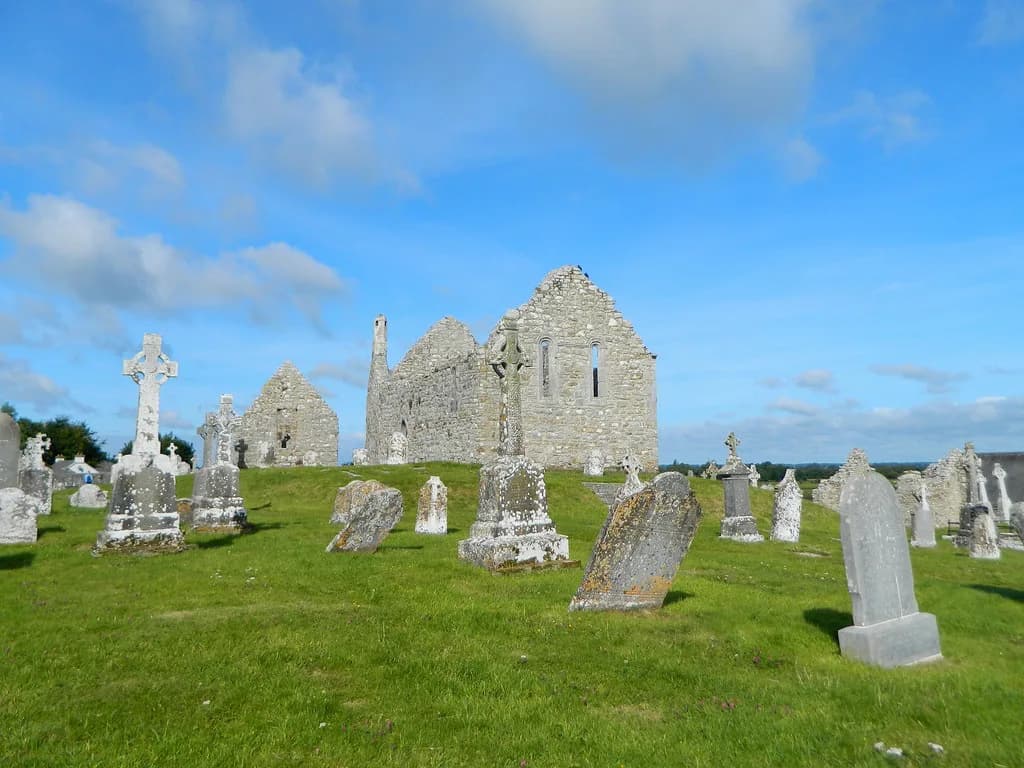
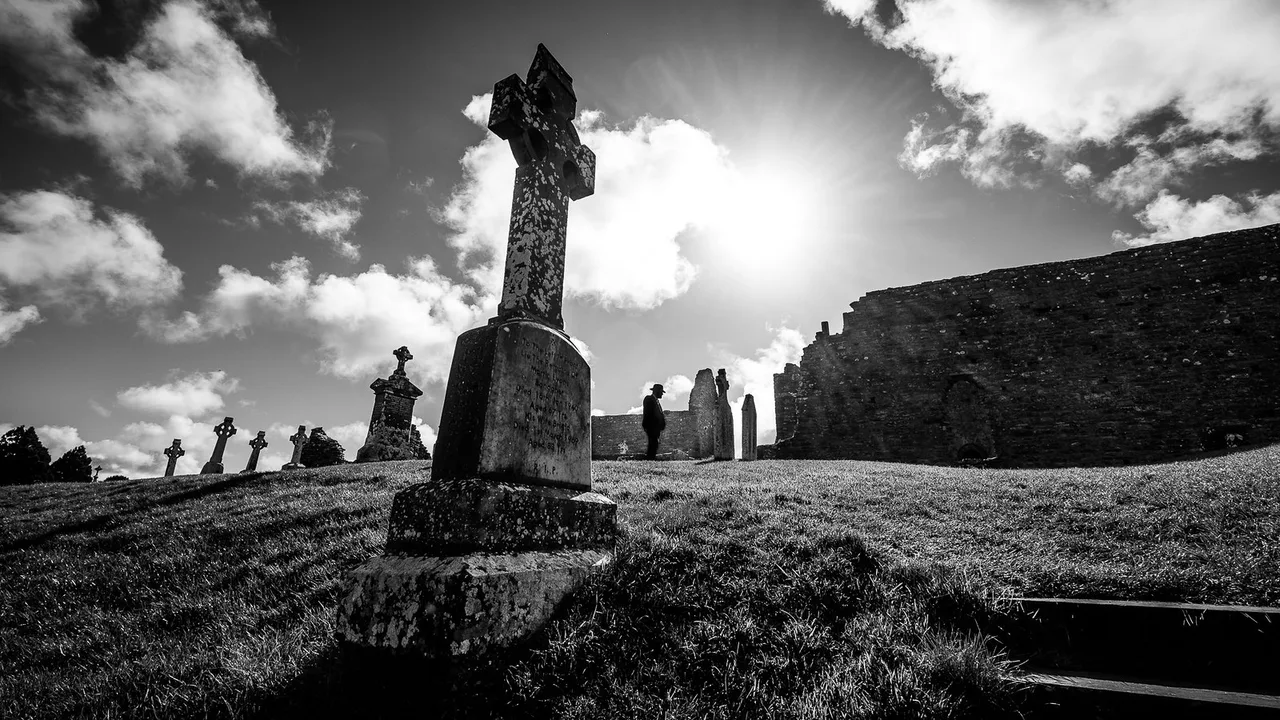
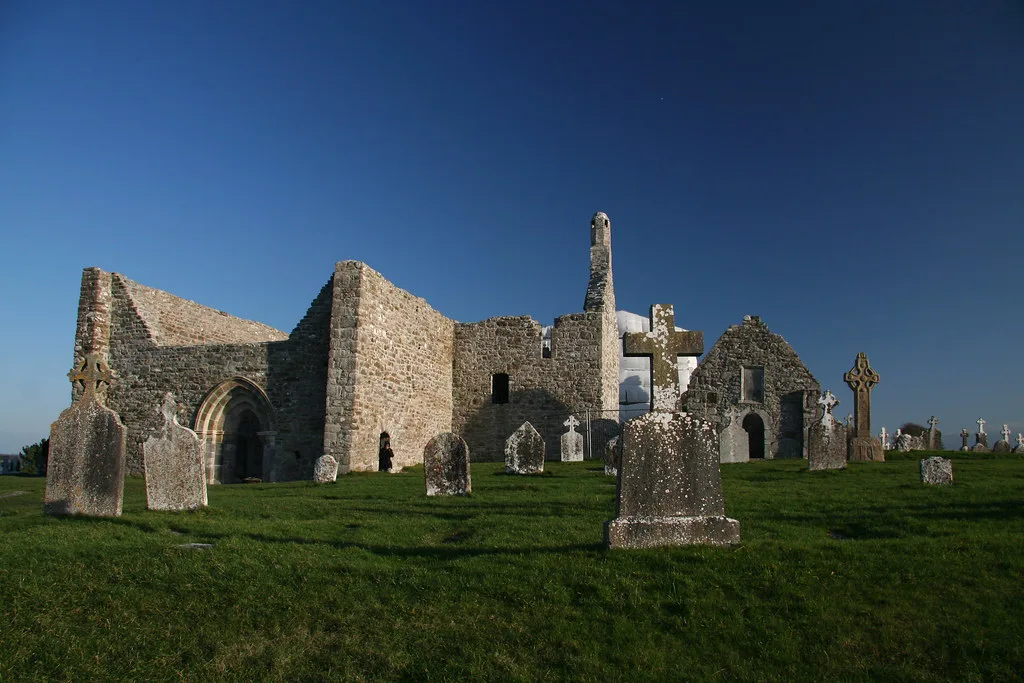
St Ciarán founded Clonmacnoise on the banks of the Shannon in the 6th century, and it grew into a great seat of learning that drew students from across Europe. The ruins hold a cathedral, two round towers, three high crosses, nine churches and more than 700 early Christian graveslabs, and the original high crosses, including the 10th-century Cross of the Scriptures, are displayed in a purpose-built visitor centre beside the enclosure.
A major redevelopment of the visitor centre was contracted in April 2026 with European Union Just Transition funding, but that does not mean easier entry now. Heritage Ireland states the site is fully closed to visitors for the carpark closure window from 19 October 2026 to 1 January 2027, and anyone planning an Offaly stop should recheck the notice for the exact current position rather than rely on older guides.
Quin Abbey: A Franciscan Foundation Near Ennis
Quin Abbey lies about 10 km from Ennis in County Clare and was founded for Franciscan friars in the 14th century, with cloisters built in the 15th. Discover Ireland notes that the abbey's tower affords impressive views of the surrounding countryside and that the cloisters are among its most prominent features, but its listing gives no access, ticket or timing detail, so check locally before assuming you can climb the tower or that any part of the site is open.
Pair Quin with Clare Abbey as a contrast in religious orders within a short drive of Ennis: Augustinian planning at Clareabbey with its belfry and absent west range, Franciscan cloister life at Quin. Both reward an hour or so of slow looking, but neither comes with published visitor facilities, so build the day around Ennis's shops and cafés rather than on-site services.
Ballintubber: A Working Church and Pilgrim Paths
Ballintubber Abbey in County Mayo describes itself as a place of continuous worship for more than 800 years, a claim the abbey makes in its own account rather than one independently verified. The grounds include St Patrick's Well, sculptures and garden space, and the abbey frames its history around kings of Connacht and a pirate queen. Read the site's panels with that self-description in mind.
Unlike the OPW ruins, Ballintubber runs organised experiences in its own account: an expert-led abbey tour, a guided walk along the ancient pilgrim path, and a self-guided walk option. The abbey is just off the N84, with Castlebar about ten minutes away and Westport, Ballinrobe and Claremorris all within roughly half an hour, so it suits a half-day loop from any of those towns. Booking and current schedules belong on the abbey's own site, not in a general guide.
If Mayo is one leg of a western tour, Ballintubber makes a natural counterpoint to the great Connacht castles and abbeys further south; travellers building a Galway base often want castles in county galway in the same itinerary before heading north. Allow time for the grounds as well as the church, since the well and pilgrim paths are part of the visit rather than an afterthought, and anyone extending that Galway leg can add the city's smaller collections using this Galway heritage guide.
Dunbrody: Cistercian Stonework on the Hook Peninsula
Dunbrody Abbey on County Wexford's Hook Peninsula is a 13th-century Cistercian foundation with much original stonework still standing, from the church walls to the cloister garden. The site runs as a visitor centre with a yew maze, pitch-and-putt and a tearoom, which makes it the most family-oriented of these houses. Its own website currently announces that the visitor centre is closed for the season, with winter events mentioned but undated.
Kylemore abbey in Connemara makes a deliberate contrast rather than a comparison of like with like: it belongs to a later, romantic strand of Irish religious building rather than the medieval Cistercian ruin, and rewards anyone tracking how Irish religious architecture is presented to visitors.
Because Dunbrody's centre closes seasonally, check the website before travelling to the Hook Peninsula and do not assume the maze, café or shop will be running. While the centre is shut, plan around confirmed openings rather than the published facilities list, and treat the ruin as closed unless the operator's own page says otherwise.
Grouping the Six by Order and Landscape
By order, the set splits usefully: Clare Abbey is Augustinian, Corcomroe and Dunbrody are Cistercian, Quin is Franciscan, Ballintubber is a working Catholic parish church in the abbey's own account, and Clonmacnoise began as an early monastic foundation before the continental orders arrived. That distinction shows in the surviving fabric: Corcomroe's original church is a Cistercian survival, while the later Franciscan house at Quin is noted for its cloister arcade.
By landscape, each site teaches something different: the Burren limestone setting at Corcomroe, the Shannon banks at Clonmacnoise, the Mayo farmland around Ballintubber, and the Hook Peninsula coast at Dunbrody. For early Christian sites of a different character entirely, ancient sites ireland offers a broad starting point. Distances between these scattered houses are substantial and secondary roads slow the driving, so allow more time than a map suggests.
Choosing Between Them on a Short Trip
If you want architecture to read for yourself, choose an unguided OPW monument such as Clare Abbey or Corcomroe: bring a plan and a glossary, and be self-sufficient. If you want interpretation or family logistics, a visitor-centre-led site fits better, though Dunbrody's seasonal closure means you must confirm status. If you want ceremony and pilgrimage context, Ballintubber's own guided tours and pilgrim paths suit the frame.
For the early medieval world specifically, Glendalough in Wicklow and Skellig Michael off Kerry are the better-known set-piece sites, each with its own access arrangements. Neither belongs to the Cistercian or Augustinian story told here, so treat them as separate days rather than substitutes for a Clare or Mayo visit.
Where Monastic Ireland Meets Royal Ireland
Monastic sites are only one strand of Ireland's medieval remains, and travellers heading south from Clare often add the rock of cashel in County Tipperary, a royal and ecclesiastical complex of a different order from the cloister ruins described here. Read it as a seat of power with a religious core rather than another abbey, and you will get more from the change of scale.
Plan Around the Notices
Two live facts should shape any monastery itinerary in the near term: Clonmacnoise is fully closed to visitors from 19 October to 1 January 2027 per Heritage Ireland, and Dunbrody's visitor centre is closed for the season with no reopening date published. Both are the sort of operational detail that changes faster than any guidebook, so check the official page in the week you travel rather than weeks ahead.
With those caveats in place, the unguided Clare and Burren ruins suit anyone willing to take responsibility for their own footing, Ballintubber is a functioning parish with its own tours, and Quin near Ennis repays a half day of slow looking. Pick one ruin to read closely and one site with its own published visitor offer, and you will see more of medieval Irish monastic life than any list of names can give you.
Explore more Ireland guides
- Ballintubber Abbey
- Clare Abbey
- Clonmacnoise
- Cong Abbey
- Corcomroe Abbey
- Ennis Friary
- Fore Abbey
- Glendalough Monastic City
- Jerpoint Abbey
- Kells Priory
- Kylemore Abbey
- Old Mellifont Abbey
- Quin Abbey
- Scattery Island
- Skellig Michael (Sceilg Mhichíl)
- Sligo Abbey
- The Rock of Cashel
- Abbeyknockmoy Cistercian Abbey
- Askeaton Franciscan Friary
- Athenry Dominican Priory
- Ballinskelligs Abbey
- Boyle Abbey
- Dunbrody Abbey
- Rosserk Abbey
- Tintern Abbey, County Wexford
Frequently Asked Questions
Which monasteries in Ireland can you actually visit right now?
Clare Abbey and Corcomroe operate as unguided OPW national monuments, Ballintubber runs tours and pilgrim walks in its own account, and Quin can be visited near Ennis, subject to the site's own arrangements. Clonmacnoise is fully closed from October 2026 to January 2027 per Heritage Ireland, and Dunbrody's visitor centre is closed for the season. Confirm each site's status shortly before travelling.
Is Clonmacnoise open to visitors in 2026?
Not for most of late 2026. Heritage Ireland states that the site will be fully closed to visitors from 19 October 2026 until 1 January 2027 because the carpark must shut and there will be no safe access. A visitor-centre redevelopment is underway, but that does not change current entry. Check the Heritage Ireland page for the latest position.
What is the difference between an unguided OPW monastery and a staffed visitor centre?
Unguided sites such as Clare Abbey and Corcomroe have no guiding, supervision or guaranteed facilities, and the OPW asks visitors to take care of themselves. A site with a visitor centre, such as Clonmacnoise, normally includes an exhibition and the original high crosses on display, though Clonmacnoise is currently closed. Ballintubber offers its own guided tours and pilgrim walks.
Sources
You might also like



Continue reading
More guides you'll find useful


