
Abbeyknockmoy Cistercian Abbey: A Visitor Guide to the Ruin
Abbeyknockmoy is an unguided Cistercian ruin in east County Galway. Learn how to reach the site and what its carvings and wall paintings reveal.
On this page
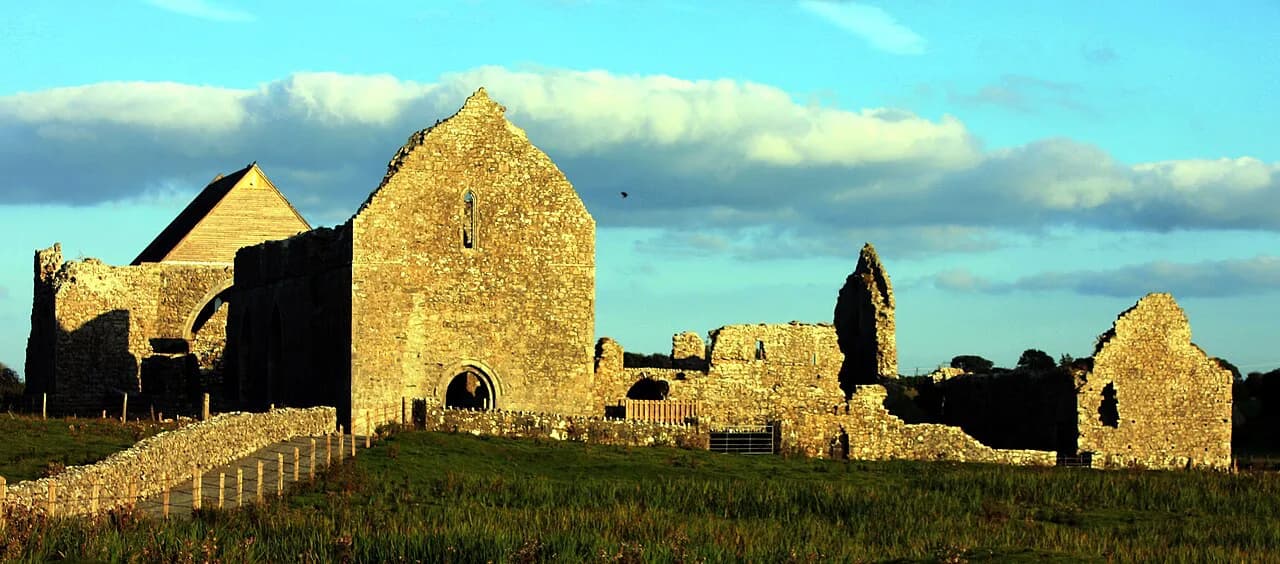
Abbeyknockmoy is a ruined Cistercian abbey on the north bank of the Abbert River in east County Galway, about 12.5 kilometres south east of Tuam and one kilometre north east of the village of Abbeyknockmoy. It is a state-owned National Monument in the care of the Office of Public Works and is an unguided site, so everything you learn there comes from what you have read before arriving.
The visit is not a museum stop. There is no staffed entrance in the published account, and the way in is over a stile with steps from a car park a short walk away near the graveyard—a physical constraint worth knowing before you set out. Heritage Ireland asks visitors to take care and caution on site, and the OPW disclaims responsibility for injuries or losses during a visit. If you would rather be indoors and under a roof, our Galway heritage guide covers the staffed alternatives in the city.
What Survives of the Cistercian House
The buildings that stand today are mostly early thirteenth-century work, with additions made in the fifteenth and sixteenth centuries, laid out on the standard Cistercian plan. The church has a wide nave, a chancel and narrow transepts to north and south containing two side chapels, and the chancel is rib-vaulted with carved capitals and an east-facing window.
That division of space carried meaning. Lay brothers worshipped in the nave while the monks used the chancel, so the surviving walls record two different congregations rather than one undivided room. Around the church stood the working parts of the monastery: a vaulted chapter room divided by cross-walls into three sections, a calefactory or monks' day room to its south, and a refectory at the south end of the church.
The cloister ruins enclose a garth on the north, east and south sides, and local graves and gravestones now stand within it, so treat that ground as a burial place. Dormitories once sat above the vaulted sacristy and chancel, a reminder that the standing fabric belonged to a larger working monastery than the fragmentary walls suggest.
Foundation by Cathal Crobhdearg Ua Conchobair
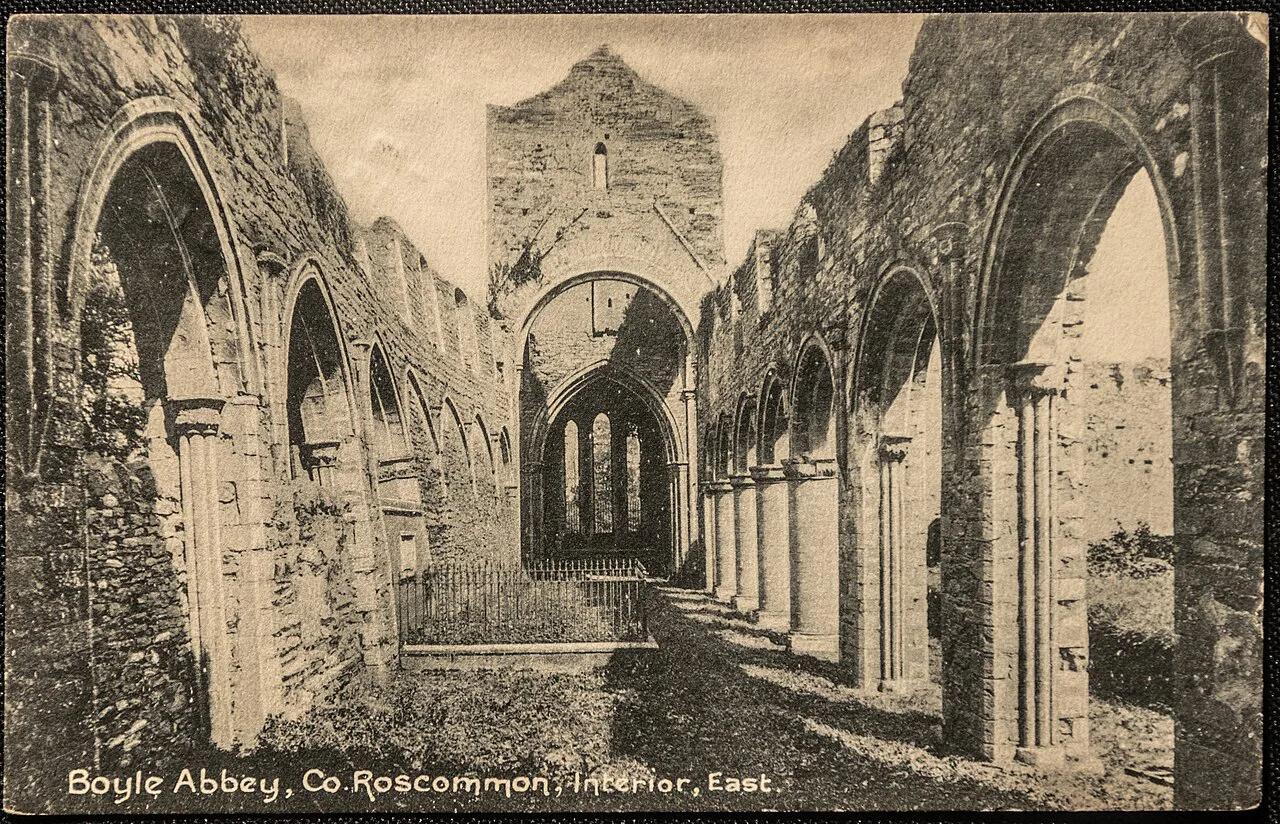
The abbey was founded in 1189/1190 by Cathal Crobhdearg Ua Conchobair, king of Connacht, who died in 1224, and was settled by monks from Boyle Abbey in County Roscommon, the earliest Cistercian house in Connacht. Monastic Ireland gives the foundation as around 1190 and reads the endowment politically: Cathal, whose career was entangled in dynastic struggles and who received a formal grant of Connacht from King John in 1210, was planting loyal religious communities in contested territory.
A tradition recorded by Monastic Ireland holds that a storm on Lough Ree killed one of Cathal's sons and several retainers, and that he founded the abbey in thanksgiving for his own survival. That story is tradition rather than documented fact, and it sits alongside the more prosaic political explanation rather than replacing it. Cathal eventually entered the monastery himself and was buried there in 1224 alongside his wife Mór Ní Briain, who had died in 1217.
The founder's family did not hold the house unchallenged. The O'Kelly family, lords of Uí Mhaine, became its patrons in the fourteenth and fifteenth centuries, using Abbeyknockmoy as a family burial place and securing control through a succession of abbots drawn from their own kin. In 1402 Malachy O'Kelly built a family tomb in the north wall of the presbytery, the space traditionally reserved for the founder's tomb, which reads as a quiet claim on the house's prestige.
Carvings and the School of the West
The east end of the abbey is associated with the so-called School of the West, masons known for fine stone carving and idiosyncratic sculptural detail, and their work is identified on the east windows. Look for carved capitals in the rib-vaulted chancel and for the moulded jambs of the original three-light window and the later single-light windows in the chapter room, details that survive better than most fittings in a roofless ruin.
In the south west corner of the church is a sculpted head of a king, its nose and chin missing but eyes, hair and crown intact. Heritage Ireland says it may represent Cathal Crobhdearg Ua Conchobair, and Monastic Ireland likewise calls it possibly the founder, so the identification should be treated as a strong suggestion rather than a confirmed portrait.
The Medieval Wall Paintings
Abbeyknockmoy holds one of only four such artworks in Ireland: tempera wall paintings that once covered the whole north end of the chancel, estimated to date from the fifteenth century. They depict the popular medieval tale of the Three Living and Three Dead Kings, a reminder of the inevitability of death, and the martyrdom of St Sebastian, the saint invoked against plague.
Their survival has a documented afterlife. Edward Ledwich reproduced them as engravings in his Antiquities of Ireland in 1790, and they were copied and displayed at the Dublin Exhibition in 1853. Because the space lay open to the weather, the Office of Public Works weather-proofed that part of the abbey in the 1980s to protect the paintings, and Monastic Ireland dates that conservation work to the late 1980s.
What this means for a visitor is modest: the paintings are protected under the vault of the presbytery rather than presented as a gallery display, so plan on understanding them from what you have read and from the sheltered space itself. Anyone weighing this fragmentary rural ruin against a major furnished monastic showpiece such as the Rock of Cashel in County Tipperary should choose deliberately, because the two deliver very different kinds of visit.
Plunder, Accusations and the 1542 Surrender
The house had a turbulent record. It was plundered in 1202 by William de Burgo and again in 1228, and in 1240 the abbot was censured for having his hair washed by a woman while in 1483 a later abbot was accused of setting fire to the abbey. Those entries are recorded censures and accusations rather than established accounts of what actually happened, and they survive as glimpses of how closely monastic discipline was monitored.
The end came through politics rather than collapse. Abbot Hugh O'Kelly surrendered the abbey to Henry VIII on 24 May 1542 during the dissolution of the monasteries and was appointed rent collector, while the abbey church continued in use as a parish church under the names Porta Magna and Teampollandorusmoir, the chapel with the big door.
Later ownership passed to lay hands: Monastic Ireland records a grant of Abbeyknockmoy by James I to Valentine Blake in 1620. Inside the ruin, a carved memorial plaque to Elevina Kirwan, second wife of Robert French of Monivae, is dated 8 August 1684 and carries her armorial bearing and the motto Laus Deo.
Putting Abbeyknockmoy in Context
Abbeyknockmoy rewards a short, focused stop rather than a half day, because the site is unguided and the fabric fragmentary. Read the plan beforehand, bring the location of the chancel and chapter room in mind, and the tumbled walls start to sort themselves into rooms; arrive without that preparation and it can read as little more than a graveyard with ruins.
If you are building an itinerary around Irish monasticism, use a wider survey of the monasteries in ireland to pair this ruin with sites where access and interpretation are managed differently, rather than expecting Abbeyknockmoy to carry a whole day. Check the operator's page before travelling for current access arrangements, since the entry route over a stile is the kind of detail that can change.
Planning the Stop
Treat Abbeyknockmoy as a place to read stone rather than to be shown around. The essentials are the founder's royal burial, the Cistercian division of nave and chancel, the School of the West carving at the east end and the protected paintings under the presbytery vault, all within a compact ruin on the Abbert's north bank.
Confirm the access position before setting out, because the published approach is a car park a short walk from the ruin near the graveyard followed by a stile with steps over a fence. Heritage Ireland publishes the site's status and restrictions, and that page is the place to check rather than assuming a staffed entrance or interpretative centre will be there.
For more heritage reading, see our guides to Skellig Michael and Glendalough. For another heritage guide, read about Kylemore Abbey.
Explore more Ireland guides
Frequently Asked Questions
How do you get into Abbeyknockmoy and where do you park?
Heritage Ireland describes a car park a short walk away from the ruin near the graveyard. Access to the monument itself is over a stile with steps through a fence, so the final approach is on foot and involves climbing. There is no staffed entrance described, and visitors are asked to take care and caution on site.
What is there to see at Abbeyknockmoy today?
You see the roofless church with its wide nave, rib-vaulted chancel, transepts and side chapels, the remains of the chapter room, calefactory and refectory, and cloister ruins containing local graves. Carved detail survives at the east end and in the chapter room, and a sculpted head of a king stands in the south west corner of the church.
Who founded Abbeyknockmoy and why?
Cathal Crobhdearg Ua Conchobair, king of Connacht, founded the abbey in 1189/1190, and monks came from Boyle Abbey in County Roscommon to settle it. Monastic Ireland interprets the endowment as part of his effort to plant loyal religious communities in contested territory. A tradition also holds that he founded it in thanksgiving after surviving a storm on Lough Ree that killed his son.
What are the Abbeyknockmoy wall paintings and can they be seen?
They are tempera paintings estimated to date from the fifteenth century, showing the Three Living and Three Dead Kings and the martyrdom of St Sebastian. Heritage Ireland describes them as among only four such artworks in Ireland. They are protected under the vault of the presbytery and were weather-proofed by the Office of Public Works in the 1980s rather than displayed as a gallery exhibit.
Is the carved head at Abbeyknockmoy a portrait of Cathal Crobhdearg?
It is a possibility rather than a certainty. Heritage Ireland says the head, in the south west corner of the church, may represent Cathal Crobhdearg Ua Conchobair, and Monastic Ireland likewise describes it as possibly the founder. Its nose and chin are missing, but the eyes, hair and crown survive.
What happened to the abbey after the Dissolution?
Abbot Hugh O'Kelly surrendered the abbey to Henry VIII on 24 May 1542 and was appointed rent collector, while the church continued as a parish church known as Porta Magna. James I later granted the site to Valentine Blake in 1620, and a memorial plaque to Elevina Kirwan dated 1684 survives inside the ruin.
Sources
You might also like



Continue reading
More guides you'll find useful





