
Corcomroe Abbey: A Visitor Guide to the Burren Ruin
Corcomroe Abbey is an unguided OPW National Monument in the Burren. See what survives, how to read the ruins, and what the O'Brien tomb tradition means.
On this page
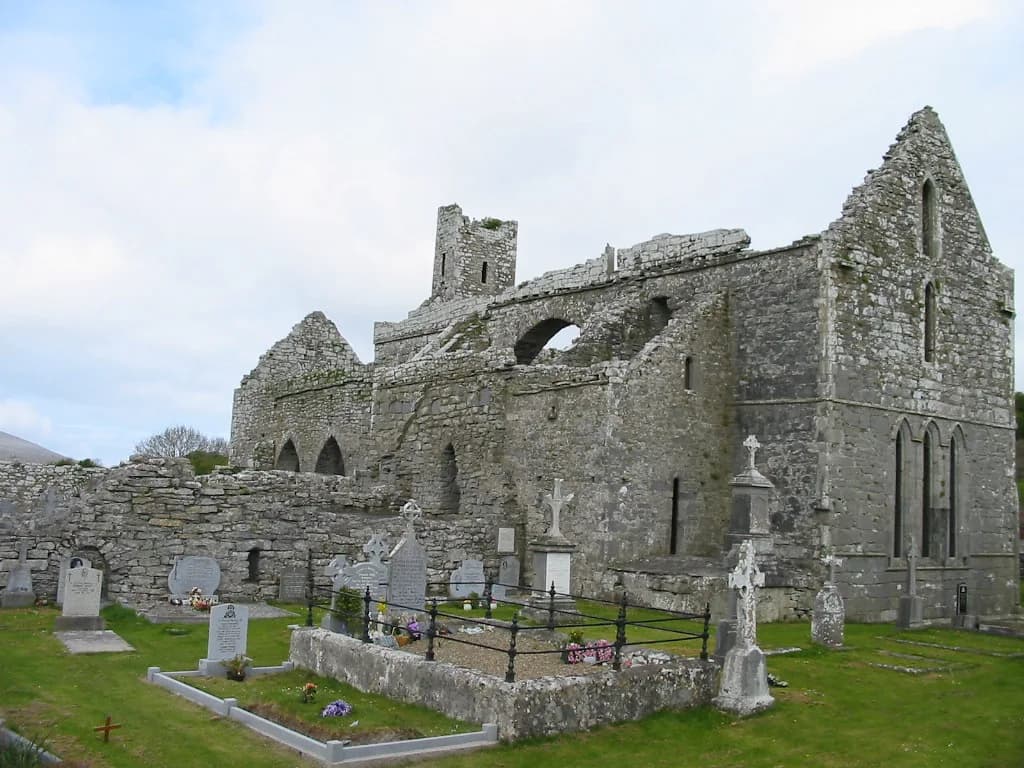
Corcomroe Cistercian Abbey is a roofless medieval ruin in County Clare, held as a National Monument in the care of the Office of Public Works and presented by Heritage Ireland as an unguided site. That single word shapes the visit: you read the masonry, tombs and graveyard on your own, without staff, tours or visitor facilities on hand.
Lonely Planet places the abbey in a quiet green hollow about two kilometres inland from Bellharbour, surrounded by the grey hills of the Burren. The setting is a large part of the experience, because the ruin sits low and exposed rather than being set up for crowds.
This guide covers what the sources actually support: the debated foundation, the surviving twelfth- and thirteenth-century church, the O'Brien tomb tradition, and the site's post-Dissolution history. It does not supply opening hours, admission arrangements or facilities, so check the official Heritage Ireland page before travelling.
What Corcomroe Abbey Is and Where It Sits
Corcomroe is a Cistercian abbey founded in the late twelfth or early thirteenth century and now preserved as a National Monument. Heritage Ireland states that it is state-owned and in the care of the Office of Public Works, protected under the National Monuments Acts 1930 to 2014.
Its position in the Burren, beneath the surrounding hills, makes it a landscape monument as much as an architectural one. For orientation, Lonely Planet describes it as sitting roughly two kilometres inland from Bellharbour, which is useful for planning a route but does not tell you anything about access.
Because the official page classifies the site as unguided, plan to interpret it yourself. Bring your own context from reading, and treat the visit as a short, quiet stop built around stonework and graveyard rather than a facility-led attraction.
What 'Unguided' Means in Practice
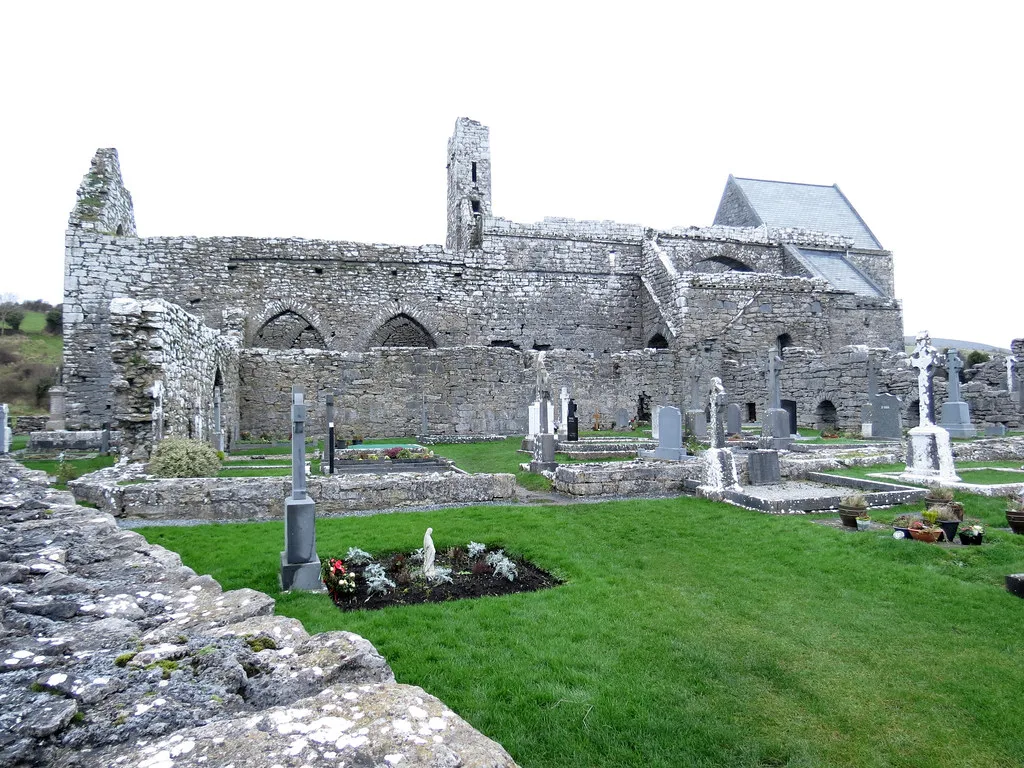
The Heritage Ireland page carries a clear notice that the site is unguided and that a level of care and caution should be maintained during the visit. That is the official framing, and it should set expectations: no guiding, no staffed interpretation and no implied visitor services.
A first-person account from a traveller who walked the site describes wet, grassy ground, uneven floors, tombs lying underfoot and carved crosses sticking up from the floor. Those are experiential impressions rather than official safety advice, but they are a useful prompt to wear sensible footwear and watch your step.
The abbey also sits within a graveyard that is closely woven into the ruins: Lonely Planet notes that modern graves crowd the remains. Treat the space as a burial ground and keep noise down and paths respected.
The Foundation Question: 1182 or 1195?
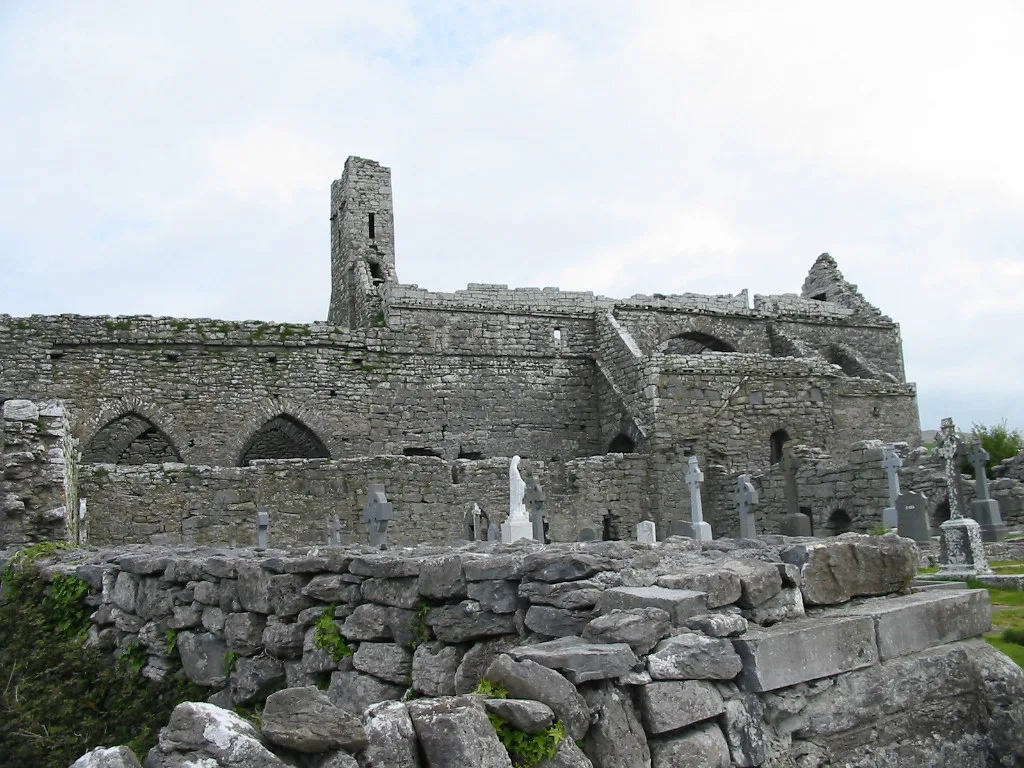
The abbey's founder is debated. Heritage Ireland names two candidates: Donal Mór O'Brien in 1182, or his son Donal Cairbreach around 1195, and it states that more sources favour the son because he brought monks over from Innishlounaght.
Lonely Planet gives the foundation as 1195 by Donal Mór O'Brien, which conflicts with the official page's leaning toward the son. Do not treat either version as settled: the honest reading is that the founding is contested, and the monks' origin at Innishlounaght is the detail that most supports the son's case.
The O'Briens were a dominant family in Clare, and the abbey belongs to that political world as much as to Cistercian reform. If you want broader context on how Irish monasticism evolved, the Monasteries in Ireland overview places a site like this among many others, and the ancient sites ireland guide sets tombs, forts and trackways alongside such ruins for wider route planning.
Why the Abbey Was Built on a Border
Heritage Ireland explains that the Corcomroe and Burren area was divided between the O'Loughlin and O'Conor tribes, and that the abbey stood on the boundary between their territories. That position looks deliberate: the O'Briens are described as wanting to project their authority across the region.
Knowing this changes how you read the site. You are not looking at a remote retreat chosen for solitude, but at a foundation placed where two neighbouring powers met, with the O'Briens asserting themselves in stone.
The border logic also explains why the abbey mattered politically well beyond its religious function. When you walk the ruins, note how exposed the site feels in the open Burren landscape, with the hills that defined those territories still visible around it.
Reading the Ruin: The Church and the Stonework
The church is one of the few original features still standing, and Heritage Ireland dates it to somewhere between 1210 and 1225. It was built in the style of the School of the West, the term the official page uses for the work of the stonemasons of the time.
Look for the surviving vaulting in the presbytery and transepts, which Lonely Planet describes as impressively intact, and some striking Romanesque carvings the same source notes survive at the site. Reading these as masonry rather than decoration is the key to the visit: the shaping of capitals and arches tells you how the building was put together.
Carved column bases and capitals, arches set into the walls and carved crosses are the details that reward a slow circuit. Because the roof is gone, the light changes constantly across the stone, so what you see depends heavily on the weather on the day you visit.
Corcomroe's distinction is the combination of intact vaulting, Romanesque carving and a raw, roofless setting in the Burren, so give the church a slow circuit rather than a quick glance. If carved stonework and vaulting are what draw you, the monasteries in ireland guide points to comparable ruins in different settings.
Tombs and Tradition
The most discussed tomb is associated with Conor na Siudaine O'Brien, king of Thomond, who died in 1268 according to Lonely Planet. The same source says he is said to occupy the tomb in the northern wall, and that a crude carving of him sits below the effigy of a bishop holding a crosier, the pastoral staff carried by a bishop or abbot.
Treat the attribution as tradition rather than confirmed identification. That framing matters at a ruined site where later burials crowd the interior and where the historical record and local memory blur.
The graveyard is part of the experience too. A visitor's account describes family tombstones laid side by side, some spanning centuries, with moss and water on the stone. That mix of medieval and modern burial is what makes Corcomroe feel like a place still in use rather than a museum set piece.
After the Dissolution: Who Held the Abbey
Heritage Ireland records that the abbey changed hands many times after the Dissolution of the Monasteries in 1536. In the 1550s it passed to Murrough, Earl of Thomond; in 1564 to Donal O'Brien, known as the Chief of Clare; in 1584 to Donagh O'Brien; and in 1611 to Richard Harding.
That sequence is useful because it shows how a monastic foundation was absorbed into lay ownership after the Dissolution, passing through the hands of local power brokers within a few generations. Keep the dates as the official page gives them rather than trying to reconstruct a single continuous narrative.
For a wider view of how Irish religious houses were shaped and later altered, comparative reading helps. Looking at other abbeys alongside Corcomroe shows how similar Cistercian and later foundations sit in different landscapes and survive in different conditions.
Conservation and Statutory Protection
The Office of Public Works carried out conservation work at Corcomroe in 2006, and the site is protected under the National Monuments Acts 1930 to 2014. That legal protection is why the ruin survives largely as masonry and graveyard rather than being reconstructed.
Understanding that frames the visit: you are seeing a conserved ruin, not a restored building, and the absence of a roof is part of its condition rather than a sign of neglect. Approach the stonework as you would any protected monument, reading the masonry from the ground and keeping off the walls and effigies.
Nearby Sites and Wider Monastic Context
Heritage Ireland lists several other OPW sites nearby, including Ennis Friary, Aughnanure Castle and Portumna Castle and Gardens. For the fortified side of the same landscape, the castles in county galway guide covers four sites and their current access. If you want to set the abbey among earlier monuments too, the ancient sites ireland guide covers tombs, forts and trackways across the country. These are named for onward planning only; check each site's own Heritage Ireland page for what it offers and whether it is staffed.
If Corcomroe sparks an interest in Ireland's monastic landscape, several contrasting sites are worth a detour. Clonmacnoise on the River Shannon and Glendalough in the Wicklow mountains show very different scales and settings, while Ballintubber Abbey in County Mayo remains a working foundation.
For a broader sweep of early Christian and medieval remains, the Ancient Sites in Ireland collection groups abbeys, high crosses and monastic settlements by region. Use it to plan a route that puts Corcomroe in context rather than treating it as an isolated stop.
Travellers heading east across the country can pair Corcomroe with the Rock of Cashel in County Tipperary, where a compact hilltop complex of church, tower and chapel gives a very different reading of Irish ecclesiastical building. The contrast is instructive: Corcomroe survives as a roofless rural ruin, while Cashel concentrates several phases of architecture in one walled enclosure.
Plan Your Visit
Corcomroe Abbey rewards a short, deliberate stop: read the vaulting and carvings, look for the tomb tradition, and take in the border landscape that gave the foundation its purpose. Go expecting an unguided ruin in a graveyard, with the care and caution the official page asks for.
Before you travel, verify current access arrangements and any site notices on the Heritage Ireland page, and dress for wet grass and uneven ground. If you want more monastic stops on the same trip, the monasteries in ireland guide links Corcomroe to the wider network of abbeys and ruins.
Explore more Ireland guides
Frequently Asked Questions
Is Corcomroe Abbey guided?
No. Heritage Ireland classifies the site as unguided and includes a notice asking visitors to exercise care and caution. There are no staffed tours or visitor facilities described on the official page, so plan to interpret the ruins yourself.
Who founded Corcomroe Abbey?
The foundation is debated. Heritage Ireland names Donal Mór O'Brien in 1182 or his son Donal Cairbreach around 1195, and notes that more sources favour the son because he brought monks from Innishlounaght. Other published accounts give 1195, so treat the date as contested rather than settled.
What can I see at Corcomroe Abbey?
The church, dated to roughly 1210 to 1225, survives with School of the West stonework, vaulting in the presbytery and transepts, carved capitals and arches, and carved crosses. The graveyard includes later family tombs, and the setting beneath the Burren hills is part of the experience.
Why was Corcomroe Abbey built where it is?
Heritage Ireland explains that the area was divided between the O'Loughlin and O'Conor tribes and that the abbey stood on the boundary between their territories. That suggests a deliberate choice by the O'Briens to project authority in a contested region rather than a retreat chosen for isolation.
Whose tomb is said to be at Corcomroe Abbey?
A tomb in the northern wall is traditionally associated with Conor na Siudaine O'Brien, king of Thomond, who died in 1268 according to Lonely Planet. The attribution is a tradition rather than a confirmed identification, and a carving of a bishop with a crosier sits nearby.
What happened to Corcomroe Abbey after the Dissolution?
Heritage Ireland records that the abbey changed hands after the Dissolution of the Monasteries in 1536. It passed to Murrough, Earl of Thomond, in the 1550s, then to Donal O'Brien in 1564, Donagh O'Brien in 1584 and Richard Harding in 1611.
Is the ground difficult to walk on at Corcomroe Abbey?
One visitor account describes wet, grassy ground, uneven floors and tombs underfoot. That is an experiential impression rather than official safety guidance, but it is a sensible prompt to wear sturdy footwear and watch where you step, especially after rain.
Sources
You might also like



Continue reading
More guides you'll find useful


