
Clare Abbey: Visiting the Augustinian Ruins Near Ennis
Clare Abbey is an unguided OPW national monument west of the River Fergus near Ennis. Learn what survives, how to read the ruins and what to expect on site.
On this page
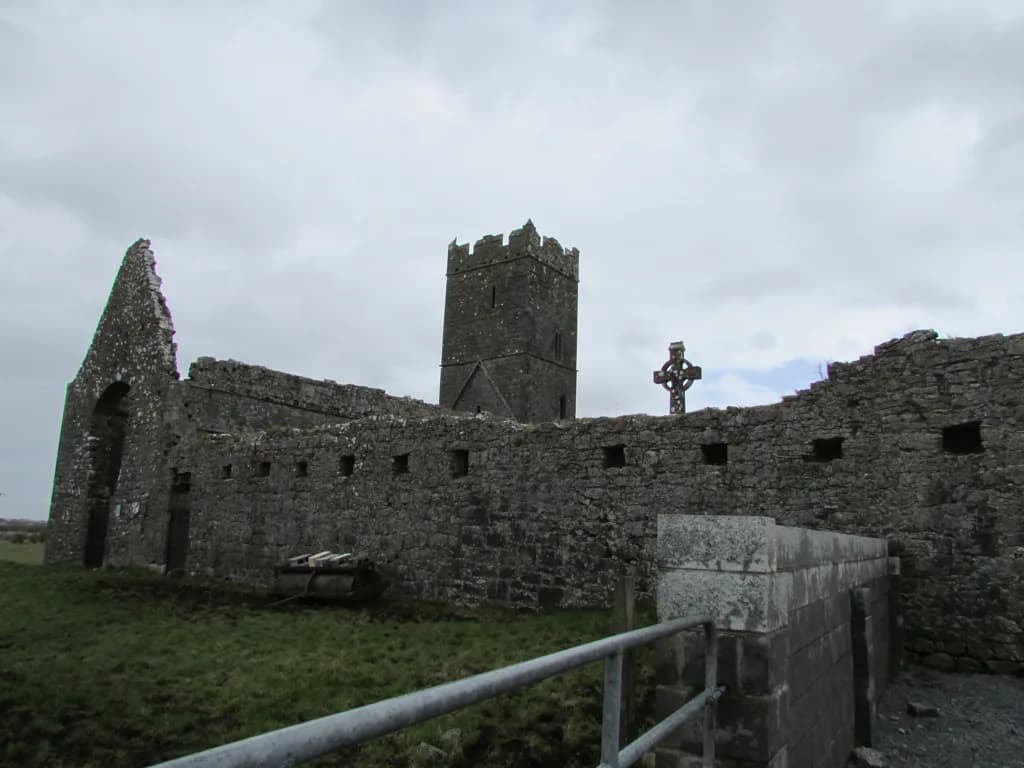
Clare Abbey is an unguided medieval ruin and national monument looked after by the Office of Public Works, standing west of the River Fergus at the end of a narrow slip road off the south-east corner of Ennis. It has no visitor centre and no guided tour, so the experience is reading standing stonework with your own eyes. The Heritage Ireland listing is the place to confirm current access details.
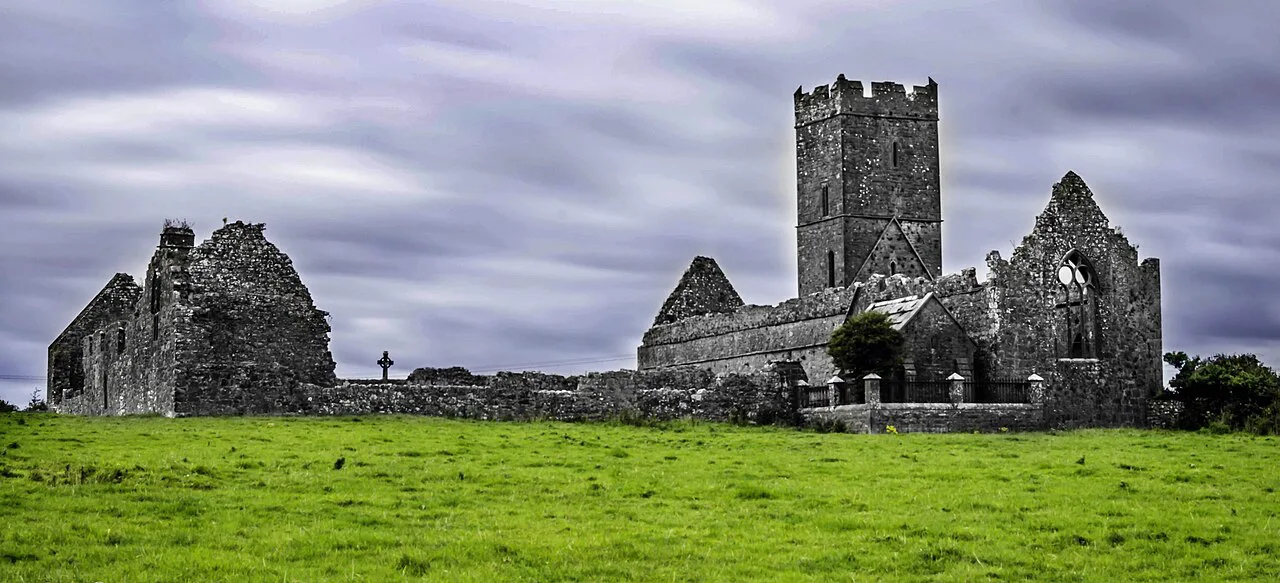
The site rewards a slow hour more than a quick photograph. What survives is a church with square belfry tower, two ranges of domestic buildings around a garden cloister, and three intact 15th-century tracery windows, and knowing what to look for changes a wall of rubble into a readable plan.
Where Clare Abbey Stands and Who Manages It
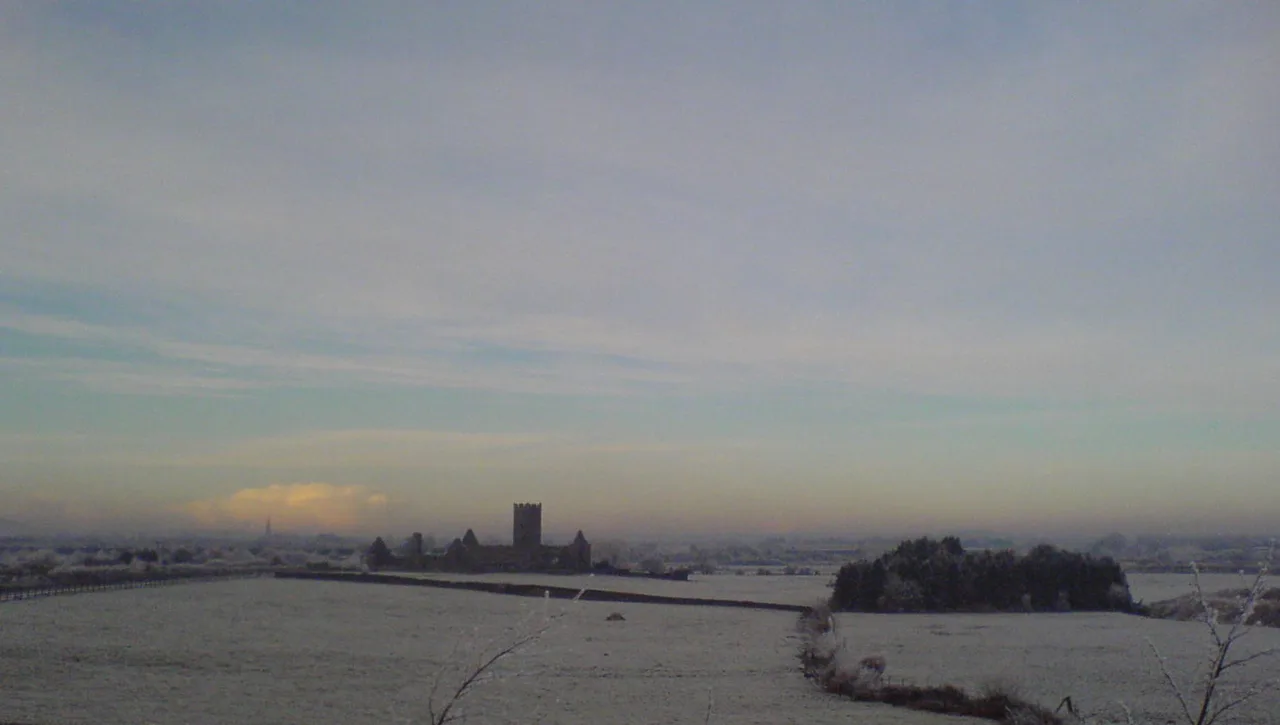
The OPW locates the ruin to the west of the River Fergus, at the end of a narrow slip road at the south-east corner of Ennis in County Clare. That is close enough to town for a brief diversion but removed from the streets and without any published facilities, so plan your approach before setting out.
Heritage Ireland classifies the property as an unguided site and warns that visitors must take care, with the OPW stating it is not responsible for damages or injuries during a visit. Treat that warning as the real access condition of the place rather than a legal formality, and watch your footing on uneven ground and loose surfaces.
The same official page gives no opening hours, no admission charge information, no parking details and no staff presence. Check the current listing before you travel rather than relying on secondhand accounts, and do not assume facilities on site.
Protection as a national monument under the National Monuments Acts 1930 to 2014 explains why the ruin survives at all, but it also means you should leave stonework, carved detail and burial markers untouched. For the wider picture of Irish monastic survival, the guide to monasteries in ireland sets Clare Abbey alongside sites that range from open ruins to conserved complexes.
Founding, Dedication and Why It Mattered
Heritage Ireland dates the foundation to about 1189 and reports that it was reportedly founded by Domnall Mór Ua Briain, also given as Donald O'Brien, King of Thomond, who died in 1194. The hedge matters: the founder attribution is a reported tradition rather than a certainty, so treat it as the official account rather than a settled fact.
Heritage Ireland gives the monastery's original name as the Abbey of St Peter and Paul at Kilmony, a name that sits beside the later local usage of Clareabbey or Clare Abbey. An independent survey of the stones notes that the abbey was dedicated to Saints Peter and Paul, and that dedication is the detail worth carrying into your reading of the site, not the modern label.
According to Heritage Ireland, the monastery was the largest and most important of County Clare's Augustinian houses while it was operating. An independent survey likewise calls it the first and largest Augustinian monastery in the county, and that standing gives a useful frame for looking at the scale of the nave and ranges still visible today.
Reading the Church and the Belfry Tower
The church consists of a long single-aisle nave and a chancel, separated by a square belfry tower whose internal staircase no longer survives. Standing on the axis you can follow the sequence of nave, tower and chancel without any equipment, which is the clearest lesson the ruin offers on medieval planning.
Parts of the church date to the 12th century, while the domestic buildings are 15th-century work, and the west window has completely collapsed. The breach in the west gable is therefore an absence rather than a feature, and an independent survey notes the west doorway is likewise missing there.
Later burials occupy parts of the interior, a common afterlife for medieval ecclesiastical ruins. Read them as a separate layer of use rather than as monastic fabric, and give the grave markers the same space you would give the carved window detail.
The 15th-Century Tracery Windows
Three inserted Gothic windows are the site's finest architectural detail. The pointed three-light east window in the chancel carries a small carved human face above its hood, a detail easily missed on a first pass; look up and slightly out from the glass line.
In the south gable of the east range, the surviving window shows an elaborate design of six trefoils and a quatrefoil set in a richly moulded projecting hood. Heritage Ireland treats this as one of the most notable features of the abbey, so it deserves the most time of any single feature.
Window tracery is a useful introduction to comparing Irish ecclesiastical ruins by eye rather than by caption. If you are building that skill, Clonmacnoise offers a very different, earlier vocabulary of carving and church plan on the River Shannon.
The Cloister, Domestic Ranges and the Missing West Range
The domestic buildings cluster south and east of the church around a garden cloister. Strikingly, the OPW states there is no sign that a west range of buildings ever existed, an asymmetry that separates Clare Abbey from the more regular four-sided cloister plans you might expect from a major house. For a different test of reading a plan by eye, the castles in county galway offer compact, defended layouts that reward the same close attention, and the ancient sites ireland guide does the same for tombs, forts and trackways.
An independent architectural survey reaches the same conclusion about the missing west range and guesses that the south range served as a kitchen at some stage, an interpretation worth treating as a reading rather than a documented fact. Architectural comparisons are often more honest when labelled as suggested function, so keep the distinction in mind as you walk the ranges.
Because the cloister is open and planted rather than roofed, the walk is a circuit of walls and foundations. That is a very different experience from roofed and furnished complexes, such as the one at Kylemore in Connemara, where the visit is largely an interior one.
Dissolution, Burials and Later Repairs
Heritage Ireland records that the monastery was dissolved under King Henry VIII in 1541, and yet the Canons of the order appear to have remained as late as 1650. That is a record of presence at particular moments, not evidence of uninterrupted operation for a century, so keep the two ideas apart.
Inside the east range, beside the choir end of the church, Thomas Crowe of Dromore House in Ruan erected a large Victorian tomb for himself and his family in 1871. The OPW separately mentions an uninscribed tomb that once lay in the north recess under the tower, and the two should not be merged into one monument.
Loose stones visible in the buildings were repaired and reset in 1898 and 1899, which explains why some of the fabric reads as consolidated rather than collapsed. For contrast with a site whose medieval fabric was shaped by later restoration decisions, the rock of cashel in County Tipperary shows how conservation work affects what a visitor sees.
What Archaeology Adds About Daily Life
Archaeological work suggests that from the 12th century onwards wine and storage containers were imported to the abbey from southwest France and Bristol. That detail turns a list of walls into a picture of a community plugged into long-distance trade, and it is a good reason to read the site as an economic entity as well as a religious one.
The same evidence is read as pointing to a rich diet of beef, pork, mutton and fish enjoyed by the monks. Nothing on site labels a refectory or kitchen for you, so hold these findings as background and resist assigning every foundation to a specific daily function.
Practical Expectations for an Unguided Stop
Plan Clare Abbey as a short, self-directed visit with no facilities and no staff to answer questions. The only stated access condition from the OPW is the care-and-caution notice, so build your timing around daylight and the weather rather than around a published schedule.
Because the official page publishes no opening hours, admission details or visitor facilities, check the Heritage Ireland listing again shortly before you go, in case conditions have changed since your last enquiry. That single check is more reliable than any older account of the site.
Bring the reading you want to do with you: a note on the east window, the belfry tower and the missing west range will carry you through the visit without signage. If you like exposed, unroofed sites with a strong sense of plan, this will suit you; if you need interpretation panels and facilities, it will not.
Clare Abbey in the Ennis Monastic Group
Heritage Ireland's Killone page names Clare Abbey alongside Ennis and Quin Franciscan friaries and Killone itself as a group of monastic sites in and around Ennis. That is a named grouping in the official text rather than a defined trail, so treat these as separate visits connected by theme.
Killone, the Augustinian convent founded in the same late 12th-century period, lies in a secluded valley on the shore of Killone Lake about 4 kilometres south of Ennis near Clarecastle. Early maps record a pilgrim's path connecting Killone with Clare Abbey, but that is a historical map record, not a route you should count on walking today.
Killone rewards the comparison: its church has an ornate Late Romanesque east window and a decorative stone quoin carved as a woman's head and arms at the south-eastern corner. Its first recorded abbess was Slaney, a daughter of Donal Mór O'Brien, whose death was recorded in 1260, and seeing a convent and a larger canons' house in the same district makes the differences between the two communities legible.
Pairing Clare Abbey With Other Irish Monastic Visits
Clare Abbey is a modest ruin with no visitor infrastructure, so it works best as one element of a broader interest in medieval Irish monasticism rather than as a destination on its own. Readers planning a wider circuit often combine ruins of this kind with larger, more formalised sites where interpretation is provided.
Among the contrasting sites, Ballintubber Abbey in County Mayo is an Augustinian foundation with a very different continuity of use, and Quin Abbey is a nearby Franciscan friary that pairs naturally with a Clare Abbey visit. Our Monasteries in Ireland guide covers foundations like these, and seeing two or three such places across a trip makes the Clare Abbey fabric easier to place.
For ruined monastic cities on a much larger scale, Glendalough in County Wicklow spreads churches, a round tower and burial ground across a valley. Skellig Michael, offshore in County Kerry, is the opposite extreme of access, so it demands separate planning rather than being tacked onto a Clare visit.
Plan Your Visit
Clare Abbey is best understood as a short, unguided encounter with a national monument at the edge of Ennis. Go for the 15th-century tracery windows, the belfry tower without its stair, and the cloister plan with no west range, and allow time to look rather than rush the circuit.
Check the official Heritage Ireland listing before travelling for current guidance, since no opening hours or facilities are published there. If you want interpretation, combine the ruin with Ennis or Quin Friary; if you want atmosphere and fabric, come for the stonework itself.
Frequently Asked Questions
Is Clare Abbey free to visit?
The official Heritage Ireland page does not state an admission charge or ticket arrangement, and it lists the property as an unguided site. Check the current listing before you travel rather than assuming either way, and plan on there being no staffed entrance.
How long should I allow at Clare Abbey?
The ruin is compact: a church, belfry tower, two domestic ranges and a garden cloister. Visitors with an interest in architecture will want a relaxed pass to study the east window carving and the south gable tracery, so set aside a short block rather than a half day.
Can I walk from Clare Abbey to Killone Abbey?
Early maps record a pilgrim's path linking Killone with Clare Abbey, but that is a historical record, and no official source describes a waymarked walking route between them today. Treat them as separate visits and check access for each site individually.
Are there guided tours or a visitor centre at Clare Abbey?
Heritage Ireland lists Clare Abbey as an unguided site with a care-and-caution warning, and the official page names no visitor centre, tours, staff or facilities. Bring your own notes on what to look for, and rely on the published listing for any change.
What should I look for first at Clare Abbey?
Start with the church axis of nave, square belfry tower and chancel, then find the three-light east window with the small carved face above its hood. Finish with the east range south gable window, whose six trefoils and quatrefoil form the most elaborate surviving tracery.
Is Clare Abbey the same as Clareabbey?
Yes, Clareabbey is the local form of the name for the same Augustinian ruin west of the River Fergus near Ennis. The monastery was originally called the Abbey of St Peter and Paul at Kilmony according to Heritage Ireland.
What happened to Clare Abbey after the dissolution?
Heritage Ireland records dissolution under Henry VIII in 1541, with Canons of the order appearing at the site as late as 1650. Later burials took place inside the ruins, and a large Victorian tomb was erected in the east range in 1871.
Sources
You might also like



Continue reading
More guides you'll find useful



