
Boyle Abbey: A Cistercian Ruin in County Roscommon
Boyle Abbey is closed for the 2026 season, with visitors expected back in 2027. Learn what this Cistercian ruin holds and how to plan around the closure.
On this page
Boyle Abbey is a Cistercian national monument in the town of Boyle, County Roscommon, and it is closed for the 2026 season. Heritage Ireland, the Office of Public Works site that manages it, states on its official page that it looks forward to welcoming visitors again in 2027. That means you cannot currently walk the ruins or the gatehouse, and no precise reopening date has been published.
The closure is seasonal rather than permanent, so the abbey remains a reasonable anchor for a future visit to this part of the Hidden Heartlands. Planning now is mostly about understanding the building and arranging alternatives in Boyle itself. This guide explains the monastery's Cistercian plan, its carved stone and its disruptive history, then sets out what to do on a day when the gates are shut.
Why Boyle Abbey matters
Boyle Abbey was one of the most powerful of the early Cistercian foundations in Ireland and among the foremost in Connacht, according to the official Heritage Ireland page. The Cistercian order sought a disciplined life of prayer, study and manual labour, and its abbeys were designed to be largely self-sufficient. Boyle's position beside the Boyle River supported that ideal, providing water for drinking, milling and drainage.
For travellers, the abbey is a compact lesson in medieval Irish architecture rather than a museum of objects. Substantial ruins survive, including carved capitals and transitional arches, and the site is a national monument in the care of the Office of Public Works. It rewards visitors who arrive knowing what to look for, which is why reading up before a 2027 trip pays off.
From Mellifont to Connacht: the twelfth-century foundation
The monastery was founded in the twelfth century by monks from Mellifont Abbey under the patronage of the local ruling family, the MacDermotts, as the official page states. Discover Ireland gives the year as 1161, when the Cistercians established the abbey at Boyle after earlier unsuccessful attempts to settle in Connacht. The same source describes the monastery as completed around 1220.
That long build is visible in the stone. Construction was interrupted repeatedly, and independent historical writing records a destructive raid in 1202 and continuing work into the thirteenth century. A consecration date of 1218 is given by some non-official accounts but is not stated on the operator's page, so treat it as a contested detail rather than a firm fact.
Boyle was a daughter house of Mellifont, the first Cistercian abbey in Ireland, which places it within a wider network of Irish Cistercian foundations. Seeing that network as a whole helps you judge what is distinctive here. Our guide to monasteries in ireland covers the broader spread of these sites and how their plans vary.
Reading the ruins: the Cistercian plan
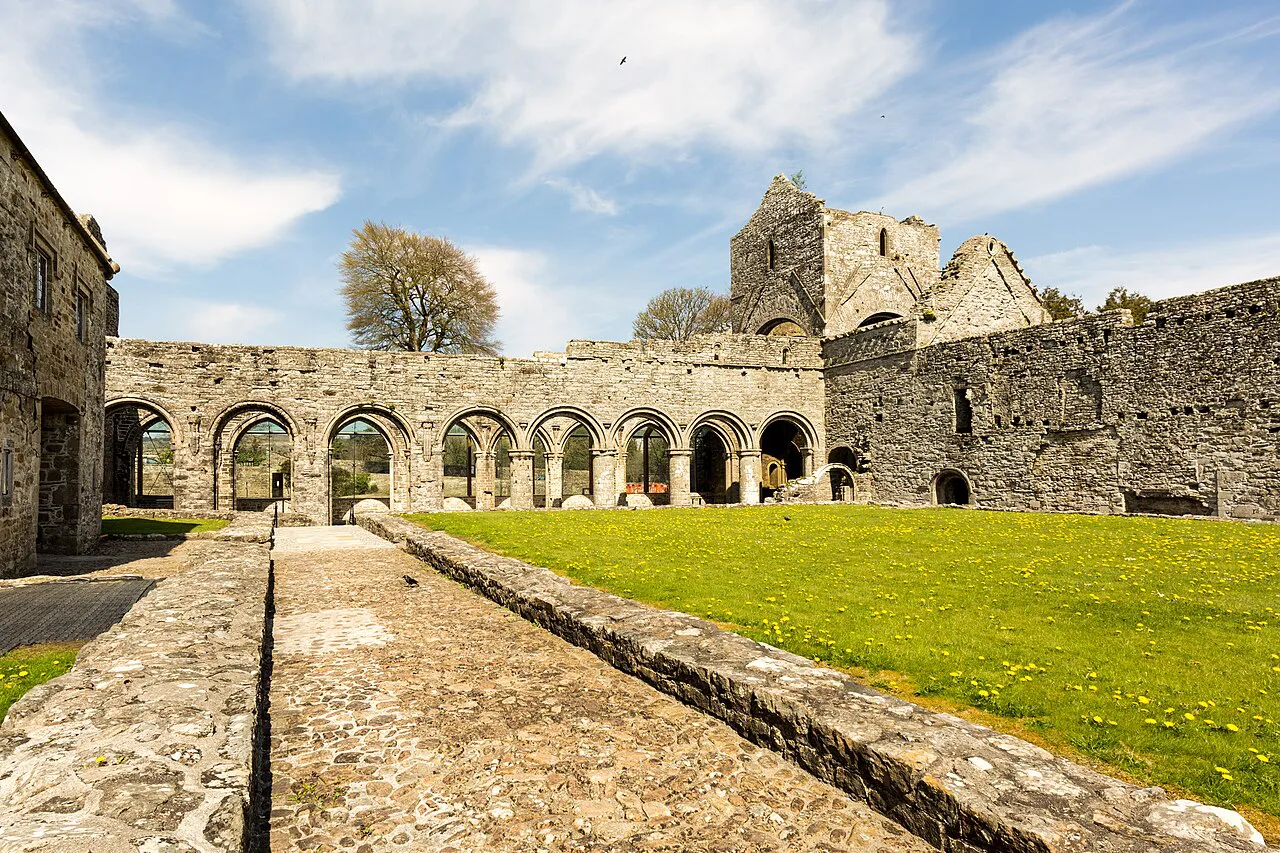
The monastery followed the standard Cistercian layout, which is the key to interpreting what survives. Discover Ireland describes a church on the north side of a rectangular cloister, with a chapter house for meetings on a second side, a kitchen and refectory on a third, and storehouses with a dormitory likely on the fourth. Knowing this arrangement lets you place the fragments you see.
Only small parts of the cloister remain today, because the site was converted to military use and later besieged. That loss is part of the story rather than a flaw. The surviving church walls and the outline of the domestic ranges still show how the monastic precinct was organised around its cloister and processional spaces.
Carved stone: the School of the West and the Ballintubber Master
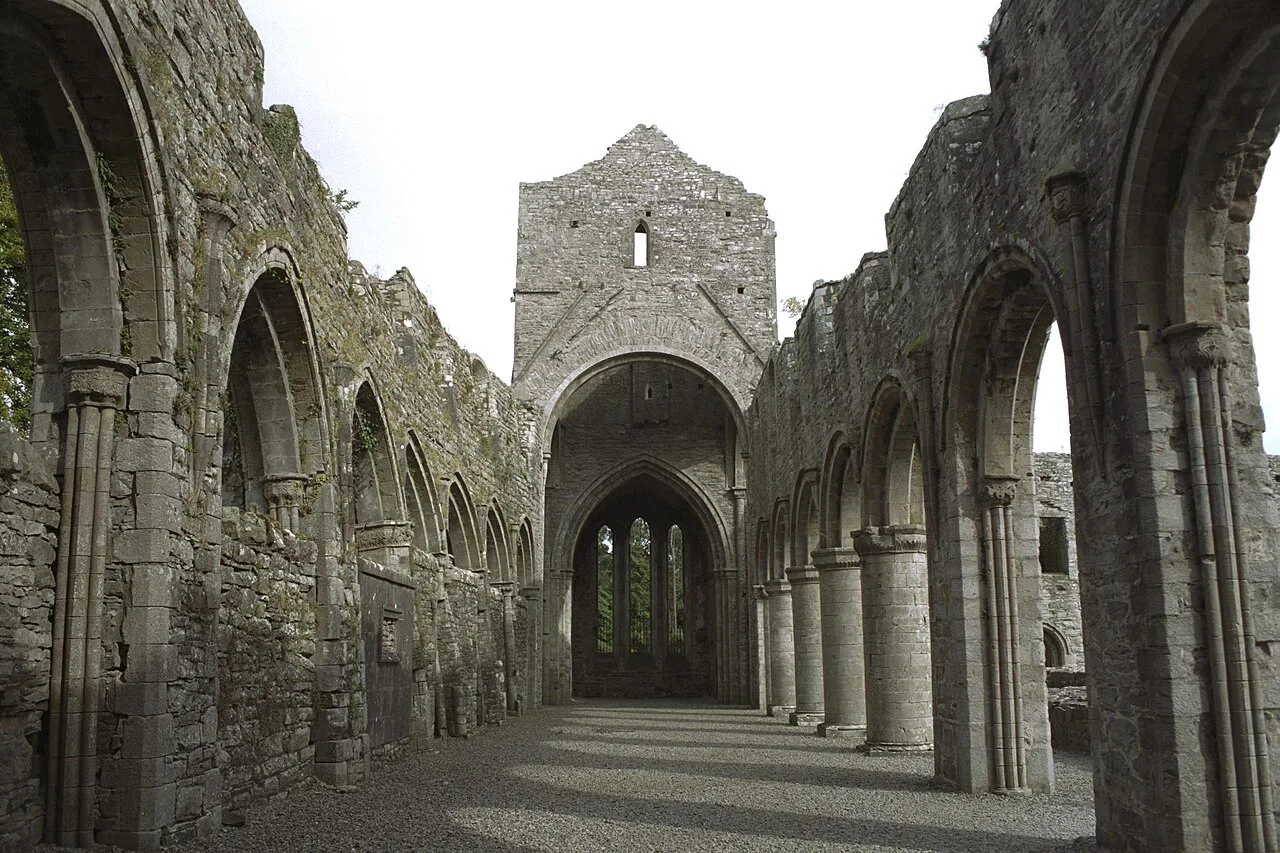
The most rewarding details at Boyle are architectural. Heritage Ireland points to arches in an unusual transitional style, bridging Romanesque and Gothic, and identifies them with the School of the West, a thirteenth-century movement whose examples are mostly found west of the Shannon. The same page highlights work attributed to the Ballintubber Master, an unnamed craftsperson of exceptional skill.
Cistercian churches were supposed to be plain, so elaborate carving at Boyle is a signal of wealth and local confidence. One historical account notes a large number of capitals needing decoration and that floral motifs and animals depart from strict Cistercian austerity. Whether that reflects Irish practice, local patronage or simply skilled workshops is debated, but the carvings themselves survive.
Once the site reopens, look for two possible Sheela-na-gig figures noted by Heritage Ireland: one in the left-hand corner as you enter the building and a defaced one further along the nave. The closed season means these cannot be examined now, so use the official highlights page to prepare. Their purpose is not settled; explanations range from older deities to fertility talismans or warnings against sin. Treat the figures as enigmatic carvings rather than evidence for any single interpretation.
Conflict and conversion: raids, dissolution and the barracks years
Boyle's history is unusually turbulent for a rural monastery. Heritage Ireland records that Cromwellian forces occupied the abbey in 1659 and that it was later used to accommodate a military garrison. Discover Ireland, by contrast, describes an Elizabethan conversion into barracks in 1592 and a Cromwellian siege in 1645. The sources differ on these years, and both sets are worth knowing rather than forcing into one timeline.
Earlier still, the abbey was caught in wider political and religious conflict. One historical account of the abbey describes involvement in the Mellifont Conspiracy, a dispute over how Irish Cistercian houses answered to the order's general chapter, and an attack in 1235. The same account records the dissolution of the monastery in 1584 and the execution of its abbot in Dublin for refusing to renounce Rome.
Those years explain why the site looks less like a monastery than a fortified shell. Military occupation over centuries damaged and adapted the buildings, yet the abbey retained enough of its medieval fabric to impress later visitors. The result is a layered monument where you read monastic, military and conservation phases in the same walls, a pattern echoed in the city sites covered in our Dublin heritage guide.
Conservation: the rebuilt north wall and the reinforced arches
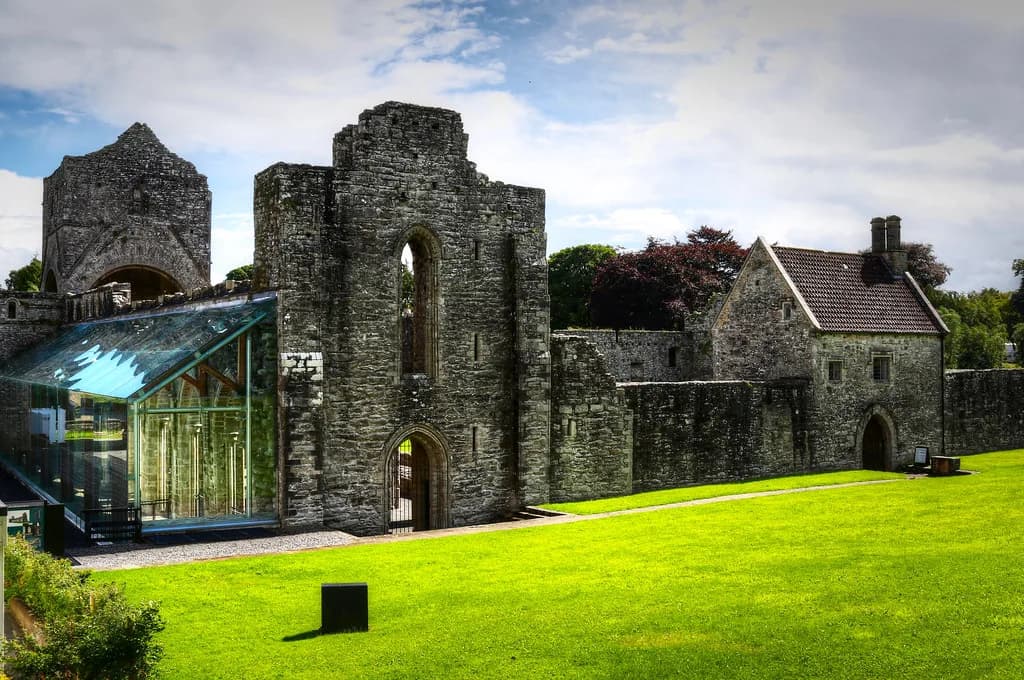
Modern conservation is part of what you see at Boyle. Heritage Ireland explains that the north wall was painstakingly dismantled and rebuilt by a team of experts to secure the structure for the future. That intervention is presented as a deliberate modern contribution rather than a restoration to an imagined original state.
One visitor account also describes a clear glass wall encasing a stretch of archways, said to have been installed to support weak masonry. The practical effect, as described, is that you can still see the arches while the structure is held safely. Treat this as a single visitor's description rather than a guarantee of what will be visible after the site reopens.
The gatehouse exhibition and the social guide
A sixteenth- or seventeenth-century gatehouse has been restored as an interpretive centre where you can learn about the abbey's history, according to Heritage Ireland. Discover Ireland likewise mentions an exhibition housed in the restored gatehouse. During the closure, neither space is accessible, so treat the exhibition as a preview of a future visit rather than something to plan around now.
Heritage Ireland also offers a downloadable social guide PDF to help first-time visitors, families and people with developmental and learning disabilities prepare for a visit. Reading it before travelling can reduce uncertainty about what to expect on site. Guided and self-guided options appear on the operator page, but tour availability for a future season should be confirmed rather than assumed.
What the closure means for your visit
The practical consequence is simple: you should not plan to enter the abbey buildings or gatehouse during the 2026 season. The official page carries a clear closure notice, and describing the site as open would be misleading. Once 2027 arrangements are announced, check access and seasonal hours on the official page rather than relying on older times quoted in blogs.
Boyle lies off the N4 Dublin–Sligo road, so the town is easy to include on a route through this part of Connacht. While the abbey is closed, plan a town walk that takes in Abbeytown Bridge and King House, and save the enclosed ruins for a return when the site has reopened.
Planning around the closure: Boyle and nearby alternatives
Heritage Ireland suggests nearby places worth combining with a Boyle visit, including Abbeytown Bridge, one of the oldest surviving stone bridges in Ireland, King House, an early Georgian mansion in the town centre, and Lough Key Forest Park. Each gives a different angle on the area's history and landscape while the abbey remains shut.
For a broader regional day, Rathcroghan Visitor Centre is listed by Heritage Ireland as a nearby site, and it interprets the ancient landscape of Connacht's early capital. It connects well with an interest in medieval and earlier settlement. Our guide to ancient sites ireland sets out comparable landscapes elsewhere on the island.
If your trip follows the story of Irish monasticism, Corcomroe Cistercian Abbey in County Clare is another foundation with a dramatically different setting. Seeing two abbeys helps you notice how local conditions shaped each one. That comparison is more instructive than viewing Boyle in isolation, and our guide to monasteries in ireland sets out more examples to compare.
A longer heritage itinerary could also include the Rock of Cashel, whose ecclesiastical complex spans a different period and style. Pairing a northern Connacht abbey with a major southern ecclesiastical site gives a fuller picture of medieval Irish church building. Both reward preparation before arrival, and our guide to the rock of cashel explains what to look for there.
Before you go: confirming 2027 arrangements
No precise 2027 reopening date or daily schedule has been published on the official page. When planning, check Heritage Ireland for updates rather than relying on seasonal hours reproduced in travel blogs. If you are booking around a fixed itinerary, leave flexibility for the abbey day and build in confirmed alternatives in Boyle town.
Similarly, admission prices or booking procedures are not stated for the coming season, so avoid budgeting from outdated figures. Confirm these details on the operator page once reopening is announced, and check the same page for any updates to the gatehouse exhibition or the social guide.
Planning a Future Visit to Boyle Abbey
Boyle Abbey rewards travellers who understand its layered history: a twelfth-century Cistercian foundation, a contested medieval community, a military garrison and a modern conservation project. The 2026 closure is a pause, not an end, and the official page points to visitors returning in 2027. Use the interval to read the architecture and plan a wider loop through Boyle and Roscommon.
Keep expectations honest and arrangements flexible. Check the official page for reopening news before booking travel around the abbey, and treat nearby sites such as King House and Lough Key Forest Park as genuine alternatives rather than filler. That approach gives you a better day in Boyle whether or not the gates are open. For more heritage reading, see our guides to Glendalough and Clonmacnoise.
For more monastic heritage, see our guides to Clare Abbey, Skellig Michael, and Ennis Friary, which offer different settings for comparison with Boyle. For another heritage guide, read about Kells Priory.
Explore more Ireland guides
Frequently Asked Questions
Is Boyle Abbey open to visitors?
No. Heritage Ireland states that Boyle Abbey is closed for the 2026 season, and the site looks forward to welcoming visitors again in 2027. No precise reopening date has been published, so check the official page before planning around it.
What is Boyle Abbey known for?
It is a twelfth-century Cistercian monastery in County Roscommon, founded by monks from Mellifont under MacDermott patronage and noted as one of the most powerful early Cistercian foundations in Ireland. It is noted for its transitional Romanesque-Gothic arches, carved capitals associated with the School of the West and the Ballintubber Master, and two possible Sheela-na-gig figures.
How long should I allow for a visit to Boyle Abbey?
The official page does not publish a recommended visit length, and tour availability is not confirmed for the next season. When the site reopens, check the Heritage Ireland page for current guided and self-guided options before you travel, then allow time to read the church ruins and find the carved detail.
What can I see at Boyle Abbey if the buildings are closed?
During the closure you cannot enter the abbey or its gatehouse exhibition. You should not assume access to the ruins, so plan alternatives in Boyle such as Abbeytown Bridge, King House and Lough Key Forest Park, and check the official site for any change in status.
What else is there to visit near Boyle Abbey?
Heritage Ireland points to Abbeytown Bridge, King House and Lough Key Forest Park in and around Boyle. Rathcroghan Visitor Centre is another Heritage Ireland site in the region, and it interprets an ancient Connacht landscape rather than a Cistercian monastery.
Sources
You might also like



Continue reading
More guides you'll find useful




