
Skellig Michael: Island Monastery Guide and Access Basics
Skellig Michael is closed for the 2026 season, with a return expected in 2027. Learn what a landing involves and how boats reach the island.
On this page
As of 23 October 2026, Skellig Michael is closed for the season. Heritage Ireland, which manages the site through the Office of Public Works, states that it looks forward to welcoming visitors again in 2027, but it publishes no fixed reopening date beyond that year.
That closure shapes how you plan. Anyone hoping to stand among the beehive huts should treat any 2027 trip as provisional until the operator confirms dates and boats, and should read the island's story now, so the logistics make sense when the season opens.
Where Sceilg Mhichíl stands
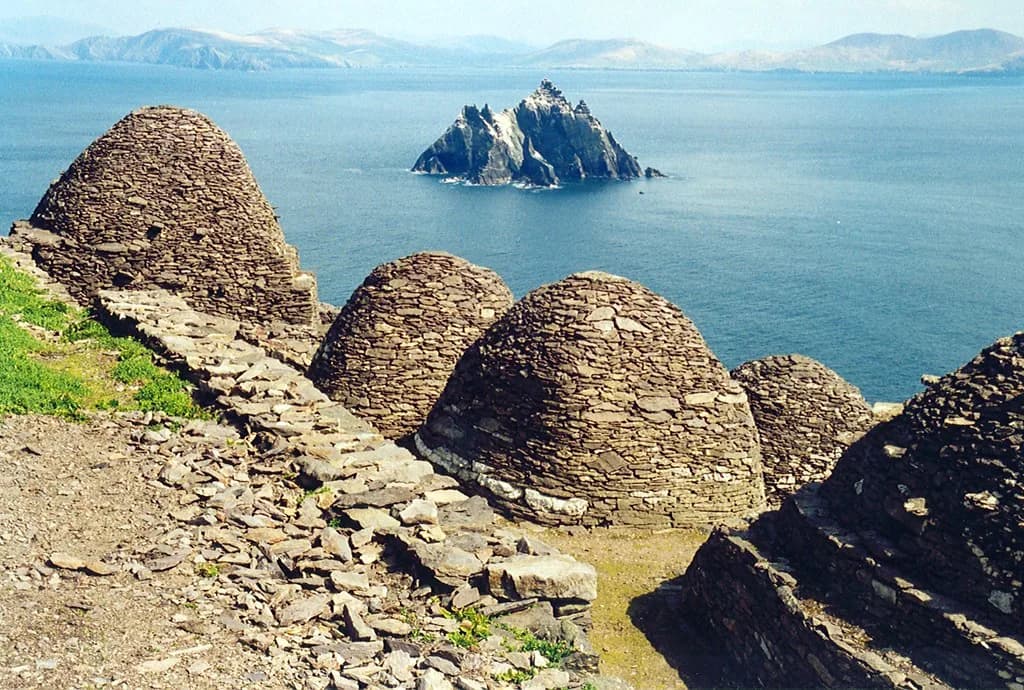
The Skellig islands rise out of the Atlantic roughly 13 km southwest of Valentia Island in County Kerry, and they are visible from high points along the Ring of Kerry. Approaching by road, the rock reads as a sharp pinnacle rather than a gentle island, which explains why the monastic remains survived so intact.
That offshore setting is not just scenery. The isolation of the island helped preserve the monastic fabric through centuries when mainland sites were rebuilt, altered or lost, which is part of why Sceilg Mhichíl carries its UNESCO designation.
For a sense of how this rock fits into Ireland's wider monastic landscape, compare it with inland foundations such as those gathered in the guide to monasteries in Ireland, where enclosure, cloister and later rebuilding shaped very different visitor experiences.
What UNESCO recognises on the island
Skellig Michael is one of only two UNESCO World Heritage Sites in the Republic of Ireland, recognised for the well-preserved early Christian monastic outpost and its setting on the Atlantic rock. Heritage Ireland presents the designation as covering the island property, so read the monastery, the dramatic rock and the surrounding bird life as part of one recognised whole rather than scenery around a single building.
The draw for visitors is the completeness of the early Christian remains: a compact monastic settlement rather than scattered fragments, preserved on an isolated rock. Travelers who understand that frame will read the enclosure differently, seeing not ruins but the working infrastructure of a small, austere religious community.
Inside the monastery enclosure
On the summit you find the stone beehive huts in which the monks prayed and slept, many of them still standing, along with oratories, a cemetery, stone crosses, holy wells and the Church of St Michael. The density is striking: these structures sit close together on a narrow, exposed platform.
The site is traditionally associated with St Fionan's monastery, one of the earliest foundations in the country. The monks left the island in the thirteenth century, after which it became a place of pilgrimage and, during the Penal Laws, a refuge for Catholics.
If you want to see how another great ecclesiastical complex layered secular and religious use over centuries, the Rock of Cashel in County Tipperary offers a useful contrast on the mainland. For the earlier, prehistoric side of Ireland's sacred landscape, the guide to ancient sites in Ireland covers tombs, forts and trackways that predate any monastery.
The climb: 618 steps and 180 metres
Reaching the monastery means climbing 618 steep, uneven steps that ascend over 600 ft, about 180 metres. Heritage Ireland describes this as a demanding climb and asks anyone with health concerns to weigh their own physical limits carefully before setting out.
Some tourism pages quote a round figure of about 500 steps; the operator's own count of 618 should be the number you plan around, because it comes from the body that maintains both the path and the safety rules. Neither figure makes the ascent easy, and the descent demands as much care as the climb.
Once on the island, visitors must stay on the recognised pathways at all times and follow the instructions of OPW guide staff. The paths are narrow and exposed, so wandering off them is both a safety risk and damage to a vulnerable monument.
What to carry and wear
Heritage Ireland advises carrying water and wearing protective clothing, since conditions on an exposed Atlantic rock change quickly. Sturdy, closed-toe footwear with good grip is strongly recommended, and sandals, flip-flops, pumps, heels and smooth-soled shoes are explicitly discouraged.
No animals are allowed on the island, so leave pets and working dogs on the mainland. Pack water and layers for the climb itself rather than for a day on the mainland, and confirm access arrangements with the operator for any planned visit during the published season.
Seabirds and Little Skellig
Beyond the monastery, the island supports a profusion of bird life, and the neighbouring rock of Little Skellig is described by Heritage Ireland as the second-largest gannet colony in the world. Discover Ireland puts the colony at roughly 27,000 pairs, a figure worth reading as the tourism body's own count.
Puffins are also associated with the Skelligs, but sightings depend on the breeding calendar and cannot be promised for any given landing day. If birds are a priority, ask the boat operator what is typically around during your chosen window rather than assuming.
How boats reach the island
Access is by boat, with an 11.5 km crossing from Portmagee, Glen Pier, Valentia, Ballinskelligs or Derrynane Harbour named by Heritage Ireland. Crossings and opening arrangements are variable and depend on weather conditions, so a booked seat is never a guarantee of landing.
One traveller's published account describes a crossing of about an hour with rough seas, and a landing where swell makes stepping on and off the boat the trickiest moment of the day. It also reports daily landing limits and early sell-outs, though these are personal observations rather than official rules.
Treat that account as a warning about conditions, not as a booking guide. Ask the boat operator directly about capacity, cancellation policies and what happens if the weather turns, since none of this is settled by a third-party blog.
Outside the season: no improvised landings
Outside the operating season the island is unmanned and visits are prohibited. That means no private landing, no off-season scramble up the steps and no assumption that a fine October day makes the site open.
The prohibition protects both people and a fragile monument. Plan around the published season rather than trying to fit the island into a trip at short notice, and check the official page for the current position.
A shore-based alternative near Valentia
If the boats are not running, or you want context before a landing, the Skellig Experience Centre sits on the waterfront beside the Valentia Island bridge. Discover Ireland names it as the dry-land option for learning about the Skelligs.
Its opening hours, exhibitions and admission are not settled here, so check ahead rather than assuming it will be open on your arrival day. It is a sensible first stop on a Kerry day that includes the Ring of Kerry viewpoints.
Setting expectations for a 2027 visit
Heritage Ireland has said it will welcome visitors again in 2027, but has published no fixed opening date, so build your plans around confirmed arrangements rather than a guess. Admission information should be taken from the official page, since charges and arrangements are tied to the season. If you are weighing up other sites for the same trip, the castles in county galway work have their own access rules to check before you commit.
A word of context from one visitor's account: the stay on the island was described as about two and a half hours, with guides stationed along the path. Useful as a rough shape for the day, but confirm timings with the operators you contact, because they set the schedule.
If you are building a wider monastic itinerary, pair an eventual Skellig landing with mainland sites such as Glendalough in County Wicklow or Clonmacnoise on the River Shannon, where access is far more predictable and the fabric tells a different story of Irish religious life.
Check Before You Plan
For now, Skellig Michael is closed for the 2026 season, and no fixed reopening date in 2027 has been published. Confirm season dates, boat availability and admission details with Heritage Ireland or the boat operator before booking anything else around a landing.
The island rewards preparation: sturdy footwear, water, respect for the paths and realistic expectations about weather. Read up on the monastery before you go, so that the climb ends in understanding rather than just a photograph.
Explore more Ireland guides
Frequently Asked Questions
Is Skellig Michael open right now?
No. As of 23 October 2026 the island is closed for the season. Heritage Ireland states that it looks forward to welcoming visitors again in 2027, and outside the operating arrangements the site is unmanned with visits prohibited. Check the official page before making any plans.
When might Skellig Michael reopen?
Heritage Ireland has published only the intention to welcome visitors again in 2027, without a fixed date or season window. Do not assume a specific month; confirm arrangements with the operator before booking travel.
How many steps are there to the monastery?
Heritage Ireland gives 618 steep, uneven steps rising over 180 metres, which is the figure to plan around. Some tourism pages quote about 500 steps, but the operator's count and safety guidance are the authoritative version.
How do boats reach Skellig Michael?
Boats sail from Portmagee, Glen Pier, Valentia, Ballinskelligs and Derrynane Harbour, with an 11.5 km crossing. Sailing and landing depend on weather, so a booked seat does not guarantee a landing.
Can you visit Skellig Michael in the off-season?
No. Outside the operating season the island is unmanned and visits are prohibited, so there is no improvised landing. Plan around the published season and check the official page for the current position.
What is there to see without landing on the island?
The Skellig Experience Centre sits on the waterfront beside the Valentia Island bridge. Its hours and contents are not established here, so check ahead. The Skelligs are also visible from high points along the Ring of Kerry.
Sources
You might also like



Continue reading
More guides you'll find useful


