
Quin Abbey: Franciscan Friary Guide, Cloisters and Tower
Quin Abbey is a 14th-century Franciscan friary in County Clare, known for its cloisters and tower. Here is what survives and what to look for on a visit.
On this page
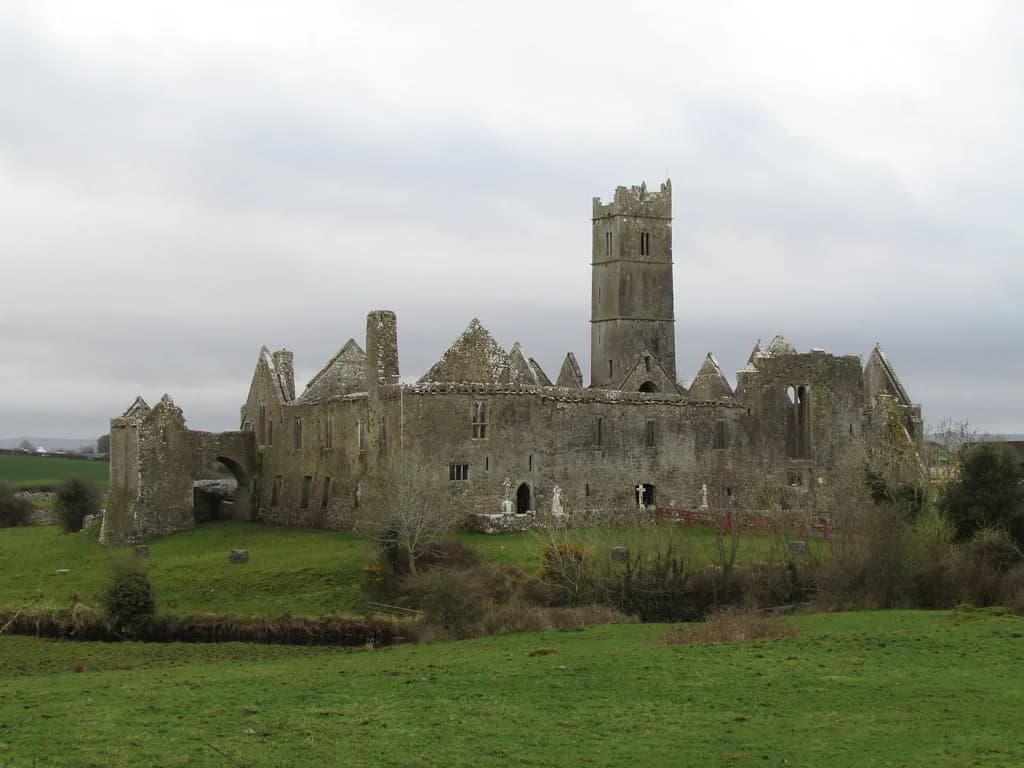
Quin Abbey is a ruined Franciscan friary standing at the centre of Quin village in County Clare, roughly 10 kilometres from Ennis. Discover Ireland, Ireland's national tourism website, singles out two features for visitors: the cloisters, built in the 15th century, and the tower, which gives views over the surrounding countryside.
It rewards a planned stop rather than a drive-by. The building is unusually legible for an Irish monastic ruin: ranges still enclose a cloister court, the church walls stand, and carved and architectural detail survives at eye level. Budget time to walk the court slowly and to look up before you look out.
Where Quin Abbey Stands
The abbey sits in Quin village, about 10 kilometres east of Ennis on the River Rine, according to the Clare visitor page. Because it is in the village centre rather than in open fields, arrival is straightforward on foot, and the surrounding streets give the ruin an everyday setting.
The Clare page describes a humpback bridge leading onto Main Street, with pubs and shops along it, as part of the village walk. Treat that crossing as arrival context rather than an attraction in itself: it helps you picture the low-lying river setting before you reach the abbey walls.
Origins: Franciscan Friars on a Norman Castle Site
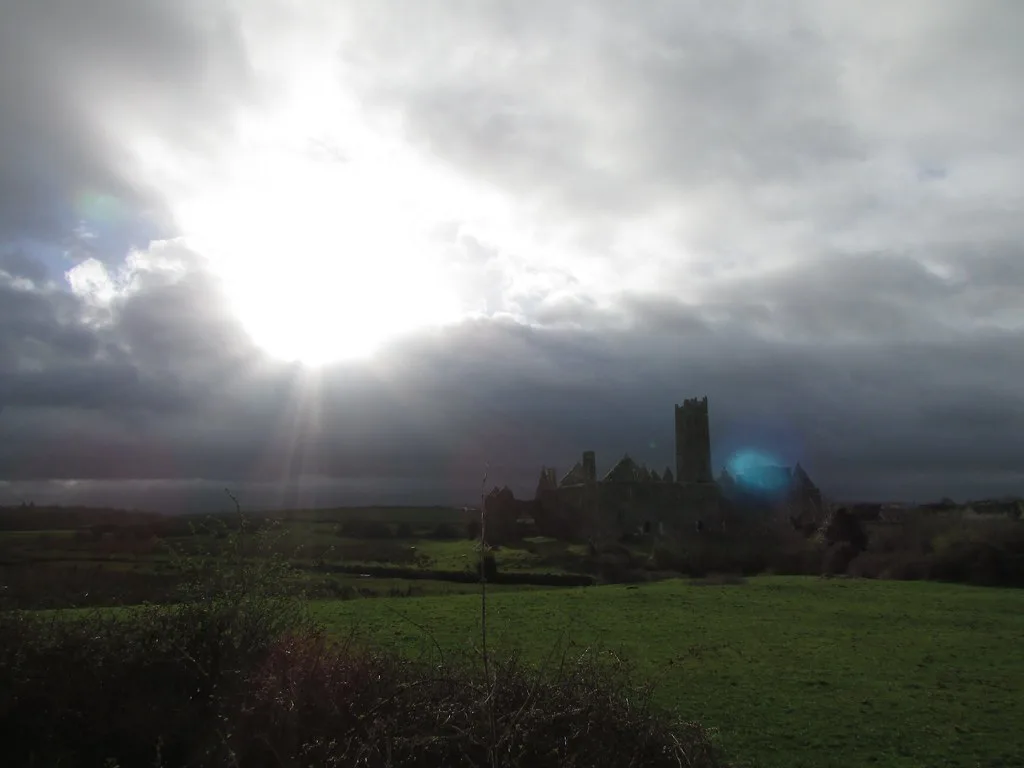
Discover Ireland dates the Franciscan foundation at Quin to the 14th century and notes that the cloisters were added in the 15th. The Clare visitor page adds that the abbey was built on the foundations of an earlier Norman castle, which explains why the site reads as a fortified enclosure as well as a religious house.
The Clare page calls Quin one of the finest and most complete surviving monastic sites in Ireland, a description worth weighing as you walk: the completeness lies in standing walls and cloister arcades, not in roofs. Nineteenth-century travellers attributed the foundation to the Macnamara family, who are also linked to the large monument inside the church — but these are historical observations, not labels confirmed on the ground today.
What Survives Above Ground
The essentials to find are the church, the central tower set between nave and chancel, and the cloister with its pillars and buttresses. Historical descriptions collected by The Irish Aesthete record altars at the entrance to the chancel, a chapel to the south containing several altars, and a monument to the Macnamaras.
Around the cloister court, the same accounts identify ranges on three sides, understood as the refectory, the dormitory and a further large room, with vaulted chambers beneath them. They also describe a strong round tower, its walls said to be close to ten feet thick and only seven or eight feet high, later used as a dovecote. These identifications come from historical observers, so read them as informed interpretation rather than labels on the ground.
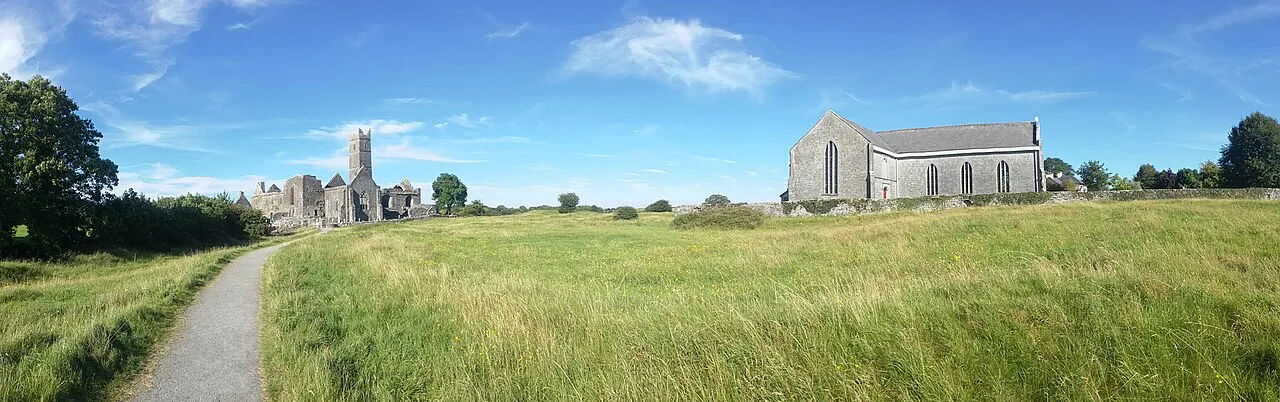
The gothic-style church next to the abbey is a separate, standing building, not part of the medieval ruin. The Clare page mentions it alongside the abbey, so treat the two as distinct stops even if they sit side by side: the medieval friary is the roofless ruin, and the church is a separate building the page describes as the local Roman Catholic church.
The Tower, the Stair and the View
The connection between any stair and the abbey is where the two tourism pages need careful reading. The Clare visitor page ties the spiral staircase and its panoramic views of scattered woodland and fields bounded by stone walls to the gothic-style church beside the abbey, not to the medieval friary itself, and it does not confirm that the stair is open to the public.
Discover Ireland separately says the abbey's tower affords impressive views of the surrounding area, without describing a climb or a stair. So treat the tower view and the church stair as two different things, and do not read either source as promising that the friary tower is open to climb.
Treat the view as a bonus rather than the whole visit. The cloister court, the church walls and the carved detail at eye level carry the stop on their own, and from ground level the tower still reads clearly as the building's vertical centre.
Reading the Ruin Through Historical Eyes
Two nineteenth-century travellers left useful descriptions of the fabric. Robert Graham, recording his Irish journals between 1835 and 1838, noted that all roofs were gone but that the buildings were otherwise among the most entire remains in Ireland, and he remarked on the cloister's pointed gothic arches. Lady Chatterton, visiting in 1838, found the cloisters in good preservation and the whole building complete apart from the roof.
These are dated observations, not a description of present conditions, and the site has had more than a century and a half of weathering since. Their value is comparative: they tell you what to look for in the masonry, such as buttresses added to the cloister wall, and they show how the abbey was experienced before modern conservation.
If you enjoy comparing monastic plans, the cloister-with-ranges arrangement at Quin has close cousins elsewhere. Our guide to monasteries in ireland sets out how Irish communities typically laid out church, cloister and domestic ranges, which makes the Quin remains easier to read in sequence.
Visiting Basics: Admission, Access and the Village Walk
Admission to the site is free, according to the Clare visitor page. That statement covers the abbey itself and does not extend to the neighbouring church, to any tour, or to the castles and heritage parks further out, several of which have their own entry arrangements. If you plan to add a castle stop in the same region, our guide to castles in county galway sets out four sites and their current access. For a site where access and fabric differ again, compare our guide to ancient sites ireland. No opening hours, seasonal restrictions or facilities are published in the sources used here.
Quin is also named as one of the trailheads of the Mid Clare Way, a long-distance loop through hills, river valleys and lakeshore country. The two tourism sources give the loop as 148km and 143.9km respectively; treat the walk as regional context for the village, not as a route through the abbey grounds.
Quin Abbey Among Clare's Other Stops
The Clare page places Knappogue Castle about two kilometres from Quin, a restored tower house used as a banquet venue, and Craggaunowen about eight kilometres east, a prehistoric park with a replica crannog, a ring fort and an Iron Age roadway. Dromoland Castle, now a hotel with a golf course, lies a short distance south. Each is a separate outing with its own arrangements.
For a broader frame, the ruined ecclesiastical ensemble at the rock of cashel in County Tipperary shows a different tradition, and reading about a great secular fortress alongside it helps distinguish castle architecture from monastic building. If you want to extend that castle-versus-monastic comparison westward, our guide to ancient sites ireland covers tombs, forts and trackways of a different kind. Build such comparisons as separate visits rather than expecting them on one site.
Plan Your Visit
Quin Abbey suits travellers who want to read a standing ruin rather than file past a display case. Allow time for the cloister court and the church, and pair the visit with a short walk through the village along Main Street.
Current opening arrangements are not set out in the sources used here, so confirm them before setting out. Admission to the site is free; everything around it is a separate decision.
Explore more Ireland guides
Frequently Asked Questions
Is Quin Abbey free to visit?
Admission to the abbey site is free, as stated by County Clare's visitor page. That applies to the abbey itself, not to the neighbouring church, to any guided tour, or to nearby attractions such as Knappogue Castle, Craggaunowen or Dromoland Castle, which have their own arrangements.
What is there to see at Quin Abbey?
Look for the church walls, the central tower between nave and chancel, the 15th-century cloister with its pillars and buttresses, and the ranges around the cloister court. Historical descriptions also record altars at the entrance to the chancel, a chapel to the south, a Macnamara monument and a strong round tower later used as a dovecote.
Can you climb a tower at Quin?
The Clare visitor page describes a spiral staircase and panoramic views in connection with the gothic-style church beside the abbey, while Discover Ireland says the abbey's tower affords views without describing a climb. Neither source confirms that any stair or tower is open to the public, so check on arrival rather than counting on it.
How far is Quin Abbey from Ennis?
Discover Ireland places the abbey about 10 kilometres from Ennis, and the Clare visitor page describes the village as 10 kilometres east of the town on the River Rine. The abbey stands in the village centre.
What is the difference between Quin Abbey and the church beside it?
Quin Abbey is the medieval Franciscan friary, founded in the 14th century, whose cloisters date from the 15th. The gothic-style church next to it is a separate, standing building mentioned by the Clare visitor page, not part of the medieval ruin.
Is Quin Abbey worth stopping for on a County Clare trip?
Yes, if you value standing ruins with a readable plan and surviving detail. The cloisters and tower give the visit focus, and the village setting makes it an easy stop between Ennis and the surrounding heritage sites. It is not a museum, and the friary has no roof left to shelter visitors.
Sources
You might also like



Continue reading
More guides you'll find useful



