
Rosserk Abbey (Rosserk Franciscan Friary): A Visitor's Guide
Rosserk Abbey is the popular name for Rosserk Franciscan Friary, an unguided National Monument in Mayo. See what survives, its history, and how to visit.
On this page
Rosserk Abbey is the name most people search for, but the monument's official title is Rosserk Franciscan Friary. It is a state-owned National Monument in the care of the Office of Public Works, standing on the shore of Killala Bay near Ballina in County Mayo. Visitors should plan for an unguided ruin rather than a staffed visitor attraction, and should check current details on the official Heritage Ireland listing before travelling.
What and Where Rosserk Friary Is
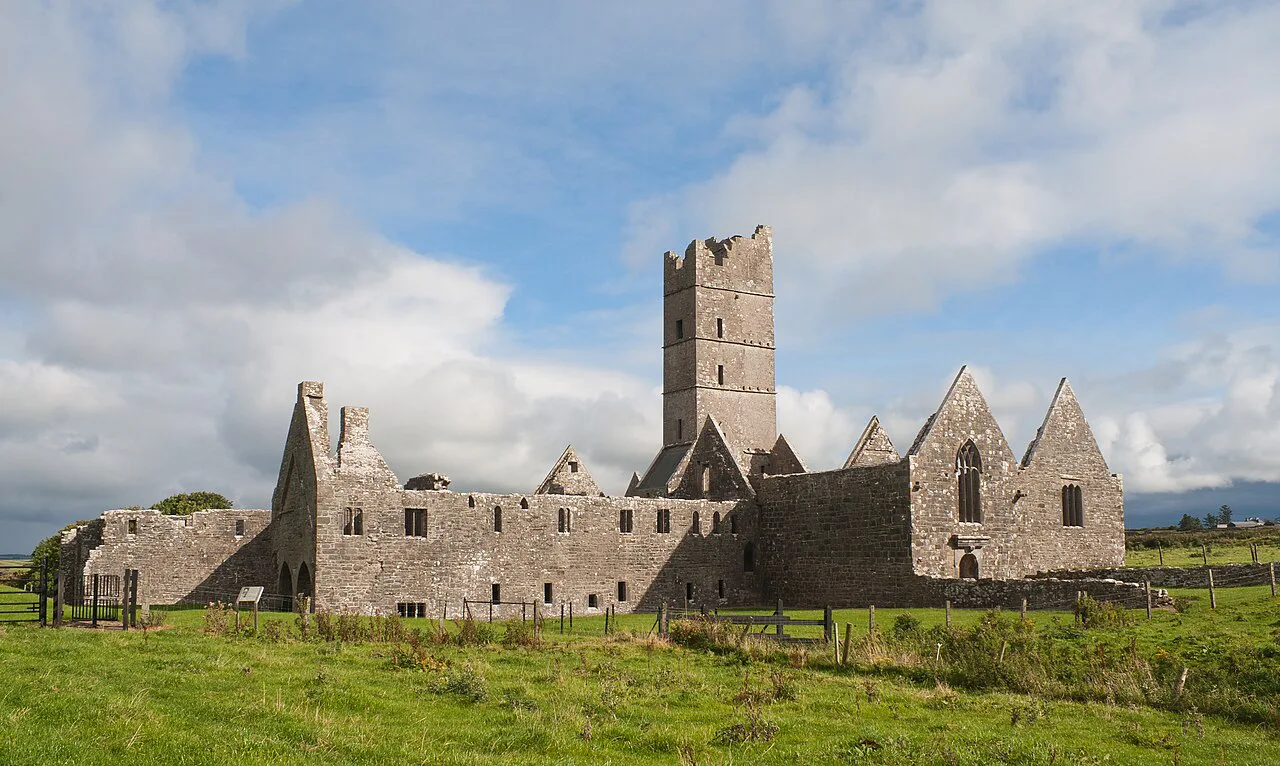
The friary occupies a quiet stretch of shoreline on Killala Bay, on the banks of the River Moy, well away from the bustle of Ballina. The setting is part of the experience: the ruins sit in open, secluded ground rather than behind a visitor-centre entrance. If you are working out how Rosserk fits into a wider tour of Irish monastic remains, the monasteries in ireland overview is a sensible starting point.
The name needs a small clarification. 'Abbey' is the popular label, but the site was a Franciscan friary, and the official Heritage Ireland pages use 'Friary' throughout. Treating the two names as one monument avoids the common mistake of hunting for a separate Rosserk Abbey nearby.
Status and Stewardship
Rosserk is protected in accordance with the National Monuments Acts 1930 to 2014 and is maintained by the Office of Public Works as a National Monument. That legal status matters to visitors because it explains why the site is preserved as standing fabric rather than developed with modern interpretation.
Heritage Ireland lists Rosserk among its unguided sites and carries a standing notice asking visitors to maintain care and caution during their visit. Read that as a prompt to watch your footing among old stone, not as a statement that the site is closed or barred.
Foundation: Around the 1440s
The official account dates the foundation to around the 1440s, established for friars of the Third Order of St Francis. That places Rosserk within the later medieval flowering of Franciscan houses in the west of Ireland, and it is safest to keep the date approximate rather than fixing on a single year.
A local estate page attributes the foundation to the Joye family, describing the house as built for the Franciscan Third Order Regular. Because the official operator page does not name a founder, that attribution is best presented as local tradition rather than settled fact. It is a useful lead for further reading, not a detail to repeat as certain.
The Burning of 1590
In 1590 the friary was burned by Sir Richard Bingham, then Governor of Connaught, during the reign of Elizabeth I. The event belongs to the wider pattern of Tudor military pressure on religious houses in Connacht; the local estate account adds the framing that the burning was carried out in reformationist zeal.
What the record does not tell us is a precise date of abandonment or a neat end to the community's story. A burning damages a building; it does not by itself explain every stage of later decay or reuse. Visitors should therefore read the 1590 entry as a recorded episode in the friary's history, not as the single cause of the state of the ruins today.
Reading the Late Irish Gothic Fabric
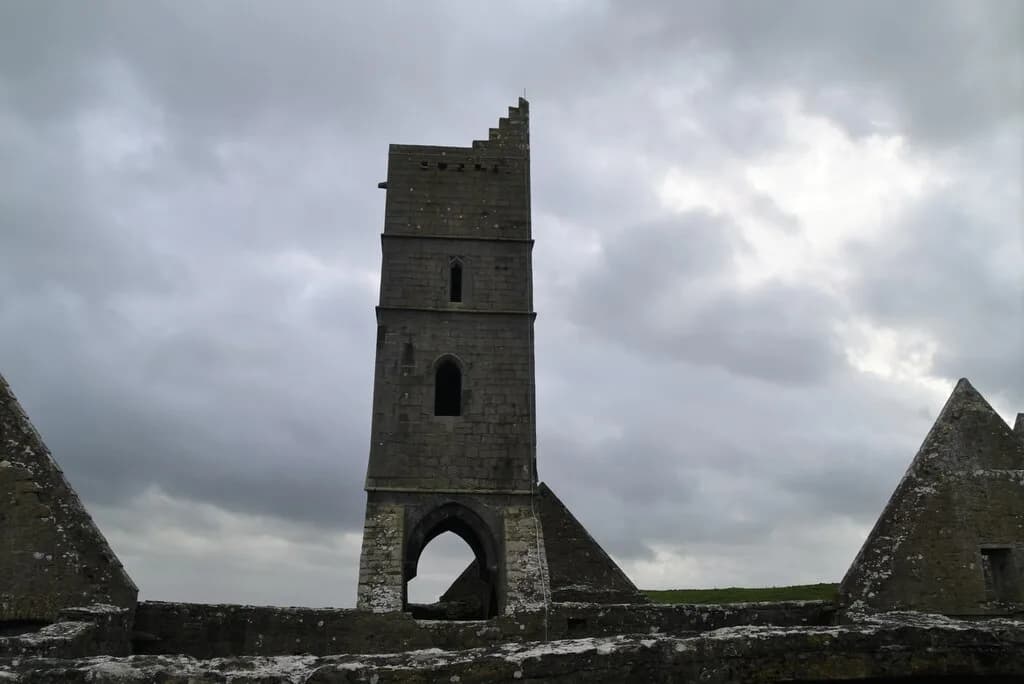
The surviving masonry is described as late Irish Gothic in style. Most of that description, including the layout, comes from a local estate account rather than the official listing, so treat the details as a written reading of the ruin rather than a surveyed record. That account describes a church with a single-aisle nave, two chantry chapels in the south transept and a bell-tower suspended over the chancel arch. None of this survives as a roofed interior, so picture the plan in your head as you walk the walls.
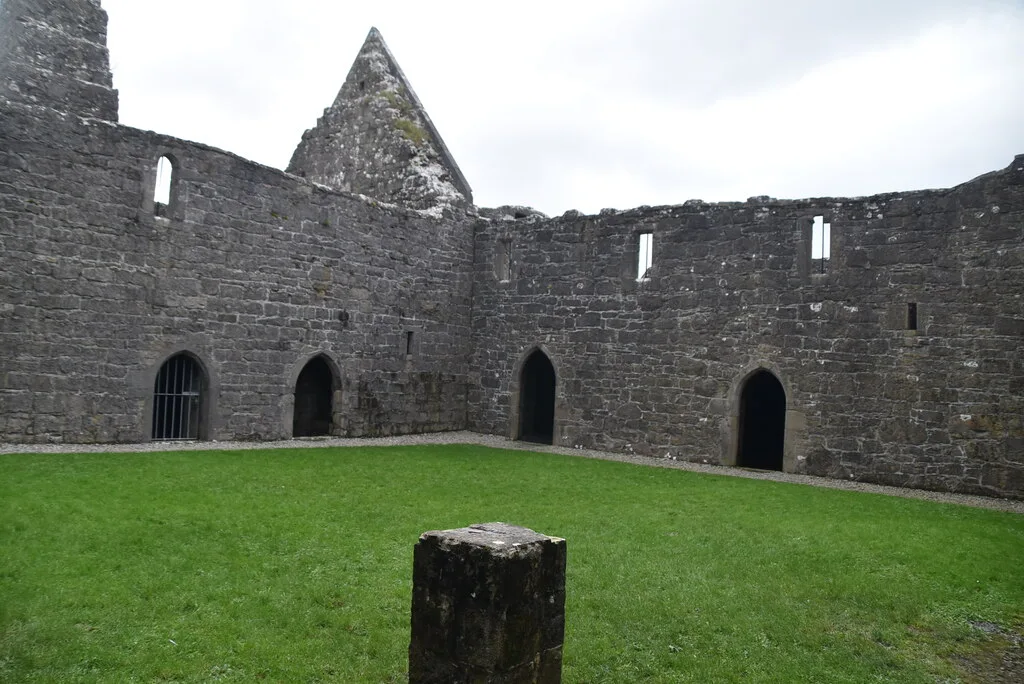
The same local account describes three vaulted rooms on each side of the conventual buildings, and places the dormitory, refectory and kitchen on the upper floor, where two fireplaces are said to remain back-to-back. Those fireplaces make a good landmark to look for when you are trying to orient yourself within the ruins, though the detail is secondary rather than official.
Details Worth Seeking Out
Two carved features make a concentrated visit worthwhile. Inside, the ruins retain an original double piscina, a recess with a stone basin used for washing the sacred vessels at Mass. On one of the pillars there is also a carving of a round tower, thought to be modelled on the tower that still stands at Killala.
At the entrance, the local description singles out a carved stone doorway showing fine workmanship. Look at it closely before stepping through, since it sets the standard for the carved detail elsewhere. For comparison with other church architecture in the west, Ballintubber Abbey offers a rewarding contrast.
Access Expectations at an Unguided Site
Rosserk is managed as an unguided site, so do not expect a reception desk, exhibition panels or a guided tour. The official listing publishes a caution notice rather than visitor facilities, and it does not set out opening hours, admission arrangements or on-site services. Plan your day around those limits and confirm the current position on the Heritage Ireland page before setting out.
Footwear and pacing matter more than they would at a managed attraction. Stonework, uneven ground and open shoreline weather all argue for an unhurried visit with time to look rather than a quick stop. If you are comparing Rosserk with larger walled complexes, the Rock of Cashel shows how differently an Irish ecclesiastical site can be presented to visitors.
Pairing Rosserk with Moyne and Nearby Sites
Moyne Friary lies close to Rosserk, north of Ballina on the west side of Killala Bay, and the two are natural companions on a short heritage circuit. The local source notes that both houses are said to have been burned by Bingham in 1590, though it frames the Moyne episode as an allegation rather than a certainty. Treat that parallel as local tradition and give Rosserk the closer attention.
Heritage Ireland's own page for Rosserk lists other state-managed monuments in the region as nearby sites to visit: Céide Fields Neolithic Site and Visitor Centre, Carrowmore Megalithic Cemetery, Sligo Abbey, Parke's Castle, Boyle Cistercian Abbey and Rathcroghan Visitor Centre. Those sites vary widely in how they are presented, so check each one's own listing before building a route around them. Linking a few of these into a longer loop gives the day more substance than Rosserk alone, and if your interests run to older monuments, our guide to ancient sites ireland covers tombs, forts and trackways worth adding to the route. For travellers weighing a different kind of ruin on the same trip, castles in county galway covers four sites and their current access.
Before You Go
Rosserk Franciscan Friary rewards travellers who arrive expecting a quiet, unguided ruin with genuine late Gothic detail rather than a polished attraction. The double piscina, the carved doorway and the round-tower carving give the visit its focus, while the shoreline setting supplies the atmosphere. Check current arrangements on the official Heritage Ireland listing before you travel, then allow the site time rather than rushing through it.
For another heritage guide, read about Skellig Michael.
Explore more Ireland guides
Frequently Asked Questions
Is Rosserk Abbey the same as Rosserk Franciscan Friary?
Yes. 'Rosserk Abbey' is the common search name for the same monument that Heritage Ireland lists officially as Rosserk Franciscan Friary. There is no separate abbey nearby to find, so use the official name when checking details.
When was Rosserk Friary founded and by whom?
Heritage Ireland dates the foundation to around the 1440s for friars of the Third Order of St Francis. A local source names the Joye family as founders, but the official page does not identify a founder, so treat that attribution as local tradition.
What happened at Rosserk in 1590?
The friary was burned in 1590 by Sir Richard Bingham, Governor of Connaught under Elizabeth I. The event is documented, but it should not be read as proof of a precise abandonment date or a complete end to the story of the buildings.
What can you still see of the architecture?
Surviving fabric in the late Irish Gothic style is described with a single-aisle nave, two chantry chapels in the south transept and a bell-tower suspended over the chancel arch. Inside, look for the double piscina, the carved stone doorway and the round-tower carving on a pillar.
Do you need a guide to visit Rosserk Friary?
No guiding is published for the site, which Heritage Ireland manages as an unguided National Monument. A standing notice asks visitors to take care and caution, and no set opening hours, tickets or facilities are published, so check the official page before travelling.
What else can you visit near Rosserk Friary?
Moyne Friary stands nearby on the west side of Killala Bay and is a natural second stop. Heritage Ireland also lists Céide Fields, Carrowmore, Sligo Abbey, Parke's Castle, Boyle Cistercian Abbey and Rathcroghan as regional options, each with its own arrangements to confirm.
Sources
You might also like



Continue reading
More guides you'll find useful





