
Cong Abbey, Co. Mayo: A Guide to the Ruins and River
Plan a visit to Cong Abbey in County Mayo: the O'Connor story, the surviving church and cloister, and the Monk's Fishing House on the River Cong.
On this page
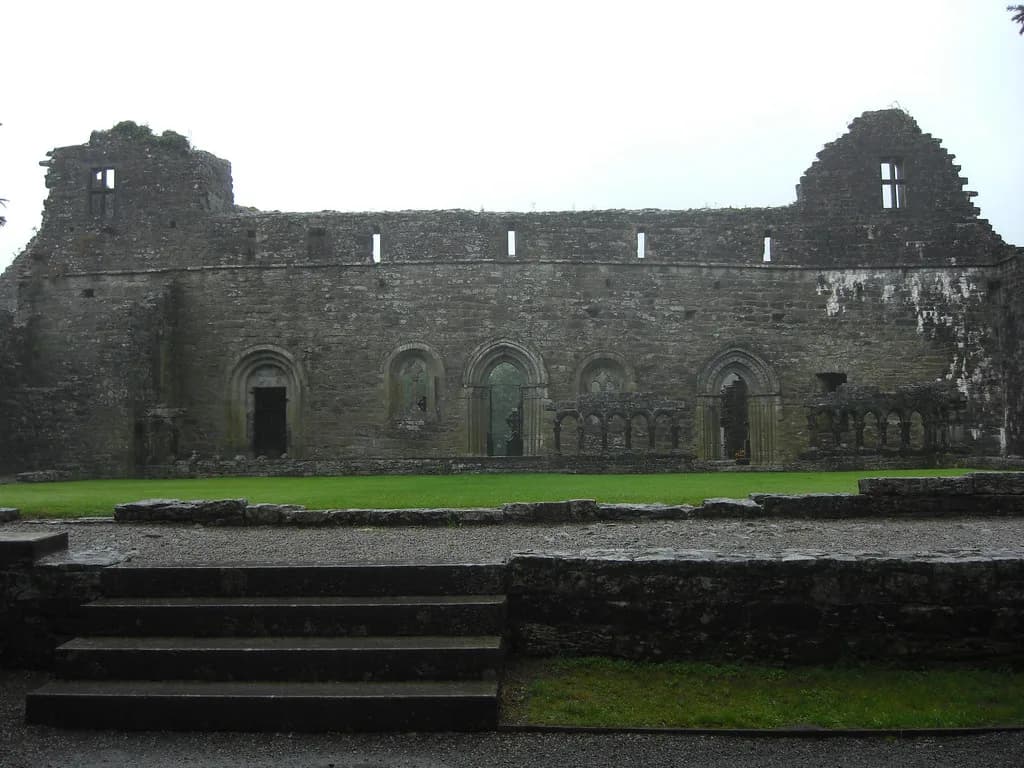
Cong Abbey is a ruined Augustinian monastery standing in Cong village, County Mayo, on a site the national tourism authority places beside the River Cong. It is not a museum with a sequence of rooms: what you visit is a shell of church and cloister, an outdoor fishing house and a village setting, which suits travellers who prefer to read stonework on their own terms. The ruins are listed at Abbey Street, Cong South, and described as free to visit by Discover Ireland.
What Cong Abbey Is and Where It Stands
Discover Ireland locates the abbey in Cong village, County Mayo, and frames it as visible ruins of a 12th-century Augustinian house. The same tourism-authority page carries family-friendly, dog-friendly and free-car-parking labels and tags the site as free to visit, which is visitor framing rather than a statement by an abbey operator. Treat those labels as a starting point and confirm current arrangements with the village or a local contact before relying on them.
The address given is Abbey Street, Cong South, Cong, Co. Mayo, so the ruins sit within the built village rather than in a distant field. That matters for planning: a stop here fits between other village errands rather than requiring a dedicated excursion. The River Cong runs close by, and the fishing house described below stands on the river's left bank as an outdoor structure, not an interior you enter.
The Traditional Foundation and the Twelfth-Century Refounding
Two accounts of the abbey's beginnings should be kept separate. Discover Ireland describes a church associated with St Feichin that predates the Augustinian house, while an independent stonework reference gives 624 as the year Feichin founded an early monastery at Cong. The dates do not align neatly, so the safest reading is that a Feichin tradition underlies the site and that the visible abbey belongs to a later medieval phase.
The refounding is associated with Turlough O'Connor, High King of Ireland, whom Discover Ireland credits with establishing the Augustinian abbey in the early 12th century. The stonework reference adds a turbulent sequence: burning in 1114, rebuilding by Tairrdelbach Ua Conchobair in 1135, and burning again in 1137. Those events explain why the standing fabric is a patchwork rather than a single campaign of construction.
Royal Patronage and Rory O'Connor's Last Years
Turlough's son, Ruaidhri Ua Conchobair, known as Rory O'Connor, is tied closely to Cong. The stonework reference states that he built new structures around the main church and spent the final fifteen years of his life at the abbey, dying there in 1198. Discover Ireland likewise notes the abbey as the place where Ireland's last High King died, which gives the ruins a biographical anchor beyond architectural interest.
A separate history blog adds that Rory was buried at the abbey before being exhumed and reinterred at Clonmacnoise. That is a secondary claim rather than an official record, so treat it cautiously, but it does not conflict with the sources describing Cong as the setting of his final years. For comparison, the royal ecclesiastical landscape of the Rock of Cashel shows how such patronage sites were laid out and interpreted for visitors. If you want an indoor counterpart to these open ruins, the museums in Galway city offer a different way to read Connacht's past.
The Augustinian Community and the 1203 Attack
The monks at Cong followed the Augustinian rule, according to the stonework reference. That detail shapes how you read the remains: Augustinian houses combined communal religious life with estate management, and the fishing house downstream makes practical sense in that context. The same reference records that William de Burgh attacked the abbey in 1203, after which it was rebuilt for a third time.
Crucially, the church and cloister visible today are identified with that post-1203 rebuilding. This is the single most useful fact for a visitor, because it tells you the standing walls belong to the 13th-century recovery rather than to Turlough's original foundation. If you only remember one date sequence from this guide, let it be that one.
Reading the North Doorway and the Carved Detail
The north wall of the abbey carries a doorway with Romanesque decoration set within a Gothic design, and some capitals of its orders were rebuilt in the 19th century. That combination rewards a slow look: the ornament says one thing about the workshop tradition and the overall form says another about later rebuilding. Stand back first to see the composition, then move closer for the carved capitals.
A heritage blog describes the ruins more broadly, noting Gothic windows, clustered pillars and floral capitals among the surviving masonry. This is secondary description rather than an official architectural survey, so use it as orientation rather than as a catalogue of features. The value of such detail is that it gives you something specific to hunt for instead of walking past anonymous stone.
The Monk's Fishing House on the River Cong
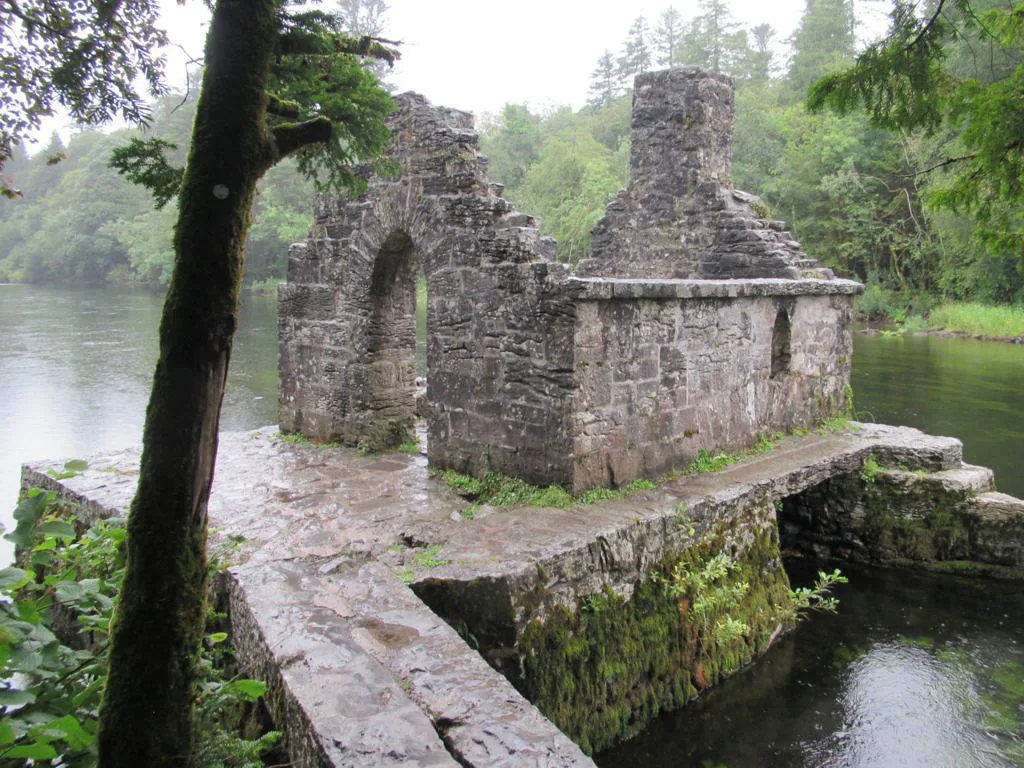
Not far from the abbey, on the left bank of the River Cong, the monks built a fishing house on a stone platform with a small arch beneath the floor. The stonework reference explains that the river flows under the platform and that a hole in the floor let the monks lower a line and bait into the water below; fish were cooked on the spot or carried back to the abbey. Read it as a working structure seen from outside, not as a room to enter.
The heritage blog repeats the description of the platform and trapdoor over the river and records a local tradition that a line ran from the fishing house to the monastery to alert the cook when fish had been caught. That signalling detail is legend rather than documented fact and should be enjoyed as such. The structure itself is the honest attraction: a small piece of engineering that ties the monastic kitchen to the river.
Later Fortunes and What the Sources Do Not Settle
The heritage blog carries a long later history, including a claim of suppression in 1542 and 19th-century restoration interest connected with the Guinness estate and nearby Ashford Castle. These are unverified secondary assertions, and the suppression date is internally inconsistent with the reign it cites. They are worth knowing as local storytelling, not as a chronology to repeat.
What the sources do not establish is just as important for planning. None of them documents guided tours, a visitor centre, toilet facilities or interior access. Anyone presenting these as certainties is going beyond the evidence; check with local contacts on the day instead.
Practical Orientation for a Short Visit
Discover Ireland lists the abbey as free to visit with free car parking, and tags it as family-friendly and dog-friendly. Those were the tourism authority's labels at the time of publication, and they are the most concrete access information available here. Treat them as the authority's visitor framing and confirm details locally if accessibility or facilities matter to your group.
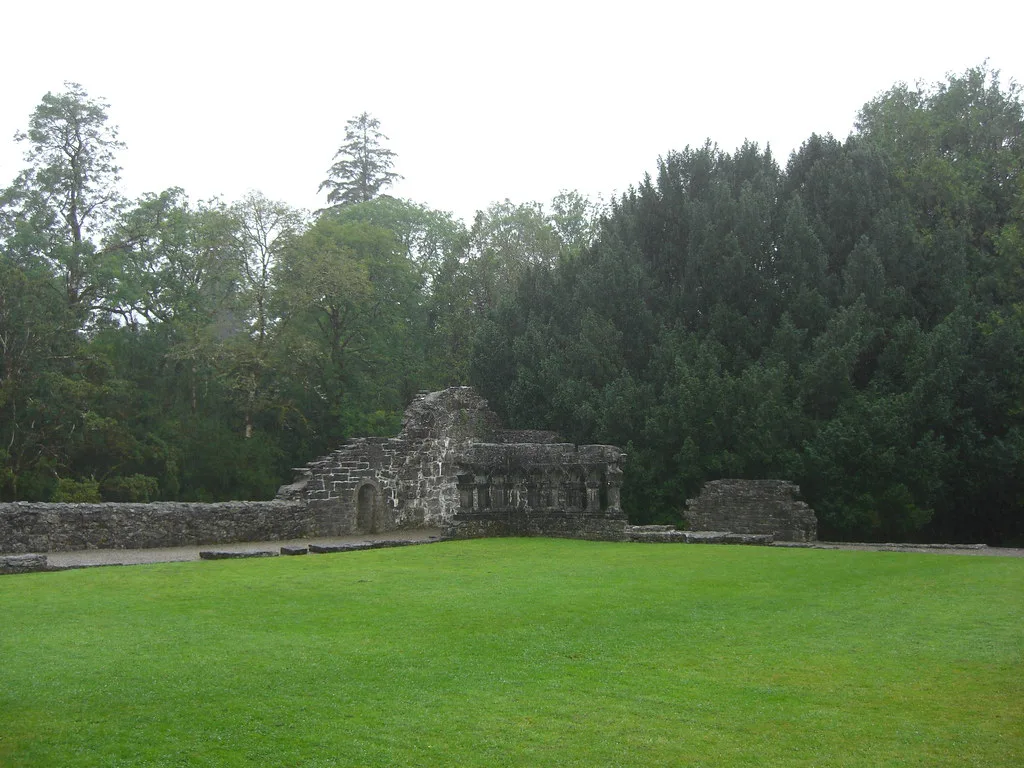
The site as described is an outdoor heritage stop built around visible ruins, a church-and-cloister core and the river-side fishing house. Plan for a compact walk over uneven historic ground rather than a museum circuit, and keep expectations modest about signage and shelter. A short visit is enough to see the doorway, the cloister area and the fishing house.
Travellers building a wider church trail in the west can compare Cong with other Augustinian and monastic sites covered in the guide to monasteries in ireland, which sets out what survives at each place, and with Ballintubber Abbey for a contrasting west-of-Ireland monastery. Cong's distinguishing feature is the combination of royal O'Connor associations and the fishing house over the river, a pairing the sources single out rather than a claim that nowhere else matches it.
Pairing the Abbey With the Village and River
Because the abbey sits on Abbey Street within Cong itself, the obvious pairing is the village centre and the riverbank rather than a separate excursion. Walk to the ruins, read the north doorway, then follow the river to the fishing house to see how the monastic economy connected to the water. That route keeps the visit coherent and avoids turning it into a checklist.
If your itinerary leans toward Connacht's big house-and-demesne attractions, Kylemore Abbey offers a contrasting, actively interpreted estate setting rather than a ruined monastic shell. The two make an instructive pair for understanding how religious sites in the west were built, abandoned and later presented to visitors. Judge each on what actually survives there rather than on a shared label.
Plan Your Visit
Cong Abbey rewards a visitor who arrives knowing what to look for: a 13th-century church and cloister shaped by rebuilding after the 1203 attack, a north doorway mixing Romanesque ornament with Gothic form, and a fishing house over the River Cong that explains monastic daily life better than any label. Keep the Feichin tradition and the O'Connor story separate, and treat blog-only dates with caution.
Before travelling, check current access and parking arrangements with a local source, since the published visitor labels come from the tourism authority rather than the site's operator. Build the stop into a village walk rather than a full day, and take the ruins as they are: open ground, visible stone and a river.
Explore more Ireland guides
Frequently Asked Questions
Is Cong Abbey free to visit?
Discover Ireland lists Cong Abbey as free to visit, with free car parking and family-friendly and dog-friendly tags. That is the tourism authority's visitor framing rather than a statement from an abbey operator, so confirm locally if access or facilities are essential to your plans.
How long does a visit to Cong Abbey take?
Allow a short walk rather than a half day. The site as described consists of visible ruins with a church and cloister core, plus the Monk's Fishing House by the River Cong, so most visitors can see the key stonework in a compact visit and still have time for the village.
Who founded Cong Abbey?
Discover Ireland credits Turlough O'Connor, High King of Ireland, with founding the Augustinian abbey in the early 12th century, on a site linked to an earlier church associated with St Feichin. An independent stonework reference dates the Feichin foundation to 624, so the two accounts do not match exactly and the Feichin association is best described as traditional.
What is the Monk's Fishing House?
It is a small structure built on a stone platform over the River Cong, with a small arch beneath the floor so the water flows under it. A hole in the floor let the monks lower a line and bait to catch fish, which were cooked on the spot or taken to the abbey. It is an outdoor feature seen from the grounds.
What can you see of the abbey's architecture?
The standing church and cloister are associated with rebuilding after the 1203 attack. The north wall has a doorway with Romanesque decoration within a Gothic design, and some capitals were rebuilt in the 19th century. Secondary descriptions also note Gothic windows, clustered pillars and floral capitals.
Is Cong Abbey in Mayo or Galway?
It is in County Mayo. Discover Ireland gives the address as Abbey Street, Cong South, Cong, Co. Mayo, placing the ruins inside the village rather than in neighbouring County Galway.
Can you go inside Cong Abbey?
The published sources describe outdoor ruins and grounds, including the fishing house over the river, and do not document interior access, guided tours or visitor facilities. Plan on seeing the visible masonry from the grounds and check with a local contact if you need to know more before travelling.
What else is near Cong Abbey for a heritage-focused trip?
Cong sits within a wider western landscape of monastic and estate sites. Visitors can compare what survives at other Augustinian and monastic ruins, or look at a contrasting demesne attraction such as Kylemore Abbey, which is presented as a working estate rather than a ruined monastery.
Sources
You might also like



Continue reading
More guides you'll find useful


