
Sligo Abbey: A Visitor Guide to the Medieval Dominican Friary
Plan a visit to Sligo Abbey, Sligo town's only surviving medieval structure, with its 1506 O'Crean tomb, cloister, high altar and published opening times.
On this page
Sligo Abbey is a Dominican priory on Abbey Street in Sligo town, occupying the eastern district the friars have dominated since the town was founded in the mid-thirteenth century. Heritage Ireland, which cares for the site, describes it as Sligo town's only surviving medieval structure, which makes an hour here the most direct way to read the town's deep past rather than its later streetscape.
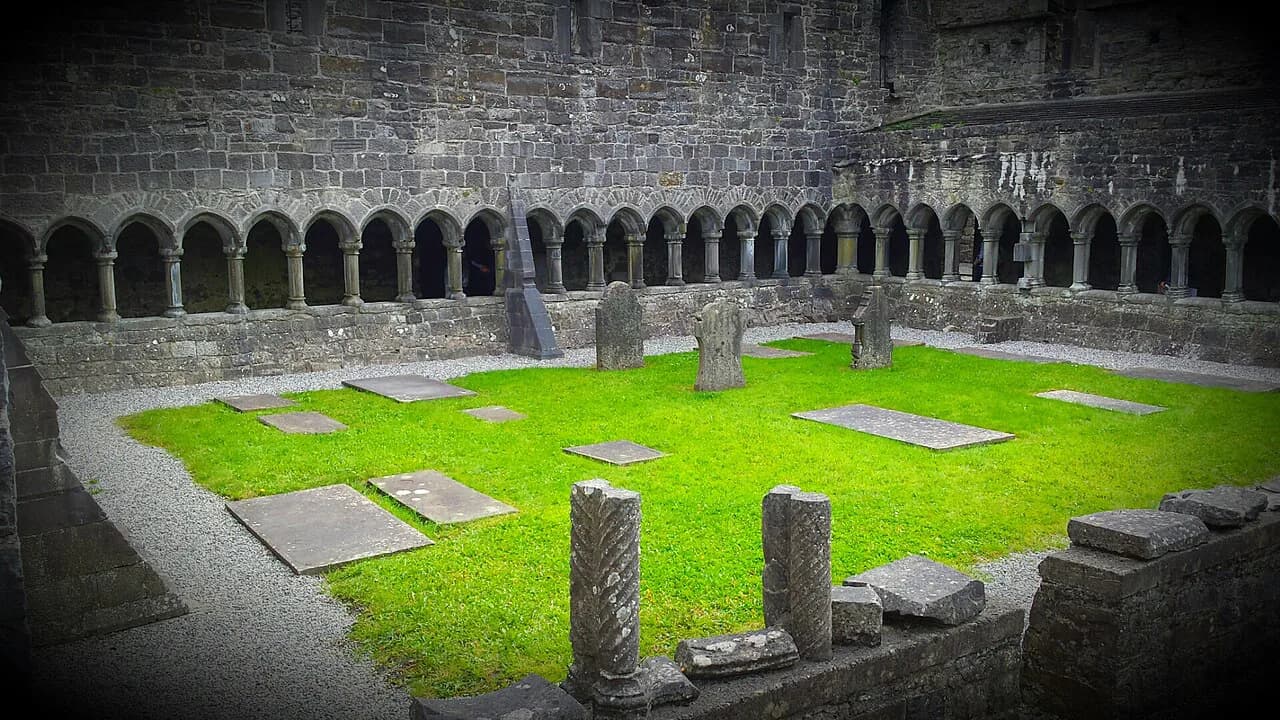
The visit rewards close looking rather than a quick circuit: substantial parts of the church, sacristy and chapterhouse survive from the founding period, the cloister arcade dates to the fifteenth century, and the upper floor still holds the remains of the dining hall and dormitories. Set aside time to read the carved stonework, which ranges across Gothic and Renaissance monumental sculpture.
Foundation and Setting
The sources place the abbey's foundation in the mid-thirteenth century and credit Maurice FitzGerald, the Anglo-Norman lord associated with establishing the medieval town of Sligo. Heritage Ireland's highlights page names him as the town's founder who constructed this building, so the friary and the town share an origin story rather than the abbey being a later addition to an existing settlement.
The friars lived through a region shaped by both Gaelic Irish and Anglo-Norman traditions, which is worth holding in mind as you walk the ruins: this was not a remote contemplative house but a community embedded in a contested town. Approaching from Abbey Street, look first at the scale of the church walls, then work inward to the cloister, because the sequence mirrors how the friars moved between public worship and enclosed daily life.
What Survives of the Medieval Fabric
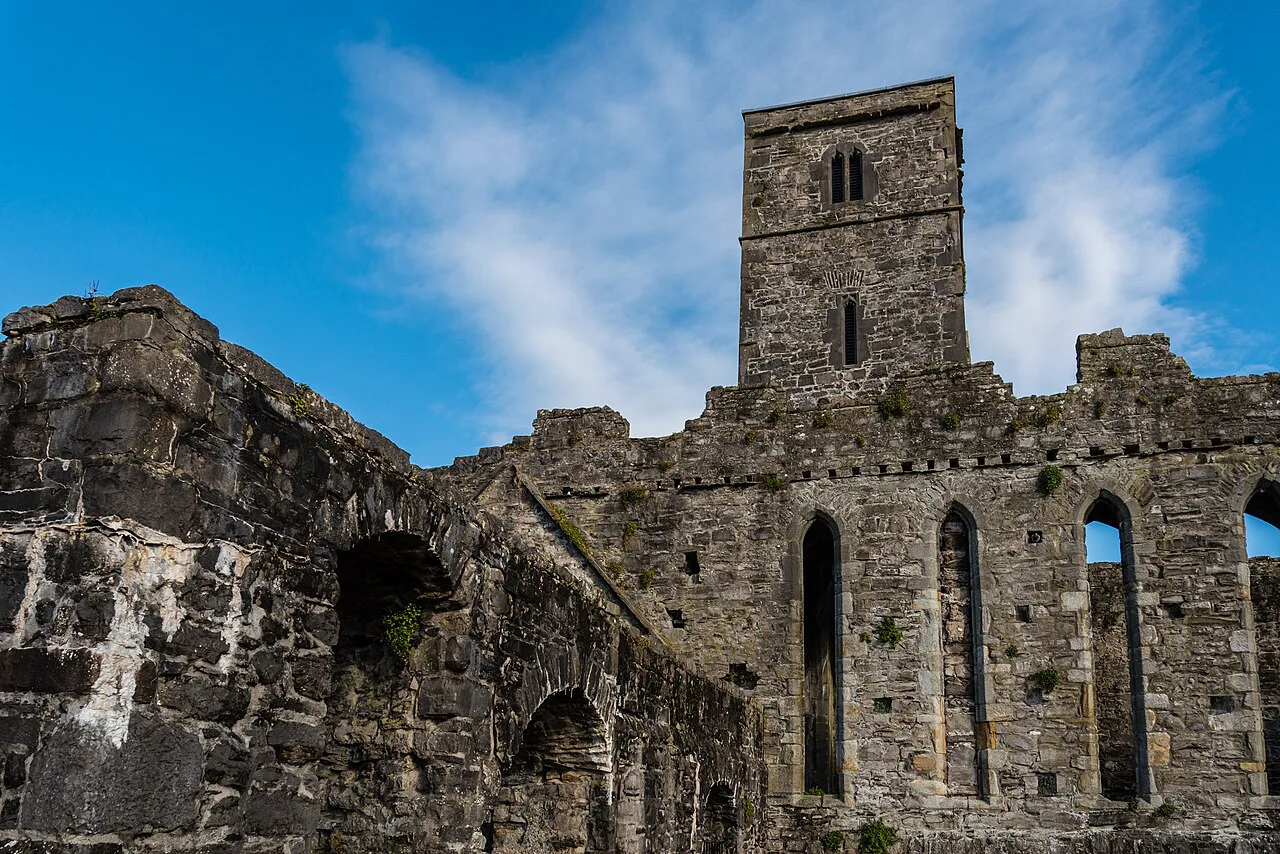
The church, sacristy and chapterhouse preserve large parts of their early fabric, and the fifteenth-century cloister and its associated buildings remain among the most legible survivals. Upstairs, visitors can explore the remains of the dining hall and dormitories, a part of the site many people skip; the upper level is where the communal, everyday side of friary life becomes concrete rather than abstract.
The surrounding graveyard is integral to the site rather than an afterthought, and it carries the abbey's long second life as a burial ground after the religious community had gone. Walk the perimeter before leaving, because the headstones and enclosure walls give a sense of how the ruined church continued to serve the town for centuries.
A Turbulent Timeline
Heritage Ireland records a sequence of disasters that explains why the abbey reads as a patchwork of periods: an accidental fire in 1414, the dismantling of a substantial wooden cross to serve as a battering ram during a siege of the town's castle, and violent destruction in 1642 at the hands of the plantation landlord Sir Frederic Hamilton. Each episode left its mark on the standing remains, and knowing the order helps you distinguish rebuilt fifteenth-century work from earlier walls.
Independent heritage writing corroborates the same arc, noting that the community rebuilt after the 1414 fire and added features that still stand, and that the site was attacked and burned again in the conflicts of 1642. When two accounts agree on the broad sequence but only the operator gives precise detail, treat the operator as your authority as you read the site. For wider context on comparable Irish religious houses, see our guide to monasteries in Ireland.
From Friary to Graveyard
Once abandoned, the abbey served as the town's main burial ground through the eighteenth century. In the summer of 1832 the graveyard was overwhelmed by victims of a cholera epidemic, and burials finally ceased in 1847, the year remembered as Black '47 at the height of the Great Famine. These dates turn the churchyard from scenery into a document of nineteenth-century public health and famine mortality in Sligo.
Sculpture to Seek Out
Start with the O'Crean tomb of 1506, the abbey's earliest monument, set in a recess in the north wall of the nave. It is an English Gothic tomb carved with nine relief figures associated with a wealthy Sligo merchant family; among them you can look for a friar, probably St Dominic, St Michael the Archangel with wings, raised sword and shield, and St Peter holding the keys to heaven. Treating the panel as a puzzle makes the nave worth several minutes rather than a glance.
Beyond the tomb, the site holds a wealth of carvings spanning Gothic and Renaissance monumental sculpture, much of it weathered but legible to a patient eye. Bring a little background knowledge rather than relying on labels alone, and give the quieter corners of the nave and choir their own time.
The High Altar
The sculptured fifteenth-century high altar is the piece to pause over: Heritage Ireland describes it as one of the very few to survive in an Irish monastic church, which is a stronger and more accurate claim than any ranking of beauty. Survivals of this kind are rare because altars were vulnerable to removal and destruction, so what you see here is an unusual piece of evidence for medieval liturgical furnishing in Ireland.
If you are comparing sites, this is the detail that distinguishes Sligo from many ruined abbeys reduced to bare walls, and it sits alongside the cloister arcade and carved tombs noted in independent accounts. Looking closely at Sligo's medieval stonework is the same exercise that pays off at the Rock of Cashel in County Tipperary, where a compact cluster of ecclesiastical buildings rewards a slow circuit, though each site preserves a different set of furnishings. For those weighing several ruined complexes on one trip, our guide to ancient sites in Ireland sets out the tombs, forts and trackways worth building an itinerary around.
The Cloister and the Love Knot
The cloister arcade is the most complete and atmospheric part of the visit, and one column carries a carving known as the Love Knot, said to represent the bond between earthly and spiritual love. Local custom holds that placing your hand on the stone and making a wish may bring it about; the abbey's own page frames this as custom rather than promise, so enjoy it as folklore woven into the masonry.
Finding the knot takes a deliberate search along the arcade columns, which is exactly the kind of slow looking the cloister rewards. The same walk gives you close views of the arcade's carved capitals and the wear of centuries on the stone.
The Dracula Story
The best-known local story attached to the abbey concerns Bram Stoker's mother, who lived in Sligo during the 1832 cholera epidemic. The story goes that she witnessed a burial in the abbey graveyard at a time when cholera could slow breathing and heartbeat so that victims were buried alive, and that she later recounted it to her son; many people believe this inspired Count Dracula. Heritage Ireland presents it as a local tradition, so treat it as storytelling attached to a real epidemic rather than documented literary fact.
Practical Visiting
Heritage Ireland publishes seasonal daily opening for the abbey: 10:00 to 18:00 with last admission at 17:15, changing to 09:00 to 17:00 with last admission at 16:15 from 25 October 2026. A dated notice also states that the abbey closes at the earlier time of 2pm on 8 November 2026, which is a one-day exception rather than a permanent change. Verify the current times on the operator's page before you travel, since seasonal switches are easy to misread.
The entrance is on Abbey Street in Sligo town, and Heritage Ireland offers a downloadable social guide to help first-time visitors, families and people with developmental and learning disabilities prepare for the visit. The highlights page invites visitors to enjoy a guided tour but publishes no timetable, so ask on arrival rather than planning around a fixed tour slot. The operator publishes an admission section on its abbey page; check it directly for current charges and any restrictions before your visit.
Nearby, Separately
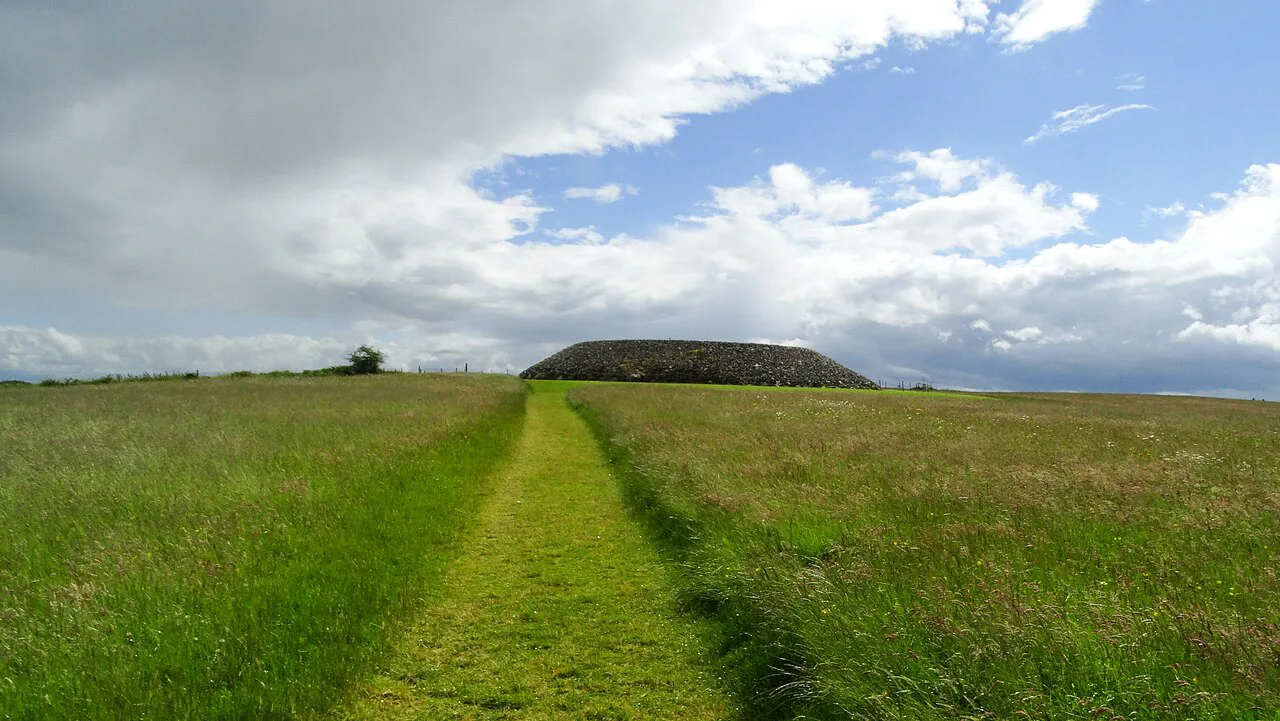
Carrowmore Megalithic Cemetery is a distinct Heritage Ireland site roughly four kilometres from Sligo town centre, reached off the N4 at the R292 junction on the Strandhill road, and it holds over thirty surviving Neolithic monuments in a landscape placed on Ireland's UNESCO tentative list. Its visitor centre was upgraded and reopened on 1 April 2026, with improved interpretation and an all-weather shelter, and its own seasonal times and last admission apply. It is not part of the abbey visit, but it pairs naturally with a medieval morning for anyone tracing Sligo's longer settlement story through ancient sites.
Two further operator sites lie north in County Leitrim: Parke's Castle, a restored early seventeenth-century castle on the northern shore of Lough Gill, and the Seán Mac Diarmada Cottage at Kiltyclogher, the only original homeplace of a Proclamation signatory, which runs limited tours that should be pre-booked. Both keep their own seasons and access rules, so treat them as separate outings rather than extensions of an abbey ticket.
Plan Your Visit
Sligo Abbey suits travellers who prefer reading stone to reading labels: an hour with the O'Crean tomb, the high altar and the cloister arcade will repay more than a hurried pass. Go early in the day if you want the ruins quiet, and check the published seasonal times before setting out, especially around the late-October switch and the early closure on 8 November 2026. If you are building a wider ruined-monuments itinerary, our guide to ancient sites in Ireland covers the tombs and forts that pair with a friary like this one.
If your interest is monumental Irish ruins more broadly, the surviving sculptured high altar here is the reason to prioritise Sligo over a longer list of bare walls, and the site works well as a compact introduction before travelling on to larger complexes such as the castles in county galway, where the medieval building tradition shifts from friary stonework to defended towers.
Explore more Ireland guides
Frequently Asked Questions
Is Sligo Abbey worth visiting?
Yes, if you value standing medieval fabric and carved stonework over reconstructed displays. Heritage Ireland describes it as Sligo town's only surviving medieval structure, with substantial parts of the church, sacristy and chapterhouse intact, a fifteenth-century cloister, and upper-floor remains of the dining hall and dormitories. The O'Crean tomb and the sculptured high altar give the visit a focus beyond general ruin-wandering.
What is there to see inside Sligo Abbey?
Look for the church, sacristy and chapterhouse, the fifteenth-century cloister arcade, and the remains of the dining hall and dormitories upstairs, plus the surrounding graveyard. Among the carvings, the O'Crean tomb of 1506 on the north wall of the nave carries nine relief figures, and the high altar is one of very few sculptured fifteenth-century examples surviving in an Irish monastic church.
What are the opening times for Sligo Abbey?
Heritage Ireland publishes daily opening of 10:00 to 18:00 with last admission at 17:15, moving to 09:00 to 17:00 with last admission at 16:15 from 25 October to 30 December 2026. A dated notice adds an early closure at 2pm on 8 November 2026. Confirm the times on the operator's page before travelling, as seasonal changes are easy to misread.
Is the Dracula story about Sligo Abbey true?
It is a local tradition rather than documented fact. The story holds that Bram Stoker's mother lived in Sligo during the 1832 cholera epidemic, witnessed a burial in the abbey graveyard at a time when victims could be buried alive, and later told her son; many people believe this inspired Count Dracula. Heritage Ireland presents it as a story attached to the site, while the 1832 cholera burials themselves are recorded history.
What is the Love Knot at Sligo Abbey?
It is a carving on one of the cloister columns, said to represent the bond between earthly and spiritual love. Local custom holds that placing your hand on the stone and making a wish may grant it. The abbey's own page presents this as local custom, so treat it as folklore rather than a guaranteed outcome, and enjoy finding it among the arcade's carved capitals.
When was Sligo Abbey founded and by whom?
The sources place the foundation in the mid-thirteenth century and credit Maurice FitzGerald, the Anglo-Norman lord linked with establishing the medieval town of Sligo. No precise founding year is published, so avoid pinning it to a single date. Heritage Ireland names him as the town's founder who constructed the abbey, which frames the friary as part of the town's original layout.
Sources
You might also like



Continue reading
More guides you'll find useful





