
Dunbrody Abbey, County Wexford: A Visitor Guide to the Ruin
Dunbrody Abbey is a ruined Cistercian monastery in County Wexford. See what survives, read its history, and check the visitor centre's seasonal status first.
On this page
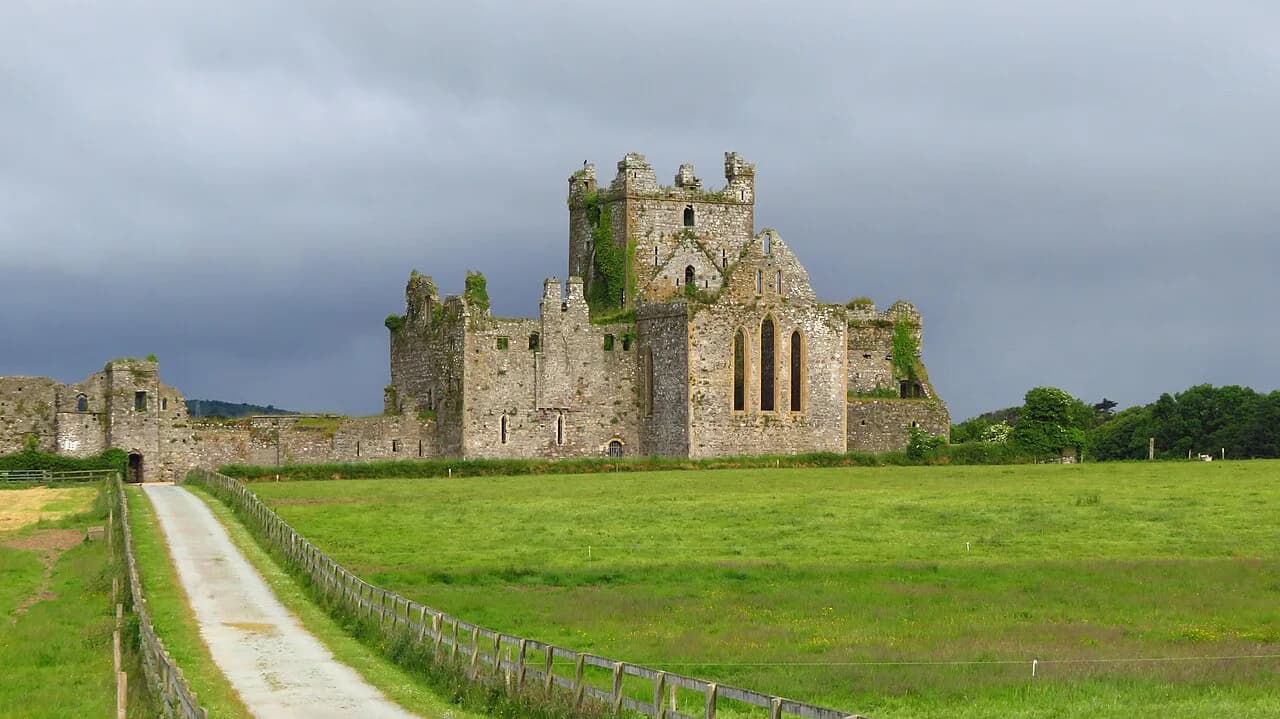
Dunbrody Abbey is a ruined Cistercian monastery at Campile in County Wexford, set on the Hook Peninsula. The operator currently reports that the visitor centre is closed for the season and mentions special winter events without giving dates, so the practical visit right now is the abbey ruin and its grounds rather than the café, maze or mini-golf. Confirm the position with the operator before you travel, because the closure notice and any event plans can change.
The site rewards an hour of slow looking more than a quick photo stop. Discover Ireland describes a church that keeps much of its 13th-century fabric, a complete nave, well-preserved transepts and chapels, and a 15th-century crossing tower, with the cloister garth remains still legible around it. Reading those parts in sequence explains how a Cistercian monastery worked far better than viewing a single facade.
Where Dunbrody Abbey Stands
The abbey sits at Campile in County Wexford, on the Hook Peninsula, and the operator and national listing treat the abbey, the adjacent Dunbrody Castle and the visitor-centre grounds as one destination. That matters for planning: you may intend only the ruin, but your arrival point, parking expectation and any facilities all belong to the same complex. Decide in advance whether you are coming for architecture alone or hoping for the family facilities, because those two visits depend on different things being open.
Discover Ireland describes the abbey and castle as places to explore, with walks and picnics on the grounds, which is the sensible outdoor fallback alongside the operator's seasonal closure notice for the centre. Confirm access before setting out, since a tourism listing is not a same-day opening confirmation.
If your interest runs to comparing monastic sites across the country, this Wexford ruin is one entry in a much wider set; the guide to monasteries in ireland sets out how Cistercian and other foundations differ in plan and survival. Use it to build a route rather than to substitute for checking Dunbrody's own status.
What Survives of the Medieval Church
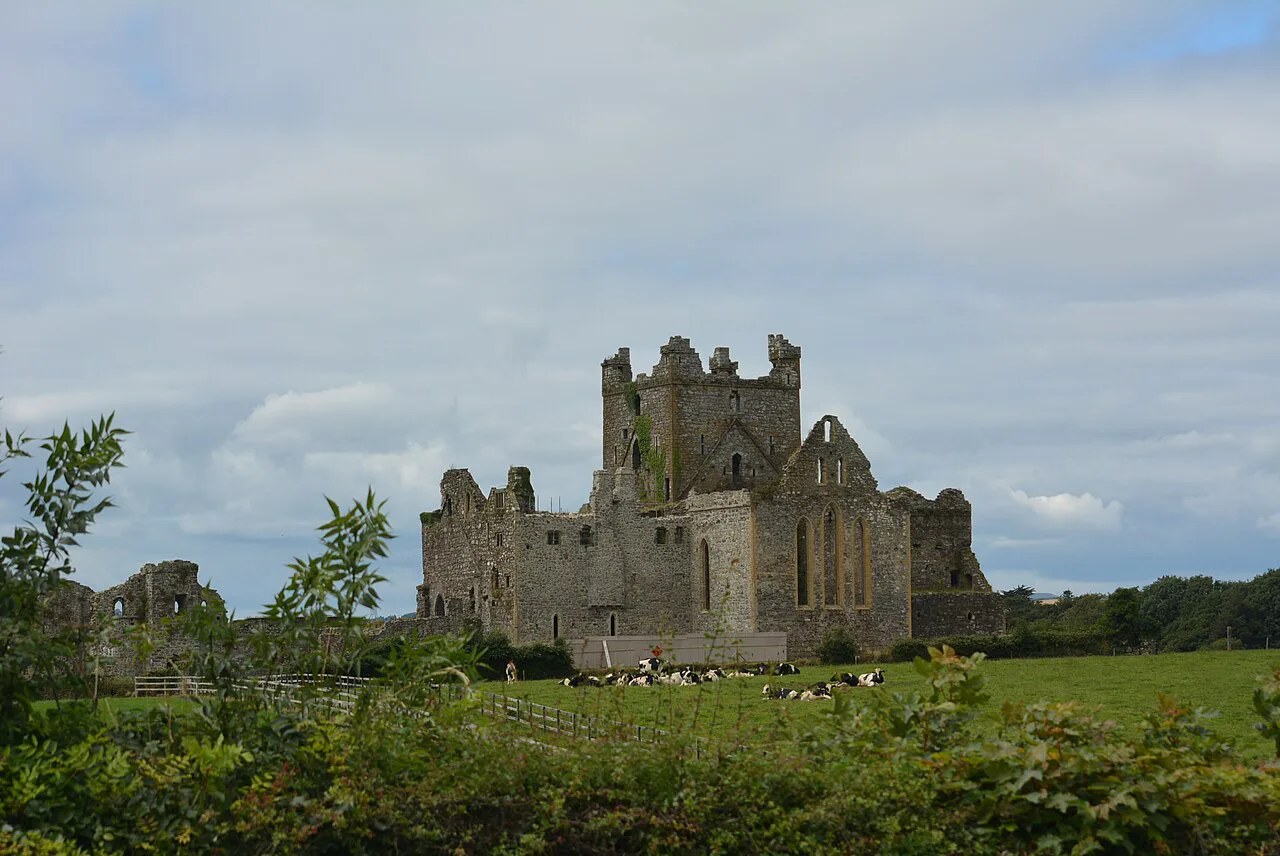
The standing ruin is substantial. According to Discover Ireland, the church retains much of its 13th-century work, the nave stands complete, the transepts and their chapels are well preserved, and the massive crossing tower was added in the 15th century. Original stonework survives across the church walls and the cloister garden, which is why the site reads as architecture rather than a scatter of fragments.
The regional directory goes further, calling the church one of the longest in Ireland. That superlative comes from Visit Wexford rather than from an independent survey, so treat it as the directory's characterisation and let the building's length speak for itself as you walk it.
Around the church, extensive remains of the buildings around the cloister garth survive. The cloister was the working heart of a Cistercian house, linking church, refectory and chapter room, so its outline is often the most informative part of a ruined abbey for a visitor trying to imagine daily life.
Reading the Stonework on Foot
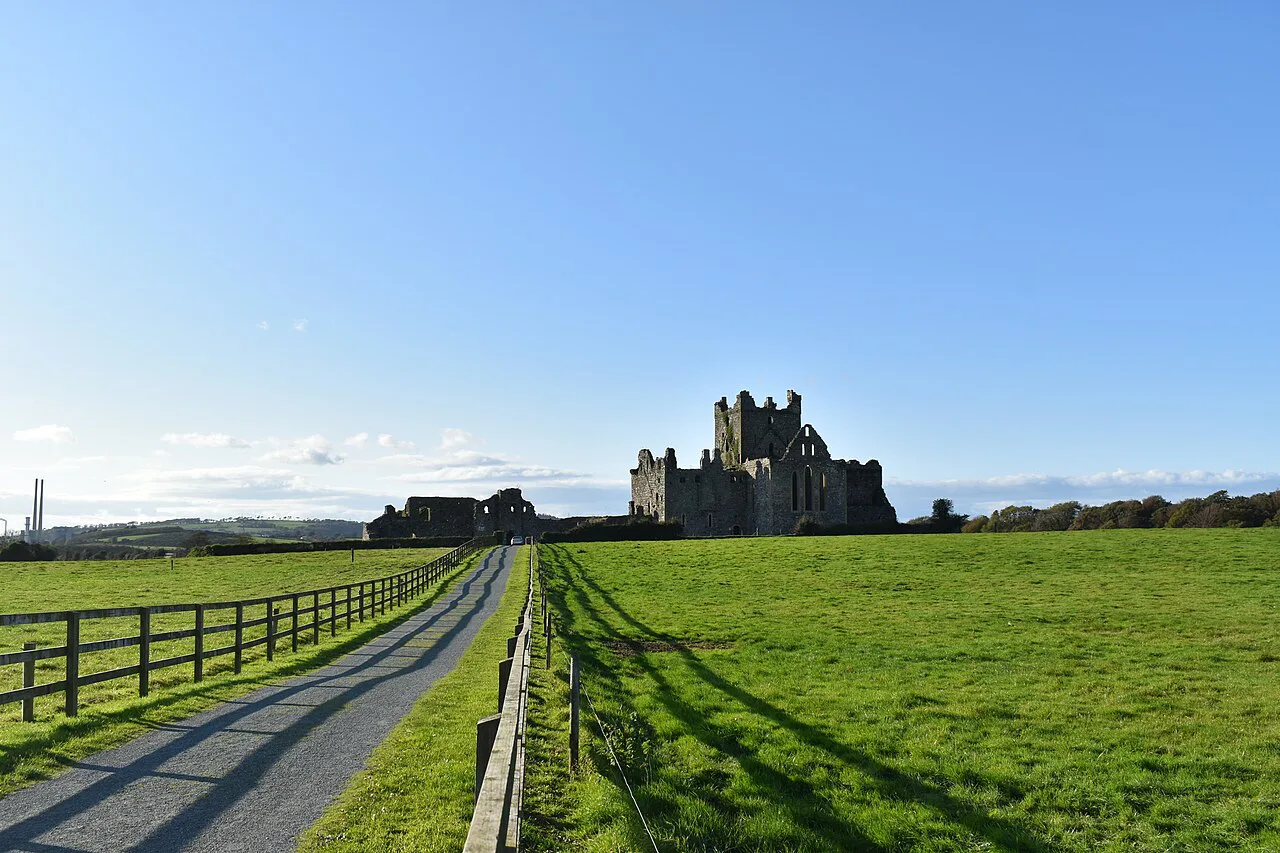
Walk the church west to east rather than starting at the most photogenic angle. Begin at the nave, which the sources describe as complete, then move into the transepts and their chapels, and finish beneath the 15th-century crossing tower. That sequence follows the liturgical axis of a Cistercian church and makes the later tower addition obvious against the earlier walls.
Then circle the cloister garth and look for the wall scars where the monastic ranges once attached to the church. Much of what a visitor reconstructs at a site like this comes from those junctions rather than from any single standing wall. The same skill transfers to other ruins, such as corcomroe abbey in the Burren, where the relationship between church and cloister ranges is equally instructive.
Allow time to look up. The crossing tower is the clearest marker of the abbey's later medieval phase, added in the 15th century according to the tourism listing, while the transept chapels show where subsidiary altars served the community. Noticing that hierarchy of spaces is what separates a meaningful visit from a quick circuit of the walls.
The Foundation Story, and Its Conflicting Dates
The tourism listings tell a consistent foundation narrative: Herve de Montmorency founded the house on the instructions of his nephew Richard de Clare, known as Strongbow, after the Norman invasion of Ireland. Discover Ireland gives the year as 1170, and Visit Wexford repeats the same 1170 foundation in its historical summary.
Visit Wexford's own opening description, however, gives 1210. The sources conflict, and the honest position for a visitor is to note both figures as they are published rather than assume one is settled. What is not in dispute is the Norman context and the Cistercian affiliation, which explain the scale of the church and the austere plan you see.
That mix of Norman patronage and Cistercian reform is a useful lens for other Irish ruins; the broader survey of monasteries in Ireland shows how patronage shaped scale and survival across different orders and centuries, which helps you read Dunbrody's size as a statement of its founders' status as much as a matter of monastic need.
After the Monasteries: Dissolution and the Etchinghams
The tourism listings record that Henry VIII dissolved the abbey in 1536 and granted it to the Etchingham family in 1545, after which part of the church was converted into a residence. That conversion is the key to reading the later fabric: a dissolved monastery becomes a private house, and domestic alterations appear inside a sacred shell.
For visitors, the practical point is that Dunbrody is not a pristine medieval survival but a building that changed use. Look for where a church window or arcade meets a domestic wall, and the sixteenth-century story becomes visible. The same layering of later building over an earlier religious site is worth tracing at the castles in county galway, where defensive additions reshape what came before.
Keeping the chronology straight helps: foundation under Norman patronage, Dissolution in 1536, grant in 1545, then centuries of use and decay. The ruin you photograph today is the end point of that sequence, not a single moment frozen in the Middle Ages.
The Christmas Eve Collapse of 1852
One event explains the abbey's most conspicuous absence. According to the tourism listings, a massive collapse occurred on Christmas Eve in 1852, destroying the south wall of the church and part of the monastery. When you stand in the nave and find the south side open to the sky, you are looking at the consequence of that night.
That makes the south wall the single most useful thing to look for. Photographs of the church from the north side flatter it; the view from the south shows how much masonry went down and how the remaining structure was left propped and exposed. Reading the ruin this way turns a picturesque shell into a dated structural event.
Late medieval and post-Dissolution alterations appear throughout the standing fabric. The same walls that carried the abbey's medieval life carried the Etchinghams' residence after them, so the ruin is a record of both phases rather than of one period alone.
The Visitor-Centre Offer in Season
When the centre operates, the site offers more than the ruin. The operator describes a yew tree maze, pitch and putt golf, a tearoom and café, and a craft shop on the grounds, all framed as a family day out on the Hook Peninsula. Discover Ireland adds that the yew hedge maze beside Dunbrody Castle is made up of 1,500 yew trees and gravel paths, and Visit Wexford notes a mini-golf course and local plants and crafts sold in summer.
Visit Wexford calls the maze one of only two full-size mazes in Ireland. That claim comes from the regional directory rather than from an independent count, so take it as the directory's description and judge the maze on its own merits if it reopens during your visit.
None of these facilities should be assumed open on a given day, and the operator's current notice that the centre is closed for the season governs right now. If the family facilities are the reason for your trip, plan around a confirmed reopening rather than around the ruin alone.
Planning Around the Seasonal Closure
The realistic near-term visit is a grounds-focused one: the abbey ruin, walks and a picnic, as Discover Ireland describes the castle and abbey grounds. Bring what you need, since the café and shop cannot be treated as available while the centre is shut. Confirm access with the operator before travelling, and treat any winter event mention as unconfirmed until dates and details are published.
Visit Wexford's directory listing describes a seasonal pattern of closure from 15 September to 30 April, with visitor-centre opening windows from 1 May to 30 June and 1 to 14 September. That is directory guidance, not the operator's confirmed hours, so check the seasonal status directly rather than relying on the pattern.
A short history-focused stop and a longer family visit are genuinely different trips here. The first depends only on the ruin and grounds; the second depends on the centre, maze, café and mini-golf being open together. Decide which you are planning before you commit a day to the Hook Peninsula.
Comparing Dunbrody With Other Irish Ruins
Dunbrody belongs to a wider set of Irish monastic and ecclesiastical ruins that reward comparison. The Rock of Cashel in County Tipperary presents a compact, heavily visited ensemble of ecclesiastical buildings on a rock, while Dunbrody's appeal lies in the legibility of a single Cistercian plan and the evidence of its later domestic use. If your route heads west instead, the castles in county galway make a similarly instructive comparison for how later defensive building reuses and reshapes earlier sites.
Other sites offer different lessons. Skellig Michael (Sceilg Mhichíl) shows an early monastic settlement in an extreme setting, and Glendalough shows a valley community. Each has its own access constraints, which is why checking each site's own published arrangements matters more than any general pattern.
For a broader route through comparable monuments, the guide to ancient sites ireland helps place a Wexford abbey alongside earlier and later foundations without overstating any single site. Use it to choose where to spend limited time, then verify each stop's access with the body that runs it.
Plan Your Visit
Dunbrody Abbey is worth a deliberate detour for anyone interested in Cistercian architecture, but the visit as it stands is a ruin-and-grounds one. Go for the complete nave, the transepts and chapels, the 15th-century crossing tower, the cloister remains and the missing south wall that the 1852 collapse explains.
Check the operator's current position before travelling, keep any hopes for the maze, café or mini-golf dependent on a confirmed reopening, and treat the directory's seasonal windows as a prompt to verify rather than as published hours. That way a low-commitment outdoor visit delivers even if the centre remains shut.
Explore more Ireland guides
Frequently Asked Questions
Is Dunbrody Abbey open to visitors now?
The operator reports that the visitor centre is closed for the season and mentions special winter events without giving dates. The tourism listing describes the abbey and castle grounds as open for walks and picnics, so confirm the current position with the operator before travelling and do not assume the centre, maze, café or mini-golf are open.
What is there to see at Dunbrody Abbey?
The standing ruin retains much of its 13th-century church, including a complete nave, well-preserved transepts and chapels, and a 15th-century crossing tower, with extensive remains of the buildings around the cloister garth. The south wall of the church is missing because of a collapse recorded as happening on Christmas Eve in 1852.
When was Dunbrody Abbey founded?
The sources conflict. Discover Ireland gives 1170, when Herve de Montmorency is said to have founded the house on the instructions of Richard de Clare, known as Strongbow, and Visit Wexford repeats 1170 in its historical summary but gives 1210 in its opening description. Neither figure should be treated as settled.
What happened to Dunbrody Abbey after the Dissolution?
The tourism listings record that Henry VIII dissolved the abbey in 1536 and granted it to the Etchingham family in 1545, after which part of the church was converted into a residence. That conversion explains why the medieval shell carries later domestic features.
Why is part of the church at Dunbrody Abbey missing?
The sources record a massive collapse on Christmas Eve in 1852 that destroyed the south wall of the church and part of the monastery. Stand in the nave and the open south side toward the sky is the direct result of that event.
Do you need the visitor centre to see the abbey?
No. The abbey ruin and grounds can be experienced without the centre, and the tourism listing supports walks and picnics on the grounds. The maze, café, craft shop and mini-golf belong to the seasonal visitor-centre offer, so only plan around them once the operator confirms they are open.
When is the visitor centre usually open?
Visit Wexford's directory listing describes a closure from 15 September to 30 April, with opening windows from 1 May to 30 June and 1 to 14 September. Those are directory figures rather than confirmed operator hours, so check the operator's current notice before relying on them.
Sources
You might also like



Continue reading
More guides you'll find useful





