
Askeaton Franciscan Friary: A Guide to the Riverside Ruin
Askeaton Franciscan Friary is an unguided National Monument by the River Deel. This guide explains its church, cloister and domestic ranges for visitors.
On this page
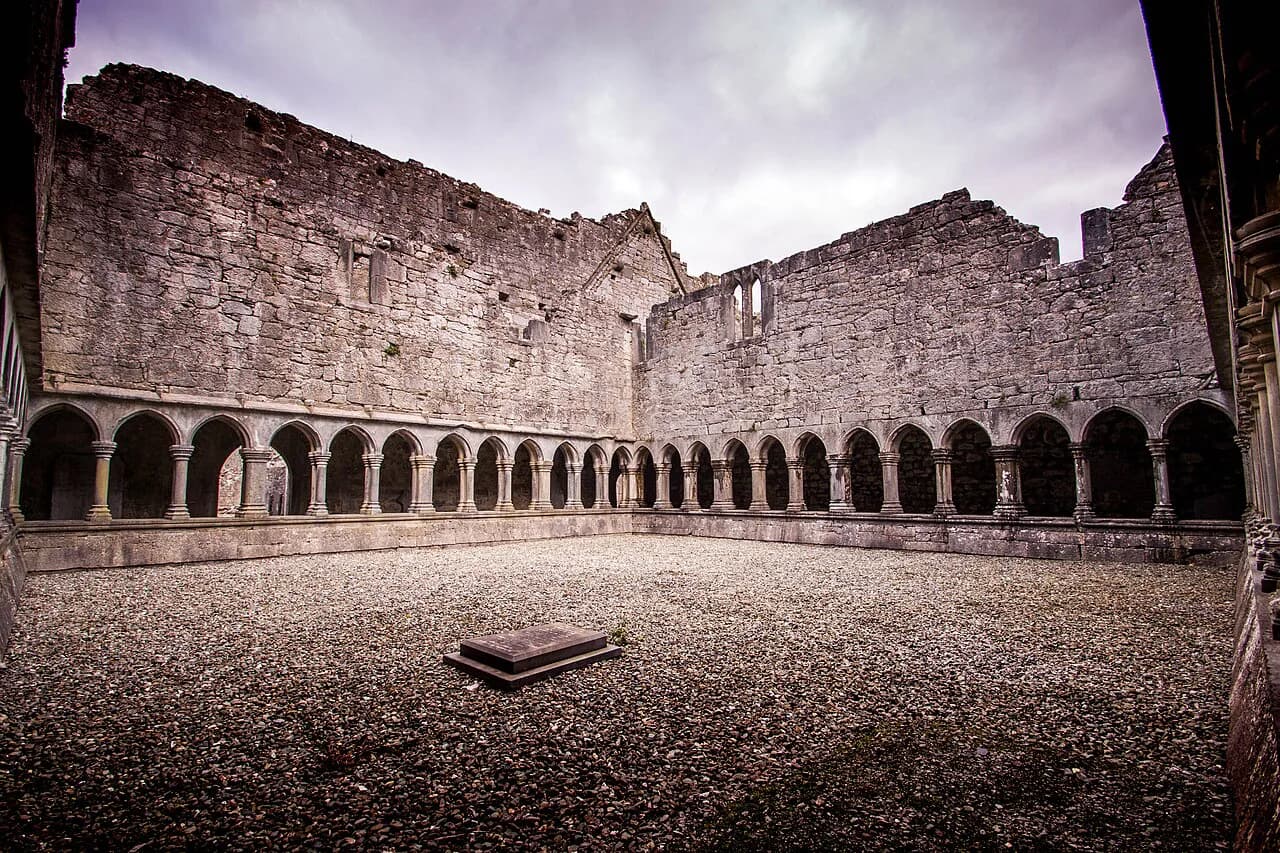
Askeaton Franciscan Friary is an unguided National Monument in state guardianship, standing beside the River Deel on the north side of Askeaton village in County Limerick. Heritage Ireland describes no visitor centre, reception desk or exhibition, so a visit means reading standing masonry rather than following displays.
That makes a little preparation worthwhile: know the order of the buildings, know which carvings to look for, and know which spaces the record does not establish as openly entered. The sections below follow the plan from the church through the cloister to the domestic ranges, then turn to the approach and the care the Office of Public Works asks visitors to take. For wider context, see our monasteries in ireland collection.
What It Is and Where It Stands
The friary lies by the River Deel, on the north side of Askeaton, and is protected as a National Monument under the National Monuments Acts 1930 to 2014. Heritage Ireland classes it among the unguided sites, and no staffed welcome is described. The operator asks visitors to maintain care and caution throughout, so treat the ruins as fragile historic fabric.
Anyone building a wider tour of Irish monastic remains can use the Monasteries in Ireland collection to see how a small riverside friary sits alongside larger, more heavily managed sites. Askeaton rewards the opposite approach from a big visitor attraction: fewer facilities, more direct contact with the stone itself.
Founding and Desmond Patronage
Heritage Ireland names Gerald Fitzgerald, 3rd Earl of Desmond, as the most probable founder, and links the foundation to a grant of indulgences by Pope Boniface IX to anyone who gave alms to the friary. An independent heritage account records an unresolved alternative: either the 3rd Earl around 1389 or James Fitzgerald, 7th Earl of Desmond around 1420. Treat the exact foundation as uncertain rather than settled.
The Fitzgerald connection is visible in the building itself, since the church holds many of the family's tombs. Read these as part of the Desmond story rather than as isolated monuments, and read the sixteenth-century carved doorways with Renaissance-style ornament as a later layer over earlier fabric.
Franciscan Life and Disruption
The house was reformed under the Order of Friars Minor in 1490 and again in 1513, and in 1564 it hosted a provincial chapter, a general assembly of friars and clergy. That sequence matters for reading the ruins: several domestic additions belong to this period of active Franciscan life rather than to the original foundation.
During the failed Second Desmond rebellion the friary was sacked and plundered by Nicholas Malby in 1579, the same year he was created Lord President of Connaught. The friars returned off and on until 1714, a long intermittent presence after the Desmond Wars. The independent account likewise records the community's expulsion during those wars.
Reading the Church
The church is a single-aisled limestone building with a cloister to the south and a range running east to west. Heritage Ireland counts five windows in the east wall and three triple-light windows in the south wall of the chancel, plus a single window in both the north and west walls. Walk the exterior first to register these openings, then enter to see how light was arranged for the altar end.
Inside, the independent account picks out a triple sedilia and choir stalls at the east end of the south wall, a large sixteenth-century plaque above the sedilia, and hooded tomb niches, three in the south wall and one in the north. The transept is reached through two large pointed arches on a drum-shaped column. Look also for the sacristy, reached by a pointed doorway from the chancel, with a spiral carving at the base of the jamb.
The Cloister and Its Carvings
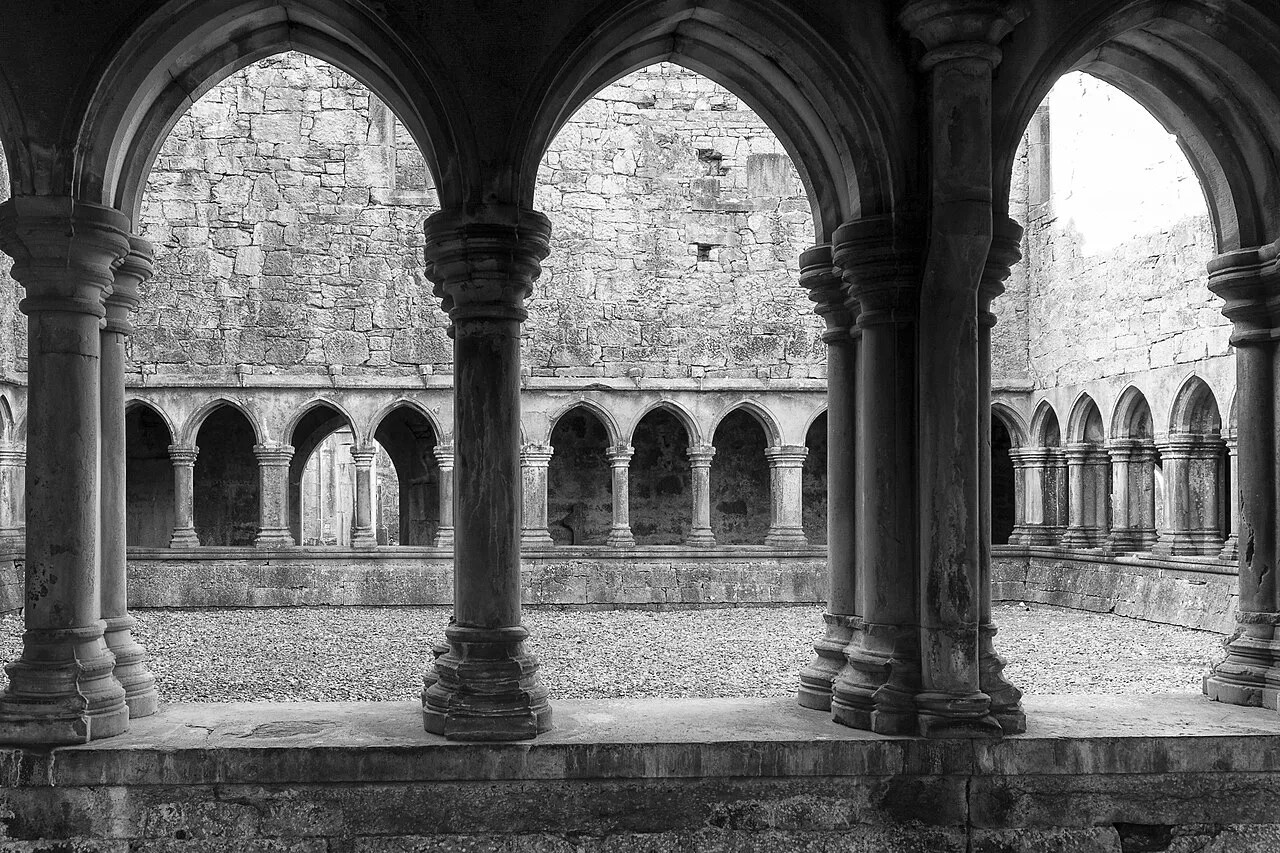
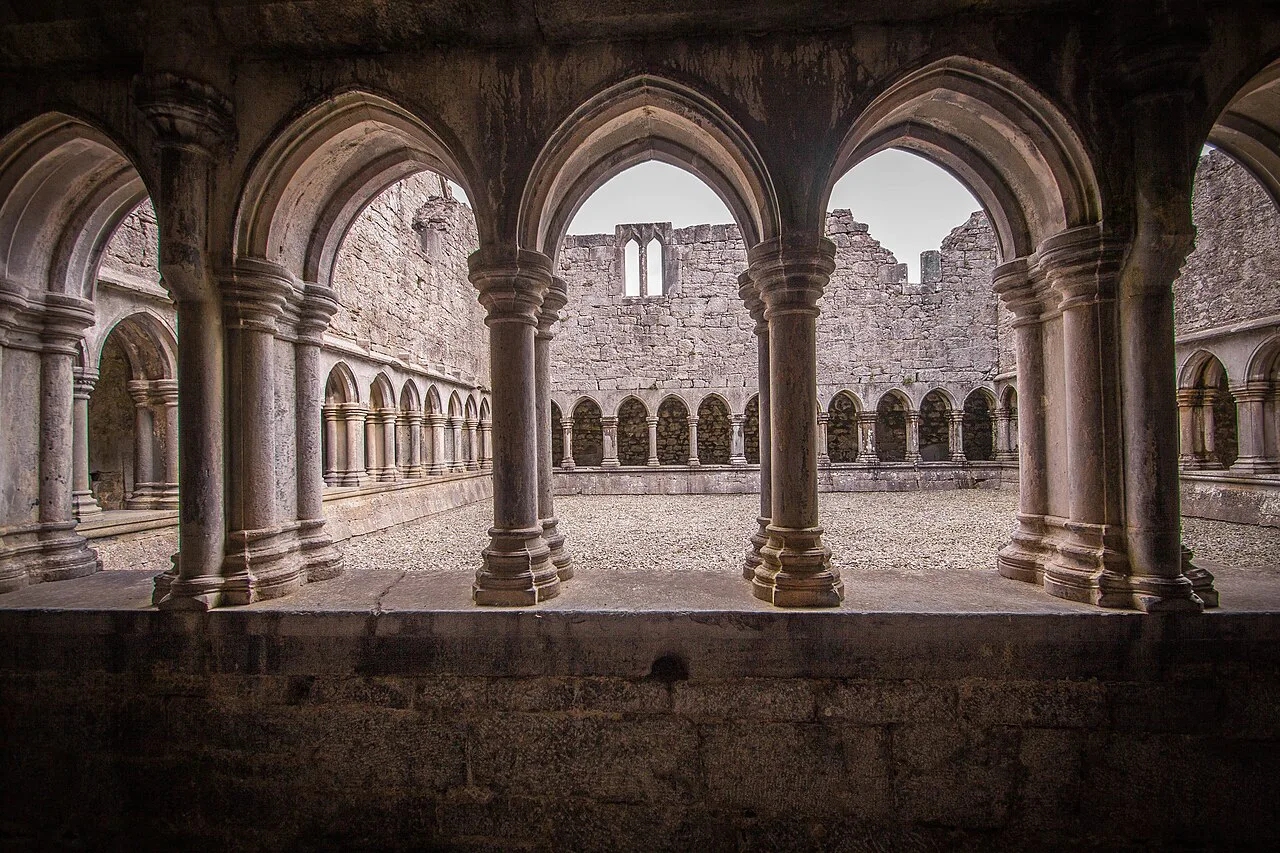
The cloister is the heart of the plan, an open court ringed by a covered walkway linking church and domestic buildings. Its pointed arcade uses web-shaped colonettes grouped in threes, and the walkway gives access through a series of doors. Plaster and wattling remain visible in the arcade, a reminder of how much surface finish has been lost.
Look for the panel carved on the north side of the cloister showing St Francis, and for the Mass dial cut into the north wall of the ambulatory. The independent account places the St Francis carving in the northeast corner, showing the saint in monastic robes with the stigmata. Surviving painted decoration is fragmentary: consecration crosses in the plaster of the first-floor south range, painted work in the west range, and traces of a devotional image on an upper floor.
Domestic Ranges
The east range of the cloister has two floors, with a long barrel-vaulted ground floor lit by three narrow splayed windows and warmed by a fireplace. A spiral stair reaches the upper floor, which covers the ground floor and the ambulatory. The independent account reads the ground floor as the monastic kitchen and locates a carved fireplace toward the north end of the east wall.
The refectory projects from the southeast corner of the cloister as a two-storey structure, its ground-level west wall holding a twin-light ogee-headed window and a reader's recess framed by rounded colonettes. West of the south range stands another two-storey structure containing a necessarium, the communal monastic latrine. The west range is also two-storeyed, with a vaulted north space and a south space known as the prison, complete with a garderobe.
Approaching and Visiting
One published account describes reaching the ruins through a modern graveyard on the east side, then entering the cloister interior by a finely carved fifteenth-century pointed doorway in the south wall, opposite a spiral stair to the east range's upper storey. Use that as a route to look for rather than a guarantee: no signage, path condition or lighting is recorded.
Heritage Ireland states that the friary is available to visit all year round, with tours available upon request. The page publishes no opening hours, admission arrangements or booking procedure, so check the listing before travelling rather than assuming staffed access. Read the all-year wording as general availability, not a daily timetable.
What to Hold Lightly
Some spaces may not be freely entered. The independent account found the chapter room behind a metal gate at the time of that visit and describes the tombs of Bishop Patrick O'Healy and Fr Conn O'Rourke within the area. That is one visitor's experience, not a stated current closure, so treat locked or gated spaces as possible rather than certain.
Upper floors reached by spiral stairs and the first-floor painted spaces are described structurally, but no source establishes that visitors can climb to them now. Plan the visit around the grounds, the church interior and the ground-floor ranges, and read the upper levels from below. This is a ruin to interpret on foot, not a roofed museum circuit.
Nearby Heritage Context
Heritage Ireland lists other sites to visit nearby, including Askeaton Castle, Adare Castle, Desmond Castle Newcastle West, Ennis Friary, Lough Gur and Scattery Island, and a day built around Limerick city's collections is covered in Museums in Limerick: A Guide to the City's Core Collections. Each has its own access arrangements, and the friary listing does not rank or compare them. Use them as separate stops rather than a single circuit with assumed opening times.
For a broader view of Irish ecclesiastical and defensive ruins, the ancient sites ireland collection sets friaries like this one alongside other monument types. Pairing a riverside Franciscan house with a larger complex such as the Rock of Cashel shows two different scales of survival and management, useful context when deciding how long to give Askeaton.
Plan Your Visit
Askeaton Franciscan Friary suits a visitor willing to walk a ruined plan and read carved detail without displays. Give priority to the church windows and sedilia, the cloister arcade with its St Francis panel and Mass dial, and the barrel-vaulted east range, then let the fragmentary painted decoration and tombs fill in the Desmond story.
Before setting out, check the Heritage Ireland listing, which sets out unguided status and general year-round availability but no timetable, and keep expectations of interior access modest. The site is best treated as a short, attentive stop on a wider County Limerick day rather than a destination with facilities.
Explore more Ireland guides
Frequently Asked Questions
Is Askeaton Franciscan Friary a staffed visitor attraction?
No. It is an unguided National Monument in state guardianship, and the official listing describes no visitor centre, shop or reception. Expect to interpret standing ruins yourself and to take care around fragile masonry, as the operator advises.
Who founded Askeaton Franciscan Friary?
Heritage Ireland gives Gerald Fitzgerald, 3rd Earl of Desmond, as the most probable founder, linked to indulgences granted by Pope Boniface IX. An independent heritage account records an unresolved alternative: either the 3rd Earl around 1389 or James Fitzgerald, 7th Earl of Desmond around 1420.
What is there to see inside the ruins?
Look for the single-aisled limestone church with its chancel windows, triple sedilia, tomb niches and Fitzgerald tombs, and the transept reached through two large pointed arches. The cloister carries a carved St Francis panel and a Mass dial, and the domestic ranges include a barrel-vaulted east range, a two-storey refectory and a necessarium.
How do you get into the cloister at Askeaton Friary?
One published account describes approaching through a modern graveyard on the east side and entering by a fifteenth-century pointed doorway in the south wall. No signage or path conditions are recorded, so treat this as the route to look for rather than a fixed arrangement.
Can you visit Askeaton Friary all year round?
Heritage Ireland states the friary is available to visit all year round, but publishes no opening hours or staffed times. Read that as general availability and check the listing before travelling rather than assuming daily access.
Are tours of Askeaton Friary available?
The official listing notes that tours are available upon request, without naming a provider or describing how to arrange one. Confirm the current position on the Heritage Ireland page before relying on a tour.
What happened to the friary in 1579?
During the failed Second Desmond rebellion the friary was sacked and plundered by Nicholas Malby. The friars nonetheless returned off and on until 1714, which helps explain how much of the plan remains legible today.
How does Askeaton Friary relate to nearby OPW sites?
The official page lists Askeaton Castle, Adare Castle, Desmond Castle Newcastle West, Ennis Friary, Lough Gur and Scattery Island among nearby sites to visit. Each has its own access arrangements, so plan separate stops rather than assuming a shared timetable.
Sources
You might also like



Continue reading
More guides you'll find useful





