
Ballinskelligs Abbey Guide: The Skellig Monks' Mainland Priory
Ballinskelligs Abbey in South Kerry is an unguided Augustinian ruin founded in 1210 for the Skellig monks. Learn what survives and how visitors reach the site.
On this page
Ballinskelligs Abbey is a roofless Augustinian priory on the edge of the Iveragh Peninsula in South Kerry, a National Monument in state guardianship cared for by the Office of Public Works. It is an unguided site: you read the standing walls and foundations yourself rather than joining a tour. Sceilg Mhichíl, the UNESCO World Heritage island, lies offshore and explains why this mainland site exists at all.
What and Where Ballinskelligs Abbey Is
The monument is also known as the Priory of the Arroasian Canons of the Order of St Augustine, the OPW's own naming for the house founded in 1210. It sits on the coast of the Iveragh Peninsula, close to the beach at Ballinskelligs, with the Skellig islands visible from the surrounding region. Because it is an unguided site, it is worth checking the Heritage Ireland page for any site notice before setting out.
It helps to place the abbey within the wider story of Irish monastic settlement, from early island foundations to later continental orders. Ballinskelligs belongs to the later, reform-era layer: a house of Augustinian Canons rather than an early hermitage. For the broader sweep of these sites, the monasteries in ireland collection is a useful starting point before you commit a day to one stretch of coast.
From Skellig to the Mainland: The 1210 Foundation
According to the OPW, the priory was founded in 1210 by Augustinian Canons from Rattoo in North Kerry, specifically to house the monks of the Skellig islands. The same account lists the pressures behind that move: Viking raids, worsening conditions on the islands and changes in the structure of the Irish church that favoured settled mainland houses. In other words, Ballinskelligs is best understood not as a new experiment but as the island community's relocation.
If you have already read about the island monastery, this is where the story continues on dry land. Sceilg Mhichíl covers the offshore phase, while Ballinskelligs shows what the community built once it had left. The two are worth treating as a pair, though any island visit depends on its own seasonal arrangements and sea conditions, so do not assume you can see both on the same day.
Dedication to St Michael and the Name
The priory is dedicated to St Michael, the archangel, according to the OPW. The dedication closely echoes Skellig Michael, which is unsurprising for a community that came from the island, and the same OPW account also names St Fíonán, an early Irish saint, in connection with the site. Discover Ireland notes that the abbey is one of a number of spiritual sites in the area dedicated to St Michael, an observation best read as that source's local context rather than evidence of a wider devotional network.
Visitors sometimes expect an early medieval ruin and are surprised by how much of the fabric is later. Discover Ireland records that most of the standing buildings date from the fifteenth century, even though the foundation is thirteenth-century. That distinction matters on site: the plan is early, but much of what you see is the result of later rebuilding.
Occupation, Abandonment and Ownership
The OPW records that the priory remained occupied until 1569 and was abandoned in 1578 under the Reformation by Elizabeth I. The site was then leased to Gyles Clinsher in the same year and, less than a decade later, leased out to John Blake. The OPW's later-ownership account records Richard Harding of Bristol as landowner in 1756 and the Sigerson family inheriting the priory in 1615, and this guide treats the colourful Sigerson–Harding marriage story, given below, as tradition rather than verified history.
The OPW also retells a story, explicitly according to tradition, about Christopher Sigerson, who was engaged to Richard Harding's daughter and met her funeral as he arrived in Bristol to marry her. Harding is said to have treated the match as if it had taken place and given Sigerson the manor of Ballinskelligs, with the abbey and lands attached. It is a good story and it belongs to the site's folklore, not to verified biography, so treat it as tradition rather than fact.
Reading the Ruins: Nave, Cloister and Prior's House
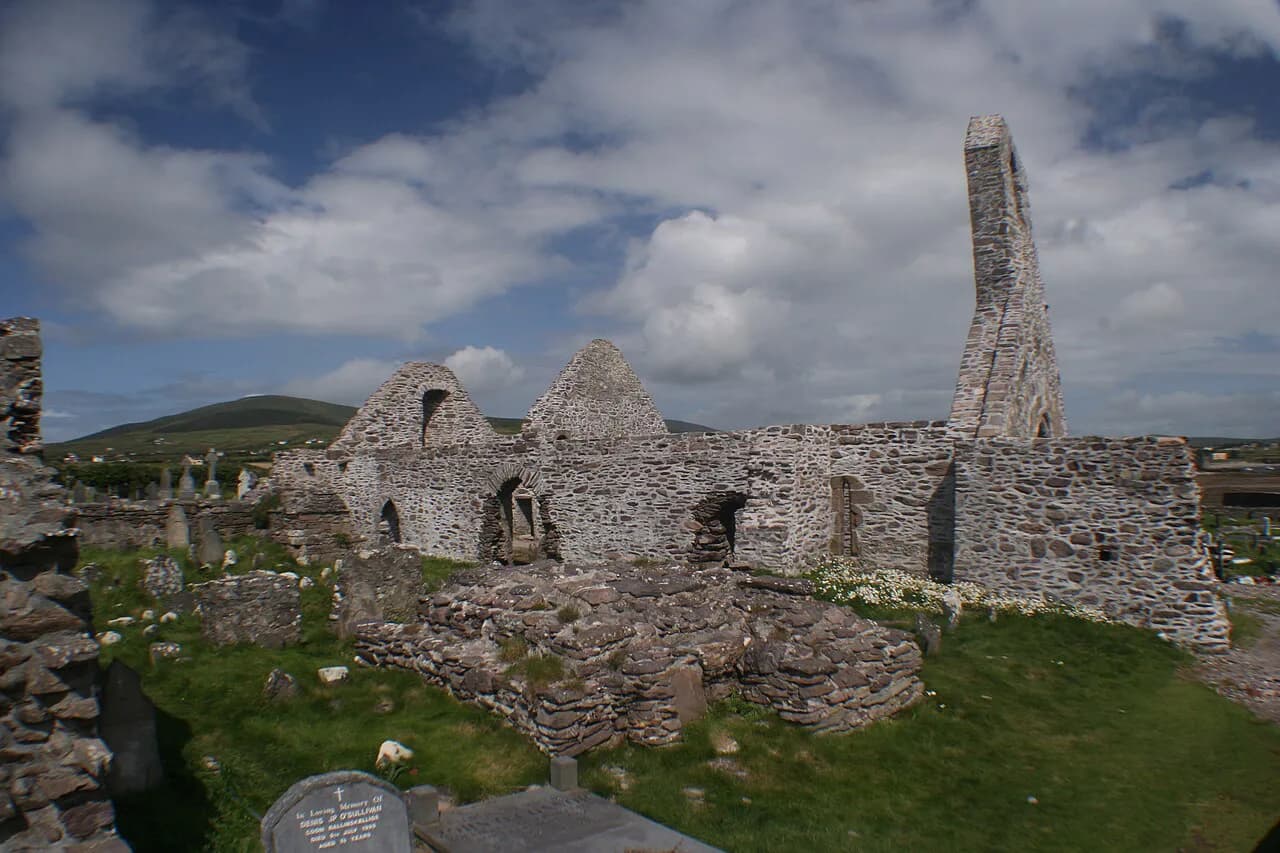
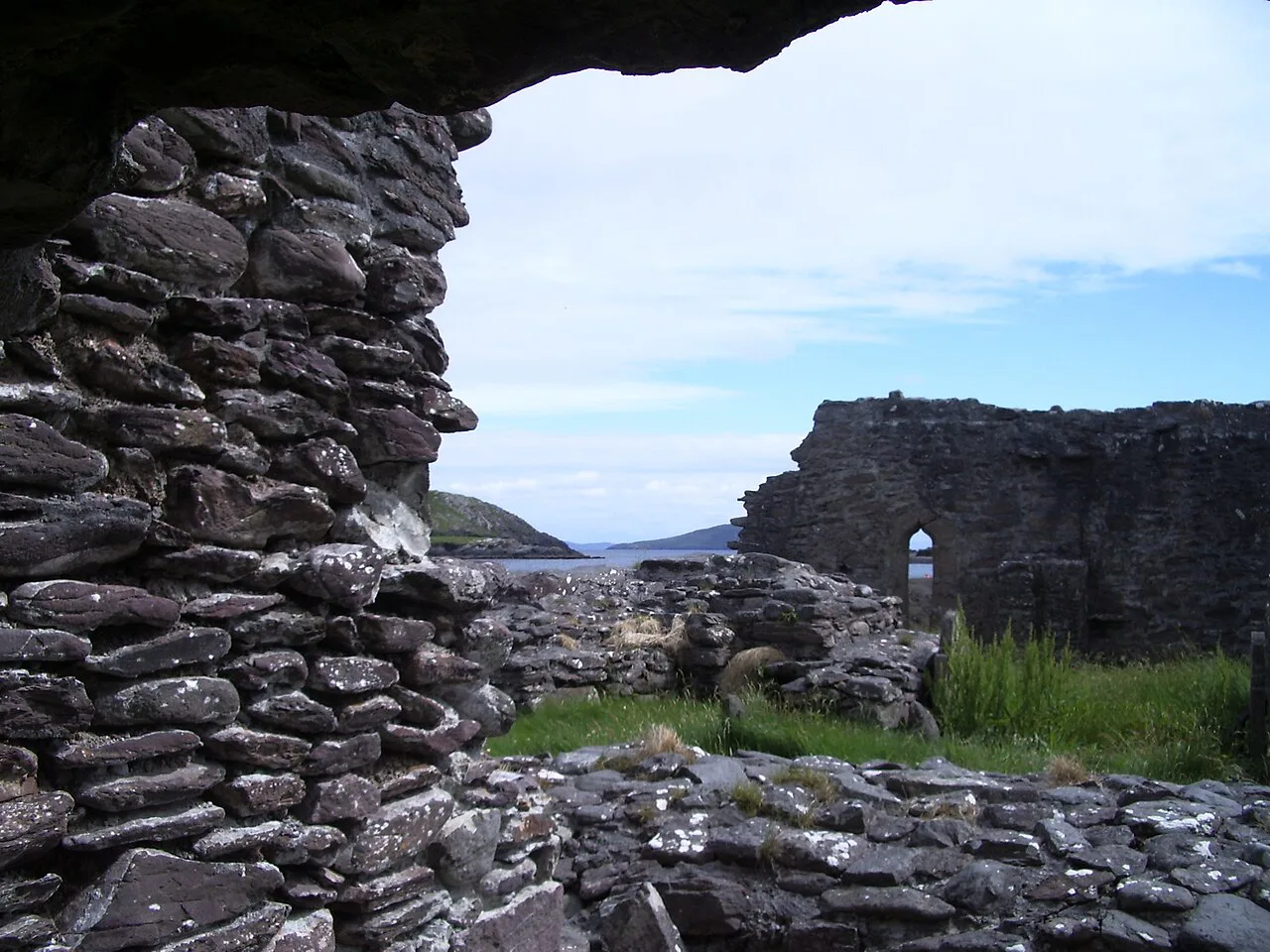
The church is of nave-and-chancel type, with the nave and part of the chancel still standing, built of roughly coursed rubble in lime and gravel mortar with sandstone dressings, and some inner walls show traces of plaster. Around the church are the cloister, the Prior's House and the refectory, the room where meals were taken. Three doorways lead off the nave at the south-west into the cloister area, one of them blocked, with the top of a blocked window showing an ogee-headed opening.
The nave also holds a number of graves marked by carved architectural fragments, which repays slow looking rather than a quick circuit. Little remains of the chancel apart from part of a pointed arched wall topped by a bellcote, and parts of two windows can be seen in the north-east wall. The OPW notes that the architectural detail visible spans the thirteenth to the fifteenth centuries, which helps in reading the jumble of low walls around the church.
Coastal Change and the Sea-Wall
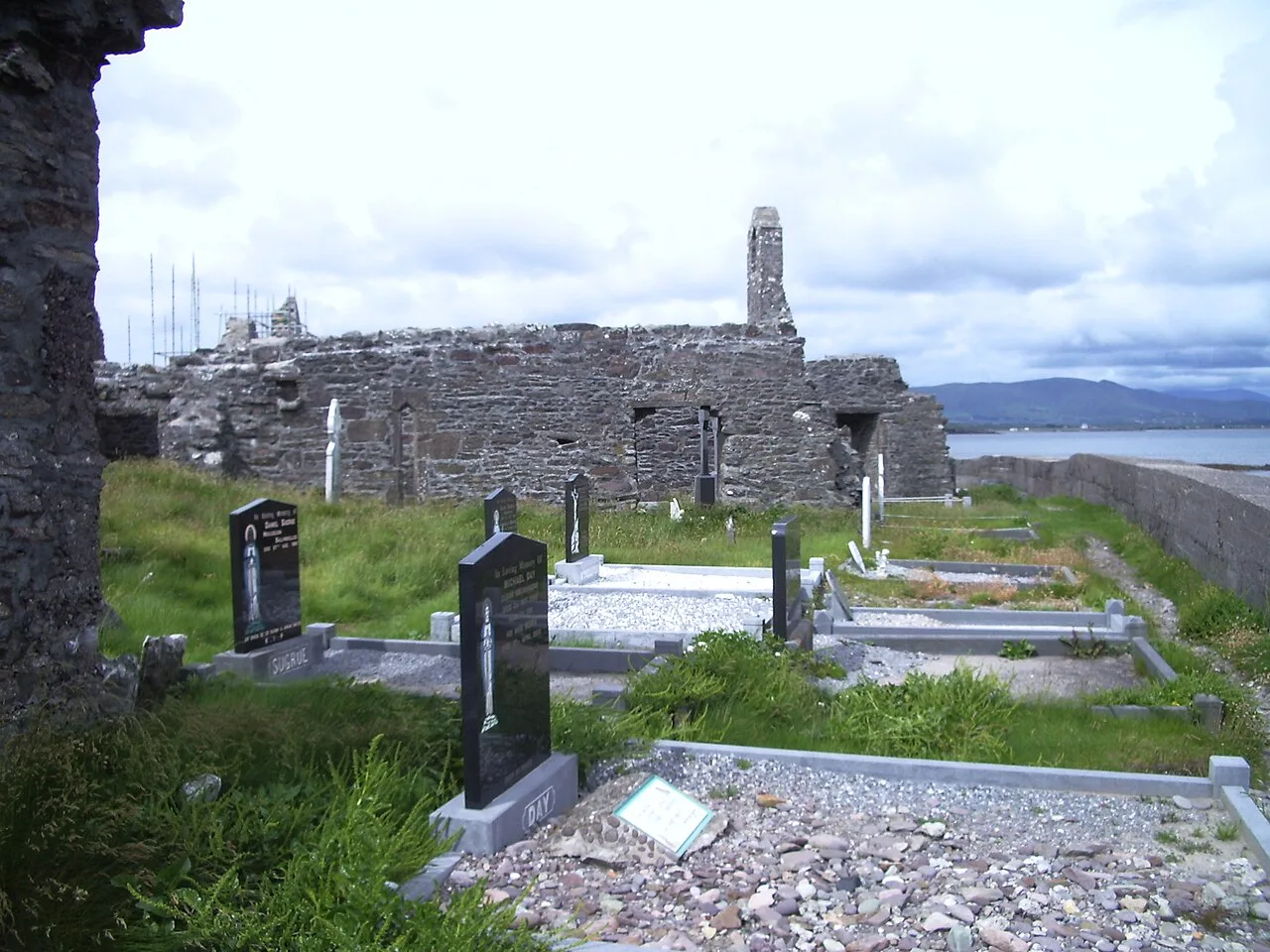
Centuries of coastal erosion have destroyed parts of the priory and its graveyard, and a sea-wall now protects what remains, according to the OPW. The same account suggests the chancel had collapsed by 1841, leaving only the surviving fragment of its wall with the bellcote above it. That makes Ballinskelligs an unusually legible example of how coastal weather, not only politics or religious change, has shaped an Irish monastic ruin.
Do not read the sea-wall as a restoration project or a promise that the site is stable. It is simply a defensive measure recorded by the OPW. Approach the shore-side walls with care, since the ground close to the water is exactly the kind of edge that has already been lost here.
Approaching the Site: A Dated Field Note
The abbey is not on a main road. One visitor's March 2025 field note describes reaching it at the end of a long, narrow lane beside a popular beach, with the abbey separated from the beach access by fencing. The same note says the car was parked at the entrance gate, and advises turning the car to face the way you came, because a second car can make turning difficult. Treat all of this as one person's observation on a particular day, not as official access information.
The practical implication is simple: expect a rural approach lane and, on the 2025 visitor's account, a small parking spot at the entrance rather than a visitor centre car park. If the turning point is occupied, patience is more useful than improvisation, and a vehicle that is easy to reverse makes the exit less stressful. Neither the OPW nor Discover Ireland publishes details of paths or surfaces at the site, so check locally if you have limited mobility.
Visiting Honestly: What the Site Offers
Ballinskelligs is an unguided site, and the OPW carries a notice asking visitors to take care and caution and stating that it accepts no responsibility for damage, injury or loss. That sets expectations: no staffed reception and no shelter. Wear footwear that can cope with uneven ground and damp grass, and keep children close around the standing walls and the shoreline.
No admission charge, opening hours, guided tours or on-site facilities are published for the abbey, so do not plan around any of them. The monument is protected under the National Monuments Acts 1930 to 2014, and its status is that of a state-guarded ruin rather than a managed attraction. Check the Heritage Ireland page before a long detour, in case a site notice has been added.
The one visitor detail beyond the official record is a metal table inside the walls displaying loose architectural remnants, noted in the 2025 field note. It is not described by the OPW, so do not count on it being there.
Nearby Context and What to Pair With It
Discover Ireland names the Emlagh Looped Walk nearby and mentions scenic views over the bay, which makes a walk a sensible companion to a look around the ruins. Beyond that, the source does not describe the walk's length, waymarking or difficulty, so check a current walking resource rather than relying on a guidebook.
Heritage Ireland lists a set of nearby sites including Derrynane House, Sceilg Mhichíl, Ionad an Bhlascaoid – The Blasket Centre, Ilnacullin – Garinish Island, Ross Castle and Ardfert Cathedral. These are listed names, not endorsements, and each has its own access arrangements. If you are touring religious ruins across the country, Corcomroe Abbey in County Clare and Jerpoint Abbey in County Kilkenny are other places linked from our broader guide to monasteries in Ireland, which gathers further examples. For the county's better-known medieval monuments, our Kilkenny heritage guide is the natural next read after Jerpoint.
Plan Your Visit
Ballinskelligs Abbey rewards a deliberately modest visit: read the nave, the cloister footings and the surviving chancel arch, then look out to the water that the community left behind. Go expecting no facilities and no formal interpretation, and the ruins will give you more than a tick-box stop. Check the Heritage Ireland page before you travel for any site notice, and treat visitor accounts as dated observations rather than current access information.
If you want to build a wider itinerary of Irish monastic sites, the monasteries in ireland collection sets Ballinskelligs alongside other abbeys, friaries and priories with their own surviving fabric and their own access rules. For a much larger and more heavily visited ecclesiastical complex of a different period, the Rock of Cashel in County Tipperary is a useful contrast on an inland touring route.
For more heritage reading, see our guides to Glendalough and Clonmacnoise, or for other monastic sites read about Kells Priory and Ennis Friary.
Explore more Ireland guides
Frequently Asked Questions
Is Ballinskelligs Abbey free to visit and is it guided?
No admission charge or guided tour is published for the abbey. It is an unguided National Monument in state guardianship, and the OPW asks visitors to take care and caution on site. Check the Heritage Ireland page before travelling in case a site notice has been added.
How much time should I allow at Ballinskelligs Abbey?
The standing remains are compact: a nave, part of a chancel with a bellcote, cloister area, the Prior's House and the refectory. Allow extra time for the rural approach lane, and more if you also walk the Emlagh Looped Walk named by Discover Ireland.
Can I walk from the beach to the abbey?
One visitor's March 2025 field note describes the abbey as separated from the beach access by fencing, so do not assume a direct route across the sand. Treat that as a dated observation rather than official access information and check locally on arrival.
Why was the abbey founded at Ballinskelligs rather than on Skellig Michael?
The OPW records that the priory was founded in 1210 by Augustinian Canons from Rattoo to house the Skellig monks, citing Viking raids, worsening conditions on the islands and changes in the Irish church. The move relocated an island community to a mainland site.
What is left standing at Ballinskelligs Abbey today?
The nave, part of the chancel wall with a bellcote, three south-west doorways, the cloister area, the Prior's House and the refectory. Graves marked by carved fragments fill the nave, and a sea-wall now protects the site from further coastal erosion.
What else can I see nearby?
Heritage Ireland lists Derrynane House, Sceilg Mhichíl, Ionad an Bhlascaoid – The Blasket Centre, Ilnacullin – Garinish Island, Ross Castle and Ardfert Cathedral as nearby sites, each with its own access arrangements. Discover Ireland also names the Emlagh Looped Walk for bay views.
Sources
You might also like



Continue reading
More guides you'll find useful





