
County Clare Castles: Tower Houses, Gardens and Castle Stays
County Clare castles range from a restored tower house at Quin to a castle hotel near Ennis. Learn what each place is and confirm access before you travel.
On this page
County Clare castles are best understood as several different kinds of place rather than one monument. A restored fifteenth-century tower house at Quin, a castle hotel on a historic estate, and a county-wide scatter of tower houses and fortified ruins all appear under the same word. The distinctions matter because each place offers a different visitor experience and a different set of access rules.
This guide separates what is documented from what still needs checking. Operator pages give the clearest picture of Knappogue Castle and its gardens, while a third-party booking listing describes Dromoland as a hotel. A county tourism board feature gives useful orientation for the wider spread of sites, but it is a curated overview rather than confirmation of current access.
What County Clare Castles Actually Are
The phrase covers at least three categories. There is a restored medieval tower house operated as a heritage and banquet venue, a luxury castle hotel on an estate associated with the O'Brien family, and a loose collection of tower houses, abbeys and fortifications that survive as ruins or partial structures across the county. Treating them as interchangeable leads to wasted journeys and wrong expectations.
The most reliable way to read the county is to start with the places whose operators publish their own information. Knappogue Castle at Quin and its formal gardens are described on the castle's own pages, which set out the building's history, the garden's design and the rules for visiting. Dromoland Castle, by contrast, appears in the sources here through a commercial booking listing rather than its own operator page.
Knappogue Castle at Quin
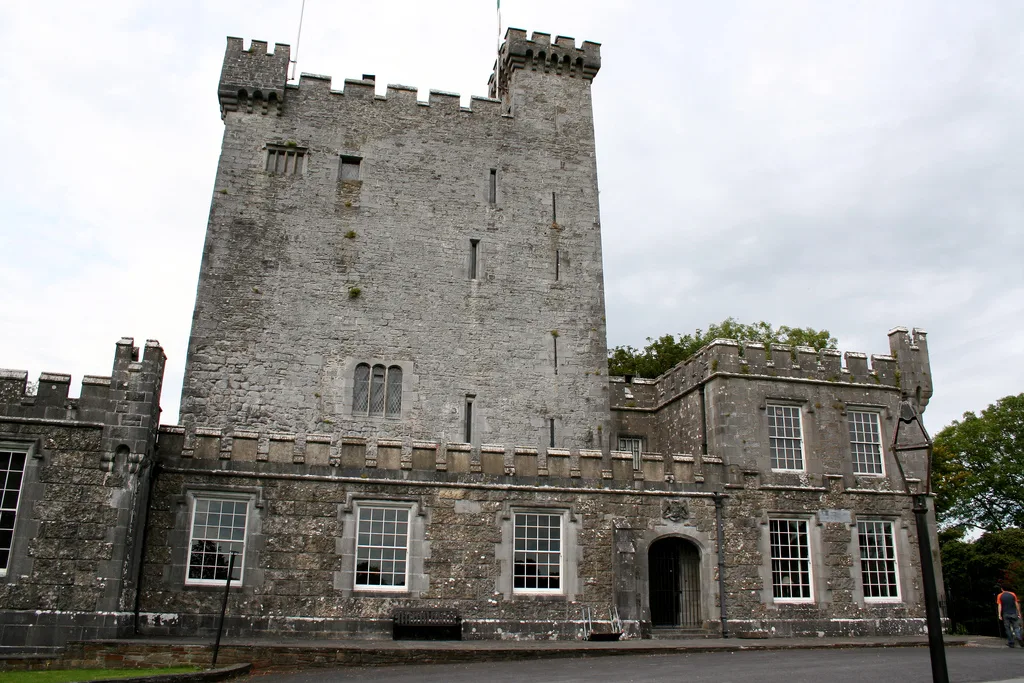
Knappogue Castle is a restored fifteenth-century medieval tower house at Quin in County Clare, described as such by its operator. Its identity as a tower house matters for planning: this is a compact medieval building rather than a sprawling later country house, and the visit is shaped around the structure and its restored setting. Quin sits in the same broad area as Ennis, which makes it a natural pairing with the town's other heritage sites.
The operator's garden page identifies the property as a restored medieval tower house at Quin, so the castle's present character is the result of twentieth-century work rather than continuous occupation. That restoration history is the key to understanding what a visitor sees today. It also explains why the gardens and the building are presented together as a managed heritage property.
Knappogue's Twentieth-Century Story
The castle's modern history is unusually well documented for a Clare tower house. During the Irish War of Independence, from 1919 to 1921, Clare County Council held meetings at Knappogue while guarded by the East Clare Flying Column, and Michael Brennan used the castle as a headquarters. In 1927 the Irish Land Commission purchased the property, and it was later owned by the Quinn family. After a period of disrepair, the Andrews family rescued it in 1966, and Mark Edwin Andrews, working with the Shannon Free Airport Development Company, carried out a major restoration in 1969.
That sequence explains why the building reads as restored medieval architecture rather than an untouched ruin. The War of Independence episode places the castle in a national political story, while the Land Commission purchase and the later Andrews restoration show how a disused tower house became a managed heritage property. Visitors interested in how Irish castles survived the twentieth century will find this timeline more revealing than the building's medieval origins alone.
Knappogue's Formal Gardens
The formal gardens at Knappogue were designed in the early 1980s by Lavone Dickensheets Andrews, a US architect, in collaboration with Shannon Development, and were officially opened to the public in 1985. The operator describes the garden as retaining its original tower, perimeter stone walls and beech hedging, with upper-terrace planting that includes Pieris, Rhododendron, Camellia and Magnolia stellata, and a lower garden with lime trees and formal box hedging.
The planting scheme is presented as largely unchanged for four decades, which gives the garden a specific period character rather than a constantly redesigned display. Seasonal interest is described across spring bloom and autumn colour in the beech hedging. For garden visitors, the value lies in seeing a designed 1980s landscape that has matured in place beside a restored medieval tower house.
The Garden Access Rule at Knappogue
The operator states that the gardens are accessible exclusively to banquet guests. That is the single most important practical point for anyone planning around Knappogue's garden: it is not described as a standalone garden attraction with separate general admission. A garden visit should be treated as part of attending a banquet rather than as an independent stop.
Banquet availability and booking arrangements are not set out in the material here, so confirm them directly with the castle before building a trip around the gardens. Readers who want a garden-led castle visit elsewhere in Ireland can compare how other properties manage house and garden access, for example at Huntington Castle, Clonegal in County Carlow. The comparison is useful precisely because access models differ so much between Irish castle properties.
Dromoland Castle as a Hotel
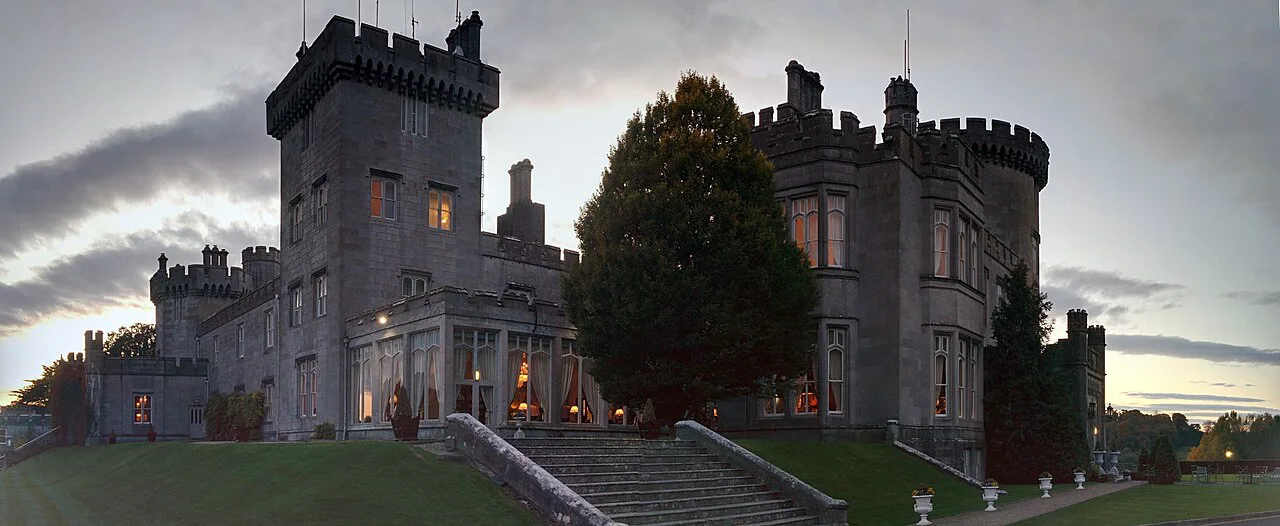
Dromoland Castle appears in the available sources through Celtic Castles, a third-party castle-booking and commercial listing rather than the hotel's own operator page. That listing describes Dromoland as a five-star castle hotel in County Clare, the ancestral home of the O'Briens of Dromoland, and a property with a 450-acre estate offering activities such as falconry, fishing, archery and clay shooting. These descriptions are the listing's marketing claims and should be read as such.
The listing also states that the castle has been welcoming guests since the 16th century and that the O'Brien lineage descends from Brian Boru. Those claims are attributed to the commercial listing and are not independently verified here. They are useful context for understanding how the property presents its history, but they are not evidence that the building operates as a public monument.
Reading Dromoland Claims Carefully
The practical difference between Dromoland and a heritage site is that Dromoland is documented as a hotel. The listing describes refurbished rooms, dining and estate activities, and places the property within reach of Ennis, which it notes has bus and rail links from Dublin, Galway and Limerick. None of that establishes that non-residents may walk the grounds, view interiors or dine without a booking.
Anyone hoping to see the castle should check directly with the hotel about what is open to non-guests before travelling. Treating a hotel listing as if it were a visitor-attraction page is a common planning error in Ireland, where historic houses and castle hotels often sit behind private or commercial gates. The same caution applies to other castle hotels covered in the castles in ireland guide.
The Wider County Picture from Visit Clare
Visit Clare, the county tourism board, publishes a curated feature on Clare's high towers and powers that groups castles, abbeys and other heritage sites into a single orientation piece. It is useful for seeing the range of places in the county, but it is an editorial overview rather than an operator page and does not confirm current opening, ticketing or interior access.
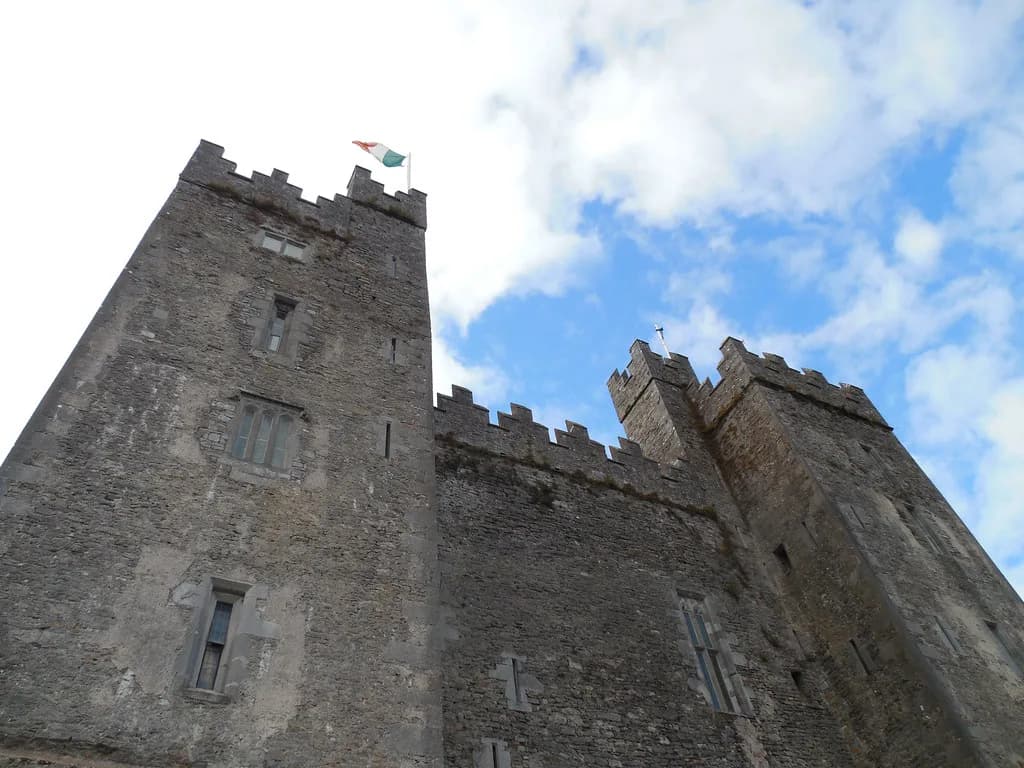
Two of its castle summaries are especially useful for orientation. It reports that the MacNamara family built the present structure at Bunratty Castle around 1425, and that by 1475 it had become the stronghold of the O'Briens. It also describes Carrigaholt Castle in West Clare as a tower house built around 1480 by the MacMahons on a promontory above the Shannon Estuary. Both are summary context, not access information.
More Tower Houses and Monastic Sites
The same county feature highlights Craggaunowen, which it describes as including a fifteenth-century tower house alongside reconstructed dwellings and a ring fort, and Dysert O'Dea, where a castle tower stands near an early Christian monastic site with carved stone crosses. These are different kinds of visit from Knappogue: one combines a tower house with an outdoor heritage experience, while the other pairs a castle tower with ecclesiastical ruins in a rural setting.
The same landscape holds abbeys and monastic remains such as Quin Abbey and Ennis Friary, which the county feature treats as part of the same heritage story. Readers drawn to the ecclesiastical and archaeological side of Clare can follow that thread through the ancient sites ireland guide. The point is that castles in Clare are rarely isolated monuments; they sit within a wider pattern of churches, abbeys and older settlement.
Choosing Between a Tower-House Stop and a Castle Stay
The sources document two clearly different experiences. Knappogue is presented as a restored tower house where the gardens are tied to banquet attendance, so a visit there is a heritage-and-evening proposition. Dromoland is presented as a hotel with an estate, so a stay there is a hospitality proposition. The county overview, meanwhile, reports a Bunratty building date of around 1425 under the MacNamaras. None of the three is documented as a straightforward daytime public monument with general admission.
A traveller who wants to walk through medieval architecture and gardens should plan around Knappogue's banquet arrangements and check them in advance. A traveller who wants to stay in a castle on a historic estate should book through the hotel and ask what guests and non-guests can access. For readers weighing castle stays more broadly, the Glenveagh Castle page shows how a castle visit can be structured around a national park setting rather than a hotel.
Planning by Geography
Clare's castle and heritage sites are spread across the county rather than clustered in one place. Knappogue at Quin and the Ennis area sit together in the east, and Visit Clare places Quin Abbey close to Ennis as well. Dysert O'Dea lies near Corofin, and Craggaunowen is presented as an outdoor heritage experience with reconstructed dwellings and a tower house, so these need their own travel time rather than being assumed to sit beside the Quin stops.
Carrigaholt Castle belongs to the coastal west, on a promontory above the Shannon Estuary, and pairs naturally with other West Clare stops rather than with the Quin cluster. The Dromoland listing notes that Ennis has bus and rail links from Dublin, Galway and Limerick, which makes the town a useful reference point for the eastern cluster, though specific travel times should be checked with transport providers. If you are basing yourself in the region's main city instead, the museums in Limerick guide covers its core collections for a rainy-day counterpart to the castles.
What to Confirm Before You Travel
No source here establishes current opening hours, tour schedules, banquet dates or admission prices for any Clare castle, so those details must come from each operator. Check the castle's own website or contact them directly, and confirm whether the gardens at Knappogue are reachable only through a banquet booking. For Dromoland, ask the hotel what non-residents may access before planning a visit.
Physical access is another point to raise directly. The material here does not describe step-free routes, lifts or accessible parking at any of these properties, and a website accessibility statement is not the same as information about the building and grounds. Travellers with mobility needs should ask the operator specific questions rather than assume.
Plan Your Clare Castle Visit
County Clare's castles reward a selective approach. Choose Knappogue if you want a restored tower house and a designed garden tied to a banquet evening, and choose Dromoland if you want a castle-hotel stay on a historic estate. Use the county tourism board's overview, which reports a MacNamara-built Bunratty structure around 1425, to see the wider spread of tower houses and abbeys, then verify access with each operator before committing.
Treat the eastern cluster around Quin and Ennis as one outing and the coastal West Clare sites as another. Confirm opening, booking and access details directly, since the sources here document identity and history more reliably than current visitor logistics. That check is what turns a list of evocative names into a workable trip.
Explore more Ireland guides
Frequently Asked Questions
What County Clare castles can you actually visit?
The sources here document Knappogue Castle as a restored tower house with banquet-linked gardens, and Dromoland Castle as a hotel on a historic estate. Visit Clare also groups Bunratty, Carrigaholt, Craggaunowen and Dysert O'Dea as heritage stops. Because no source confirms current opening arrangements, check each operator before travelling.
Is Knappogue Castle's garden open to general visitors?
The operator describes the formal gardens as accessible exclusively to banquet guests. Treat a garden visit as part of attending a banquet rather than as a separate garden admission, and confirm banquet availability directly with the castle.
Why are Knappogue's gardens linked to banquets?
The operator presents the gardens as part of the castle's banquet experience rather than as a standalone attraction. The garden was designed in the early 1980s by Lavone Dickensheets Andrews with Shannon Development and opened in 1985, and it is now described as reserved for banquet guests.
Is Dromoland Castle a public monument or a hotel?
The available description comes from a third-party booking listing that presents Dromoland as a castle hotel with an estate. It is not documented here as a public monument. Ask the hotel directly what non-residents may access before planning a visit.
Which Clare tower houses does the county tourism board highlight?
Visit Clare highlights Bunratty Castle, where it reports the MacNamaras built the present structure around 1425, Carrigaholt Castle, built around 1480 by the MacMahons, Craggaunowen's fifteenth-century tower house and Dysert O'Dea's castle tower. These are summary descriptions for orientation rather than confirmation of current access.
How should you plan a route between the Quin and Ennis castles and West Clare?
Group Knappogue at Quin with Ennis and the eastern heritage sites in one outing, and treat Carrigaholt and the coastal west as a separate day. Ennis has bus and rail links from Dublin, Galway and Limerick, which makes it a useful reference point, but confirm transport details with providers.
What should you confirm before travelling to a Clare castle?
Confirm current opening, banquet availability, ticketing and physical access directly with each operator, because the sources here do not establish current visitor arrangements. For Dromoland, ask what non-residents may access, and for Knappogue, confirm whether the gardens require a banquet booking.
Sources
- County Clare's “High Towers And High Powers" | County Clare, Ireland
- Dromoland Castle - 5-star castle hotel in County Clare, Ireland
- Castle Accomodation Ireland | Castle Accomodation Clare | Book Now | Knappogue Castle
- Knappogue Castle | Medieval Castle in Ireland | Things to Do In Clare | Book Now | Knappogue Castle
You might also like



Continue reading
More guides you'll find useful




