
Clonony Castle, County Offaly: History and Access Guide
Clonony Castle is a privately held tower house near Shannon Harbour, County Offaly. Learn its history and confirm access before you travel.
On this page
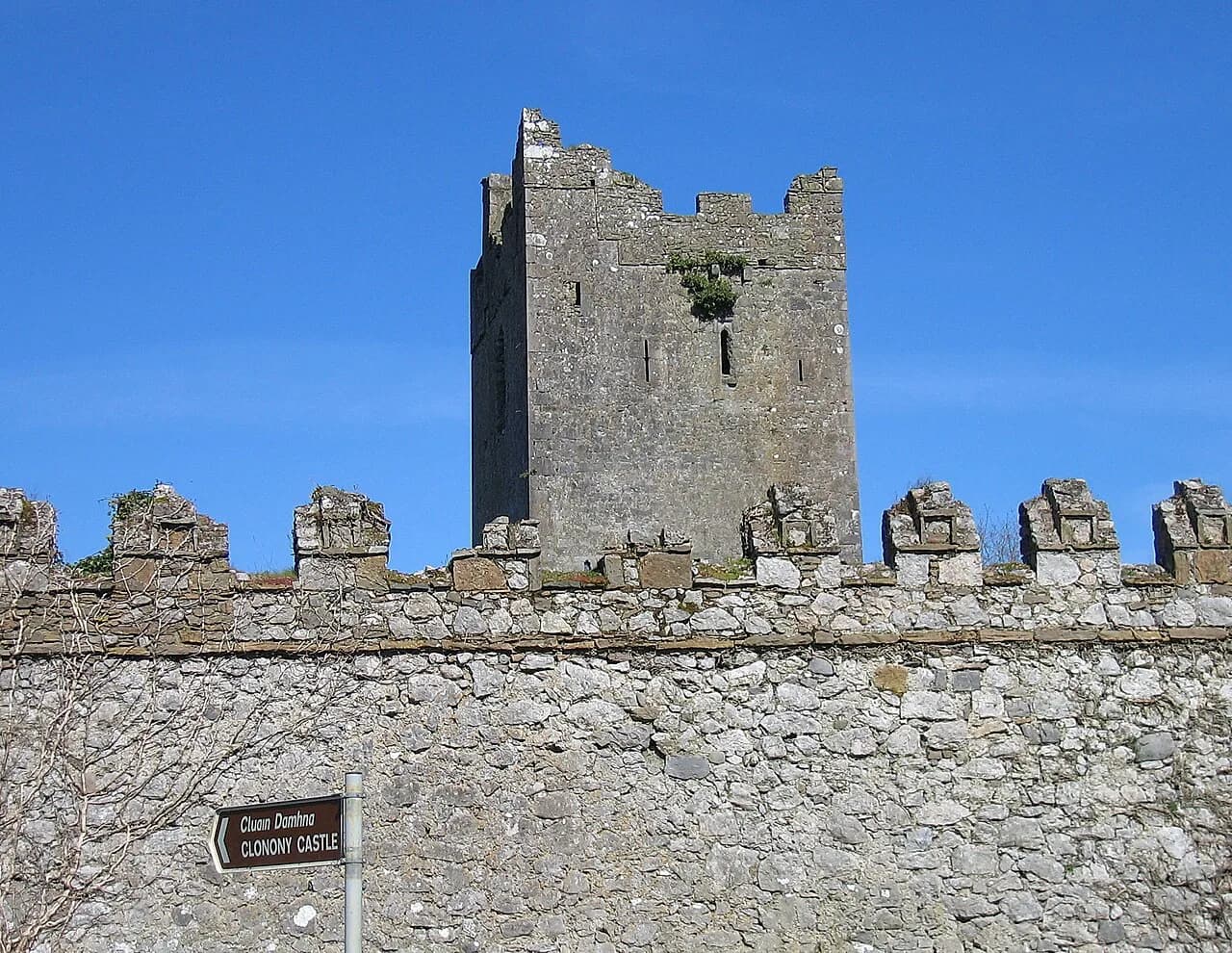
Clonony Castle is a three-storey tower house at Clonony More in west County Offaly, close to Shannon Harbour and not far from Ferbane. It is privately held rather than run as a staffed visitor attraction, so the first practical step is to contact the property before planning any stop. No opening hours, admission charge or tour schedule is currently confirmed in public sources. For wider context, see castles in county offaly.
What makes it worth the detour is the layering: a MacCoghlan stronghold in a contested Gaelic territory, a plantation-era owner, a nineteenth-century barrister's ornamental conversion, and a stewardship campaign now seeking to return it to clan care. The recorded monument number is OF022-008001, useful if you want to check the archaeological record yourself.
Access First: A Private Monument, Not a Visitor Attraction
Because the castle is in private hands, there is no safe assumption that you can go inside, and the honest starting point is an enquiry rather than an itinerary. The property's own stewardship page frames opening as a future goal: acquisition, stabilisation, restoration and eventual operation as a heritage destination are described as phases still to be carried out. Until that changes, treat any visit as conditional on a direct reply.
There is a precedent for limited seasonal opening: a 2019 local history account described the proprietor then hosting summer events and having the castle open, after years of restoration work. That is dated evidence of what happened around that time, not a standing promise. Anyone travelling in the off-season or on a weekday should assume nothing and ask first.
The site is protected under the National Monuments Acts, which does not by itself create a public right of way across the grounds. If you receive confirmation of access, ask specifically what is included, since the restored floors, roof deck and interior rooms are separate from a view of the exterior. This is the one place where a short email saves a wasted journey.
Orientation: Where the Castle Stands
Clonony sits on a limestone outcrop near Shannon Harbour in County Offaly, in the old territory of Delvin MacCoghlan, roughly the later barony of Garrycastle. The archaeological record gives precise coordinates, which is more reliable for planning than any description of gates or lanes. Note that there is no confirmed visitor car park, toilet or café, so plan facilities elsewhere in the area.
Nearby Ferbane and the Grand Canal give the castle a wider setting: this was a settled and contested part of west Offaly long before it became a heritage stop. If your priority is guaranteed interiors and grounds, the documented castles in county offaly offer more predictable days out, and pairing Clonony as an exterior stop with one of those is the sensible trade-off. If you are widening the search west of the Shannon, the castles in county galway follow the same rule of checking current access before setting out.
The MacCoghlan Tower House
The MacCoghlans were the ruling family of west Offaly and built several tower houses across their territory, with Clonony counted among them. The property site itself calls the building a fifteenth-century tower house, while the licensed archaeological testing describes an early sixteenth-century three-storey tower house; the discrepancy is worth knowing rather than silently resolving. Older names recorded for the place, Cluana Damhna and Cluain Nóna, appear in annals cited in heritage reporting.
Irish Heritage News, drawing on the Annals of the Four Masters, reports a 1519 killing at the castle during a MacCoghlan feud and a 1553 episode in which the castle was seized by a local man who turned on its warders. These are attributed episodes rather than neutral description, and they underline that Clonony was a working fortified residence in a violent political landscape. Read them as reported history, not as folklore dressed up as fact.
Form and Defensive Features
The tower house is roughly rectangular and built of coursed limestone rubble, entered through a rebuilt doorway in the west wall. Inside the entrance, a murder hole in the ceiling and gun loops in the walls show how security was designed into domestic space; a spiral stone stair in the south-western angle links the upper floors. The basement batter and the projecting machicolation complete the defensive kit.
Around the tower stand later inner and outer bawn walls and ancillary buildings on the west, south and east sides. The excavation record attributes the bawn areas to the eighteenth or nineteenth centuries and links possible construction of the walls and outbuildings to the early-to-mid nineteenth-century owner. That makes Clonony a useful teaching example of a medieval core wrapped in later layers rather than a single-period ruin.
The Boleyn Slab: Inscription Versus Tradition
In 1803 workmen recovered a large grave-slab near the castle commemorating two women named Elizabeth and Mary Bullyn, described on the stone as daughters within the Boleyn family line. Irish Heritage News reports that the slab can still be seen on the castle grounds, though its heavily weathered lettering limits what can be read on site. Because the grounds are private, seeing it depends on whatever access arrangement you have confirmed.
A widespread local tradition links the castle to Anne Boleyn's relatives, believed in some versions to have come west after her 1536 execution, though heritage reporting notes the details are hazy and stories about the sisters' deaths vary between versions. None of this establishes that Anne Boleyn herself lived at or visited Clonony, and the surviving slab should be treated as evidence of a family memorial, not proof of a queen's residence. Label the dramatic tales as legend when you repeat them.
Matthew De Renzi and the Plantation Years
After MacCoghlan power was forfeited in the early seventeenth century, a German-born cloth merchant named Matthew De Renzi acquired the castle and lands, later expanding his estate substantially. He learned Irish and compiled material on the language even while holding dismissive views of the native population, an uncomfortable combination that historians of the plantation period often cite. He died in 1634 and is buried at Athlone.
De Renzi's tenure is the reason Clonony appears in plantation narratives as well as castle lists: land changed hands under legal pressure, and the MacCoghlans contested the loss for years. The pattern of forfeiture and regrant recurs across the castles in county offaly, so Clonony is a useful case study rather than an isolated curiosity.
Counsellor Edmond Maloney's Ornate Residence
By the early to mid-nineteenth century the castle had passed to Edmond Maloney, a barrister associated with Birr, who set about turning the tower house into a more ornate residence. He widened narrow window openings, probably built up parts of the bawn and outbuildings, and is said to have created an observatory within the structure. The excavation record confirms the broad sequence of nineteenth-century alteration without dating every change.
Local memory attached flagstaffs on the battlements to his courtroom victories, and his relations with neighbours were poor enough that he faced armed hostility in the 1830s. He died in the 1840s, after which competing wills produced a court case over the estate. Treat the flag and observatory stories as tradition attached to a documented owner rather than verified detail.
Archaeology, Protection and Restoration
Before renovation, licensed testing in 2003 opened four small trenches that exposed the original clay floor, a nineteenth-century floor level, intact medieval vault fill and slate cladding on the wall-walk. These modest interventions are the documented archaeological basis for much of what is said about the building's sequence, which is why they are worth citing over picturesque guesswork. The monument is also subject to a preservation order.
Heritage reporting also records an 1851 find at the castle of an Elizabethan silver coin, a sword and a large skeleton, though interpretation of that assemblage remains limited. Restoration from 2010 replaced a collapsed floor, repaired the vaulted ceiling and installed modern services, work carried out under permission and monument legislation. If you want comparable excavated context elsewhere in the region, ancient sites ireland covers monuments where the record and the visit are better documented.
Stewardship and the Coghlan Vision
A campaign led by members of the Coghlan family aims to acquire the castle and convey it to a heritage trust, with four stated phases: secure the property, stabilise and protect the structure, restore and open it, and endow its long-term care. The property site describes the castle as the ancestral seat of the Uí Cochláin and presents the project as a return home for the wider clan diaspora. None of this means the transfer has already happened.
For travellers, the practical reading is simple: the castle is a protected monument with an announced ambition to become a heritage destination, but it is not yet operating as one with published hours. Check the stewardship site for any change in status shortly before you travel rather than relying on older accounts of summer opening.
Practical Trade-Offs for a Visit
If access is confirmed, the reward is close reading of a tower house with a layered story: medieval defences, plantation politics, a nineteenth-century makeover and an active conservation project. If it is not, an exterior appreciation combined with a documented site elsewhere gives a more reliable day out. Birr Castle Demesne is a long-established visitor property; consult its own guide and check arrangements directly before you travel.
Leap Castle, County Offaly is another tower house with a long and contested history; its own opening arrangements should be checked separately before you go. Pairing one confirmed interior visit with one exterior stop keeps expectations honest and the driving reasonable.
Plan Your Visit
Clonony Castle is best approached as a documented historic monument in private care rather than a guaranteed attraction. Contact the property first, read the stewardship page for current plans, and keep your plans flexible until you have a reply.
If the answer is no, the history still rewards reading, and Offaly has plenty of castles where the welcome and the opening arrangements are established. Use Clonony to understand how a Gaelic tower house became a plantation holding and then a Victorian residence, and let that context sharpen what you notice at the next one. For another heritage guide, read about Charleville Castle.
Frequently Asked Questions
Is Clonony Castle open to visitors?
There is no confirmed public opening at present. The property's stewardship page describes opening as a future phase of its restoration plan, and a 2019 account of seasonal opening is dated history rather than a current promise. Contact the property directly and confirm before travelling.
Can you go inside Clonony Castle?
Interior access depends entirely on the owner's arrangements at the time of your enquiry. Ask specifically whether the tower interior, floors or grounds are included, since a confirmed exterior visit does not necessarily mean the rooms are open. Do not assume entry on arrival.
Is there an entrance fee at Clonony Castle?
No admission charge is currently published, and none should be assumed in either direction. If access is arranged, ask the property what applies. Prices and conditions can change, so the owner's reply is the only reliable answer.
Was Anne Boleyn connected to Clonony Castle?
The connection rests on local tradition and on a grave-slab commemorating Elizabeth and Mary Bullyn, recovered near the castle in 1803. It does not establish that Anne Boleyn lived at or visited Clonony. Treat the dramatic stories about the sisters as legend and the slab as a family memorial.
When was Clonony Castle built?
The licensed archaeological testing describes an early sixteenth-century three-storey tower house with later eighteenth and nineteenth-century bawn areas. The property site calls it a fifteenth-century tower house. Both attributions are in circulation, so treat the construction date as approximate rather than fixed.
Who owns Clonony Castle now?
It remains privately held. A Coghlan-led initiative has announced a plan to acquire the castle and place it in a heritage trust, but that transfer is described as an aim rather than a completed fact. Check the stewardship page for the latest position before relying on it.
What is the Boleyn slab at Clonony Castle?
It is a large, weathered grave-slab found near the castle in 1803, inscribed to Elizabeth and Mary Bullyn and their Boleyn lineage. Heritage reporting says it can still be seen on the castle grounds, but the grounds are private, so viewing depends on confirmed access.
Where exactly is Clonony Castle in County Offaly?
It stands at Clonony More near Shannon Harbour, in west County Offaly not far from Ferbane, in the historic territory of Delvin MacCoghlan. The recorded monument number is OF022-008001, and the excavation record gives coordinates if you want to plot the location precisely.
Sources
- Jane Molony, the hot lover from Clonony Castle near Ferbane by Cosney Molloy. Blog No 121, 16th Feb 2019 – offalyhistoryblog
- Clonony Castle — Ancestral Home of the Coghlan Clan
- Stewardship | Clonony Castle
- 10572 - Excavations.ie
- Clonony Castle's rich heritage and ties to the ill-fated Queen of England Anne Boleyn
You might also like



Continue reading
More guides you'll find useful





