
Leap Castle, County Offaly: History, Architecture and Visiting
Leap Castle in County Offaly is part ruin, part private home. Explore its tower-house history, folklore, photo archive and how access is arranged.
On this page
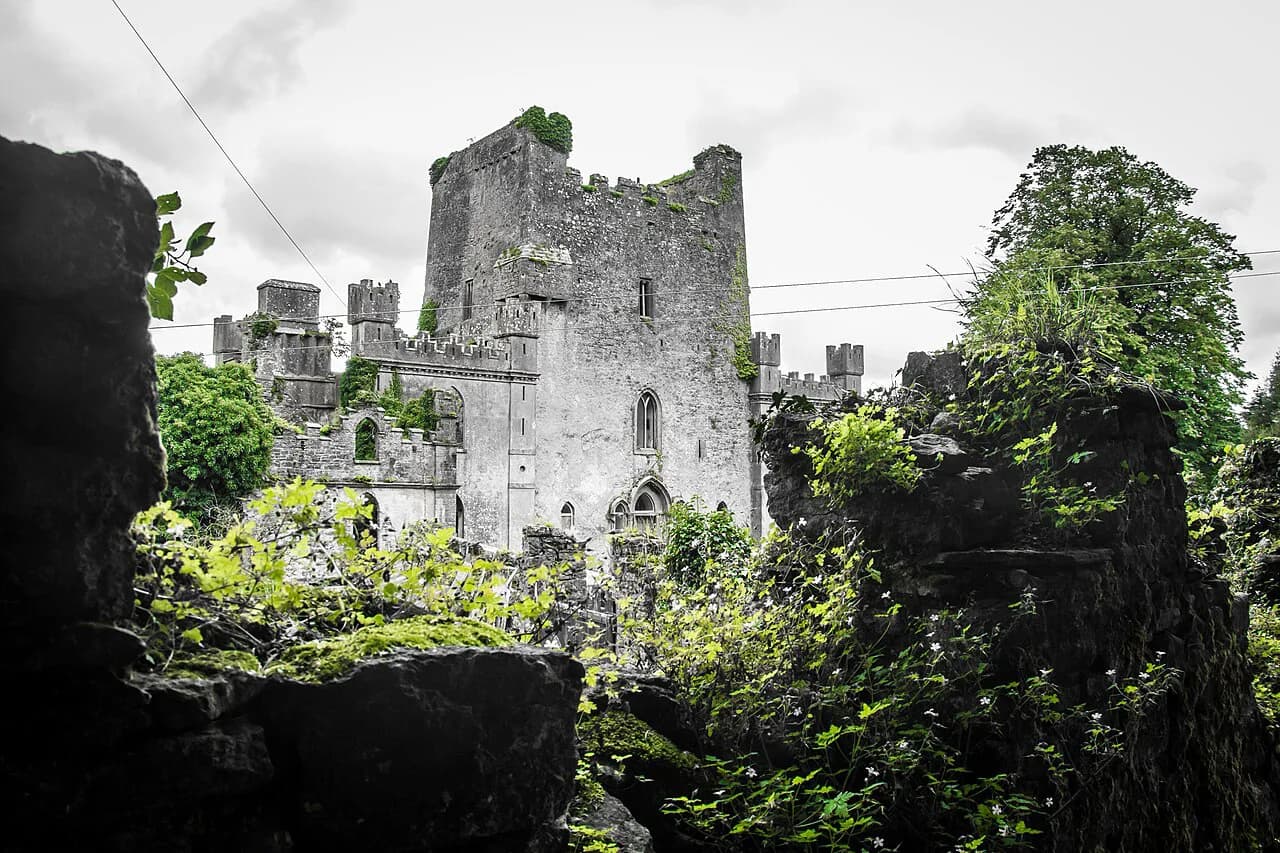
Leap Castle sits in County Offaly on the R421 north of Roscrea, a short drive from the western slopes of the Slieve Bloom mountains. It is not a conventional visitor attraction: the castle is a modified tower house with later wings, partly ruin and partly a private residence, and restoration work continues under its current owners. Plan a visit around permission rather than a ticket desk.
Most people arrive knowing the widely repeated description of Leap as Ireland's most haunted castle, a label drawn from decades of ghost lore and television coverage. The building rewards a different reading: its tower house, Jacobean and Georgian additions, and 1922 ruin tell a history of conflict, ownership and rebuilding. Treat the hauntings as stories with their own value, not as established fact.
What Leap Castle Is and Where It Stands
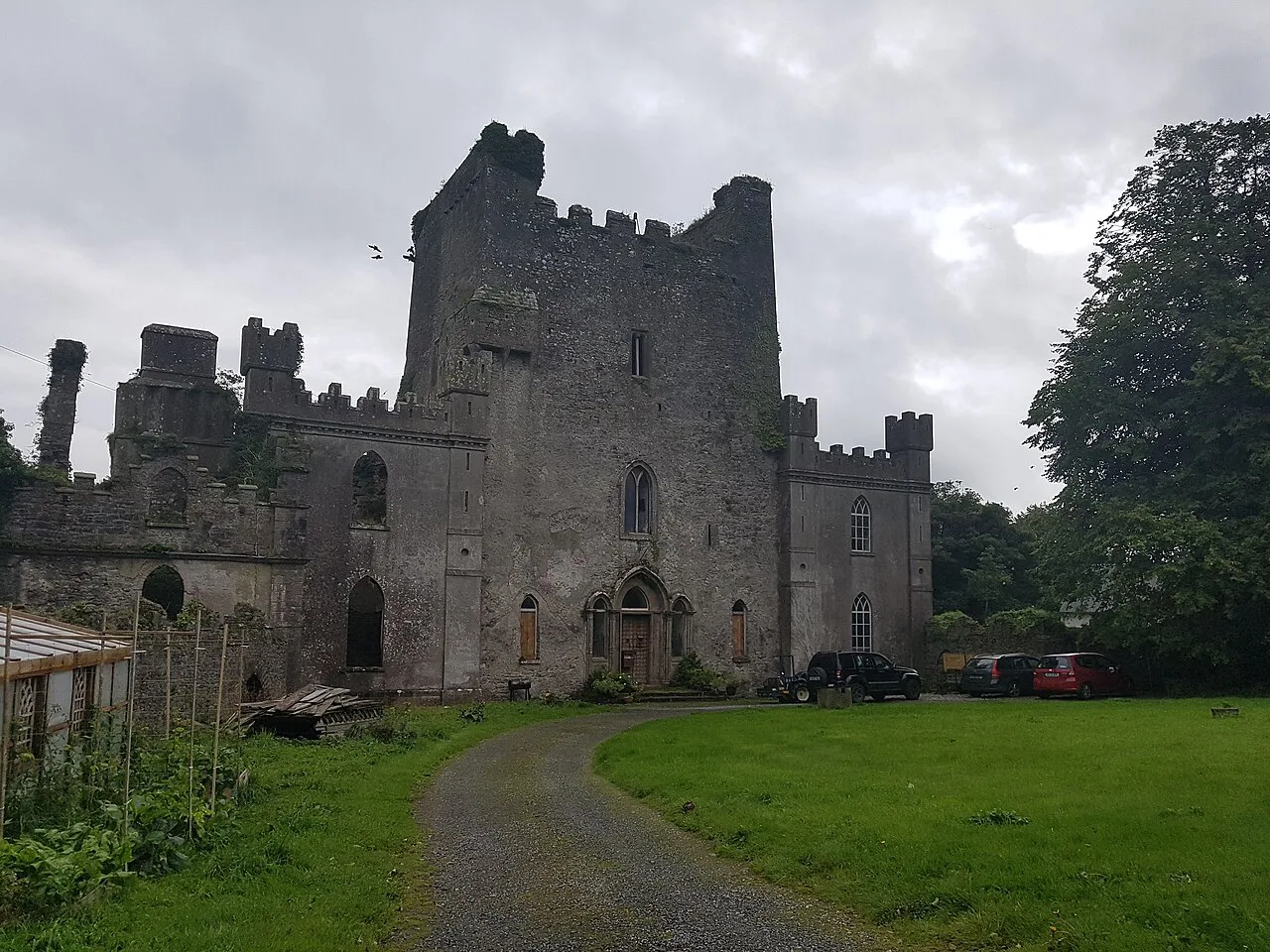
Leap is best understood as a modified tower house that was later converted into a fortified house, with the original medieval core still readable in the centre of the structure. The castle's own archive frames the site as a building that has been repeatedly altered, occupied, damaged and restored, which is a more accurate starting point than the ghost-show image.
The setting matters to the story: the castle was used as a principal stronghold by the O'Carroll clan to guard a pass through the Slieve Bloom mountains. Ireland.com places it in County Offaly countryside with the Slieve Bloom slopes in view, which helps explain why such a defensive site was worth contesting so often.
Two Origin Stories: O'Bannon Legend and O'Carroll Power
The castle's original Irish name, Leim Ui Bhanain, means the Leap of the O'Bannons, and the archive records a legend that two O'Bannon brothers settled a chieftainship contest by jumping from the rocky outcrop where the castle would stand. That should be labelled a tradition, not a documented event; it explains the name rather than the archaeology.
The documented story shifts quickly to the O'Carrolls, who made Leap their principal seat and whose reputation for ruthless internal rivalry shaped much of what followed. The O'Bannons are described as secondary chieftains under O'Carroll rule, and the operator's history page states the castle was taken from the O'Carrolls in 1642 by John Darby of the Cromwellian forces.
An Unresolved Dating Question
Visitors looking for a single construction date will not find one settled here. The operator's archive gives a traditional early-sixteenth-century origin for Leap while noting that an Archaeological Inventory excerpt characterises the surviving tower house as late sixteenth century, and the site explicitly preserves that disagreement rather than resolving it. Treat any confident single date with caution.
Conflict and Rebuilding in the Sixteenth Century
An independent heritage account reports that the castle was attacked in 1514 by the Earl of Kildare and again in 1516, and that it was deliberately set on fire in 1558 to keep it from Elizabethan forces, who occupied it anyway before the O'Carrolls recovered it within a year. These are reported events from a secondary source rather than formal excavation findings, and they read as history rather than spectacle.
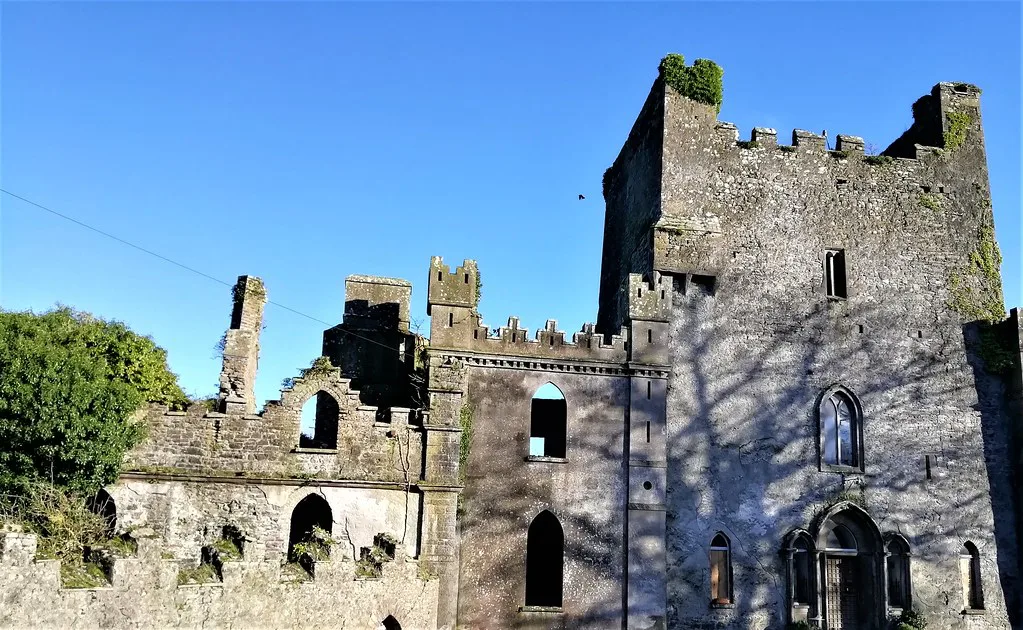
That same account describes Leap as a tower house adapted into a later fortified house, with the medieval core still visible among later additions. For a visitor trying to read the building, that layering is the key: each period of occupation and damage left something behind, and the wings show it more plainly than the tower.
The Darby Era and the Remodelling Programme
The Darby family held Leap from 1642 until the burning of 1922, according to the operator's history, and they were responsible for most of the castle's remodelling. The archive records extensive Darby-era work beginning in 1753, and an independent account notes seventeenth-century Jacobean and later Georgian additions on the north side of the tower house.
Mildred Darby, who lived at Leap in the early twentieth century, is associated in the archive with the rediscovery of hidden spaces including a guardroom and lower stair access. Her investigations belong to the family's own account of the house, and they sit alongside the period photographs that survive from before 1922.
1922 and the Making of the Ruin
Two successive fires in 1922 destroyed the inhabited wings and left Leap a ruin, and the archive records looting and aftermath as part of the same episode. An independent account specifies that the destruction involved bombs and petrol during the Civil War, which explains why the later additions are in worse condition than the medieval tower today.
The ruin stood dormant until Peter Bartlett bought the castle in 1974 and began preliminary restoration, work that has continued under Seán Ryan and Anne Callanan-Ryan. Ireland.com notes that Seán Ryan and his wife have lived at the castle since 1994. The house is therefore a working restoration project rather than a frozen monument, and that is visible in how the building is used and protected.
Reading the Building Today
Visitors who reach the interior describe restored ground and first floors, a fine medieval fireplace, a small gallery reached by a spiral stair, and windows that look like later insertions. The upper level is the so-called Bloody Chapel, with the oubliette shaft below it, a feature noted for being unusually accessible compared with similar castles.
Not all of the castle is open ground. The same account reports that the north wing is derelict and too dangerous to enter, while the south wing is private and occupied by the Ryan family, so a visit should not be treated as a free run of the whole building. Watch your footing on upper levels, where the report warns of tripping hazards near the machicolation.
Visitors to the interior describe coats of arms, wooden beams, statues and whitewashed stone walls that keep much of the castle's medieval character alongside later furniture. Access to the upper floors in that feature involved an owner-led walk with torches up a dark spiral stair, which is a visit context rather than a published tour schedule.
Folklore, Evidence and the Archive's Method
Leap's ghost stories include the Red Lady, associated with the Darby family, a Governess said to favour blonde visitors, and reports of two girls called Emily and Charlotte. The archive treats apparitions as paranormal testimony attributed to witnesses, not as verified history, which is the right framework for reading them.
The most elaborate account is the seventeenth-century report attributed to Mrs Jonathan Darby of a creature called an elemental, preserved in full in an independent account. The traditionally told story of a brother killing his brother at the altar in the chapel is likewise repeated as tradition rather than established fact, and both are best read as stories with their own afterlife.
The archive's own approach is to separate documented history, historical accounts, oral tradition, paranormal testimony and legend into distinct categories. Useful as that is for researchers, it also helps visitors decide what they are looking at when a guide or a television programme mixes the categories together.
The Pre-1922 Photograph Archive
Very few photographs of Leap survive from before the 1922 burning, particularly of interior spaces, which is why the archive is worth browsing before a visit. It holds named exterior views from the western, south-eastern, north-eastern and northern sides, plus images identified as Mildred Darby in the Great Hall and a gallery in the Upper Hall.
Five of these images are presented as AI-assisted digital restorations paired with the untouched source scans, and some credit the David O'Bannon collection. Compare the restored and original versions rather than treating a restoration as an unaltered photograph, and note that rights and provenance review is described as ongoing.
Arranging Access and Behaving on Site
Any visit has to start with contact rather than arrival. A 2009 account reports that entry was by appointment only, that the approach is a gated driveway a little further along the road rather than the house in front, and that visitors should ask permission and respect the family's privacy. That is dated guidance, so check directly with the operator before travelling.
Ireland.com notes that Seán Ryan and his wife have lived at the castle since 1994, which underlines that this is a home as well as a monument. Ask about the current position on visits, what parts may be seen, and any conditions attached, rather than assuming a time or fee.
Practical Orientation in County Offaly
For planning, the castle's published location on the R421 north of Roscrea, with an OS grid and GPS reference taken at the entrance gate, is the most reliable starting point. Do not assume parking, signage, toilets or other facilities at the site itself; confirm the approach and any access conditions with the operator before travelling.
If you want a broader castle itinerary in the county, pair a Leap enquiry with a separate documented site such as Birr Castle Demesne, checking its opening arrangements independently before you travel. If you are weighing up how much of a day to give over to fortified sites, it also helps to see how access works at the castles in county galway before committing your itinerary.
Plan Your Visit
Leap Castle rewards travellers who come for the building first and the ghost stories second. The tower house, its Darby-era additions and its 1922 ruin are the substance; the hauntings are lore that the archive is careful to label as such. Read the pre-1922 photographs before you go so the surviving fragments of interior make sense.
Contact the operator before you travel to confirm whether visits are currently possible and on what terms: a 2009 account reported entry by appointment only and asked visitors to respect the family's privacy, and the castle remains a private residence. Then plan the rest of your County Offaly day around places with clear public arrangements, using a wider guide to Castles in County Offaly to choose. If you want more heritage stops, see Charleville Castle and Clonony Castle. Travelling further west, you can compare access arrangements at the castles in county galway before setting out.
Explore more Ireland guides
Frequently Asked Questions
Can you visit Leap Castle?
Access is permission-led. A dated visitor account from 2009 reports entry by appointment only, through a gated driveway separate from the house in front, with a request to respect the family's privacy. Because the castle remains a private residence, contact the operator to ask whether visits are possible and what they involve before you travel.
Why is Leap Castle called the Leap of the O'Bannons?
The castle's original Irish name, Leim Ui Bhanain, translates as the Leap of the O'Bannons. The castle archive records a legend that two O'Bannon brothers competed for the chieftainship by jumping from the rocky outcrop where the castle was later built. It is a naming tradition rather than a documented historical event.
When was Leap Castle built?
The date is not settled. The castle archive gives a traditional early-sixteenth-century origin while noting that an Archaeological Inventory description characterises the surviving tower house as late sixteenth century, and the archive deliberately shows that disagreement rather than resolving it. Read any single construction date as one reading among others.
What happened at Leap Castle in 1922?
Two successive fires in 1922 destroyed the inhabited wings and left the castle a ruin, with looting recorded in the aftermath. An independent account specifies bombs and petrol during the Civil War. That destruction is why the later additions are in far worse condition than the medieval tower core.
Is Leap Castle really the most haunted castle in Ireland?
That is a widely repeated description rather than a verifiable fact. The ghost stories, including the Red Lady and the Governess, circulate through tourism features and visitor retellings, while the castle archive classifies apparitions as paranormal testimony or legend rather than documented history. Treat the label as folklore.
What parts of Leap Castle can be seen?
Visitors who have been inside describe restored lower floors with a medieval fireplace, a gallery and a spiral stair, plus the upper chamber known as the Bloody Chapel and the oubliette below it. An independent account reports the north wing as derelict and unsafe and the south wing as private and occupied, so the whole site is not walkable.
Are there photographs of Leap Castle before 1922?
Very few survive, especially of interior spaces. The castle archive holds named exterior views plus Great Hall and Upper Hall images, some credited to the David O'Bannon collection. Five are presented as AI-assisted restorations paired with the retained source scans, so compare both versions rather than assuming a restoration is an original.
Sources
You might also like



Continue reading
More guides you'll find useful




