
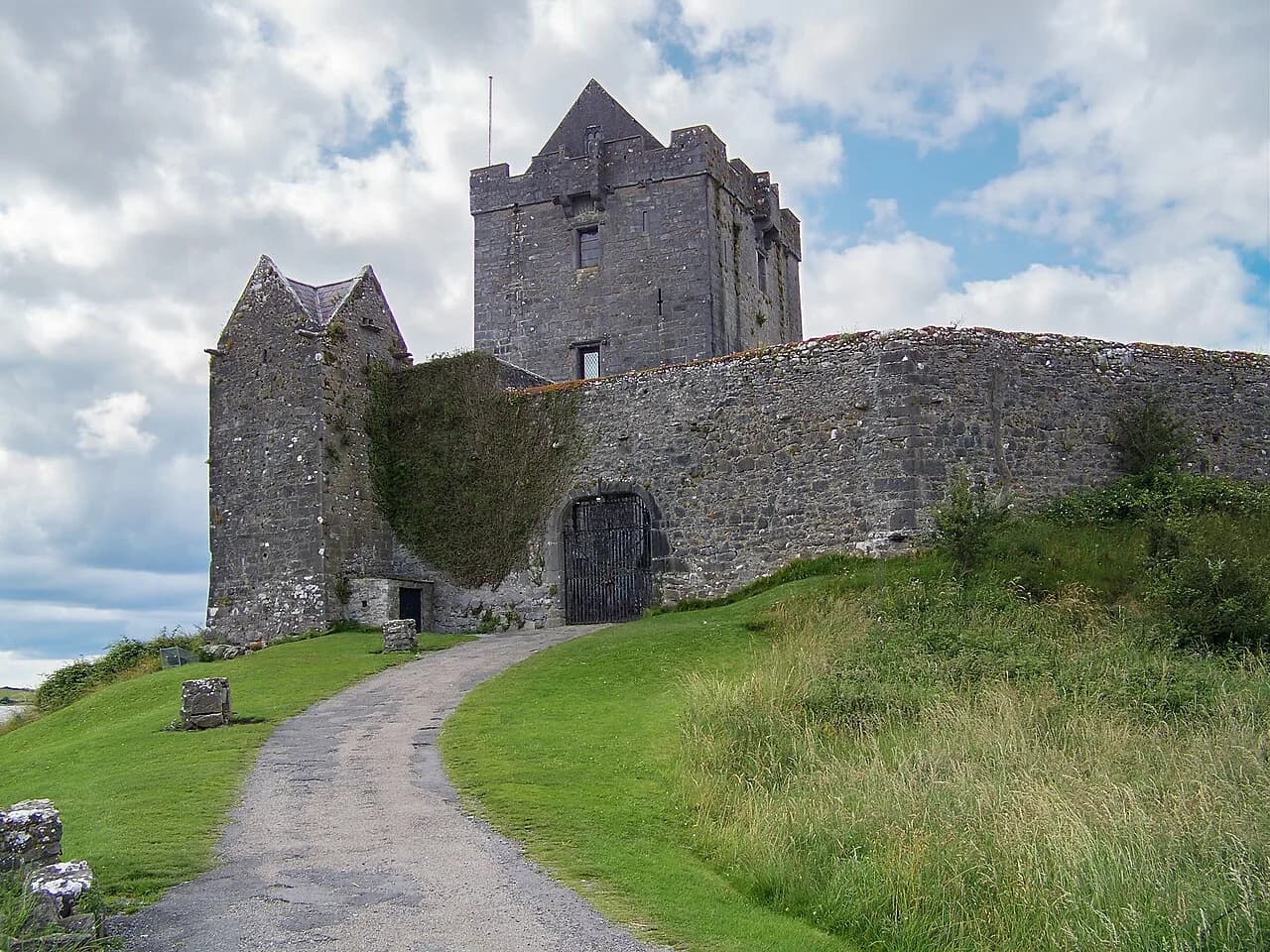
Dunguaire Castle, Kinvara: History and Current Visitor Status
Dunguaire Castle in Kinvara is a 16th-century tower house tied to the Literary Revival, but it has been closed since 2023. Here is what you can and cannot see.
On this page
Dunguaire Castle is not currently an attraction you can tour. The tower house stands at Kinvara on the edge of Galway Bay in County Galway, and it has been closed to visitors since 2023; the operator's site still carries a closure notice, and the castle remained locked as of a Seanad contribution on 24 September 2026.
That status matters before anything else, because most of what has been written about Dunguaire describes banquets, tours and a restored interior that are not presently on offer. What remains is a compact, highly recognisable tower house in a shoreline setting, with a history that runs through the Celtic Revival and two 20th-century restorations. If you are weighing which Castles in County Galway to build a day around, this one should be planned as a pause, not a visit. Readers building a broader city itinerary can pair it with the Museums in Galway City: Two Places Worth Your Time for an indoor alternative.
Where Dunguaire Castle Stands
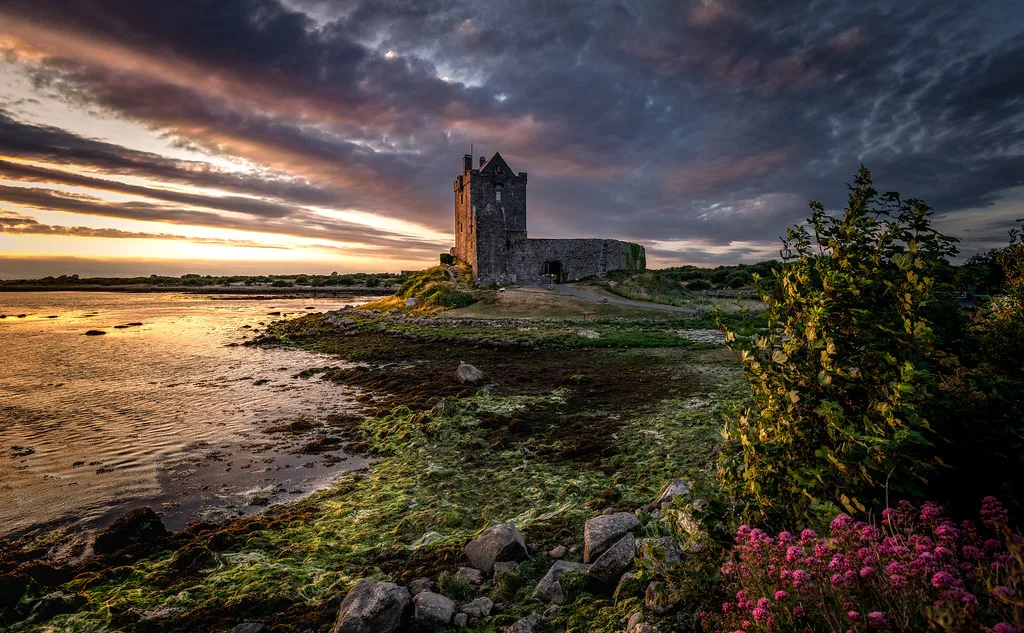
The castle occupies a rocky outcrop on the shores of Galway Bay, as the operator's own history page describes it, at Kinvara in south County Galway. That position on the water is the reason the building reads so clearly from a distance: it is a vertical stone form against a low horizon rather than a ruin folded into fields.
Its setting on the Wild Atlantic Way explains why coach parties keep arriving even in closure. A senator speaking in September 2026 noted that tour buses still come and that visitors can only look in through the gates, which tells you what to expect on the ground rather than what a brochure promises. Treat the castle as a landmark you pass and observe, not a stop with a desk and a guide.
Built Form: A Restored Tower House
Dunguaire is described by its operator as a restored 16th-century tower house, and the description is worth taking literally. A tower house is a tall, narrow defended residence, so expect a strong vertical mass and thick walls rather than the spread of a courtyard castle. Nothing in the published material gives interior room counts or layout, so do not arrive with a mental floor plan.
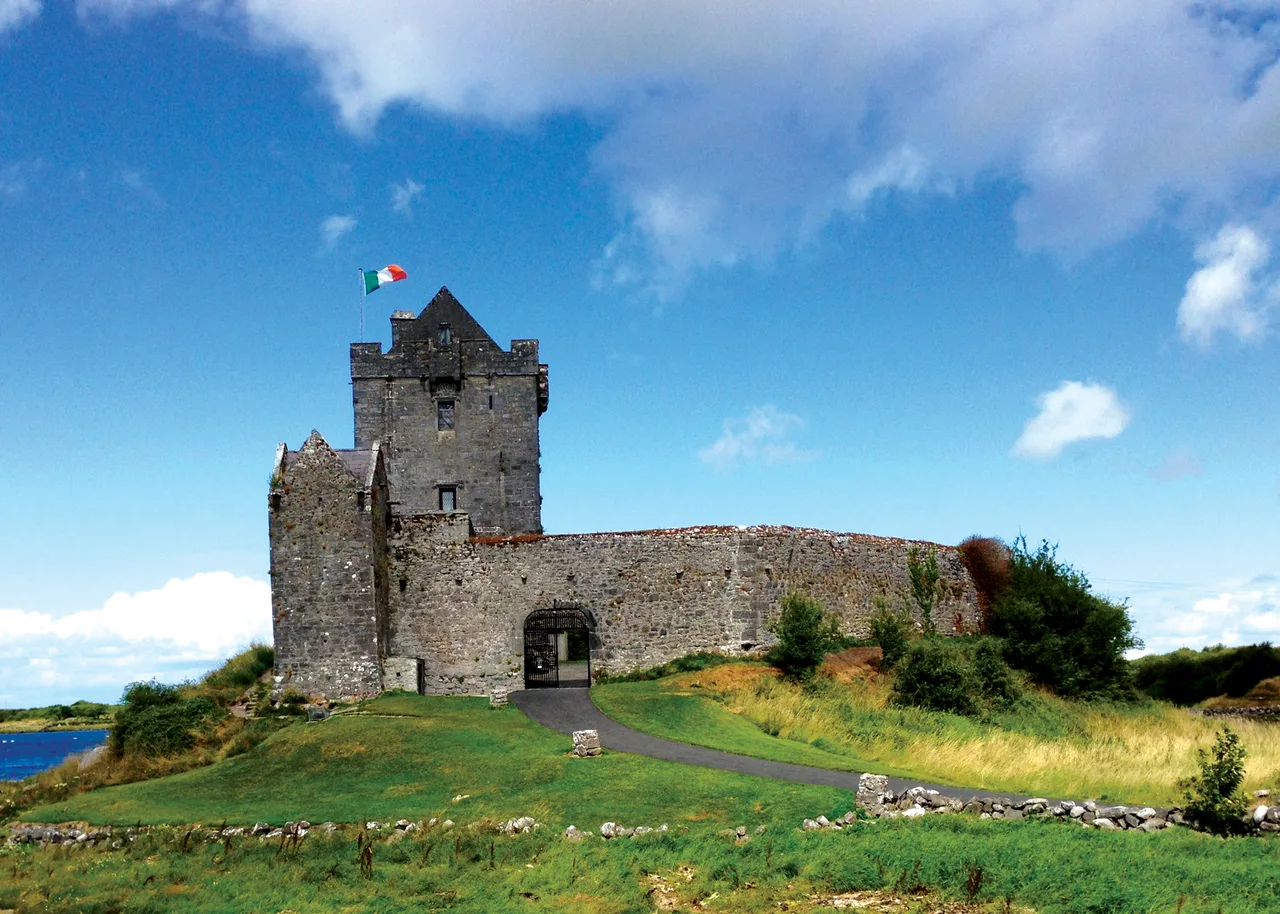
The word restored carries real weight here, because the building has been altered twice in the last century. What you see from outside is a 16th-century structure as repaired and finished in the 1900s, not an untouched medieval shell. Reading it that way sharpens the exterior view: you are looking at a building whose present appearance is partly a modern decision.
Dating and the Question of Who Built It
The operator dates construction to 1520 and attributes it to the O'Hynes clan, but that attribution should be presented as the operator's dating rather than as a settled fact. The castle's origins are frequently discussed in local and popular accounts, and the safest position for a visitor is the modest one: a 16th-century tower house with a traditional founding date.
This is not pedantry. Early tower house histories in Galway were transmitted through family tradition and later antiquarian writing, and claims about founders can conflict between sources without either being careless. If the identity of the builder matters to your reading of the place, ask at a local heritage or library service rather than relying on a single sign or webpage.
Oliver St John Gogarty and the 1924 Repair
In 1924 the castle was bought and repaired by Oliver St John Gogarty, the surgeon and writer, according to the operator's history. That date places the building's revival squarely inside the years of the Celtic Revival, when Irish writers and patrons were actively reworking the country's medieval and bardic past into new literature. Gogarty's purchase is the hinge between Dunguaire as a decaying old structure and Dunguaire as a literary address.
The operator's page notes that the castle became a venue for meetings of literary revivalists. Read that as documented association and context, not as a record of a particular evening: no published source here lists who was in the room on a given date. It is enough to know that the building entered the Revival's social orbit rather than standing apart from it.
Literary Associations, Handled With Care
The names the operator connects to the castle's Revival context include W.B. Yeats, Lady Gregory, George Bernard Shaw, Edward Martyn and J.M. Synge. One detail requires care: Synge died in 1909, well before Gogarty's 1924 purchase, so he cannot have attended gatherings in the castle after that repair. The association is with the movement and its milieu, not with a single house party.
For a visitor, that distinction changes how the place should be imagined. Dunguaire is interesting because a defined literary circle valued and used Irish historic buildings, and this one came into that circle through Gogarty. It is a story about taste, patronage and restoration as much as about poetry written under a particular roof.
Lady Ampthill and Later Stewardship
In 1954 the castle was acquired by Christobel Lady Ampthill, who completed the restoration Gogarty had begun, the operator reports. Her work is why the building presents as a finished structure rather than a stabilized fragment. The castle subsequently passed to Shannon Heritage, again according to the operator, which is the ownership strand that leads toward its later commercial use as a visitor attraction.
That sequence matters when you read current news about the site's future, because responsibility for the building has changed hands more than once in living memory. A tower house that has been bought, repaired and transferred repeatedly is a building whose condition reflects decisions as much as weather.
What the Restored Interior Was Meant to Show
The operator frames the restored castle as giving an insight into the lifestyle of the people who lived there from 1520 into modern times. That is an interpretive claim about how the rooms were presented when the castle operated, not a description of contents you can now walk through. Until the castle reopens, treat it as a statement of intent rather than an available exhibition.
It is also a reminder that Dunguaire's recent past included furnished display and evening entertainment, formats that depend on an intact interior and staff on site. Those operations are exactly what a closure interrupts, which is why the operator's current notice should override older tour and banquet pages you may find in search results.
Current Status: Locked Since 2023
The castle has been closed since 2023, a fact confirmed both by local reporting and by the Seanad record of 24 September 2026. A Galway newspaper reported that the gates have remained locked and that no reopening date has been announced. Nothing published since then establishes a reopening, so plan on the basis that the interior is unavailable.
The same reporting describes deterioration linked to a lack of maintenance, with concern about water ingress into a protected structure. That is a conservation problem rather than a cosmetic one, and it helps explain why reopening is not simply a matter of unlocking a gate. If your trip depends on getting inside, confirm the position with the operator before you travel.
Ownership and the Transfer Question
According to the Galway Advertiser, Shannon Airport Group owns the castle and closed it in 2023, later offering to transfer it to Galway County Council or the State; the paper reports that no transfer had been completed and no restoration plan presented. Those are the newspaper's characterizations and should be read as reporting on an unresolved situation, not as a settled account agreed by every party.
For visitors the practical consequence is simple: there is no published timetable to plan around. Ownership and funding questions of this kind can move slowly, and announcements may come through the operator, the council or the press rather than a ticket page. Checking news and the operator's site closer to your dates is more reliable than assuming last year's position still holds.
The Kinvara Campaign
A community campaign in Kinvara has pressed for the castle's protection and reopening, and its stated asks include a government commitment to acquire the site, a clear timetable for transfer, urgent protective work and eventual reopening as a heritage attraction. These are campaign demands, not government commitments, and they should be described that way.
The campaign's significance for a visitor is contextual rather than operational. It shows that the closure is contested locally and has drawn wider attention, including international press coverage as reported by the newspaper and referenced in the Seanad. That attention may influence outcomes, but it does not open a door today.
Reading the Building From Outside
From public ground around Kinvara the castle reads as a single tall block set close to the water, the classic tower house silhouette. Stand back and look at the proportion between height and footprint against the low horizon; that massing is the reason the site photographs so well, and it is legible without entry.
Do not expect facilities or a formal viewing arrangement; none are published for the closed period. Practical details such as where to leave a car or how close you can stand safely are best judged on arrival and by respecting whatever barriers or signage are in place. If you want a castle you can actually enter in the same county, Aughnanure Castle near Lough Corrib is the better match for a dedicated outing.
When a Stop Still Repays the Detour
If your route already passes through Kinvara, an exterior look costs little and the setting alone justifies a short pause. The trade-off is that you will not gain interior access, interpretation panels or a guided narrative on site, so the visit is architectural and atmospheric rather than instructive. Build the stop around the building and the bay, not around a hoped-for tour.
If Dunguaire is the sole reason for a long journey, defer it until reopening is confirmed by the operator. Other County Galway sites make a more dependable day, including Athenry Castle, Portumna Castle and Gardens and Aughnanure Castle, which is the county's classic tower house for a dedicated outing.
A Landmark in Transition
Dunguaire Castle is best understood right now as a heritage building between roles: a 16th-century tower house restored in the 20th century, associated with a literary movement and a chain of owners, and currently locked while questions of responsibility and repair are worked out. Describing it as an open attraction would be inaccurate, and describing it as lost would be worse.
Plan an exterior view if you are nearby, keep your expectations honest, and check the operator's notice and recent reporting before any trip made specifically to get inside. Readers who want to compare it with castles that are open can start with the wider selection of castles in county galway, where Dunguaire belongs as a landmark rather than as a destination with a ticket desk.
Explore more Ireland guides
Frequently Asked Questions
Is Dunguaire Castle open to visitors?
No. The castle has been closed since 2023, and the parliamentary record of 24 September 2026 still treats it as closed. No reopening date has been announced, so there are no interior tours, banquets or grounds admission to book at present. Check the operator's site before travelling.
Why has Dunguaire Castle been closed?
Local reporting describes a closure that began in 2023 and has continued while ownership and restoration questions remain unresolved, with concern about deterioration and water ingress in a protected structure. The newspaper reports that no transfer of ownership had been completed and no restoration plan presented, though those are its characterizations of an unresolved situation.
Can you still see Dunguaire Castle from outside?
Yes. The castle is a visible landmark on its rocky outcrop by Galway Bay, and both the Seanad record and local reporting describe visitors arriving and viewing it from the gates. What you cannot expect is any guarantee of interior or grounds access.
Who built Dunguaire Castle and when?
The operator dates construction to 1520 and attributes it to the O'Hynes clan, but that should be read as the operator's dating rather than a settled finding. Accounts of the castle's origins vary, so treat the founding story with appropriate caution.
What connects Dunguaire Castle to Yeats and the Literary Revival?
Oliver St John Gogarty bought and repaired the castle in 1924, during the Celtic Revival, and the operator says it became a venue for meetings of literary revivalists and names figures including Yeats, Lady Gregory, Shaw and Synge. Because Synge died in 1909, the connection is to the movement and its milieu rather than to gatherings after 1924.
Who owns Dunguaire Castle now?
The Galway Advertiser reports that Shannon Airport Group owns the castle and offered to transfer it to Galway County Council or the State, with no completed transfer at the time of its report. Because ownership is contested and evolving, verify the current position with the council or the operator rather than relying on older accounts.
Is it worth stopping at Dunguaire Castle while it is closed?
It is worth a short pause if Kinvara is already on your route, because the tower house form and shoreline setting read well from outside. It is not worth a long dedicated journey while there is no confirmed access; choose an open site such as Aughnanure, Athenry or Portumna for a castle-focused day.
When might Dunguaire Castle reopen?
No reopening date has been published. The campaign in Kinvara has asked for a transfer timetable and protective works, but those are campaign demands rather than commitments. Watch the operator's site and local Galway reporting for an announcement.
Sources
- Dunguaire Castle Kinvara | Castle in Galway | Medieval Castle Ireland | Dunguaire Castle
- Advertiser.ie - Dunguaire Castle closure makes international headlines as State fails to act
- Dunguaire Castle: castle and restoration history
- Seanad Éireann, 24 September 2026: Senator Shane Curley on Dunguaire closure
You might also like



Continue reading
More guides you'll find useful




