Dublin Theatres: Abbey, Gate, Gaiety and Smock Alley Guide
Compare Dublin's Abbey, Gate, Gaiety and Smock Alley theatres by history and published access details, so you can pick the venue that fits your visit.
On this page
Dublin's historic theatres are working buildings first and heritage sites second, and the four covered here entered the city's theatrical life in very different ways. The Abbey grew out of a cultural-revival company, the Gate out of an experimental studio, the Gaiety out of Victorian entertainment, while Smock Alley is a modern venue whose published access notes place its parking at the bottom of Fishamble Street. These are not museums you wander through at will: you attend a performance or event, or contact the venue, and each publishes its own account of its past and its own access arrangements.
This guide compares rather than ranks. It uses each theatre's own published history and access pages, so dates and facilities can change and should be checked with the venue before booking. If you want to place these stages within a wider picture of the city, the dublin history pages on this site cover the streets and institutions around them.
The Abbey Theatre: A Company, a Fire and a 1966 Building
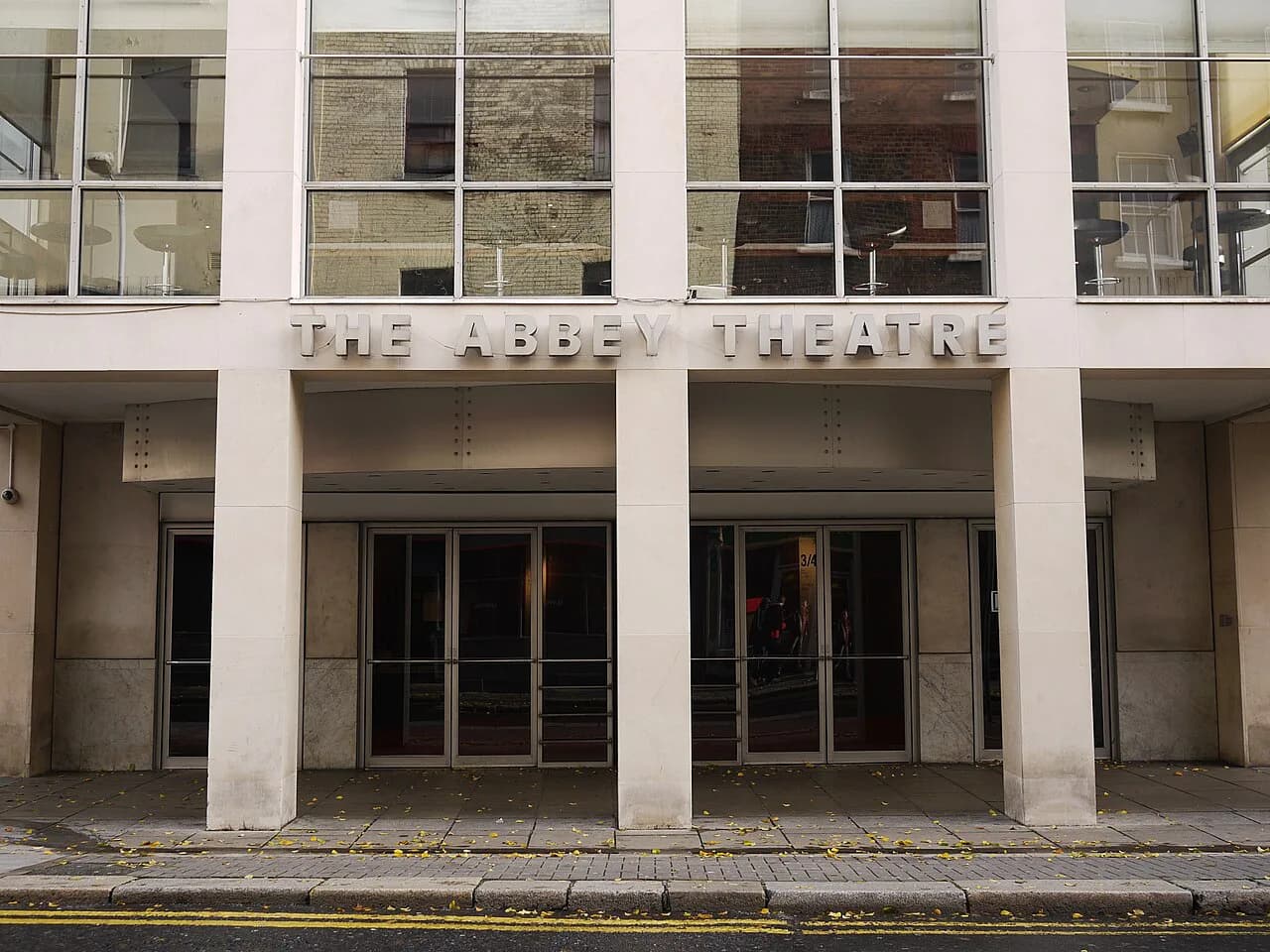
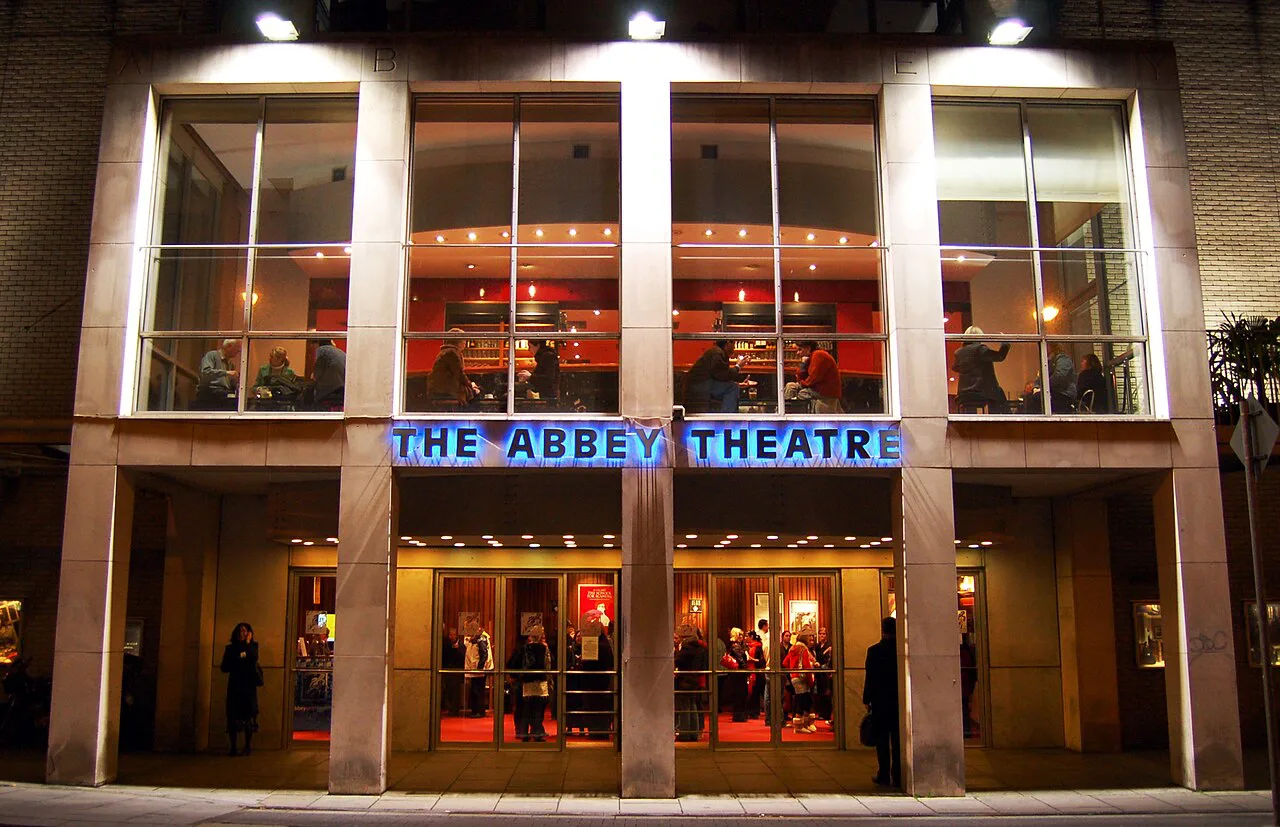
The Abbey's own history begins with money and conversion: Annie Horniman's patronage paid for architect Joseph Holloway to turn the Mechanics Institute on Abbey Street, plus a neighbouring Marlborough Street building, into a theatre. It opened on 27 December 1904 with a bill that included premières of W.B. Yeats's On Baile's Strand and Lady Gregory's Spreading the News. That makes the founding date 1904, but it does not describe the building you would enter today.
A fire damaged the original buildings in 1951 during a run of The Plough and the Stars, and the company moved to the Queen's Theatre on Pearse Street. It returned to Abbey Street on 18 July 1966, exactly fifteen years later, into the building designed by Michael Scott & Associates that still houses the theatre. Keep the two dates separate when you plan a visit: 1904 marks the company's first performance, 1966 the present building.
Abbey Flashpoints: Playboy, Shaw and O'Casey
The Abbey's published timeline reads partly as a record of audience trouble, which is useful context for anyone interested in the cultural revival. Synge's The Playboy of the Western World provoked disturbances in 1907, and the cast was later arrested during an American tour in Philadelphia, where the case was dismissed. In 1909 the directors staged Shaw's The Shewing-up of Blanco Posnet after it had been refused a licence in England, a deliberate statement about freedom of expression.
The pattern continued in 1926, when objections to Seán O'Casey's The Plough and the Stars during its first run set off a riot. The theatre's account also links its acting company and staff to the 1916 Rising, noting that Seán Connolly, due on stage that day, was the Rising's first rebel fatality. For visitors tracing that period on foot, a dublin 1916 walking tour pairs naturally with an evening at the Abbey.
Tours and an oral history project are the ways the Abbey describes encountering this material beyond performance. Full interviews in the oral history collection are available for consultation by appointment, so treat them as research access rather than a drop-in exhibit. Tour scheduling, ticket details and current productions are not fixed by the history page and need checking directly with the theatre.
The Gate Theatre: Studio Origins and the Rotunda Annex
The Gate was founded in 1928 by Hilton Edwards and Micheál MacLiammóir, growing out of the Gate Theatre Studio co-founded by Daisy Bannard Cogley and Gearóid Ó Lochlainn. Its first season offered seven plays, among them Ibsen's Peer Gynt, O'Neill's The Hairy Ape and Wilde's Salomé, and the programming introduced Dublin audiences to European and American work alongside Irish and modern classics. Orson Welles, James Mason, Geraldine Fitzgerald and Michael Gambon are among the actors the theatre names as having begun their careers there.
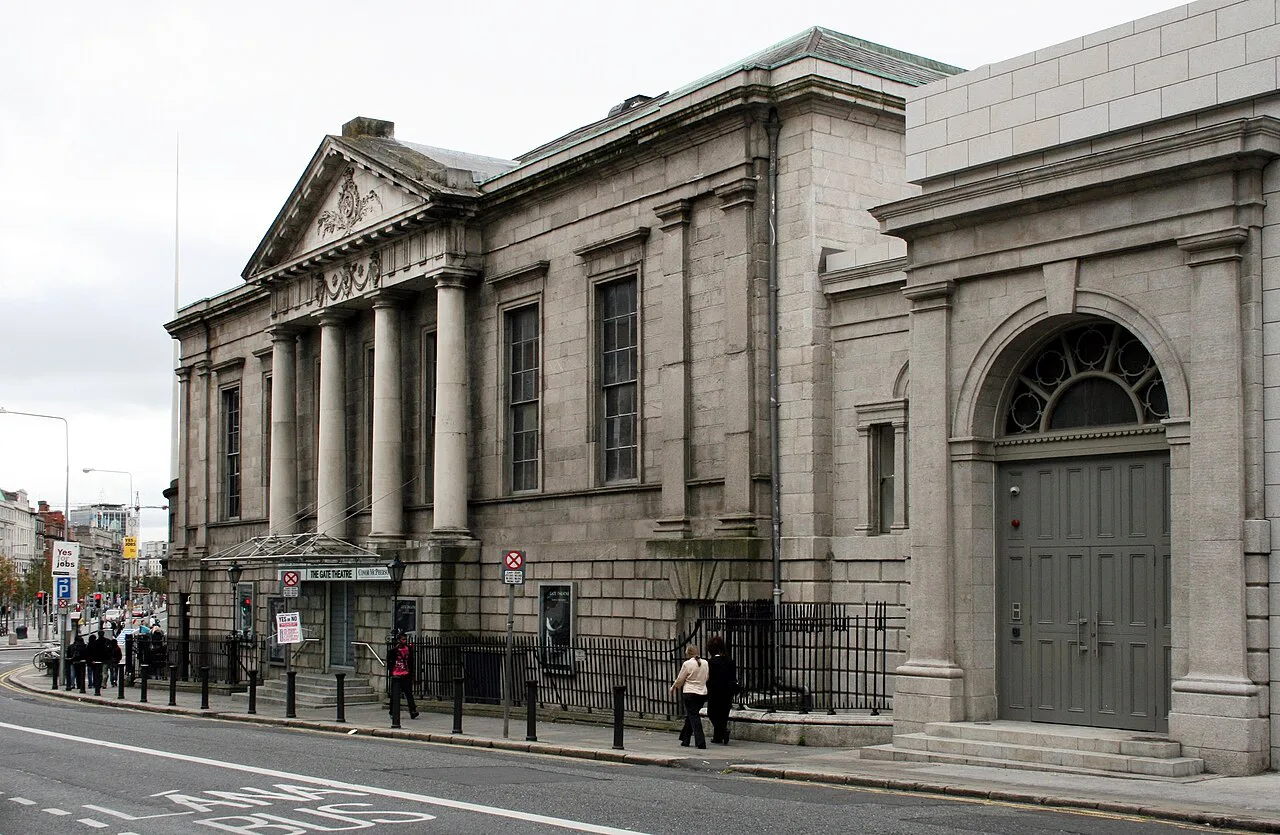
The company spent two seasons at the Peacock before signing a lease on Christmas Eve 1929 for the 18th-century Rotunda Annex, the former Upper Concert Hall that remains its home. Goethe's Faust opened there on 17 February 1930. That distinction matters for visitors: the company dates from 1928, the present auditorium from 1930, and the building itself is older than both.
Visiting the Gate with Access Needs
The Gate's setting is Georgian, and its access reflects that. The lift sits at the rear of the building and, on performance days, can be reached from the Rotunda Hospital car park and from a pedestrian gate on Parnell Square East starting 45 minutes before the show. Users are asked to arrive no later than 15 minutes before the start, and front-of-house staff can collect tickets from the box office. Pre-booking the lift by phone or email lets the team prepare.
The auditorium has two wheelchair spaces and an accessible bathroom on the auditorium level. The bar is not wheelchair accessible, but staff can arrange pre-show or interval drinks in the coffee dock or the John Pollard Foyer, which is a workable trade-off rather than a full solution. Some larger motorised wheelchairs may not fit the lift, so the theatre publishes maximum dimensions to check before booking, and guide or medical service dogs should be flagged in advance.
Hearing aid users can stream venue audio through Auracast if their devices support Bluetooth LE Audio, and Irish Sign Language interpreted performances are listed on each individual production page rather than a central calendar. None of this describes a fully step-free building; it describes specific routes that need arranging.
The Gaiety Theatre: Victorian Entertainment Since 1871
The Gaiety opened on 27 November 1871 with the Lord Lieutenant present and a double bill of Goldsmith's She Stoops to Conquer and La Belle Sauvage. Its published account presents the house as a mixed programmer from the start, spanning opera, musicals, drama, revues, comedy, concerts, dance and pantomime rather than a single dramatic tradition. That breadth is the reason its history reads more as a roll call of popular entertainment than a tale of manifestos and riots.
The theatre names performers long associated with it, including Maureen Potter, Niall Toibin, John B. Keane, Anna Manahan, Des Keogh and Rosaleen Linehan, and notes bronze handprints set into the pavement outside, alongside those of Luciano Pavarotti and Brian Friel. Those marks on South King Street are free to see without a ticket, which makes them a small, tangible stop on a walk through the city centre; for more pavement-level monuments, the dublin statues guide covers the wider habit of commemorating figures in public.
According to the theatre's own account, its owners invested more than €2.15 million in a restoration completed in 2003, adding air conditioning and reseating with more leg room, and further substantial works in 2007 rebuilt the stage, enlarged the orchestra pit and added a taller tower and loading galleries. Those works explain why a Victorian house can stage large-scale productions; they do not make the auditorium step-free.
Visiting the Gaiety with Limited Mobility
The Gaiety states plainly that there is no lift. Patrons who cannot manage stairs are advised to book seats on the Parterre, the ground-floor level, and to tell the box office about any requirements. This is the single most important decision when booking here, because an upper-level seat cannot be made accessible on the night.
Wheelchair seating is capped at four places, all on the Parterre, each with a complimentary carer seat, and availability changes with every performance. Accessible bookings go through a dedicated phone line or email; the theatre warns that its box office may not return calls from international numbers, so overseas visitors should include an email address in any enquiry.
Smock Alley: Door Procedures and Tickets
Smock Alley's visitor information is about process rather than architecture, and it is worth reading before you travel. The box office is open Monday to Saturday from 10am to 6pm and for one hour before performances, and online bookings carry a charge of one euro per ticket. Ticketing is paperless: you give the name on the booking at the door, and separate arrivals can be checked in individually.
Concessions cover students, senior citizens aged 65 and over, equity card holders, the long-term unemployed and people with access needs, subject to availability. Tickets cannot be exchanged or refunded unless the venue cancels, and latecomers are admitted only at the venue's discretion, so arriving early is the safer plan. Smoking, photography and recording are forbidden in the auditorium.
Smock Alley by Space: Steps, Parking and Hearing Loops
Smock Alley's access page treats each room separately, which is unusual and useful. The Main Space is reached step-free down the side of the building, and front-row seats can be removed to fit up to about six wheelchairs. The Black Box is entirely on ground level with the same route, while the Boys' School is entered through a fire escape door on Exchange Street Lower with a temporary ramp and room for one or two wheelchairs depending on the layout. The Banquet Hall is reached through the Boys' School.
The building has twelve steps from street level to the foyer and a further twenty-six to the Banquet Hall, and two accessible bathrooms. Five disabled parking bays sit at the bottom of Fishamble Street about 45 metres away, but the footpath between them and the entrance is narrow and a wheelchair user may need to travel briefly on the road. A mobility-assistance buzzer at street level calls the box office directly.
The induction loop is fitted in the Main Space only, not in the Boys' School or the Black Box, so a hearing aid user should check which room a performance uses before booking. The theatre has hosted audio-described, surtitled and relaxed performances, and asks that access requirements be given at the time of booking.
Choosing Between the Four Theatres
The choice comes down to what you want from the evening and what access you need. The Abbey suits anyone following the literary revival and its controversies; the Gate suits an interest in European repertoire and a small historic auditorium; the Gaiety suits large-scale popular entertainment and a Victorian interior; Smock Alley suits a visit to the old city with the most detailed per-room access information of the four, covering its Main Space, Black Box, Boys' School and Banquet Hall room by room.
Access should narrow the field before programming does. The Gate and Smock Alley both require arranging a route in advance, and the Gaiety cannot offer step-free access above the Parterre, while Smock Alley's spaces differ enough that the room matters as much as the venue. Check each theatre's own current listings before booking, since none of these pages promises particular productions, running times or ticket availability.
Plan Your Visit
Read each venue's own access page before you book and contact the box office where an arrangement is needed: the Gate lift, Smock Alley's Boys' School ramp and the Gaiety's Parterre seating are all cases where telling the team in advance helps. Then confirm what is playing directly with the theatre, because the histories above are stable but the programmes are not.
If you are building a walking day around these stages, the dublin castles guide covers the city centre's older buildings as complementary heritage stops.
Explore more Dublin guides
Frequently Asked Questions
Which Dublin theatres does this guide cover?
It covers four named venues: the Abbey Theatre on Abbey Street, the Gate Theatre at the Rotunda Annex on Parnell Square, the Gaiety Theatre on South King Street, and Smock Alley, which publishes access notes for its spaces and for disabled parking at the bottom of Fishamble Street. Each has its own published history and access information, and the guide compares them without ranking one above another.
When did the Abbey Theatre open, and when did it move to its current building?
The Abbey opened on 27 December 1904 in the converted Mechanics Institute on Abbey Street. After a fire in 1951 and a period at the Queen's Theatre on Pearse Street, the company returned to Abbey Street on 18 July 1966 into the building designed by Michael Scott & Associates. The two dates refer to different buildings.
When was the Gate Theatre founded, and when did it open at the Rotunda Annex?
The Gate was founded in 1928 by Hilton Edwards and Micheál MacLiammóir. Its present home, the 18th-century Rotunda Annex, opened with Goethe's Faust on 17 February 1930 after the company spent two seasons at the Peacock Theatre.
Does the Gaiety Theatre have a lift?
No. The theatre's access page states that there is no lift and advises patrons who cannot climb stairs to book seats on the Parterre, the ground-floor level. Wheelchair spaces, up to four, are all on that level and availability changes with each performance.
How many wheelchair spaces does the Gate Theatre have?
The auditorium has two wheelchair spaces and an accessible bathroom on the auditorium level. The lift is at the rear of the building, reached from the Rotunda Hospital car park and a Parnell Square East pedestrian gate, and should be arranged with the box office in advance.
Which Smock Alley spaces have an induction loop?
The induction loop is installed in the Main Space only. The Boys' School and Black Box do not have the system, so check which room a performance uses before booking if you rely on it.
Do I need to print a ticket for Smock Alley?
No. Ticketing is paperless and you give the name on the booking at the door. Members of the same booking arriving separately can be checked in individually. Online bookings carry a one-euro per-ticket charge.
Sources
You might also like

Continue reading
More guides you'll find useful