
St John's Cathedral, Limerick: A Visitor's Guide to the Spire and Interior
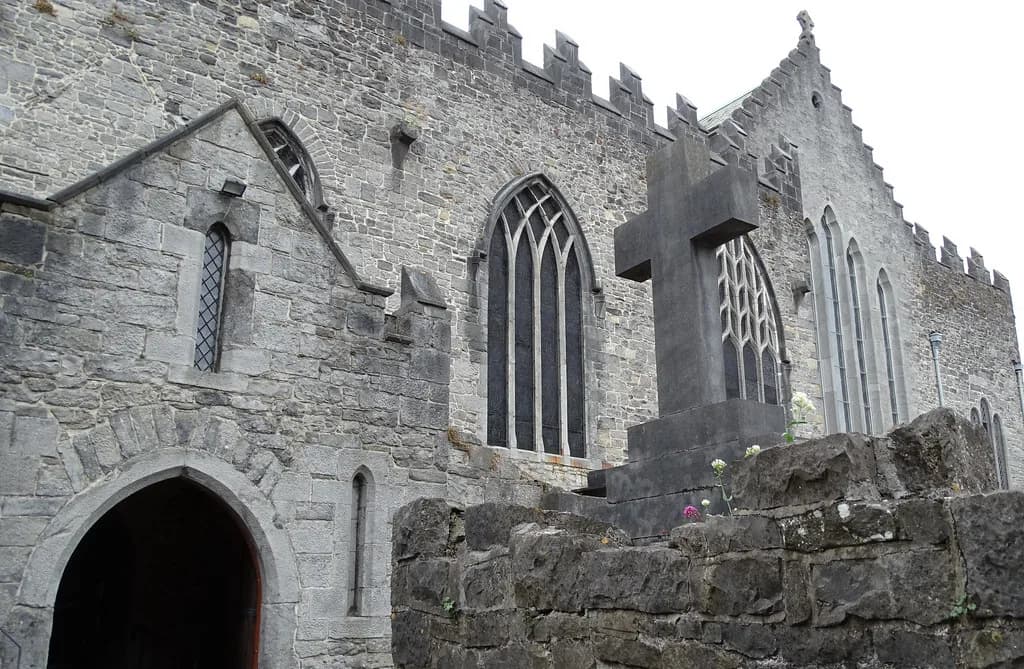
St John's Cathedral is the Roman Catholic cathedral of St John the Baptist Parish, at Cathedral Place, Cathedral Square, in Limerick City. It is a separate building from the former Church of Ireland St John's Church by Johns Square, a distinction worth settling before you set out, since the shared name causes real confusion.
This guide sticks to what the Diocese of Limerick and the parish itself publish: the building's design and dates, the tower and spire, and the interior elements a visitor can actually look for. It makes no promise about opening hours, admission or tour schedules, because the published material does not settle them.
Where St John's Cathedral Stands
The published address is Cathedral Place, Cathedral Square, Limerick, and the same location details appear on both the diocesan page and the parish website. That places the cathedral in the city rather than in a suburban or rural parish, which makes it a realistic stop within a walk through central Limerick.
Both sources list the same telephone contact, 061-414624, alongside an email address for the parish office. If you want to know whether the building can be entered when you plan to be in the city, that contact route is the most direct way to ask, rather than relying on an old guidebook entry.
Read the name carefully when planning. The cathedral is not the former Church of Ireland St John's Church at Johns Square, and the two should not be merged into a single stop; the diocesan material describes the Cathedral Place building as the present-day cathedral of the Catholic diocese.

The Tower and Spire: Limerick's Vertical Landmark
The tower is the feature most people notice first. According to the Diocese, the spire measures 265 feet and 9 inches from the base of the tower to the top of the cross, a figure the Diocese presents as one of the highest spires in Ireland. Treat that as the Diocese's own description rather than an independent survey.
The diocesan account adds that the tower was designed in 1878 to stand at 274 feet 9 inches on walls roughly four feet thick, with thirty-foot spirelettes guarding the top of the tower and the base of the spire. The limestone for the tower was quarried at Rosbrien, tying the structure to a named local source rather than imported stone.
The Diocese also describes how the spire reads from the approaches to Limerick, appearing against the horizon or against the backdrop of the Clare hills. That is a useful prompt for how to look at the building: the exterior is best understood from a distance as well as from the square in front of it.

Hardwick's Design and the Building Sequence
The cathedral was designed by the English architect Thomas Hardwick, and the Diocese records that the foundation stone was laid in May 1856. By March 1859 the building had been roofed and the first Mass was celebrated there, so the shell of the church was in use well before the tower existed.
The tower came later and from a different hand. A Limerick firm, Messrs. Hennessey, was commissioned to design it, and the Diocese gives its completion as 1882, more than two decades after the first Mass. Reading the building in that order stops the whole composition from being mistaken for a single design of one date.
Official consecration followed in June 1894, under Bishop Edward Thomas O'Dwyer, according to the diocesan history. For a visitor the sequence matters less as a chronology to memorise than as a way of seeing the cathedral as a layered building: nave first, tower second, ceremonial completion later.
Restorations and Change Over Time
The Diocese lists three major programmes of reconstruction, one in the 1950s and another beginning in 1977, so the interior you see today reflects more than a century of maintenance as well as original design. Look at surfaces and finishes as evidence of later work rather than as untouched 19th-century fabric.
The third restoration was completed by Dr Donal Murray in June 2003 and took two years, per the diocesan account. Floodlighting was first installed in 1986 and replaced during that 2003 restoration, which is why the exterior illumination the Diocese describes belongs to the recent phase of the building's life.
None of this tells you what is currently open or how the interior is arranged for visitors at any given moment. The building is an active parish church, so arrangements can change with liturgical use; check with the parish before making it the fixed point of a day.
What to Look For Inside
The cathedra, or bishop's chair, and the chapter stalls were carved in Munich in 1894, according to the Diocese. The cathedra was originally placed in the centre of the apse, framed by the reredos of the high altar, so its present setting is not its first one and is worth reading as a change rather than a fixed original arrangement.
The Diocese notes that the finely carved back and canopy of the cathedral now sit in the north transept, where they house the oils used in baptism, confirmation and the anointing of the sick, blessed at the Mass of Chrism on Holy Thursday. That gives a visitor a specific place to look and a specific function to understand, rather than a vague instruction to admire the woodwork.
The altar is described as a table of Limerick marble, with a substructure of alabaster and coloured marble, and a central group carved in white alabaster depicting the sacrifice of Abraham. Look for the local marble and the carved centre rather than scanning the whole sanctuary at once.
The Six Bishops Buried in the Cathedral
Six bishops are buried in the cathedral, and the Diocese locates them by aisle. Bishop Ryan and Bishop O'Dwyer lie in the main aisle before the high altar; Bishop Butler and Bishop Hallinan lie between the main aisle and the south door; Bishop Keane and Bishop Newman lie in front of the reserved Blessed Sacrament in the north transept.
Those locations turn a general impression of memorials into three findable groupings. If you only have time for one, the north transept pairs two of the bishops with the relocated carved canopy, so a single area covers two distinct features.
Visiting Practically
The parish site is the operator's own channel and publishes links to Mass times and a 'Take a Tour' resource, along with a live stream of the cathedral. These pages exist, but their contents, schedules and any conditions attached to touring the building are not set out in the material available here, so open them directly rather than assuming what they contain.
Use the parish's own pages first for anything time-sensitive, and follow up by phone on 061-414624 if a page does not answer your question. Mass times and access around services are the kind of detail that changes, and a phone call the week you travel is more reliable than a summary written elsewhere.
Because Mass is celebrated here and the Diocese describes the building as the present-day cathedral, plan around worship rather than treating it purely as a monument. A quiet, respectful visit is the realistic expectation; a substantial visitor centre or exhibition is not something these sources describe.
How Much Time to Allow
The interior features the Diocese describes are concentrated: the altar and apse area, the north transept with the canopy and two bishops' tombs, and the main aisle with its memorials. A focused look at those, plus a walk around the exterior to read the tower, is a short visit rather than a half-day.
If you enjoy architectural detail, take time outside to compare the Hardwick design with the later Hennessey tower, because their dates differ and the tower is the element the Diocese treats as a city landmark. If you are short of time, the exterior and spire can be read from the surrounding streets, whether or not you go inside.
Placing the Cathedral in a Limerick Day
St John's Cathedral works best as one deliberate stop in central Limerick rather than the anchor of an entire day. Its interest is concentrated in the building itself, and the published material describes no visitor facilities, collections or displays on site, so build the rest of your time around other places.
If you want museum collections and indoor interpretation, the Hunt Museum, Limerick is a different sort of stop and worth planning separately. For medieval fortification and riverside context, King John's Castle, Limerick sits at the other end of the historical spectrum from a 19th-century Catholic cathedral.
Readers comparing Limerick's cathedrals should note that St Mary's Cathedral is a separate building with its own history and its own visitor arrangements, distinct from the Roman Catholic St John's Cathedral at Cathedral Place. Grouping the two into one visit without checking each one's arrangements risks arriving at the wrong door. If you are weighing up which cathedral to see or how to compare interiors, there is a separate St Mary's Cathedral, Kilkenny: A Visitor's Guide for the Kilkenny namesake.
Before You Go
St John's Cathedral rewards a close reading: the Rosbrien limestone tower with its Diocese-recorded height, the Hardwick shell of the 1850s, the Hennessey tower finished in 1882 and the Munich-carved furniture of 1894 all belong to different moments. Knowing that sequence turns a quick look into an intelligible visit.
Confirm access with the parish before you travel, using the Mass times page or the phone number both sources publish, and treat any schedule you find elsewhere as unverified. That single step is the difference between a planned stop and a wasted journey across the city.
For the wider set of city sights, start from the Limerick Attractions: 10 Visitor Guides hub and pick stops by the kind of visit you want, rather than assuming one central church fills a whole afternoon.
Explore more Limerick guides
Frequently Asked Questions
Is St John's Cathedral the same as St John's Church in Limerick?
No. St John's Cathedral is the Roman Catholic cathedral of St John the Baptist Parish at Cathedral Place, Cathedral Square. It is a separate building from the former Church of Ireland St John's Church by Johns Square, so check which one you are heading for before you set out.
How tall is the spire of St John's Cathedral?
The Diocese of Limerick describes the spire as 265 feet and 9 inches from the base of the tower to the top of the cross, and presents it as one of the highest spires in Ireland. That is the Diocese's own description rather than an independent measurement, so treat it accordingly.
Who designed St John's Cathedral and when was it built?
The cathedral was designed by Thomas Hardwick, with the foundation stone laid in May 1856 and the first Mass celebrated in March 1859 once the building was roofed. The tower was designed by the Limerick firm Messrs. Hennessey and completed in 1882, and the cathedral was officially consecrated in June 1894.
What should I look for inside St John's Cathedral?
Look for the cathedra and chapter stalls carved in Munich in 1894, the Limerick marble altar with its white alabaster centrepiece, and the carved back and canopy now in the north transept. Six bishops are buried in the cathedral, in the main aisle, near the south door and in the north transept.
How do I check when I can visit St John's Cathedral?
Use the parish website, which publishes links to Mass times, a live stream and a tour resource, or telephone the parish on 061-414624. The published material available does not set out visitor opening hours, admission arrangements or tour schedules, so confirm directly rather than assuming.
How long should I spend at St John's Cathedral?
The interior features are concentrated around the altar, the north transept and the main aisle, so a focused look is a short visit rather than a half-day. Add time outside to read the tower and spire, which the Diocese treats as a landmark visible from the approaches to the city.