
Book of Armagh: Trinity College Dublin MS 52 Explained
The Book of Armagh is Trinity College Dublin MS 52, made at Armagh around 807. Learn who wrote it, what it contains and how to approach seeing it.
On this page
The Book of Armagh is Trinity College Dublin MS 52, also called Liber Ardmachanus: a vellum manuscript written at Armagh around 807, not by St Patrick but by the scribe Ferdomnach and two assisting scribes, according to the Royal Irish Academy's manuscript description. Trinity dates it to about 807 AD in its medieval Latin collections. The popular belief that Patrick wrote it does not hold, and the manuscript's own inscriptions identifying its real makers were erased early on precisely because they weakened that association.
Treat it as a working library book with a political purpose rather than a treasure displayed for tourists. Its value lies in what it copied, what it omitted and why, and in the improbable chain of owners that carried it from a medieval Armagh scriptorium to a Dublin university library. This guide explains the manuscript itself and then sets out what a visitor to Trinity can and cannot expect to see.
How the Book of Armagh was made
Ferdomnach wrote the first part of the book in 807 or 808 for Abbot Torbach, Patrick's heir at Armagh, according to an inscription on one folio that Charles Graves deciphered in 1846. The same account describes Ferdomnach as a scholar and excellent scribe, names two assistants, and notes that he signed the book on five pages. The CELT edition of the Liber Angeli at University College Cork agrees that the manuscript was probably copied at Armagh around 807 and that three scribes were likely involved, with Ferdomnach as master scribe.
Physically it is a compact vellum book: 217 folios survive of perhaps 222, measuring roughly 195 by 145 mm, written in Irish minuscule in double columns of 34 to 40 lines. Five leaves are missing, including the opening folio and two bifolia from Matthew's Gospel. Knowing the format helps when you meet photographs of the pages, because the script is small and dense rather than the expansive display lettering people associate with gospel books.
The Trinity collection page places the Book of Armagh alongside the Book of Kells and the Book of Durrow as the Library's best-known medieval codices, which is the right frame for understanding it: it belongs to a working tradition of Irish and Latin book production, not a single isolated relic. The same page describes a changing exhibition in the Old Library for Gospel manuscripts of the period such as the Book of Kells and the Book of Durrow; it does not say that the Book of Armagh is among them. For the wider story of Irish illuminated manuscripts, see the Irish illuminated manuscripts guide.
What the manuscript contains
The Book of Armagh holds the earliest known copy of Patrick's Confessio, but with significant passages deliberately omitted, apparently to present Patrick as a wholly successful missionary and founder of monasteries. For the same reason the Epistola is suppressed entirely. The omissions are a deliberate editorial choice by a compiler with an argument to make.
The book is also a New Testament manuscript, and the Patrician material sits within it as a dossier rather than as an appendix. That dossier includes the Liber Angeli, copied by Ferdomnach into the section of the manuscript the CELT edition describes as the Patriciana, the collection of texts relating to Patrick. For a reader today, the takeaway is that scripture and saint's reputation were bound together as one project.
It is worth separating this manuscript from the metalwork that often appears in the same conversation about early Irish Christian art. A brooch such as the Tara Brooch is a different class of object with its own materials and collection history, and studying it alongside a vellum codex is a comparison of contexts rather than of like with like.
Why the book was compiled
The conjunction of Patrician texts with the New Testament served to strengthen Armagh's claims to ecclesiastical primacy in Ireland during the Middle Ages, as the Royal Irish Academy's description explains. In other words, the manuscript was an instrument of institutional argument as much as devotion.
The Liber Angeli fits that campaign neatly: it is a Latin text set at Armagh in which an angel addresses Patrick and confirms the standing of his church there, and it was copied into the Patrician dossier of this manuscript. A visitor who understands this will read the manuscript's presentation of Patrick as advocacy rather than neutral biography, and will be less surprised that inconvenient passages were trimmed.
Transmission and survival
The book was enshrined in 937 by Donnchadh, son of Flan, king of Ireland, though the shrine itself has not survived. In 1005 King Brían Bóramha visited Armagh, left twenty ounces of gold on the church altar and had an entry made in the manuscript acknowledging Armagh's supreme position in the affections of Patrick. These are the moments when the book functioned openly as a public emblem of Armagh's authority.
By the twelfth century the manuscript was in the care of a hereditary keeper, and around 1680 it passed from the last of that line, Florence MacMoyre, to the Brownlow family of Lurgan, one of whom, Arthur Brownlow, produced the present foliation. The book moved through private hands for centuries rather than sitting continuously in a cathedral treasury.
On 26 May 1831 it was offered at public auction in Dublin and bought in at £390, and in 1853 it was displayed at the Dublin Exhibition with a notice declaring it was to be sold. The antiquary William Reeves, Bishop of Down, bought it for £300 and passed it to Lord John George Beresford, Archbishop of Armagh, on the understanding that ownership would go to Trinity when Reeves died. That happened in 1892.
Object details worth pausing on
Three physical survivals tell the story better than any summary. The original oak binding boards, lined with vellum and covered in pink-stained goatskin tooled with blind lines and stamps, survive uniquely among early Irish bindings of their kind; they were rediscovered in 1961 inside a late medieval leather satchel associated with the manuscript, one of only three such Irish book satchels known. The present vellum binding is a modern one, made by Roger Powell in 1957.
For a general reader, that means the book you would see in photographs is a rebinding around an older core, with the earliest protective fittings now kept separately. It is a reminder that manuscripts survive through repeated human intervention, not by standing still.
Where it sits today
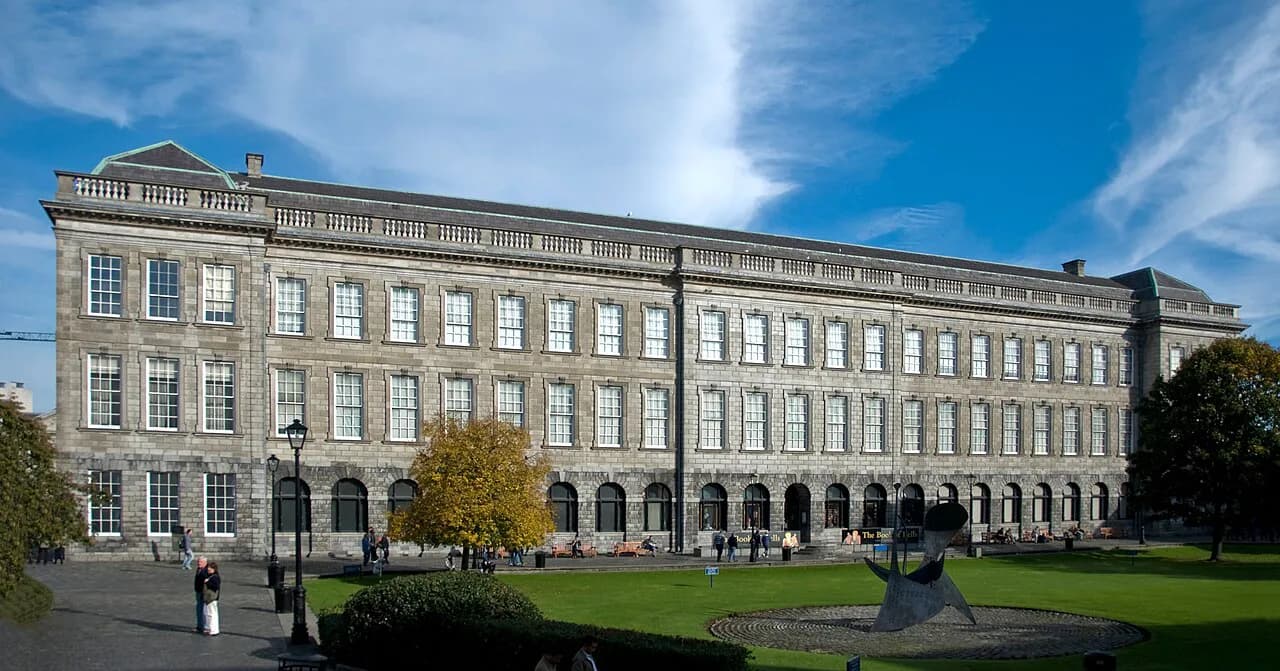
Trinity College Library holds around 450 separately numbered Latin manuscripts, rich in historical and theological texts, and names the Book of Armagh as MS 52 among its best-known medieval codices. Others in the same company include the Book of Kells and the Book of Durrow. Custody, however, is not the same as display: Trinity's page refers to the Gospel manuscripts forming part of the changing exhibition in the Old Library, so you should not assume that any named codex is on view on a given day.
If your interest is specifically the Book of Armagh, treat viewing it as a research enquiry rather than a sightseeing stop. Trinity's catalogues for individual collections are available in the reading room of Manuscripts & Archives, which is the documented route into the collection for scholarly consultation. Check current reading-room conditions well before travelling rather than relying on any schedule described secondhand.
Visiting the Old Library site honestly
The separately ticketed Book of Kells Experience covers the Book of Kells, the Long Room and the digital exhibition in the Red Pavilion; it is not a route to the Book of Armagh and no official page promises that this manuscript is included. Online booking is strongly recommended and entry is timed, with tickets non-refundable once purchased and concessions available for senior citizens and students. Confirm current hours and availability directly before booking, since they change seasonally.
Both the Old Library and the Pavilion are fully wheelchair accessible, with staff arranging a library guard to assist with the elevator, though there are no toilets in the Old Library itself and facilities come later in the visit. Non-flash photography for personal, non-commercial use is allowed through the experience, but photography is forbidden in the Treasury where the Book of Kells is housed, and tripods are not permitted. Allow roughly ninety minutes to take in the full visit.
Expect a further change while the historic Old Library redevelopment continues: all books have been removed from the Long Room shelves except the first four bays as you enter. That affects the visual drama of the room, so set expectations accordingly and value the visit for the manuscripts and interpretation rather than for a fully stocked gallery.
Plan Your Visit
If the Book of Armagh is your reason for travelling to Dublin, plan around an honest expectation: a research enquiry through Trinity's Manuscripts & Archives catalogues, with no promise that the physical volume is on display. If you simply want Ireland's manuscript heritage, the Old Library experience delivers the Book of Kells and the Long Room on a timed, pre-bookable visit. For the broader story of the city's medieval sites, our Dublin history guide sets out the chronology.
Read the manuscript's story before you go, so the objects on display have context. The editorial trimming of Patrick's Confessio, the suppressed Epistola and the Armagh primacy campaign are what make this c.807 book worth more than a glance.
Explore more Ireland guides
Frequently Asked Questions
Is the Book of Armagh on public display in Dublin?
Trinity's own pages do not state that the Book of Armagh is currently on display. The Book of Kells Experience covers the Book of Kells, the Long Room and the Red Pavilion, and Trinity describes a changing exhibition in the Old Library. Anyone hoping to see MS 52 in person should enquire through the Library's Manuscripts & Archives reading room rather than assume it is on view.
Did St Patrick write the Book of Armagh?
No. The manuscript was written around 807 at Armagh by the scribe Ferdomnach and assisting scribes, for Abbot Torbach. The belief that Patrick was its author was a later reputation, and the inscriptions identifying the real makers were erased early on because they weakened the connection to Patrick.
What is the difference between the Book of Armagh and the Book of Kells?
Both are Trinity College Dublin manuscripts, but they are different books with different purposes. The Book of Kells is a decorated Gospel manuscript dated to about 800 AD, while the Book of Armagh is a smaller working vellum codex of about 807 containing a New Testament plus Patrician texts, including the earliest known copy of Patrick's Confessio.
Why does the Book of Armagh matter to Armagh's church history?
The manuscript gathers Patrician texts beside the New Testament in a way that served Armagh's claims to ecclesiastical primacy in medieval Ireland. It was enshrined in 937, and in 1005 King Brían Bóramha had an entry made in it acknowledging Armagh's standing in the affections of Patrick.
Can researchers consult the Book of Armagh at Trinity College Dublin?
Trinity's catalogues for individual collections are available in the reading room of Manuscripts & Archives, which is the documented starting point for scholarly consultation. The Library does not publish open access to MS 52, so confirm requirements and conditions with the Library before making travel plans.
What happened to the Book of Armagh between the medieval period and 1892?
It passed through hereditary keepers and, around 1680, to the Brownlow family of Lurgan. It was offered at auction in Dublin in 1831 and displayed at the Dublin Exhibition of 1853, where William Reeves bought it and passed it to Lord John George Beresford on the understanding that it would reach Trinity, which it did in 1892.
Sources
You might also like



Continue reading
More guides you'll find useful



