
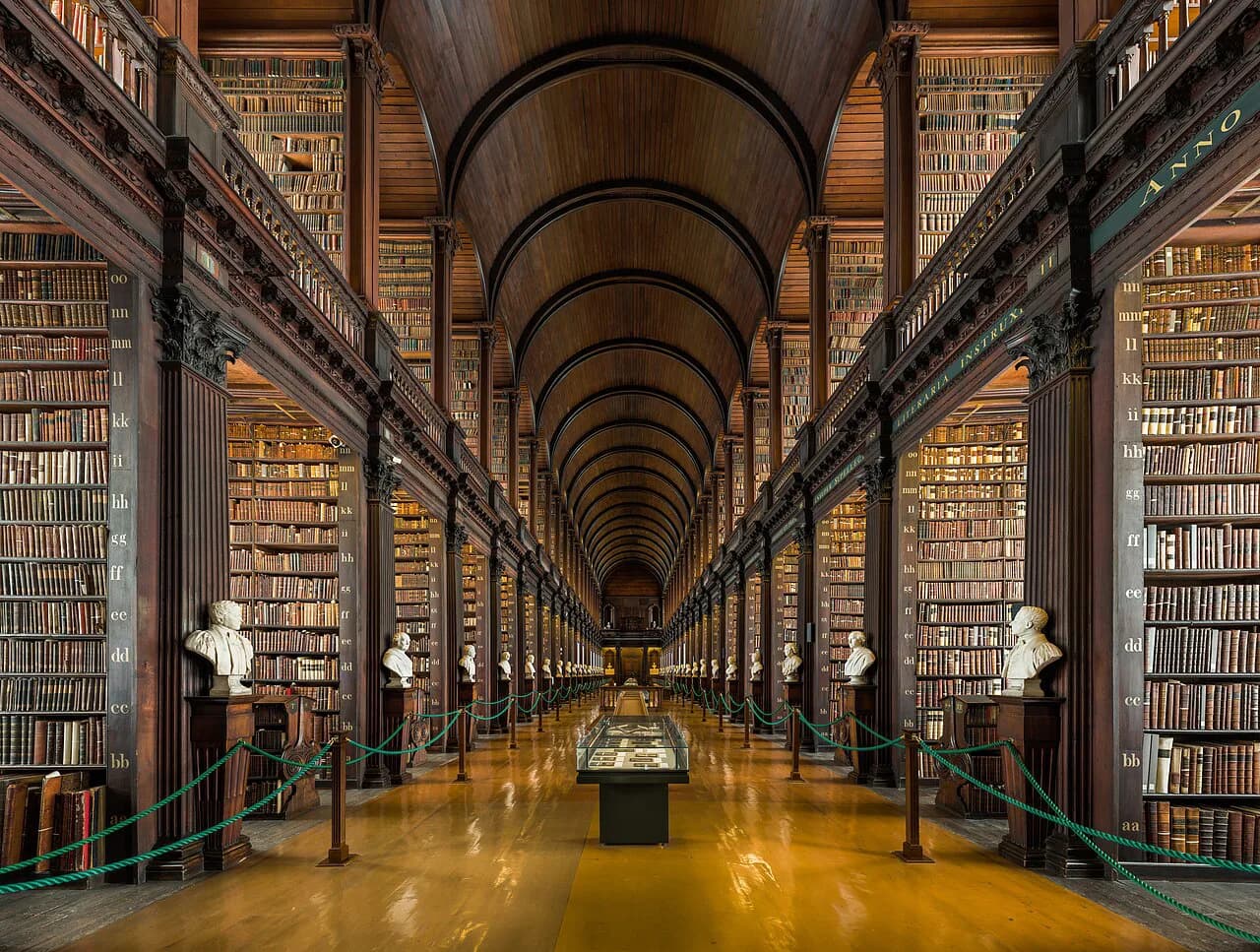
Irish Illuminated Manuscripts: Durrow, Armagh, Kells and the Faddan More Psalter
Irish illuminated manuscripts are decorated manuscript books. Meet Durrow, Armagh, Kells and the Faddan More Psalter, and learn where each is kept today.
On this page
Irish illuminated manuscripts are handwritten books whose pages were decorated with ornament, colour and figurative symbols, and they are a different class of object from metalwork such as chalices or brooches. The four books treated here are named survivals with documented histories and documented custodians: the Book of Durrow, the Book of Kells and the Book of Armagh at Trinity College Dublin, and the Faddan More Psalter at the National Museum of Ireland. Knowing which institution holds a book matters, because custody is the only starting point for deciding whether a visit can realistically include it.
The practical distinction to carry through this guide is between a book's home collection and a book's display. Trinity describes its medieval gospel books as forming part of a changing exhibition in the Old Library, so a collection holding a manuscript is not a promise that the manuscript will be visible on a given day. Read each section for the history and then for the visit, and check current display details directly with the holding institution rather than assuming.
What illumination means: decorated books, not metalwork
An illuminated manuscript is a book written by hand and embellished with decoration: coloured initials, full ornamental pages, framed symbols and pigment work. The Book of Durrow illustrates the principle clearly, with a limited palette of red, yellow and green filling entire carpet pages with dense ornament, while its Evangelist symbols stand isolated against creamy vellum inside bands of interlace. That vocabulary belongs to the page, not to the goldsmith's workshop.
This distinction is not pedantry. Early medieval Irish art includes spectacular metal objects, and museums display them alongside manuscripts, but calling a chalice or a brooch an illuminated manuscript confuses two different crafts and two different kinds of evidence. Read a manuscript for script, pigment, page layout and binding; read a metal object for metalwork technique. The Tara Brooch is a metalwork piece rather than a book, and it is useful to keep that category boundary in mind when comparing collections.
Trinity College Dublin's early gospel books as a collection
Trinity College Dublin Library holds an unusually deep run of medieval manuscripts, including roughly 450 separately numbered Latin items. Its best-known medieval codices are the Book of Kells (MS 58, c. 800), the Book of Durrow (MS 57, dated c. 650-700 on Trinity's exhibition page and given as c. 700 in its collections summary) and the Book of Armagh (MS 52, c. 807), with related gospel books including the Codex Usserianus Primus, the Book of Dimma and the Book of Mulling. Together these give a visitor a sense of a tradition extending across centuries rather than a single masterpiece.
Trinity states that these gospel manuscripts form part of a changing exhibition in the Old Library. The word changing is the operative one: a group can be described as part of an exhibition without every member being on view at once, and rotations protect fragile vellum from light. If a specific book is the reason for your visit, treat the collection description as context and confirm display separately before booking.
The Book of Durrow: restrained palette, carpet pages and isolated symbols
The Book of Durrow is dated c. 650-700 and is described by Trinity as a more restrained precursor to the Book of Kells. Its palette is narrow, built on red, yellow and green, and it uses that limitation deliberately: carpet pages carry dizzying all-over ornament, while the Evangelist symbols are set apart against empty vellum, framed by interlace bands. The effect is concise symbolism rather than spectacle, which is precisely why some viewers find it the more rewarding book.
Scale and intricacy differ sharply between Durrow and Kells, but Trinity presents them as sharing an artistic lineage, which makes the pair useful to compare rather than rank. If you are building a reading list before a visit, compare the two books on the same criteria: colour range, page layout, symbol treatment and the balance between ornament and open vellum. That comparison will do more for your eye than any list of superlatives.
Reading Durrow's symbolism: the older pre-Vulgate scheme
The Book of Durrow assigns the four Evangelist symbols differently from the Book of Kells. Trinity explains that Durrow follows a pre-Vulgate convention in which the lion stands for John and the eagle for Mark, whereas Kells, following the Latin Vulgate tradition associated with Jerome, uses man, lion, calf and eagle for Matthew, Mark, Luke and John. The difference is a century's worth of textual convention visible on the page.
For a visitor, this is the single most useful interpretive key at Durrow: identify the symbol, then remember that the code is older than the one most people have absorbed from later medieval art. Trinity also notes the physical survival of a book roughly 1,300 years old as remarkable in itself. That survival is the reason a modern viewer can test the symbol scheme against the actual page rather than a reproduction.
The Book of Armagh: Patrick's Confessio and a shaped text
The Book of Armagh contains the earliest surviving copy of Saint Patrick's Confessio, but it is not a neutral transcription. The manuscript description published through the Confessio project notes that significant passages were deliberately omitted, apparently to present Patrick as a wholly successful missionary and monastery founder, and that the Epistola was suppressed entirely. Pairing the Patrician texts with the New Testament served Armagh's claims to ecclesiastical primacy in medieval Ireland.
That framing matters for anyone inclined to read the manuscript as a straightforward witness. What survives is a curated dossier shaped by an institution with a case to make. The manuscript's own history reinforces the point: inscriptions that weakened the association with Patrick were erased at an early date. When you encounter the Confessio in translation, it is worth remembering that the textual tradition behind it involves editorial decisions made more than a millennium ago.
The Book of Armagh as an object: scribe, oak boards and satchel
The Book of Armagh was written around 807-808 by the scribe Ferdomnach of Armagh for Abbot Torbach, according to an inscription deciphered in the nineteenth century. It is a vellum manuscript of 217 surviving folios written in Irish minuscule, and its original oak binding boards survive, uniquely among early Irish bindings of this kind. The boards, lined with vellum and covered in pink-stained goatskin, are now kept separately from the modern binding made by Roger Powell in 1957.
The boards were rediscovered in 1961 inside a late medieval leather satchel associated with the manuscript, one of only three such Irish book satchels known to survive. The manuscript's later route to Trinity ran through private owners and an 1831 Dublin auction before it was deposited with the Royal Irish Academy and eventually passed to the College. Its original home was Armagh, but its current custody is Trinity College Dublin, so plan accordingly.
The Book of Kells today: timed entry, photography rules and Long Room changes
The Book of Kells Experience is the operator's name for the ticketed visit that begins in the Old Library, where you view the Book of Kells and explore the Long Room, before continuing to the Red Pavilion for a digital exhibition. Entry is timed and online booking is strongly recommended, and the operator suggests allowing about ninety minutes for the whole experience. The Old Library and the Pavilion are described as wheelchair accessible, with staff arranging lift access on arrival.
Two current conditions affect what you will actually see. Photography is forbidden in the Treasury where the Book of Kells is housed because of the manuscript's sensitivity, and all Long Room books have been removed during the Old Library Redevelopment Project except in the first four bays as you enter. Non-flash photography is permitted elsewhere for personal, non-commercial use, but tripods are not allowed anywhere in the experience.
The Book of Kells ticket trade-off: which entry types include what
Ticket types are not equivalent, and the differences matter. The operator lists a full Book of Kells Experience that includes the Old Library, the Book of Kells and the Red Pavilion digital exhibition, a separate Book of Kells and Old Library option that explicitly excludes the Red Pavilion, and a guided version with a maximum group size of sixteen. Admission starts from a published per-person rate shown on the operator's booking page, so compare the current figures there before choosing rather than relying on secondhand prices.
The trade-off is time and scope against simplicity. The digital Pavilion adds a distinct stage to the visit and sits less than a minute's walk from the Old Library, while the shorter ticket suits travellers who want the manuscript and the Long Room only. Audio guides are available in many languages through an on-site QR code, so language need not decide the ticket. Whichever option you pick, the same photography restrictions apply in the Treasury.
The Faddan More Psalter: a chance bog discovery
The Faddan More Psalter was found by chance in 2006 in a bog in County Tipperary, noticed by a peat-harvesting machine operator in the bucket of his machine. It is dated to approximately AD 800 and consists of sixty vellum sheets divided into five gatherings or quires, written in iron gall ink with a number of pigments used for decoration. The book carries the standard 150 psalms, with decorated openings at the first, fifty-first and hundred-first psalms, a convention found in other Irish psalters.
Preservation varies dramatically from page to page: in places only page edges and loose letters survive, which makes the manuscript as much an archaeological find as a book. The National Museum of Ireland's collection page does not settle the reasons for its deposition in the bog, and it is better to leave that question open than to repeat a popular guess. What is documented is the discovery, the structure and the decoration, and those are the facts worth carrying into the gallery.
The Psalter's leather wallet: horn buttons, papyrus lining and trial motifs
The Psalter was protected by a wallet-shaped leather cover with a flap, fastened by three horn buttons and probably closed by wrapping a leather thong around them. The outside is painted with a black carbon-based pigment and carries motifs that are probably trial pieces, while the inside is lined with papyrus, a writing material from the eastern Mediterranean and principally Egypt. That lining is a small but striking indication of long-distance connections behind an object found in an Irish bog.
When you look at the cover in the gallery, the trial motifs reward close attention: they show a craftsperson working out a design on the object itself rather than following a finished pattern. Allow time for the cover as a separate exhibit from the pages, since conservation display often separates binding from text block. The Psalter is best read as a complete artefact of making, use and loss, not only as a decorated text.
Inside the Treasury at Kildare Street: three galleries of early medieval art
The Treasury at the National Museum of Ireland's Kildare Street site is a permanent exhibition arranged in three galleries. Gallery One sets out Irish art chronologically from the Iron Age to the twelfth century, highlighting the flowering of native and foreign-influenced craftsmanship from the late seventh to early ninth centuries and the impact of Viking art styles; Gallery Two is given over entirely to the Faddan More Psalter; and Gallery Three explores the techniques of early medieval metalworkers with interactive close-up imagery.
That layout makes the museum a useful complement to Trinity rather than a duplicate. The Psalter's dedicated gallery gives a bog-preserved book the kind of focused treatment a large manuscript display rarely receives, and the craft gallery explains techniques that illuminate how such objects were made. Metalwork such as the Ardagh Chalice belongs to this broader early medieval story, and the museum context helps keep it distinct from the manuscripts.
Separating custody from display: why a home collection is not a guarantee
A manuscript's institutional home tells you who cares for it, not what is in a case on your chosen date. The Book of Durrow, Book of Armagh, Book of Dimma and Book of Mulling are all associated with Trinity's changing Old Library exhibition, and the National Museum warns that individual galleries may occasionally close at short notice. The museum's own advice, if you are planning around a particular object, is to telephone ahead and confirm availability.
For Trinity, the equivalent check runs through the Book of Kells Experience operator, whose page describes which parts of the visit each ticket includes and which are subject to redevelopment. Neither institution promises that every named manuscript is on view, and neither should be read that way. Build a visit around the experience you can confirm, and treat any additional manuscript sighting as a bonus rather than the plan.
Planning the two-stop comparison: hours, free entry and a dated closure
The National Museum of Ireland at Kildare Street (D02 FH48) has free admission, with ordinary opening Tuesday to Saturday from 10am to 5pm and Sunday and Monday from 1pm to 5pm, plus a late opening on the last Thursday of each month. The museum recommends arriving by 4.30pm to see the galleries properly. A dated notice states that the Kildare Street site is closed on Sunday 25 and Monday 26 October 2026 because of industrial action, so those two days should be treated as unavailable regardless of the usual pattern.
Pairing the two stops works because they answer different questions: Trinity for early gospel books and their ornament, the museum for a bog-preserved psalter in a dedicated gallery alongside wider early medieval craft. Book the Trinity experience for a timed slot and leave the museum flexible, since free entry removes the cost of a short visit. Check both institutions' current pages in the days before you travel, and confirm any specific manuscript by phone or email rather than assuming. For the city's other historic sites, a Dublin heritage guide helps place both collections in context.
Plan Your Visit
Irish illuminated manuscripts reward a visit built on two clearly different collections: Trinity College Dublin's early gospel books, seen through the timed Book of Kells Experience and its changing Old Library display, and the National Museum of Ireland's Faddan More Psalter in the free Treasury galleries at Kildare Street. Decide in advance which book matters most to you, then confirm its display directly with the holding institution, because custody and exhibition are not the same thing.
Keep the category boundaries clear as you go: a manuscript is a decorated book, while a chalice, brooch or shrine belongs to metalwork and deserves to be read on its own terms. That discipline makes both collections more legible, and it keeps the visit focused on what the sources actually document rather than on convenient assumptions.
For another heritage guide, read about Broighter Gold.
Explore more Ireland guides
Frequently Asked Questions
What is the difference between an illuminated manuscript and a metalwork treasure?
An illuminated manuscript is a handwritten book decorated with coloured ornament, initials or figurative symbols on vellum pages. A metalwork treasure such as a chalice or brooch is a crafted metal object with a different production technique and a different kind of evidence. Museums often display both together, but only the book is properly called an illuminated manuscript.
Where are Irish illuminated manuscripts kept today?
The Book of Durrow, Book of Kells and Book of Armagh are held by Trinity College Dublin Library, along with related gospel books such as the Codex Usserianus Primus, Book of Dimma and Book of Mulling. The Faddan More Psalter is cared for by the National Museum of Ireland and displayed in its Treasury exhibition at Kildare Street. Custody does not guarantee that a particular book is on view on your chosen day.
Can I see the Book of Durrow or Book of Armagh at Trinity College Dublin?
Both are part of Trinity's collections, and Trinity describes its early gospel manuscripts as forming part of a changing exhibition in the Old Library. Because the display rotates, neither should be assumed to be visible on a given date. Confirm current display arrangements with the library or the Book of Kells Experience operator before you plan a visit around either book.
What makes the Book of Durrow different from the Book of Kells?
The Book of Durrow is dated c. 650-700 and uses a restrained palette of red, yellow and green, with dense carpet pages and Evangelist symbols isolated against plain vellum. It also follows an older, pre-Vulgate symbol scheme in which the lion stands for John and the eagle for Mark, whereas the Book of Kells uses the later Vulgate convention. Scale and intricacy differ markedly, but Trinity presents the two as sharing an artistic lineage.
Why does the Book of Armagh matter for St Patrick's Confessio?
The Book of Armagh contains the earliest surviving copy of Patrick's Confessio, but it is a shaped text rather than a neutral one. Significant passages were deliberately omitted and the Epistola was suppressed, apparently to present Patrick as an unqualified success and to support Armagh's claims to ecclesiastical primacy. The manuscript was written around 807-808 by the scribe Ferdomnach of Armagh for Abbot Torbach.
What is the Faddan More Psalter and where is it displayed?
It is a psalter of approximately AD 800, found by chance in 2006 in a County Tipperary bog. It consists of sixty vellum sheets in five quires, written in iron gall ink, and was protected by a wallet-shaped leather cover with three horn buttons and a papyrus lining. It is displayed in Gallery Two of the Treasury at the National Museum of Ireland, Kildare Street.
How long should I allow for the Book of Kells Experience?
The operator recommends allowing about ninety minutes for the complete experience from start to finish. That covers the Old Library, the Book of Kells, the Long Room and, on tickets that include it, the Red Pavilion digital exhibition. Entry is timed and online booking is strongly recommended, so choose your slot before you arrive.
Is the National Museum of Ireland at Kildare Street free, and when is it open?
Admission is free. Ordinary hours are Tuesday to Saturday 10am to 5pm and Sunday and Monday 1pm to 5pm, with a late opening on the last Thursday of the month and a recommended last entry of 4.30pm. A dated notice states the site is closed on Sunday 25 and Monday 26 October 2026 for industrial action, so check the museum's current page before those dates.
Sources
- Book of Durrow - Director's Choice Uncut - Trinity College Dublin (https://www.tcd.ie/library/exhibitions/directors-choice/durrow/)
- https://www.tcd.ie/library/research-collections/subject-strengths/medieval/medieval-latin.php
- The Book of Armagh - MS Trinity College Dublin 52 | St. Patrick’s Confessio
- The Faddan More Psalter | National Museum of Ireland
- The Treasury | Archaeology | National Museum of Ireland
- Book of Kells Experience | Trinity College Dublin | Official Site
- Opening Hours, Location and Facilities | Archaeology | National Museum of Ireland
You might also like



Continue reading
More guides you'll find useful





