
Ardagh Chalice: Where to See It in Dublin's National Museum
The Ardagh Chalice is an 8th-century silver chalice displayed in the Treasury at the National Museum of Ireland on Kildare Street, Dublin. Here is what to look for.
On this page
The Ardagh Chalice is an 8th-century silver chalice used for Eucharistic wine during Mass, and it is displayed in the Treasury exhibition at the National Museum of Ireland, Archaeology, on Kildare Street in Dublin 2. The findspot is elsewhere: the object came from Reerasta near Ardagh in County Limerick, which is not an exhibition site. Travel plans should therefore point at the Dublin gallery, not the Limerick countryside.
Where the Chalice Actually Is
The Treasury is a permanent exhibition at the museum's archaeology building on Kildare Street, Dublin 2, D02 FH48, and the exhibition page gives that address directly. Admission to all four sites of the National Museum of Ireland is free, so there is no ticket decision to weigh before you walk in. Treat the case as part of a collection rather than a standalone attraction.
The Ardagh Chalice sits in a museum context where other early medieval metalwork can be read alongside it, and the object record itself compares its craftsmanship to The Tara Brooch. If you already plan to read about the wider early-medieval tradition, the Irish Illuminated Manuscripts pillar sets out the manuscript side; metalwork such as this chalice is a separate strand of the same period, and the object records are where that distinction is clearest.
A Vessel Made for the Mass
The National Museum's object record describes a silver chalice that held Eucharistic wine at Mass, and its overall shape looks back to late Roman tableware even though the working method is Irish. That combination rewards a moment's pause: you are looking at a liturgical vessel whose silhouette was familiar across the late antique world, made here in a distinct local way.
For a visitor, the practical point is that this is church plate, not jewellery or a manuscript. Knowing what it was used for helps you read the decoration as ceremonial finish rather than ornament for its own sake. The same broad tradition includes other ecclesiastical metalwork, so the chalice makes more sense when read alongside the Derrynaflan Paten than alone.
Silver, Bronze and a Rock Crystal
The bowl and foot are spun silver, joined to the stem by a bronze pin, and the outside of the bowl carries applied gold, silver, glass, amber and enamel ornament. Under the foot sits a polished rock crystal at the centre of further decoration. These details are easy to miss from a standing position, so give the case time and look at the underside as best the display permits.
Gallery Three of the Treasury turns to the working world of early medieval craftspeople, with artefacts tied to producing and decorating metalwork, and interactive kiosks with extreme close-up images. That is where the construction you have just seen on the chalice becomes legible as technique. If your time is short, see the chalice first and use the technique gallery as the explanatory follow-up.
Reading the Decoration
A gold filigree band and studs encircle the bowl, with the names of eleven apostles and St Paul inscribed below them against a stippled ground. Below the two handle escutcheons you can find incised animal ornament, and the escutcheons themselves carry glass studs and filigree panels. Try reading the inscriptions first and the animal work second, because the lettering is the more deliberate guide to what the vessel was for.
For anyone following early Irish book art, the tight, controlled metalwork here offers a useful contrast with ink on vellum; the Book of Durrow is a good next reference point if you want to see how comparable interlacing and patterning work on a page rather than in metal. Neither replaces the other, and that is the reason to look at both.
The Reerasta Find and Its Distance from Dublin
The chalice came to light in the 19th century at Reerasta, Ardagh, County Limerick, when a young man was digging for potatoes, and it formed part of a hoard of objects. That is the find story as the museum records it, and it is worth keeping firmly separate from the display.
Nothing in the museum's account describes the Limerick findspot as an exhibition venue, so do not build a trip around seeing the chalice in County Limerick. The artefact is a museum object now, and its public presentation is the Dublin case. If you are touring ancient sites in the wider region, treat the findspot as historical geography rather than a visitor stop.
The Derrynaflan Paten Beside It
The Derrynaflan Silver Paten, found at Derrynaflan in County Tipperary as part of a hoard of altar vessels, was made to hold the Eucharist at Mass and sits in the same broad tradition. The museum notes that its construction runs to more than 300 pieces, with gilt-bronze frames holding gold filigree panels and studs of glass and enamel. It is listed as on display, which makes the comparison easy to make in person.
The two objects are dated to the same period, and their shared use of filigree, knitted wire, mesh and enamels has prompted the suggestion that they may have come from one workshop. That remains a suggestion rather than a settled attribution, so phrase it to yourself as a question the display raises. The Derrynaflan Chalice from the same hoard is covered separately if you want to follow the altar-set story further.
The Setting of the Treasury
The first gallery runs chronologically from the Iron Age to the twelfth century, tracing the shift from paganism to Christianity and the foreign and native influences behind a flowering of Irish art from the late seventh to early ninth centuries. Viking impact and later church reform follow. Reading the gallery in that order gives the chalice a date and a context instead of leaving it as an isolated showpiece. If you want to place what you have seen among the city's other historic buildings and monuments, the Dublin heritage guide maps them out by period.
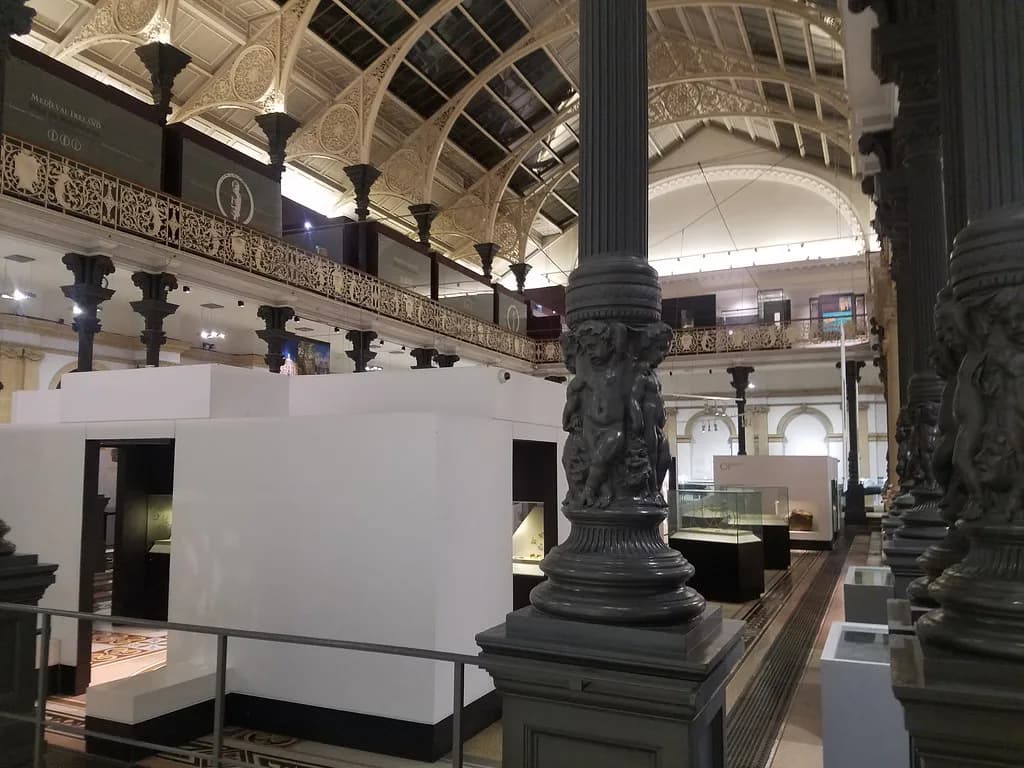
The second gallery is given over to the Faddan More Psalter, a book of Psalms found in a County Tipperary bog in 2006, so a single visit can move from metalwork to manuscript. The building adds its own layer: nineteenth-century mosaic floors, majolica fireplaces and carved doors were restored and worked into the exhibition layout. Look up from the cases at least once.
Planning the Visit
Ordinary hours are Tuesday to Saturday from 10am to 5pm and Sunday and Monday from 1pm to 5pm, with a recommended last entry of 4.30pm, and admission is free across the museum's four sites. The same page carries a dated notice that Kildare Street will be closed on Sunday 25 and Bank Holiday Monday 26 October 2026 because of industrial action, so check that notice before you travel rather than assuming the ordinary timetable applies.
Galleries can close at short notice, so if the chalice is the single reason for your visit, telephone the museum on +353 1 677 7444 to confirm it is available that day. Allow roughly an hour and a half for the Treasury alone if you read the labels, and decide in advance whether the technique gallery matters more than the manuscript room.
Rules for Looking Closely
Hand-held cameras may be used in the galleries, but flash, video, tripods and professional equipment are not permitted, and photographs are for personal use only. Cloakroom services are currently unavailable, so large bags, suitcases and motorcycle helmets should be left behind. Arriving unencumbered makes the close looking the case rewards actually possible.
All groups of eight or more wishing to visit must book in advance through the bookings office, while individuals, families and small groups need no booking. If you want a quieter look at the filigree, aim for a weekday opening rather than a weekend afternoon.
Making the Most of One Case
The Ardagh Chalice rewards a visitor who arrives knowing three things: it held wine at Mass, its silver and gold body carries apostle names and animal ornament, and it came from a potato-dig in County Limerick rather than from Dublin. With those fixed, the case becomes a document rather than a shiny object.
Pair it with the Derrynaflan Paten in the same exhibition, glance at the Faddan More Psalter in the next gallery, and you have a compact introduction to early Irish church art in a single building. Confirm the day's opening before setting out, and travel light.
Explore more Ireland guides
Frequently Asked Questions
Where can I see the Ardagh Chalice?
It is displayed in the Treasury exhibition at the National Museum of Ireland, Archaeology, Kildare Street, Dublin 2 (D02 FH48). That is a museum gallery, not the place where the object was found.
Was the Ardagh Chalice found in Dublin?
No. It was found at Reerasta near Ardagh in County Limerick in the 19th century as part of a hoard, and the museum record does not describe that findspot as an exhibition site.
What was the Ardagh Chalice used for?
It is a liturgical vessel that held Eucharistic wine during the celebration of Mass, which explains its shape and its apostle inscriptions.
How old is the Ardagh Chalice?
The National Museum dates it to the 8th century AD, the same broader period as the Derrynaflan Paten.
Is the Ardagh Chalice connected to the Derrynaflan Paten?
The two share filigree, knitted wire, mesh and enamel work, which the museum says suggests they may have been made in the same workshop. That is presented as a possibility, not a confirmed attribution.
Is entry to see the Ardagh Chalice free?
Yes. Admission is free at all four sites of the National Museum of Ireland, including the Kildare Street building. Check the visitor information page for any dated closure, and note that galleries may close at short notice, so call ahead if the chalice is your main reason for visiting.
Can I photograph the Ardagh Chalice?
Hand-held cameras may be used in the galleries for personal use. Flash, video, tripods and professional equipment are not permitted.
Sources
You might also like



Continue reading
More guides you'll find useful




