
Cross of Cong: Ireland's 1123 Reliquary and Where to See It
The Cross of Cong is a 1123 reliquary held in the National Museum of Ireland in Dublin, not in Cong. Read its making, inscription and later history.
On this page
The Cross of Cong is a processional reliquary cross made in 1123 to enshrine a fragment of the True Cross, and it now belongs to the national collection at the National Museum of Ireland in Dublin. It is not kept in Cong, County Mayo. The Mayo connection is historical: the object spent centuries at the Augustinian Friary there and takes its name from that long residence.
That distinction matters for planning. A traveller who wants to study the metalwork, the crystal and the inscription needs a Dublin stop, while Cong offers a separate heritage visit built around a ruined abbey and a town with its own story. Treating the two as one outing leads to disappointment, because the cross is not on show in Mayo.
What the Cross of Cong Is
The National Museum of Ireland describes the cross as the conclusion of a long tradition of distinctively Irish church metalwork, decorated in an impressive range of styles. It was designed for processional use, though the museum notes it may have been mostly used as an altar cross. That double function helps explain its shape and the care taken over both faces.
It is church metalwork, not a manuscript, and belongs with the collection's early medieval objects rather than its books. For readers drawn to the period more broadly, it sits alongside the Irish Illuminated Manuscripts as another strand of early medieval Irish art worth studying, even though the two are different kinds of object.
A scholarly review gives its dimensions as roughly thirty inches high and nineteen inches wide, with an oak core covered by cast bronze plates. The same review places it among the most important surviving examples of Irish twelfth-century metalwork and records its national collection inventory number, R2833. Those figures are useful for setting expectations: this is a substantial object, but it rewards close looking rather than distance viewing.
Why It Was Made: The True Cross and a High King's Patronage
The cross was made to enshrine a relic of the True Cross, which written sources say was acquired in 1122 by Toirrdelbach Ua Conchobair, High King of Ireland. The museum's own account links the commission directly to that relic and to the king's patronage. A reliquary of this kind was a statement of religious seriousness as well as wealth.
The Medieval Review's assessment of the standard monograph sets the commission against a period of church reform in Ireland, with the status of Tuam as an archdiocesan capital part of the picture. That reading treats the cross as a political and ecclesiastical act, not simply a devotional gift. Presenting it as interpretation rather than settled fact is the honest approach.
Popular heritage writing often frames the commission as a bid for church backing in a contested kingship. That is a reasonable summary of scholarly argument, but it should be read as interpretation. The object itself is the firmer evidence, which is why the inscription matters so much.
How It Was Made: Oak, Bronze and Rock Crystal
Under the ornament is a simple structure: an oak core covered by plates of cast bronze. The surfaces are cast openwork, decorated with ribbon-shaped intertwined animals in the Scandinavian-derived Urnes style. The museum describes gold filigree, niello and blue and white glass bosses around the crystal mount, a combination that shows several techniques on one object.
A large polished rock crystal sits at the junction of the arms and shaft, set in a conical mount and intended to protect the relic. The relic itself does not survive, so what visitors see is the container and its setting rather than the fragment it once held. That absence is part of the object's history, not a flaw in the display.
The scholarly review reports the monograph's argument that the designer and craftsman were one and the same person, and that the craftsman behind the cross appears to have been responsible for much of the metalwork surviving from twelfth-century Ireland. Whether or not one accepts every attribution, the point is that this is the work of an identifiable hand rather than an anonymous workshop product.
Ornament and Style: Urnes Animals and the Insular Debate
The intertwining animals on the bronze plates belong to the Urnes style, which derives from Scandinavian art and was adapted by Irish craftsmen. Scholarly discussion has weighed how far the cross is Insular in character and how far it looks to outside models. The review summarises the monograph's conclusion that the cross owes most to the native Irish metalworking tradition while acknowledging those wider parallels.
A common visitor question is whether this is a Celtic cross in the familiar ringed sense. Heritage commentary points out that it lacks the characteristic ring, so its silhouette differs from the high stone crosses. The ornament, however, echoes interlace and spiral designs found on those crosses and in other Irish treasures, so the Irish character is in the detail rather than the outline.
Reading the Inscription
The inscription on the sides of the cross names Toirrdelbach Ua Conchobair as patron and Máel Ísú mac Bratáin Uí Echach as the craftsman who made it. Two prominent churchmen also appear. The text is in Irish, framed by two identical lines in Latin that the museum translates as a statement that the cross covers the cross on which the creator of the world suffered.
For a visitor, the inscription is the most direct document on the object. It identifies people, gives the commission a social setting and states the relic's purpose in the object's own terms. Reading a transcription before you go makes the physical object easier to follow, because the lettering is small and wraps around the sides.
Why It Is Called the Cross of Cong
The name comes from the object's long residence at the Augustinian Friary at Cong, County Mayo, not from the place of manufacture. The museum's account says it was kept there for centuries, and the scholarly review notes it may not have been made at Cong at all. That is the simplest way to hold the name and the location apart.
Why it moved west is not settled. The museum's account records the residence at Cong without giving a motive, and scholarly study treats the transfer as unresolved rather than naming a single cause. Where a popular retelling offers a confident explanation, it is worth checking against those two accounts before repeating it.
Cong itself is a small town on the borders of Mayo and Galway, associated in popular memory with the filming of The Quiet Man as well as with its abbey. Those associations belong to the town, not to the cross's present whereabouts. Keep them as context for a separate walk rather than a reason to expect the object there.
From Cong to the National Collection
The cross entered a museum collection in 1839, when it was acquired by the Royal Irish Academy. The scholarly review describes that acquisition as pivotal to the foundation of the national collection. That institutional history explains why an object so tied to Mayo is now studied mainly in Dublin. For a wider view of the city's historic sites, see this Dublin heritage guide.
The museum's published account of the cross is the place to start for its date, materials and inscription. Current gallery-level information is a separate question, and the museum's own notices should be checked before a trip. Some notices on that page concern other locations and exhibitions rather than this object.
Seeing the Cross in Dublin
The cross is part of the national collection in Dublin, and the most reliable starting point for a visit is the museum's own collections and visitor information. Confirm the current display arrangements directly before travelling, since gallery-level access is not something these sources establish. Do not assume a particular room from older guidebooks.
Give the object unhurried time. The inscription runs along the sides, the crystal mount sits at the junction of the arms, and the animal ornament is worked at a small scale. A visit built around one case rewards patience more than a rapid circuit of a gallery.
If the metalwork is the reason for your interest, pair it with other early medieval objects in the same tradition. Comparisons sharpen the eye for techniques and ornament, and they make the Cross of Cong's particular qualities easier to see.
Cong as a Separate Heritage Visit
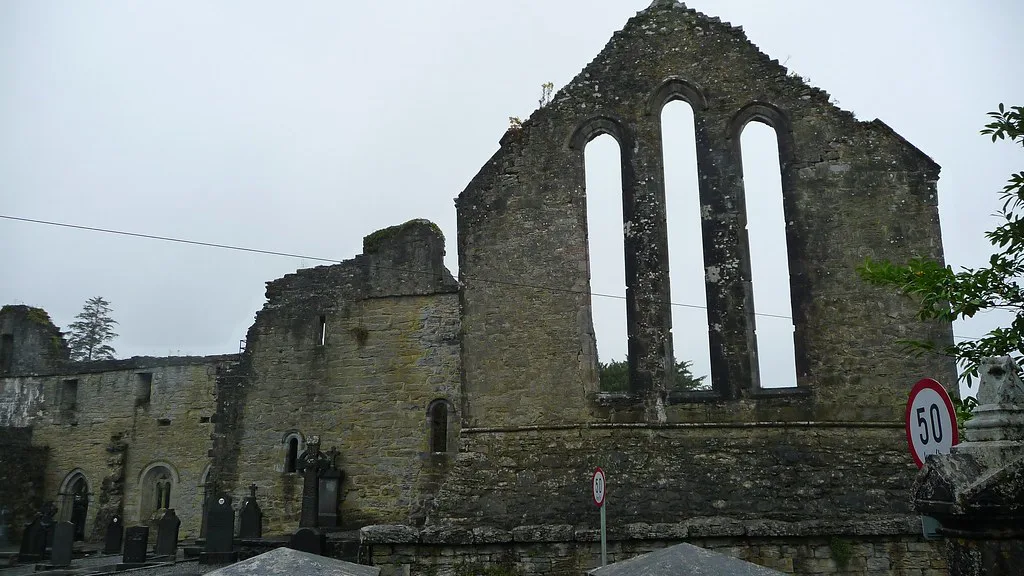
Cong's abbey heritage is the reason the town belongs in a discussion of the cross, and it is worth a visit on its own terms. Secondary heritage writing describes the Augustinian abbey as containing some of the finest medieval religious architecture in Ireland, though the buildings are ruined. Treat the ruins as an outdoor heritage site and do not assume interior access, guided tours or facilities.
A walk through the town can combine the abbey setting with the streets and buildings associated with the Quiet Man film. That pairing suits travellers already in the west rather than a day trip made solely for the cross. Check locally for access arrangements on the day.
Comparing It with Other Irish Metalwork Treasures
Scholars place the cross alongside the Ardagh Chalice, the Derrynaflan assemblage and the Tara Brooch as key survivals of Irish metalwork. The comparison is useful because it shows a shared repertoire of techniques and ornament across different object types. It also shows how much of the surviving material has been studied through single-object monographs.
Seeing several of these objects in one city helps a visitor register what is distinctive about each. The cross's reliquary purpose, its rock crystal and its inscription set it apart from a chalice or a brooch. A little background reading before a museum visit makes those differences legible.
Plan Your Visit
Decide first whether your priority is the object or the place. The cross is in the national collection in Dublin, so a museum-focused visit is the way to see it. Cong offers the abbey ruins and town heritage that gave the cross its name, but not the cross itself.
Before travelling, check the museum's own pages for current display and gallery information, and treat notices about other locations as irrelevant to this object. For Cong, plan around an outdoor heritage walk.
Explore more Ireland guides
Frequently Asked Questions
Where is the Cross of Cong now?
It is held in the national collection at the National Museum of Ireland in Dublin. It is not kept in Cong, County Mayo, although the town gave the object its name through the centuries it spent at the Augustinian friary there.
When was the Cross of Cong made and why?
It was made in 1123 to enshrine a fragment of the True Cross acquired by Toirrdelbach Ua Conchobair, High King of Ireland. The museum's account connects the commission to that relic and to the king's patronage.
What is the Cross of Cong made of?
An oak core is covered with cast bronze openwork plates, with gold filigree, niello and blue and white glass bosses. A polished rock crystal at the junction of the arms and shaft was set there to protect the relic, which no longer survives.
What does the inscription on the Cross of Cong say?
It names Toirrdelbach Ua Conchobair as patron and Máel Ísú mac Bratáin Uí Echach as craftsman, with two churchmen also mentioned. Irish text is framed by Latin lines stating that the cross covers the cross on which the creator suffered.
Why is it called the Cross of Cong if it is in Dublin?
The name records where it was long kept, at the Augustinian Friary at Cong in County Mayo, not where it was made or where it is today. The cross may not have been made at Cong, and the reason for its move west is not settled.
Is the Cross of Cong a Celtic cross?
It lacks the ring of the familiar high stone crosses, so its outline differs. Its ornament, though, draws on the same Irish traditions of interlace and animal design seen on high crosses and other metalwork.
Can you see the Cross of Cong in Cong, County Mayo?
No. Cong has the ruined abbey and town heritage associated with the cross's history, but the object itself is in Dublin. Check the museum's current display information before planning a visit.
Sources
You might also like



Continue reading
More guides you'll find useful



