
Tara Brooch: What It Is and Where to See the Original
The Tara Brooch was not found at Tara. Learn how this cast and gilt silver brooch was found at Bettystown and where to seek the original in Ireland.
On this page
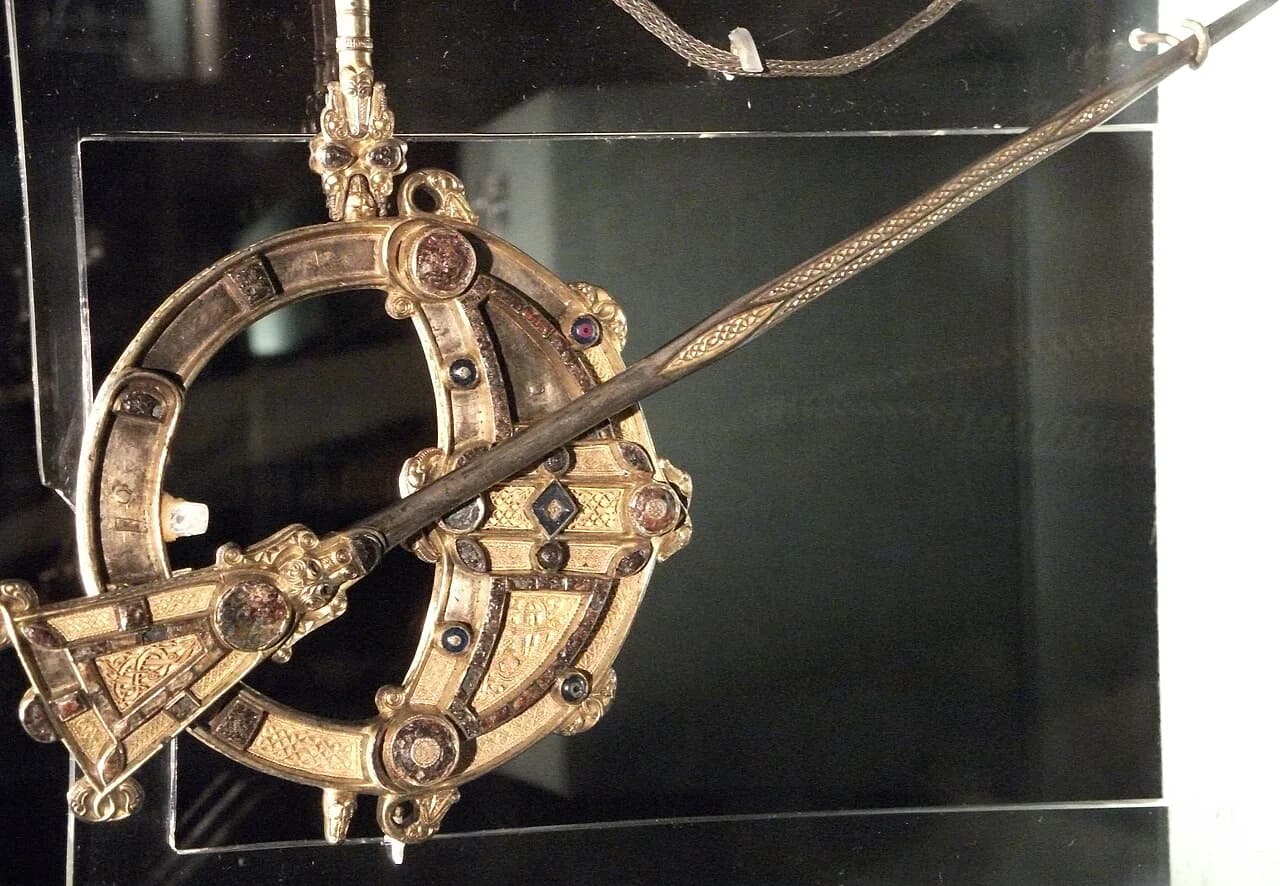
The Tara Brooch is a cast and gilt silver brooch found near the seashore at Bettystown in 1850, not at the Hill of Tara. The National Museum of Ireland record states plainly that the association with the ancient royal site was an invention by Waterhouse & Co., a Dublin firm of jewellers, intended to enhance the piece's value. Understanding that split between object and name is the key to reading everything else about it.
This guide treats the brooch as metalwork, not as a manuscript or a manuscript fitting, and it avoids promising a particular case or room. Instead it explains the documented discovery, the commercial naming, the construction details worth studying at close range, and how to approach the original through the museum's own collections and visitor information.
Direct Answer: A Brooch Named for a Place It Never Came From
If you have one question about the Tara Brooch, it is probably whether it was found at Tara. It was not. The museum's object record places the find near the seashore at Bettystown, and an independent editorial feature from Lyon & Turnbull likewise stresses that the brooch was never found at the Hill of Tara despite becoming synonymous with it.
The practical consequence for a visitor is simple: treat the name as a nineteenth-century commercial label rather than an archaeological findspot. Keep the object's own story and the story of its name separate, and the rest of the evidence falls into place without requiring any legendary Tara connection.
What the Surviving Object Actually Is
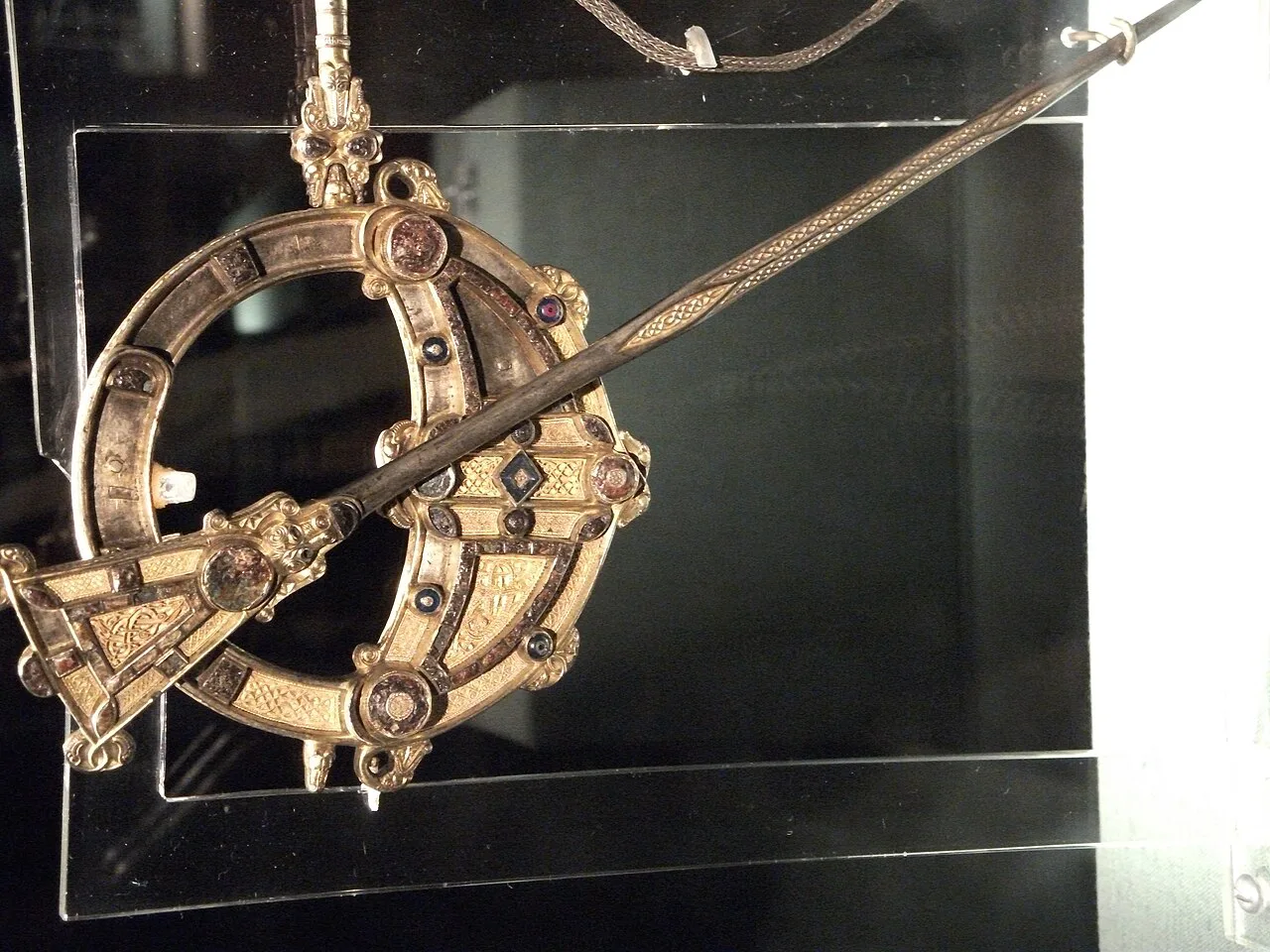
The brooch is made of cast and gilt silver. Its front is built as a network of recessed cells filled with panels of gold filigree, and some of those panels are missing, so the surviving surface should be read as a partly preserved scheme rather than a complete one. Separating the filigree panels are studs of glass, enamel and amber.
A guard-chain of woven silver wires ends in a swivel attachment made of cast snake and animal heads framing two tiny human heads of cast glass. That combination of materials, gold on silver with glass, enamel and amber settings, is why the piece rewards slow looking rather than a quick glance. It is composite metalwork, and each material catches light differently.
The Finding at Bettystown in 1850
The museum record dates the discovery to 1850 and locates it near the seashore at Bettystown. Its further reading lists Whitfield's 1974 article on the finding of the Tara Brooch in the Journal of the Royal Society of Antiquaries of Ireland, which is the reference to follow if you want the discovery documented in detail. No exact day or month is given in the collection record, so treat more precise dating claims with caution.
Secondary accounts add colour about how the piece passed into a Dublin jeweller's hands, but the museum's attribution of the Tara name to Waterhouse & Co. is the firmest statement available here. Read any more dramatic version of the find, including stories of a buried box or a deliberately altered findspot, as unverified narrative rather than established fact.
How 'Tara' Got Attached
The museum describes the Tara association as an invention by Waterhouse & Co., a Dublin firm of jewellers, to enhance the brooch's value. That is a commercial explanation, not a geographic one, and it fits the wider Victorian appetite for ornaments linked to Ireland's ancient royal sites. The Hill of Tara supplied prestige by association, even though the brooch surfaced on the County Meath coast. For more on the royal site that gave the brooch its borrowed name, this Dublin heritage guide covers its story among the city's key sites.
The independent auction-house feature reaches the same conclusion: a Dublin jeweller renamed the piece to tie it to Ireland's royal site, and the name helped turn it into a celebrated example of early medieval Celtic metalwork. Two separate sources agreeing on the naming mechanism is the strongest support for this part of the story, and it is the naming, not the findspot, that the evidence establishes.
Reading the Front: Cells, Panels and Studs
Begin with the structure rather than the shine. The front is a grid of recessed cells, each holding a gold filigree panel where it survives, and the empty settings are as informative as the filled ones. Look for the boundaries between panels and studs, because they show how the design was planned as a sequence rather than a single sheet of ornament.
Then compare the stud materials. Glass, enamel and amber sit between the filigree panels, and their colour and translucency differ enough to notice at close range. Because some panels are missing, resist the assumption that the front was once uniformly covered; the museum record describes what survives, and the gaps are part of the object's present condition.
Close Detail: The Two-Centimetre Terminal Panel
One terminal carries a triangular filigree panel measuring only 2 cm end to end, and within that small space sits an animal in heraldic pose, front paw raised and body wound back on itself. The museum specifies this measurement for that panel alone, so do not assume it applies to every panel on the brooch.
The technique is worth naming before you look: beaded and twisted gold wires and gold granules are soldered to a base of sheet gold. Knowing that, the panel reads as assembled micro-sculpture rather than drawn line, and the density of detail explains why the brooch is studied through magnification as much as through gallery viewing.
The Back of the Brooch and the Hoop Ornament
The reverse is not a plain afterthought. The museum notes that the back is as ornate as the front but flatter, with no filigree wires that would catch on cloth, because this side rested against the wearer's clothing. That is a functional decision embedded in decoration, and it is the sort of detail that separates a working dress fitting from a display object.
The hoop and terminals carry designs of scrolls and triple spirals. When you reach the original, or study it through published images, try to read the front, the reverse and the hoop as three related surfaces rather than one face; the difference in relief between them is the clearest evidence of how the brooch was meant to be worn.
Why the Name Stuck
The Tara label travelled further than the object's findspot ever could. Lyon & Turnbull's feature treats the brooch as one of the most celebrated pieces of early medieval Celtic metalwork and connects its celebrity to the misleading royal-site name. That is a claim about reputation and influence, and it should be kept distinct from the brooch's own manufacture.
A retailer's blog repeats the Bettystown finding and the Waterhouse naming, and attributes the revival reputation to the name; it is useful only as weak secondary context and should not be used for exhibition dates, royal inspections or attributions of ownership. For the object itself, rely on the museum's collection record and its cited scholarship rather than sales copy.
The revival afterlife also helps explain why the brooch is so often grouped with other early medieval Irish treasures, including manuscript-era art made in different media. If your interest runs in that direction, the wider context of irish illuminated manuscripts shows how book art and metalwork belonged to overlapping worlds of patronage and display, without turning the brooch itself into a manuscript.
Where to See the Original
The original is associated with the collections of the National Museum of Ireland, which is the institution to consult for the object's current display arrangements. Seek it out through the museum's own collections and visitor information rather than relying on older guidebooks, and check the museum's site before travelling, since this record documents the object but not gallery placement or opening arrangements.
If your trip is built around early medieval Irish art, the Book of Durrow offers a companion in a different medium, and seeing both sharpens the contrast between manuscript ornament and metalwork. The brooch's gold filigree and glass settings are best understood beside such material, not folded into it.
What Visitors Commonly Get Wrong
The first error is looking for a Tara connection in the ground. The second is assuming the filigree front is complete; several panels are missing, and the museum record describes the surviving network rather than a fully intact design. The third is expecting a manuscript-style display, when this is a three-dimensional silver brooch whose back and edge matter as much as its face.
A fourth error is treating the name as neutral. It was a commercial decision by a Dublin firm, and its success is a fact about nineteenth-century taste and the Celtic Revival rather than about where the brooch was made or found. Holding those two histories apart is what makes a close look at the object worthwhile.
Plan Your Visit Around the Object
Build the visit around a single object rather than a circuit of sites. Read the museum's collection record before you go, note the names of the materials, and decide in advance which details you want to find: the recessed cells, the surviving filigree, the glass, enamel and amber studs, the snake and animal heads on the swivel, and the flatter ornament on the reverse.
Then check the National Museum of Ireland's own pages for current arrangements, as this is the only reliable way to confirm what is on view when you travel. Pair the visit with related early medieval metalwork and manuscripts where collections allow, and keep the Tara name in your notes as a label with a history, not a findspot. For another heritage guide, read about Ardagh Chalice.
Explore more Ireland guides
Frequently Asked Questions
Was the Tara Brooch found at the Hill of Tara?
No. The National Museum of Ireland record places the find near the seashore at Bettystown in 1850, and an independent auction-house feature also states that the brooch was not discovered at the Hill of Tara. The Tara name was attached later by Dublin jewellers to associate the piece with Ireland's ancient royal site.
What is the Tara Brooch made of?
The body is cast and gilt silver. Its front is a network of recessed cells holding gold filigree panels where they survive, separated by studs of glass, enamel and amber, and a woven silver guard-chain ends in a swivel with cast snake and animal heads framing two small glass human heads.
Why is it called the Tara Brooch if it has no Tara connection?
The museum states that the association with Tara was an invention by Waterhouse & Co., a Dublin firm of jewellers, to enhance the brooch's value. The name tied the object to a prestigious royal site and helped it become widely celebrated during the Victorian Celtic Revival.
Where can I see the original Tara Brooch?
The original is associated with the collections of the National Museum of Ireland. The museum's own collections and visitor pages are the place to confirm current display arrangements, since the object record does not document gallery placement, opening times or access conditions.
What details should I look for on the brooch itself?
Look for the recessed cells and the surviving filigree panels, the gaps where panels are missing, the glass, enamel and amber studs, the 2 cm triangular terminal panel with its heraldic animal, and the flatter scroll and triple-spiral ornament on the back and hoop.
How old is the Tara Brooch?
The sources here do not give a firm manufacture date, so avoid treating any precise century as settled. What is documented is the 1850 discovery near Bettystown and the later nineteenth-century naming; for dating, consult the museum's collection record and the scholarship it cites.
Is the Tara Brooch a manuscript?
No. It is a three-dimensional silver brooch with gold filigree and settings of glass, enamel and amber. It belongs with early medieval Irish metalwork, a separate category from illuminated manuscripts, though both are often studied together as part of the same artistic world.
Sources
You might also like



Continue reading
More guides you'll find useful




