
Limerick Lace: How It Was Made and Where to See It
Limerick lace is embroidery worked on machine-made net. Learn how tambour and needlerun differ, how the 1829 industry grew, and where to see examples.
On this page
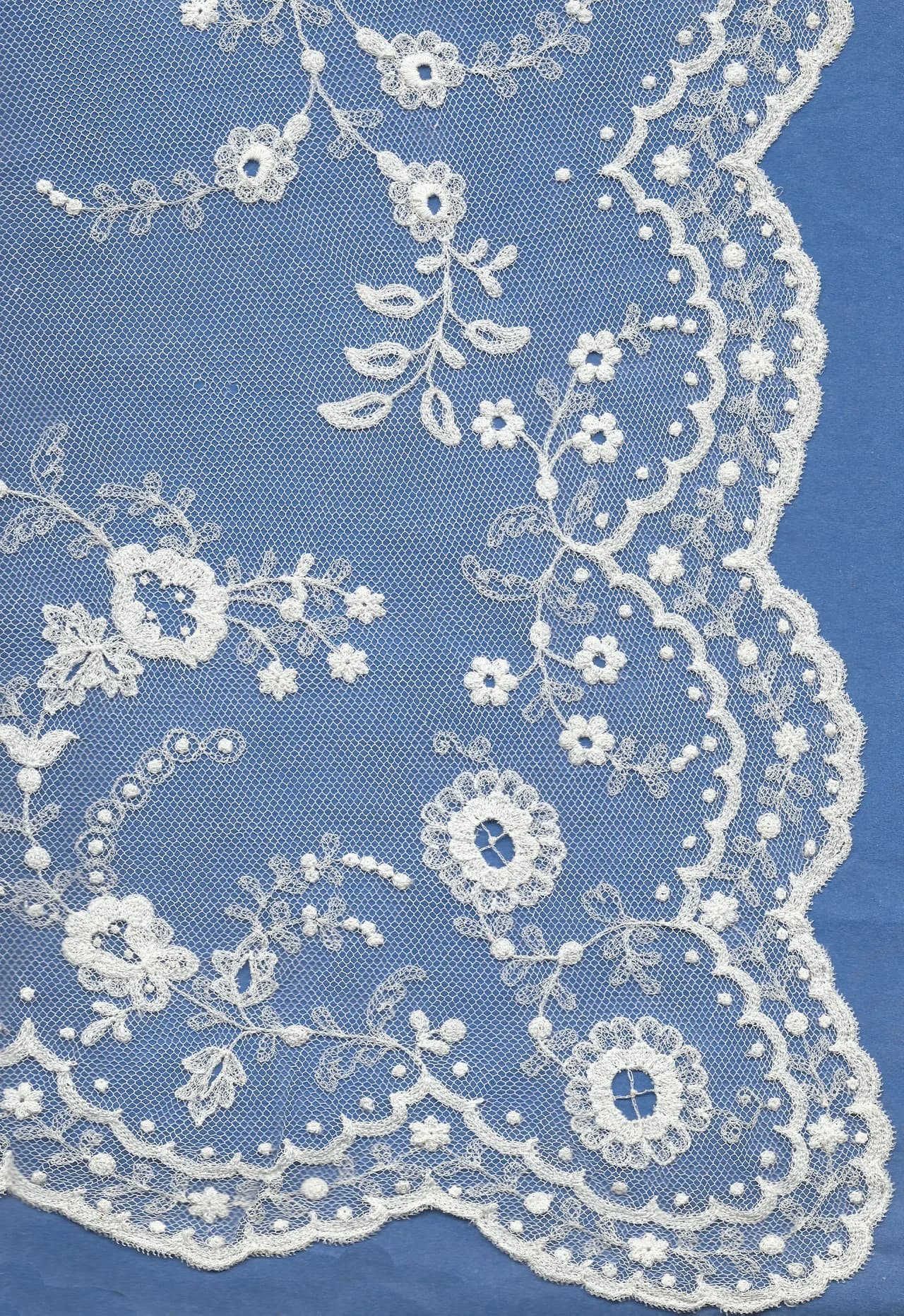
Limerick lace is embroidery worked on a machine-made net background. Two methods were used: tambour, where a hook draws a chain stitch through stretched net, and needlerun, where a needle outlines the design and fills it with darning. It is not crochet and not needle lace, and knowing that distinction is the single most useful thing to carry into a display case.
The craft is closely tied to one city. Limerick's lace trade began as a commercial venture in 1829, passed through factory, convent and school phases, and survives today mostly through the work of volunteer groups and small-scale makers. For a visitor, the practical anchor is Limerick Museum on Henry Street, which holds the largest collection of Limerick lace in the country.
What Limerick Lace Actually Is
The foundation of every piece is a manufactured net, stretched taut over a frame so the maker can work into its mesh. The design is outlined first, then the enclosed areas are filled with small stitching patterns. Laces of Ireland notes that one collar has been recorded with as many as forty-seven different fillings, which gives a sense of how varied the interior work could be.
The Guild of Irish Lacemakers describes the visual character as a contrast between the crisp outline of the design and the filling stitches packed into small compartments known as caskets. That contrast is what to look for in a case: the net ground should read as a fine grid, the motif edges as firm lines, and the interiors as dense but varied texture rather than flat colour.
This structure also explains why the lace sits flat and delicate rather than sculptural. Because the net carries the design, the maker is drawing on a ready-made grid instead of building fabric stitch by stitch. Limerick work therefore belongs with the embroidered-net family of Irish laces, not with crochet or true needle lace traditions.
Two Methods, Two Textures
Tambour work takes its name from the drum-like frame that holds the net. A small hook passes through the mesh and pulls a loop back to form a chain stitch along the design line, a technique the Guild describes as working the outline with a hook. The result reads slightly heavier and more continuous than the alternative.
Needlerun lace uses no hook. The outline is stitched with a needle and then the shapes are filled with darning, light or heavy, before fancy net stitches are added in the open spaces. Laces of Ireland explains that the net is pinned with the design underneath, the outline worked in double thread, and the filling then darned in single thread.
The practical consequence for a visitor is that run lace appears lighter and more open than tambour. When a label identifies the technique, compare the outline: a hooked chain stitch has a rounded, ropy quality, while needlerun outlines look finer and more drawn. Where no technique is given, it is fair to look but not to guess aloud.
The Net That Made It Possible
Limerick lace existed only because net became cheap. Handmade net was an expensive fabric until machine netmaking arrived in the early nineteenth century, and Laces of Ireland dates the pivotal machine to 1815 in Devon, with the maker's patent expiring in 1823.
After that, inexpensive machine net flowed to Irish lacemakers and turned embroidery on net into a viable trade rather than a luxury pastime. The wider history published by Limerick City Council treats Limerick lace as a named, place-branded product of the nineteenth century, which is a useful frame: the town's name functioned as a guarantee of a particular style of work.
A Commercial Beginning in 1829
Charles Walker, an Englishman from Oxfordshire, founded the Limerick lace industry in 1829. He brought twenty-four young women over from England to teach the skill locally, and he chose Limerick partly because the city had a large population of women with factory work experience and few jobs for them.
This was a business, not a charity, which distinguishes Limerick from several other Irish lace traditions that grew out of philanthropic schemes. The Guild of Irish Lacemakers makes the same point plainly, noting that Limerick lace began as a purely commercial enterprise started by an Englishman.
Factory Decades and Their Workforces
For roughly its first forty years the industry was factory-based. William Lloyd opened a second Limerick lace factory in 1835, first at Clare Street and later in Abbey Court off Nicholas Street, and by 1841 he employed four hundred women and girls. Leycester Greaves, a Cork man, opened another in 1836, and the city's lace factories together gave work to nearly two thousand women and girls.
The early factory period is conventionally dated from 1829 to about 1870, after which production shifted to homes and workshops until around 1914. That change matters when reading labels and dates: an object made in the 1850s most likely came out of a factory, while one from the 1890s probably did not.
Convent, School and Revival Work
From the 1840s lacemaking was taken up in convents, which spread the skill well beyond Limerick to houses in places such as Youghal, Kinsale and Kenmare. At the Good Shepherd Convent on Clare Street in Limerick, lacemaking was introduced in 1850, and it remained the last lacemaking centre in the city until production ceased there in 1990.
The Good Shepherd Convent on Clare Street ceased lacemaking in 1990 as the last lacemaking centre in the city. Its former lace work belongs to history rather than to a current visitor offer, which is why the places named in this guide are the public museum collection and voluntary groups rather than religious houses.
After Charles Walker died in 1849 the trade declined, though pieces shown at the Great Exhibition in London in 1851 won medals. The 1880s brought a revival led by Florence Vere O'Brien, whose lace school opened with eight pupils in May 1889 and ran until 1922. The Countess of Aberdeen's Irish Industries Association, founded in 1886, pushed the buy-Irish message that supported such work.
Mrs Maude Kearney established the Thomond Lace Industry in 1904 in Thomondgate, employing between fifty and eighty workers at its height. Limerick lace declined rapidly again after the Second World War. In 2019 the craft was added to the National Inventory of Intangible Cultural Heritage, a listing that recognises the tradition rather than guaranteeing any site you can walk into.
Limerick Museum: The Collection to Start With
Limerick Museum holds the largest collection of Limerick lace in the country. It occupies the Old Franciscan Friary on Henry Street, postcode V94 C7W1, less than five minutes on foot from the tourist office and O'Connell Street and about fifteen minutes from the rail and bus station.
Admission is free. Opening hours are Monday to Friday from 10am to 5pm and Saturday from 10am to 1pm and again from 2pm to 5pm, with the Saturday lunchtime gap worth planning around. Confirm the hours before you travel, since civic museums adjust them.
The collection claim is not a display promise. No source here confirms that any particular shawl, collar or robe is currently on view, so treat a visit as a chance to see what the museum has chosen to show rather than a checklist. The Laces of Ireland history records that the museum held a series of lace exhibitions and conferences in 2018, 2019, 2024 and 2025, which suggests the subject is revisited periodically, but temporary displays come and go.
Living Practice and How to Check It
Limerick lace is still made on a very small commercial scale, and classes run in the city and elsewhere to keep the skill alive. Several voluntary groups support this: Pennywell Lacemakers, founded in 2013, have lent expertise to a conservation project at Limerick Museum, while Friends of Lace Limerick, formed in 2017, catalogues and researches surviving pieces.
Organised activity exists, but it moves. The Limerick lace project site has advertised class terms, walking tours of lace-related city sites, a symposium series and a craft festival at King John's Castle, all with specific dates attached. Every one of those notices is dated and has passed, so check the site's current listings rather than turning up expecting a particular workshop.
A sensible approach is to look for what is announced now, confirm the venue, and ask whether attendance needs registering in advance. Do not treat a published class timetable as a standing visitor offer, and do not assume a demonstration will be running on the day you happen to be in town.
Placing Limerick Among Irish Laces
Ireland has several distinct lace traditions, and they are easy to confuse because most are named for towns. Limerick's identity rests on embroidery over net; other traditions build fabric differently, and comparing them side by side sharpens your eye. A broader look at Irish lace traditions helps set the Limerick method against the rest.
Crochet work, for instance, is constructed stitch by stitch with a hook rather than embroidered onto a net ground, which is precisely why Limerick lace should not be described as crochet. That distinction is worth holding onto when labels use the word loosely. Irish crochet lace developed along its own separate lines.
If your interest is comparative, the Irish lace guide sets Limerick alongside the country's other traditions and shows where each one sits. Carrickmacross lace and Kenmare lace are the natural next stops, each with its own guide explaining how that work is built.
Plan Your Visit Around the Collection
Build a Limerick lace visit around the museum rather than around a hoped-for demonstration. Henry Street is central, entry is free, and the lace collection is the strongest documented reason to go. Allow time to look closely at outline and filling, which is where the craft's character actually sits.
Then check what the city's lace groups have scheduled in the week you travel; if nothing is on, the museum still stands as the reliable stop. Read the technique labels before comparing pieces, and the differences between tambour and needlerun will start to show themselves.
Explore more Ireland guides
Frequently Asked Questions
Is Limerick lace crochet or needle lace?
Neither. Limerick lace is embroidery worked onto a machine-made net ground: the net supplies the fabric and the maker stitches the design into it. Crochet is built stitch by stitch with a hook, and needle lace is constructed from loops of thread without a net base. If a label calls Limerick work crochet, that is a loose use of the word rather than a description of the technique.
What is the difference between tambour lace and needlerun lace?
Both are Limerick methods, but the tool and texture differ. Tambour uses a small hook that passes through net stretched on a drum-like frame and pulls a chain stitch along the design line, giving a slightly heavier, ropier outline. Needlerun uses a needle: the outline is stitched first, then the shapes are darned and finished with fancy net stitches, so the finished piece reads lighter and more open.
Where can I see Limerick lace in Limerick?
Limerick Museum on Henry Street holds the largest collection of Limerick lace in the country and is the obvious place to start. It is a short walk from O'Connell Street. The museum has not published which lace pieces are on view at any given time, so treat the visit as a chance to see what is currently displayed rather than a fixed checklist of objects.
Is Limerick Museum free to visit?
Yes, admission to Limerick Museum is free. It sits in the Old Franciscan Friary on Henry Street, and the council lists weekday opening from 10am to 5pm with a Saturday break over lunch. Hours can change, so confirm them with the museum before you set out, especially if you are travelling a distance to reach it.
Is Limerick lace still made today?
On a very small commercial scale, yes, and classes run in Limerick and elsewhere to keep the skill going. Voluntary groups such as Pennywell Lacemakers and Friends of Lace Limerick support conservation, cataloguing and teaching. What you cannot assume is a fixed timetable: classes, walking tours and symposia are organised at changing venues, so check current listings rather than relying on an old notice.
Sources
You might also like



Continue reading
More guides you'll find useful



