
Irish Lace: Regional Traditions and Where to See Them
Irish lace is several regional crafts, not one. See how Youghal, Kenmare, Carrickmacross, Clones and Limerick lace differ and where each is displayed.
On this page
Irish lace is not a single craft. The name covers a family of regional traditions — needle lace at Youghal and Kenmare, applied work on machine net at Carrickmacross, crochet associated with Clones, and net-based Limerick work — and each was made with different tools and techniques.
That distinction matters for anyone planning a visit, because the places that display Irish lace tend to be rooted in one tradition rather than all of them at once. Knowing which technique you want to see tells you whether to head for a working gallery, a local museum or a design centre.
A Short History of Lacemaking in Ireland
A study published by Limerick City and County Council divides Irish lacemaking into three broad periods. The first ran from the 1730s to the 1780s, when few examples survived; the second, from 1820 to 1914, is described as the Golden Age, when the classic Irish laces were developed and lacemaking became a major industry; the third, from 1914 onward, has been one of long decline.
The same study traces the earliest references to Irish lacemaking to the Dublin Society, established in 1731, whose records show three lace workshops in Dublin by 1739. It also corrects the assumption that every Irish lace began as famine relief: significant pre-Famine production is recorded at Headford in County Galway, Tallow in County Waterford and in Dublin city, although many other laces did indeed originate in the 1840s as relief measures.
Ireland's National Inventory of Intangible Cultural Heritage records that lace-making centres once operated across the island from the eighteenth to the early twentieth century, and that demand fell with the mechanisation of lace production and the disruption of trade during the First World War. Small creative hubs still survive in Dublin, Cork, Limerick and Monaghan, though the craft is now practised largely as a hobby.

How the Traditions Differ
The clearest way to keep Irish lace straight is by construction. Youghal and Kenmare are needle laces, worked entirely with a needle and fine cotton thread. Carrickmacross applies fabric to a machine-net base, with the design outlined and surplus material cut away. Limerick is worked on machine net rather than by needlepoint, and Irish crochet is made with a single hook.
Crochet sits somewhere between lace and knitting: it uses a single hook rather than two needles, and the resulting fabric is generally heavier than true lace. The National Inventory describes Irish crochet as separate motifs joined by background netting or mesh, so that each finished piece reflects the maker's own choice of motif and mesh.
Limerick lace is different again, built on a machine-net base with tambour and needlerun work rather than needlepoint. The Limerick study groups Carrickmacross and Limerick together as the two earliest surviving indigenous Irish laces, both founded in the 1820s and both dependent on machine-made net — a point that has led some authorities to question whether they count as true lace.
Youghal Needle Lace
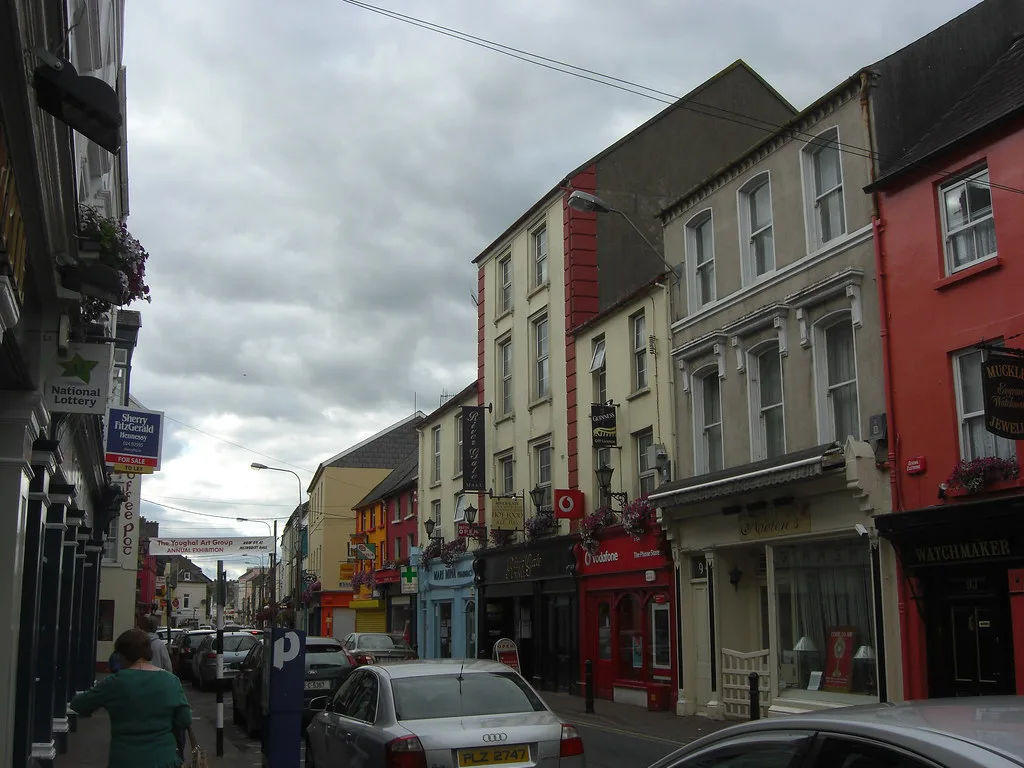
Youghal needle lace grew out of the need for employment during the potato famine of 1846. According to the Guild of Irish Lacemakers, a piece of Italian lace came into the possession of Mother Mary Ann Smith of the Presentation Convent in Youghal, County Cork; she unravelled it to study how it was made, mastered the stitches, and taught children in the convent who showed aptitude for needlework. A convent lace school opened in 1852.
The school's record included a shawl presented to the Princess of Wales in 1863 and medals at exhibitions including the Vatican Exhibition of 1888 and the Chicago World's Fair of 1893. Work continued after Mother Smith's death in 1872 under Sister Mary Regis Lynch, and the nuns kept making lace until the late 1950s. A revival began in 1987, when Veronica Stuart and Sister Mary Coleman again unravelled a piece of Youghal lace to recover the technique.
The Guild's page documents the history and the revival but does not name a public display venue or its opening arrangements, so anyone hoping to see Youghal lace should confirm with local heritage contacts in Youghal before travelling.
Kenmare Lace and the Design Tradition
Kenmare lace is closely tied to the Poor Clares, whom the parish priest brought to the town in 1861 to open a school. The Kenmare Lace & Design Centre's own history explains that the convent's work became a commercial success, with some girls earning between five and eighteen shillings a week, and that a design school linked to London and Cork art institutions later raised standards.
The dates are worth stating carefully rather than tidying away. The operator dates the nuns' arrival to 1861, while the Limerick study gives 1864 for the introduction of Kenmare lace specifically, so the two accounts describe slightly different moments.
Kenmare work reached an unusually wide audience: the centre records commissions connected to Queen Victoria, Edward VII and Alexandra, and pieces sent to the Vatican. The centre states that the original designs, long central to the local style, can still be seen there today — making it the one place in this guide where a specific holding is documented. Check current opening arrangements directly with the centre rather than assuming seasonal hours.
Carrickmacross Lace
Carrickmacross lace was set up in the early 1820s by Mrs Margaret Grey Porter, wife of the rector of Donaghmoyne near Carrickmacross in County Monaghan, with her maid Anne Steadman, after the two took an active interest in lace manufacture while on honeymoon in Italy. The technique applies muslin or fine fabric to a machine-net base, outlines the design in thick thread and cuts away the surplus fabric. For the fuller story, see our guide to Carrickmacross lace in County Monaghan.
After Mrs Grey Porter's death the industry survived through a small lace class using her designs and was later saved from extinction when lacemaking was introduced on the two largest landed estates in County Monaghan; it underwent a further revival in the 1890s under the Sisters of St Louis. The Carrickmacross lace technique was used on the wedding dresses of Princess Diana in 1981 and Kate Middleton in 2011. The Carrickmacross Lace Co-operative now carries the tradition on in the town, and its own site dates the craft to 1820.
For visitors this is the most concretely arranged stop: the Carrickmacross Lace Gallery opens Monday to Saturday from 9.30am to 4.00pm, stays open through lunchtime, and closes on Sundays and bank holidays. The co-op asks tour groups and sewing guilds to book demonstrations in advance, so a group visit needs planning rather than a spur-of-the-moment arrival.
Clones and the Irish Crochet Tradition
Crochet became widespread in Ireland in the 1840s from two centres: the Ursuline convent at Blackrock in Cork, where production began in 1845, and Clones in County Monaghan, where Mrs Cassandra Hand introduced the craft. The Dunlavin crochet industry that started at the same time declined and disappeared, while the Clones tradition flourished and spread. If the Cork side of that story appeals, our Blackrock, Cork: A Built-Heritage Guide to the Historic District covers the neighbourhood where the Ursuline convent stood.
Irish crochet earned the name point d'Irlande on the Continent and was taken up by designers including the Parisian couturier Jeanne Paquin and the Irish designers Irene Gilbert and Sybil Connolly. The National Inventory records locally recognisable styles such as Clones crochet lace alongside Youghal and Kenmare lace. See our irish crochet lace guide for the Clones tradition in detail.
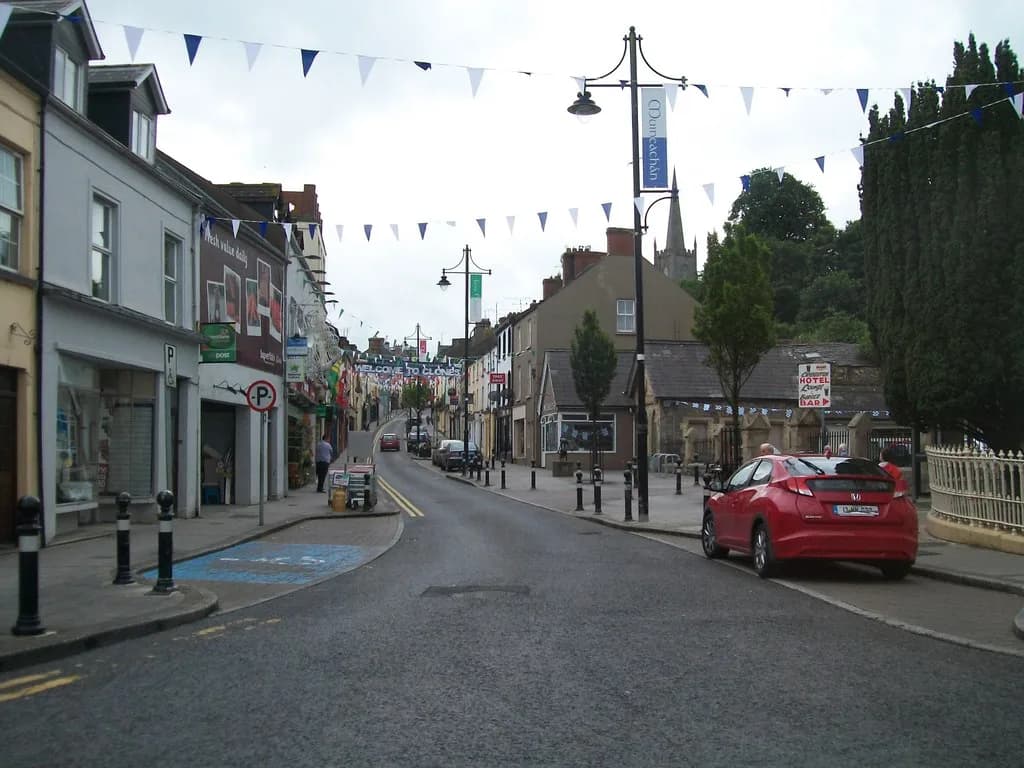
Clones now has a dedicated lace museum inside the Ulster Canal Stores Visitor Centre, tracing the local craft from its origins following the Irish Famine of the 1840s right up to today's makers. The centre has full disabled access, a free onsite car park, an adjacent playpark and an onsite restaurant, and welcomes groups and coaches by prior arrangement.
Limerick Lace Today
Limerick lace belongs to the net-based branch of Irish lacemaking, with tambour and needlerun work replacing the needlepoint used at Youghal and Kenmare. It was established in the 1820s, and the city's lace history is documented in the Limerick study published by the local authority.
Present-day activity is organised by the Limerick lace project, which lists classes and walking tours through the city's lace history. These are individually dated listings rather than a standing programme: the site carries classes, walking tours, a one-day craft festival at King John's Castle and a symposium at named venues, with dates given for 2025 and early 2026. Treat each as a specific listing and confirm any future edition directly rather than assuming the dates repeat.
Limerick lace activity is spread across schools, workshops and city venues rather than concentrated in one gallery, and the project's own site lists walking tours through places connected to the city's lace history. For wider context on Ireland's older built heritage you may want to read our guide to ancient sites in Ireland; these are a separate subject from the lace itself.
What to Notice in a Display Case
Once you know the categories, a display case becomes readable. Needle lace shows the fine, thread-by-thread work of Youghal or Kenmare; Carrickmacross shows fabric secured on net and cut back to form the pattern; crochet shows the joined motifs and mesh described by the National Inventory; Limerick work shows tambour and needlerun stitching on a net ground.
Design lineage is the second thing to watch. The Limerick study records that a design school was established in Kenmare with links to art institutions in London and Cork, and the Kenmare centre states that its original designs still exist and can be viewed there — a distinction worth holding onto, because a historic pattern in a modern piece is not the same as an original design drawing.
Choosing Which Lace Venue to Visit
The venues fall into recognisably different types. Carrickmacross offers a working gallery attached to a co-operative, with stated opening hours and bookable demonstrations; Clones offers a museum exhibition inside a visitor centre with practical facilities and step-free access; Kenmare offers a design centre holding the original designs.
Trade-offs follow from that. A visitor centre suits families and anyone who wants facilities and parking alongside the lace, while a design centre rewards someone interested in pattern and provenance rather than finished goods. Group demonstrations at Carrickmacross must be arranged in advance, which is worth factoring into a group timetable.
Lace-making once supported families across the country, and the National Inventory notes that earnings for individual girls were often key to a family's ability to survive difficult economic times. If you are travelling more widely in the west, castles in county galway can be combined with a lace-focused stop in the region, though the castle sites are a separate subject and not lace venues.
Plan Around the Lace
Start from the technique you want to see and work outward. Carrickmacross, Clones and Kenmare each anchor a distinct tradition and publish their own arrangements; Youghal and Limerick are documented historically but need a direct check for display venues before you build a day around them.
That habit — confirming directly with the operator or local heritage body, and treating dated event listings as one-off rather than recurring — keeps a lace-focused trip accurate as well as enjoyable.
Explore more Ireland guides
Frequently Asked Questions
Is Irish lace the same as Irish crochet?
No. Irish crochet is one branch of Irish lacemaking, built from separate motifs joined by background netting or mesh, and it is the tradition associated with Clones. Youghal and Kenmare are needle laces made entirely with a needle and fine thread, Carrickmacross applies fabric to a machine-net base, and Limerick uses tambour and needlerun work on net.
What is the difference between Youghal and Kenmare lace?
Both are needle laces, but they developed separately. Youghal grew from famine-relief teaching at the Presentation Convent and had a lace school from 1852. Kenmare developed around the Poor Clares, whom the parish priest brought to the town in 1861 to open a school; a school of design followed, giving the local lace its strong emphasis on original pattern design.
Where can I see Irish lace on display?
Three venues are named by their own institutions: the Carrickmacross Lace Gallery in County Monaghan, the Clones crochet lace museum inside the Ulster Canal Stores Visitor Centre, and the Kenmare Lace and Design Centre in County Kerry, which says its original designs can be seen there today. For Youghal and Limerick the historical record is clear but a specific public display venue is not confirmed, so check with local heritage contacts first.
Did all Irish lace start during the Famine?
No, though many laces did begin as famine relief in the 1840s. A Limerick City and County Council study identifies significant pre-Famine lacemaking at Headford in County Galway, Tallow in County Waterford and in Dublin city, and corrects the older view that all other Irish lace enterprises were founded during the Famine.
How is Carrickmacross lace made?
It is an applied style built on machine-made net. Fine fabric or muslin is laid over the net, the design is outlined with a thick thread, and the surplus fabric is then cut away so the pattern stands against the mesh. The technique dates to the early 1820s and is still carried on by the co-operative in Carrickmacross.
Where can I see original Kenmare lace designs?
The Kenmare Lace and Design Centre says its original designs survive and can be seen there today. Check current opening arrangements with the centre before you travel so you know when it is open for visitors.
What should I confirm before travelling to a lace venue?
Confirm the venue's current opening hours and whether a group booking is needed, since the Carrickmacross co-op asks groups to arrange demonstrations in advance and the Clones centre takes groups by prior arrangement. For Limerick lace classes, walks and events, treat each date on the project's site as a specific listing and check whether anything similar is scheduled for your dates.
Sources
- Irish Crochet Lace - Ireland’s National Inventory of Intangible Cultural Heritage
- The History of Kenmare Lace – Kenmare Lace & Design Centre
- Youghal Lace – The Guild of Irish Lacemakers
- https://www.carrickmacrosslace.ie/
- Lace Muesum
- Limerick Lace – The Past, the Present and the Future of Limerick lace
- amazing-lace-a-history-of-the-limerick-lace-industry-resized.pdf
You might also like



Continue reading
More guides you'll find useful



