
Carrickmacross Lace: The Craft and Its Gallery
Carrickmacross lace is a Monaghan needlework tradition from the early 1820s. Learn how appliqué and guipure differ and how to visit the co-operative gallery.
On this page
Carrickmacross lace is a hand-worked needle lace from County Monaghan, developed in the early 1820s and still made in the town of Carrickmacross by a small co-operative. To see it, go to the Carrickmacross Lace Gallery, which shows early pieces alongside current work and sells finished lace.
The craft is best understood through two construction methods, appliqué and guipure, which are now often combined in a single piece. The story of how it moved from estate classes to a Famine-relief industry and then to a co-operative explains why the gallery, rather than a museum case, is the place to encounter it. For the wider family of Irish needlework traditions, the irish lace overview is a useful companion.
Appliqué and Guipure: Two Ways of Making Carrickmacross Lace
Appliqué Carrickmacross lace is built from two layers: a fine organdie fabric laid over a hexagonal net ground. The design is outlined and secured, then the surplus organdie outside the pattern is cut away, leaving the motif sitting on the net. Guipure is made without the net layer, so the pattern areas are linked to each other to create an openwork effect rather than resting on a mesh.
Contemporary makers frequently use both approaches in one piece, combining fabric appliqué with linked guipure sections to build contrast and openness. When you look at a finished piece in the gallery, the useful question is whether you can see a continuous net background under the fabric, which points to appliqué, or only connected motif areas, which points to guipure.
Reading a Piece of Lace Closely
A finished Carrickmacross piece rewards slow looking. The net ground and the organdie give the surface its two textures, while a thicker cord is couched along the outlines of the pattern to define the design. The outer edge typically finishes with a small looped picot, a detail characteristic of traditional hand-worked Carrickmacross described by the heritage type pages.
Traditional designs drew on shamrocks, ivy leaves, berries and flowers, and the spaces inside motifs were filled with embroidery stitches. Makers use a vocabulary of named fillings such as bars, pops and cobweb, and the exact fillings can vary from one piece to another depending on the pattern and the maker's choices.
Origins: Donaghmoyne and the Early 1820s
The tradition is credited to Margaret Grey Porter, wife of the rector of Donaghmoyne near Carrickmacross, who encountered appliqué lace in Italy in the early 1820s and began teaching the method locally. Her maid, Anne Steadman, travelled with her and helped transmit the skill. The Limerick City and County Council history dates the surviving Carrickmacross tradition to 1820–21, placing it alongside Limerick lace as one of the two earliest indigenous Irish laces that still survive.
After Mrs Grey Porter's death, the classes were continued by a Miss Read, who used Mrs Grey Porter's patterns, and later moved to Culloville where lace teaching carried on to the end of the century. The name itself took time to settle: the earliest catalogue known to describe an exhibit as Carrickmacross was that of the Dublin Workingman's Exhibition of 1872, decades after the craft began.
Famine Hardship and the Estate Schools
The Great Famine of 1846 and the hardship that followed pushed landowners to create employment, and lace schools were one response. Tristam Kennedy, manager of the Bath Estate, built seven schools on the estate, while Captain Morant of the Shirley Estate arranged for a vacant building in Carrickmacross to serve as a central lace school supplying instructions, designs and orders to others.
A separate lace school was established at Crossmaglen in 1886 by Mrs Donaldson of Urker House, and the teaching network extended across the Monaghan and South Armagh borderland. It is worth holding on to that geography when you read about the craft: the industry was never confined to one town, even though Carrickmacross gave the lace its name. The South Armagh Lace Collective continues to promote this cross-border strand, though its public visitor arrangements are not documented.
Revival, Co-operative and the Market House
Commercial demand for lace fell towards the end of the nineteenth century, but interest revived when the Sisters of St Louis founded a convent in Carrickmacross in the 1890s. That revival, rather than continuous commercial production, carried the craft into the twentieth century and eventually into co-operative ownership.
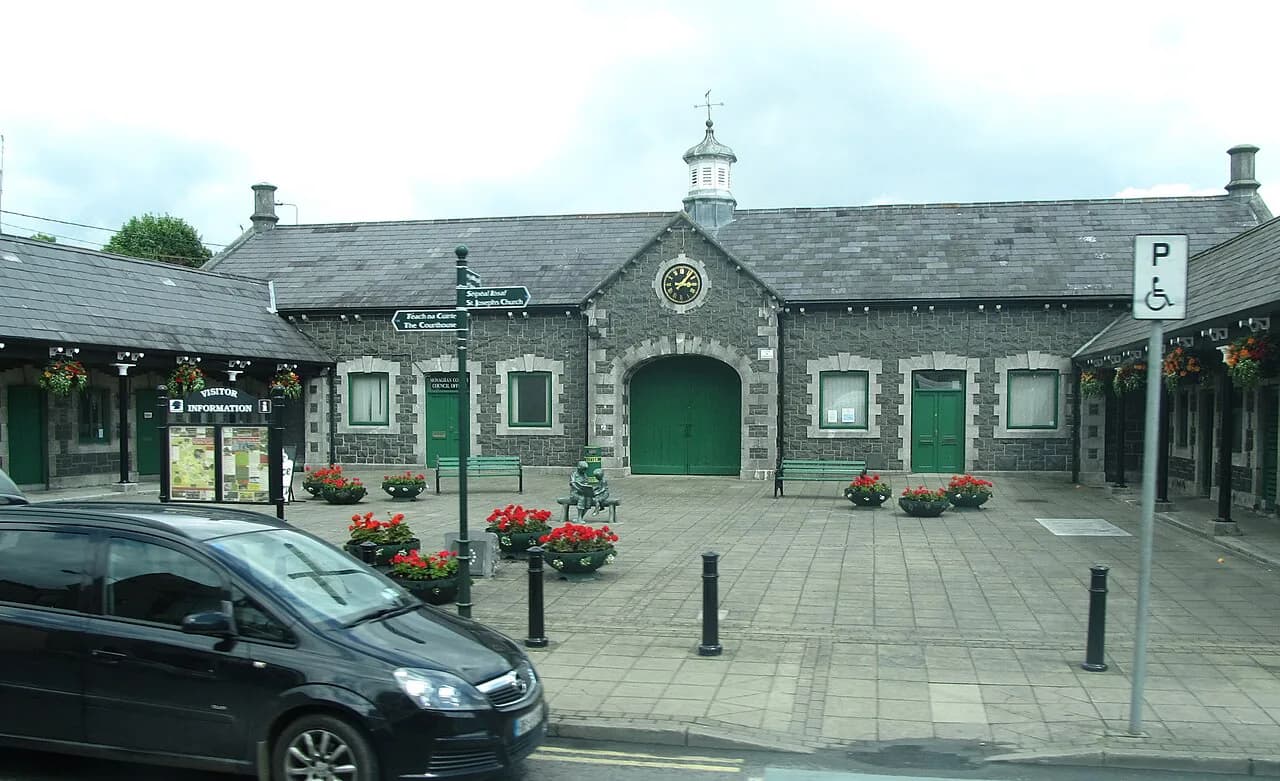
The Carrickmacross Lace Co-operative was formed in 1984 and became known as the Carrickmacross Lace Gallery, first at the Toll House and later at larger premises in Market Square. It now occupies the Market House, a building of 1861 refurbished as a modern gallery, where early lace is displayed alongside current work offered for sale.
Where Carrickmacross Lace Sits Among Irish Laces
The Limerick Council history divides Irish lacemaking into three broad periods, with the years from 1820 to 1914 treated as a golden age in which lace was high fashion in British and Irish elite circles. Carrickmacross and Limerick lace both used machine-made net as a base, a fact that led some authorities to dispute whether they counted as true lace at all — a technical argument rather than a judgment on quality.
The style travelled: Carrickmacross lace was also produced at other centres including Cobh, Tuam and Bundoran, so a piece labelled with the technique does not necessarily come from County Monaghan. For comparison, Youghal needle lace and Limerick lace each developed their own distinctive methods and local institutions, which makes the Monaghan version easier to recognise by contrast. If you want to trace the Limerick side in person, the Museums in Limerick: A Guide to the City's Core Collections is a useful next step.
Dress History: What the Wedding Dresses Do and Do Not Tell You
Carrickmacross lace technique was used on the wedding dresses of Princess Diana in 1981 and Kate Middleton in 2011, according to the Limerick Council history. That is a statement about high-profile commissions and international attention, not about anything on display in Carrickmacross. Visitors should not expect to see either dress in the gallery, and no source describes such an exhibition.
The gallery's own account notes that international designers and royalty have commissioned work from Carrickmacross and cites the Emmanuelles' use of the lace on Diana's wedding dress. Treat these as claims about the craft's reputation and commissioning history, useful for understanding why a small town sustains a specialist workshop, rather than as a description of the gallery's contents.
Visiting the Carrickmacross Lace Gallery
The gallery in Carrickmacross is the one place in the town where visitors can reliably see both early and contemporary Carrickmacross lace. It functions as a working co-operative rather than a state museum, which shapes the visit: there is lace to view and lace to buy, and the emphasis is on craft practice as much as on display cases.
The operator currently lists opening hours of Monday to Saturday, 09:30 to 16:00, closed on Sundays and bank holidays, and notes that the gallery stays open over lunchtime. Confirm these hours on the operator's site before travelling, since a small co-operative's hours can change. The operator's pages give no admission price, café, shop or accessibility details, so contact the gallery directly with specific questions.
Booking a Demonstration or Commissioning a Piece
Tour groups are welcomed, and demonstrations for sewing guilds and similar groups can be arranged if contact is made in advance. There is no published fixed demonstration schedule, so a drop-in visitor should not assume live lacemaking will be under way on any given day.
The gallery accepts special commissions for occasions such as weddings and christenings, and the co-operative operates quality control over the cottage-style production it sells. If you are commissioning, bring a clear brief and allow time; this is hand needlework, and the gallery's role as a standards body for local makers is part of what you are buying into.
Clones and the Wider Ulster Lace Network
County Monaghan's lace story has a second strand in Clones, where crochet was introduced in the 1840s and grew into a sizeable industry concentrated in the town. Irish crochet lace was exported and highly regarded abroad, and designers later used it in couture. Clones Crochet Lace and Carrickmacross lace are distinct techniques with separate local institutions, but they share the same Ulster border landscape and a similar philanthropic origin.
Visitors with an interest in textile heritage can extend the theme to Clones, where crochet was introduced in 1847 by Mrs Cassandra Hand and grew into a sizeable industry that spread to other centres. Read the Clones Crochet Lace guide for that side of the story. Check any venue's own published hours separately; the Carrickmacross hours apply only to Carrickmacross, and no shared schedule exists.
Plan Your Visit
The practical case for visiting Carrickmacross is straightforward: the gallery is the supported place to see the craft where it is still practised, and the surrounding border countryside explains the network of classes that produced it. Allow time to look at finished pieces rather than only at the shop shelves, and ask the staff about the difference between appliqué and guipure if it is not immediately obvious.
Check the operator's published hours before you set out, and contact the gallery in advance if you need a group demonstration or a commission. Beyond that, expect a small working co-operative rather than a full museum experience, and plan your day around Monaghan's wider heritage accordingly.
Explore more Ireland guides
Frequently Asked Questions
Where can I see Carrickmacross lace in Ireland?
The Carrickmacross Lace Gallery in Carrickmacross, County Monaghan, is the place supported by the operator's own information. It is run by the Carrickmacross Lace Co-operative and shows early pieces alongside contemporary work offered for sale. No other named venue is documented as a display location, so plan the gallery as the core of a textile-focused visit to the town.
What is the difference between Carrickmacross appliqué and guipure?
Appliqué is made by laying fine organdie over a net ground, securing the design and cutting away the surplus fabric, so the motif sits on a visible mesh. Guipure is made without the net layer, with the pattern areas linked to one another as openwork. Contemporary pieces often combine both approaches, so look for a continuous net background to identify appliqué sections.
When should I visit the Carrickmacross Lace Gallery?
The operator lists hours of Monday to Saturday, 09:30 to 16:00, with Sunday and bank holiday closures, and says the gallery stays open at lunchtime. These hours apply only to this gallery and should be confirmed on its own site before you travel, since a small co-operative can adjust them. No admission price is published there, so ask directly if that matters to your plans.
Can I book a lacemaking demonstration for a group?
The operator welcomes tour groups and says demonstrations for sewing guilds and similar groups can be arranged when you make contact in advance. No fixed demonstration schedule or capacity is published, so a casual drop-in should not expect live lacemaking. Write to the gallery with your dates and group details well ahead if a demonstration is central to your visit.
Can I commission a piece from the co-operative?
The gallery states that it accepts special commissions for occasions such as weddings, christenings and gifts, and it applies quality control to the cottage-style production it sells. Because the work is hand needlework, allow realistic lead time and bring a clear brief. Contact the gallery directly to discuss design, materials and timing rather than relying on any published price list.
Why is Carrickmacross lace sometimes not counted as true lace?
Carrickmacross and Limerick lace were both built on machine-made net, which led some authorities to dispute whether they qualified as true lace at all. That is a technical classification argument rather than a judgment on quality. The Limerick City and County Council history notes the point while treating Carrickmacross as one of the earliest surviving indigenous Irish laces.
Sources
You might also like



Continue reading
More guides you'll find useful





