
Broighter Gold: The Iron Age Hoard and Where to See It
The Broighter Gold is a first-century BC hoard found in Co. Derry in 1896. Learn what it contains, why the collar matters, and where to see it in Dublin.
On this page
Broighter gold is the shorthand for a hoard of Early Iron Age gold objects, dated to the 1st century BC, ploughed up at Broighter in County Derry in 1896. The objects left the findspot long ago and are held in Dublin, so the place to see them is the National Museum of Ireland on Kildare Street rather than the Derry landscape. This guide explains what the hoard contains, why the collar repays close looking, and how to fit a viewing into a museum visit.
Discovery and Findspot: A Plough, a Townland and the State
The historic environment record for the findspot states that a farmer ploughing at Broighter in 1896 turned up the hoard of worked gold objects. The same entry places the find in Broighter townland, parish of Tamlaght Finlagan, on the Foyle alluvial plain, and records that the finds were removed from the landscape and are housed at the National Museum in Kildare Street. The findspot itself is logged as a recorded site rather than an accessible monument.
Two practical consequences follow. First, a journey to Broighter townland will not bring you face to face with the gold: the record describes a findspot with the objects long since removed, and it establishes no visitor facilities or access arrangement. Second, the gold is state-owned, which is why the collection route leads to a national museum rather than a private or local display. Treat the Derry location as a place of archaeological record and plan the viewing in Dublin. For the wider sequence of sites and periods around the city, our Dublin heritage guide helps set this museum visit in context.
What the Hoard Contains
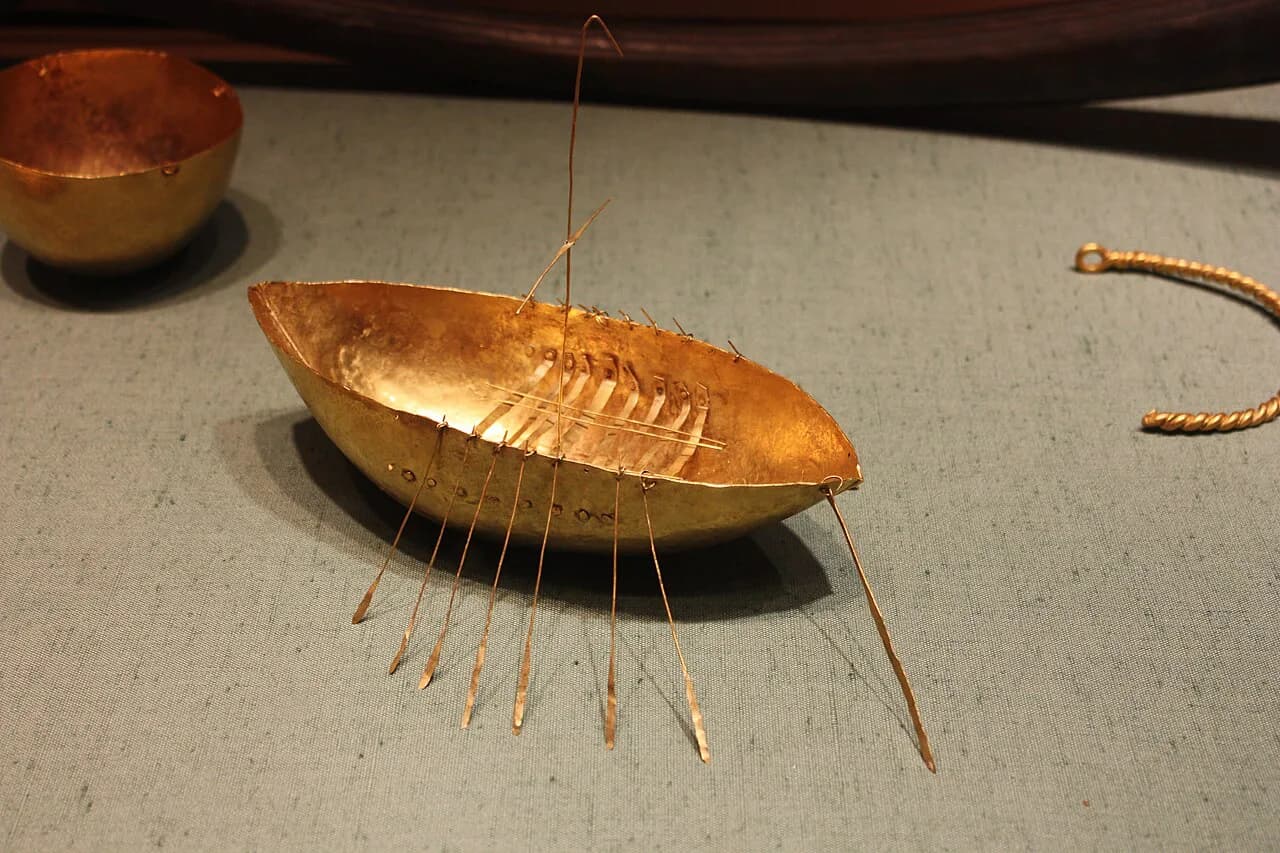
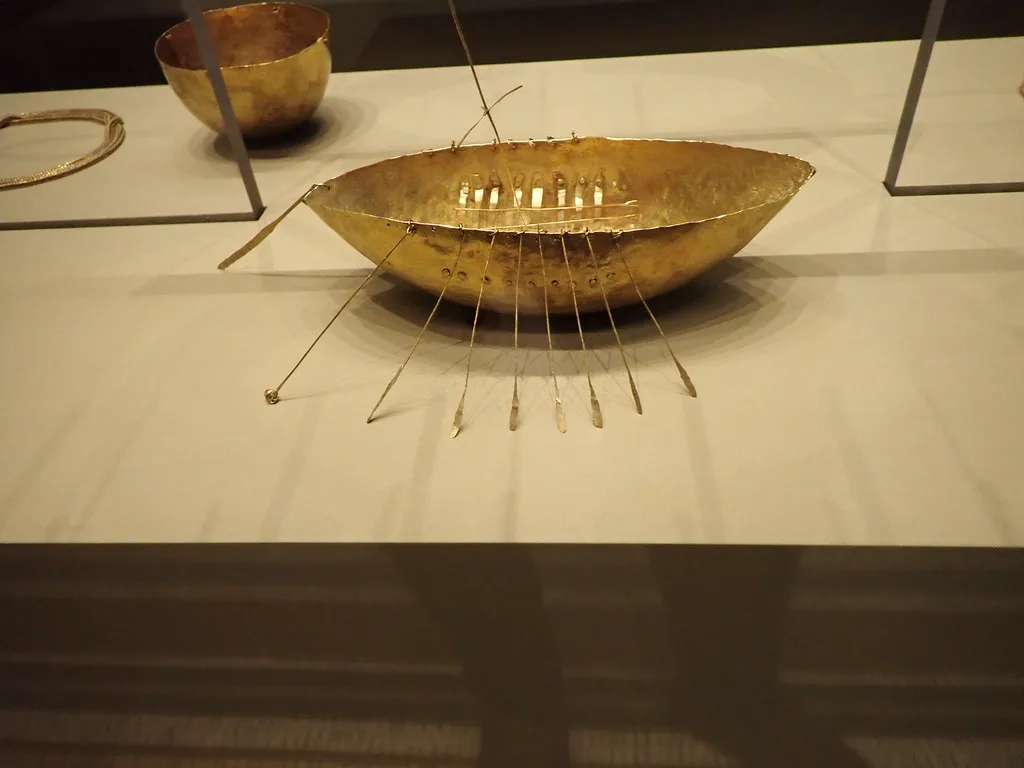
The hoard is an assemblage, not one trophy. The record lists a thick, highly decorated gold neck torc or collar, a bowl, two necklaces made of twisted ropes of gold, two bar torcs, and a gold model of a boat complete with benches, oars and mast. Museum teaching notes describe the same group as a gold boat, a gold cauldron, two gold neck ornaments, two gold chains and a gold collar, all Early Iron Age and 1st century BC. Read those lists together and the core is clear even where the wording for the bowl or cauldron differs.
Keep the components distinct when you look for them. The collar is a neck ornament; the two twisted gold pieces are necklaces or chains; the bar torcs are a separate form; and the boat is a miniature vessel. Grouping them all under 'torcs' or assuming the boat is a brooch or vessel for pouring would misread the assemblage. The sources give no weights, dimensions or valuations, so any figures you encounter elsewhere should be checked against the museum's own object record rather than assumed.
The record suggests the objects were probably deposited some time after 100 BC, phrasing that keeps the occasion open rather than settled. That matters for interpretation: a hoard can be read as a deliberate deposition without claiming to know the ritual behind it. Arrive at the gallery with the sequence of objects in mind, and let the display's own labels carry any finer argument.
The Collar in Detail
The National Museum's object page calls the collar the most sumptuous Irish Iron Age gold collar and describes a large tubular neck ornament with buffer terminals. It closes with a mortise-and-tenon device, and the museum's teaching notes single out the same 't-shaped' locking mechanism in images. The construction is worth pausing over because it tells you the collar was engineered to open, fasten and sit on a neck, not simply cast as a solid ring.
The ornament is raised and incised on the ring, with stylised bird and horse motifs standing out against incised concentric arcs. The museum's presentation highlights La Tène decoration in close-up detail, placing the collar within the wider Iron Age decorative tradition of Europe, though the sources here do not expand on the style beyond that label. Look for the contrast between the relief motifs and the finer arcs behind them: that layered treatment is what makes the collar more than a plain band of gold.
The museum's object page places the find in County Derry, close to the ancient shore of Lough Foyle, a setting the museum uses when it discusses the object's meaning. If your interests run to later Irish metalwork, the same museum building holds a very different tradition: the Tara Brooch belongs to a much later, Christian period, and comparing the two rewards attention precisely because the techniques and styles differ.
The Model Boat and the Rest of the Assemblage
The miniature gold boat is the hoard's most unusual survivor. The record specifies a model complete with benches, oars and mast, which makes it a representation of a working vessel in miniature rather than a simple ingot or blank. The museum notes list it alongside the collar and the other pieces as part of the same early Iron Age group. Do not read the boat as proof of a documented voyage or ritual: the sources describe the object, not a narrative attached to it.
Dates matter here. The collar, the boat and the rest are dated to the Early Iron Age, 1st century BC, and the assemblage as a whole is framed the same way. They are not early medieval, not Christian, and not part of a manuscript collection, even though they share a museum building with later treasures. Keeping the period straight makes sense of the gallery sequence when you reach it.
Reading the Symbolism Carefully
The National Museum's object page notes that collars are especially associated with Celtic kings and gods, and offers a specific reading for Broighter. The sea god Manannán mac Lir was associated with Lough Foyle, and the museum suggests he may have held special significance for a local king, whether as protective deity or divine ancestor. The page also derives the placename Broighter from Brú Íochtair and suggests that a brú, a residence of a god, combined with íochtair, 'lower', might point to the god's underwater residence.
Take those ideas as the museum's interpretation, not as settled history. No source here says Manannán mac Lir owned or wore the collar, and the placename etymology is offered as a reading of the name. The value of the interpretation is that it explains why the horse motif and the watery findspot are worth noticing together, not that it settles who deposited the gold or why. Ask at the gallery if you want to know how the display itself presents the argument.
The Treasury is described by the museum as a permanent exhibition whose first gallery follows Irish art from the Iron Age to the twelfth century, so the Broighter material belongs to its earliest, Iron Age layer rather than to the later Christian treasures. If your broader interest is in Ireland's manuscripts and later metalwork, this is the moment to step back and consider how the Iron Age gold sits in relation to works such as the Book of Durrow and the Book of Kells. The Irish illuminated manuscripts guide gives the later side of the story, and you can read more about the exhibition itself on the museum's Treasury page. The point of comparison is chronological and technical, not a claim that the objects belong to one period.
Where to See It: The Treasury at Kildare Street
The Broighter objects are displayed in The Treasury, a permanent exhibition at the National Museum of Ireland's Archaeology branch on Kildare Street, Dublin 2, D02 FH48, and admission is free. The museum's notes specify that the objects are on the ground floor in The Treasury. The exhibition's first gallery moves chronologically from the Iron Age to the twelfth century, which means the gold is encountered as part of a sequence rather than as an isolated case. If you are also following the museum's manuscript collections, the Irish Illuminated Manuscripts guide covers the later book tradition held in the same building.
The gallery setting rewards more than a quick glance at the collar. A later gallery is devoted to the Faddan More Psalter, a manuscript found in a Tipperary bog and dated to about AD 800, which shows how the museum moves from Iron Age metalwork into early medieval book culture. The thematic connection to the Faddan More Psalter is worth following through the guide to that manuscript, though it is a different object from a different period. The practical trade-off is simple: a focused viewing of the collar takes minutes, while reading it within the whole gallery takes considerably longer.
The exhibition also preserves the architecture it was built into, including nineteenth-century mosaic floors and carved doors that evoke the cathedral treasuries the display was modelled on. Those details are easy to miss when you are fixed on the gold. Spend a few minutes looking up and around, then return to the collar with its La Tène ornament in mind.
Practical Access and the Dates to Know
The museum's visitor page gives ordinary hours as Tuesday to Saturday 10am to 5pm, Sunday and Monday 1pm to 5pm, with a late opening on the last Thursday of each month. It recommends a 4.30pm last entry to see the galleries properly, since the building closes at 5pm, and it confirms free admission across the National Museum's four sites. Check these against the visitor page before travelling, especially if your trip falls near a bank holiday.
One dated exception is worth noting for anyone planning around late October. The museum has posted that Kildare Street will be closed on Sunday 25 October and Bank Holiday Monday 26 October 2026 because of industrial action, which is a specific interruption rather than a change to the regular timetable. If your visit falls near those days, confirm the position directly rather than assuming the usual Sunday hours.
Because individual galleries can close at short notice, the museum advises phoning ahead on +353 1 677 7444 if you are making the trip for a particular object or exhibition. That is the sensible step for anyone travelling specifically for the Broighter gold. Bag rules also shape the visit: there is no cloakroom at present, so do not bring suitcases, motorcycle helmets or large bags into the galleries. Hand-held cameras are allowed, but flash, video and tripods are not, and photographs are for personal use only.
The Findspot Today: Record, Not Attraction
Nothing in the record turns Broighter into a visitor attraction. The site is registered as an SMR entry, the finds are removed, and no access route, opening arrangement or facility is described. That is not a reason to avoid the area if you are passing through, but it is a reason not to plan a trip around the townland expecting to see the gold. The place to go is the museum in Dublin.
Keeping the two locations separate also helps you read the landscape context the record supplies. Broighter sits on the Foyle alluvial plain near Lough Foyle, a setting the museum uses when it discusses the hoard's meaning. That is a historical and geographical point, not an invitation to treat the modern fields as an open-air exhibition.
Plan Your Visit
The Broighter gold is a first-century BC hoard that left County Derry in the nineteenth century and now belongs to the National Museum of Ireland on Kildare Street. Plan for The Treasury, allow time to read the collar's construction and ornament rather than treating it as a single trophy, and note the ordinary hours plus the late-October closure notice. A quick phone call before travelling is the surest way to confirm that the gallery you want is open. If you later want the manuscript side of the same museum, the Kildare Street guide to the illuminated manuscripts is a natural next stop.
For more heritage reading, see our guides to Ardagh Chalice and Cross Of Cong.
Explore more Ireland guides
Frequently Asked Questions
What is the Broighter gold?
It is a hoard of Early Iron Age gold objects dated to the 1st century BC, found at Broighter in County Derry in 1896. It includes a decorated gold collar, a gold model boat, a bowl or cauldron, two twisted gold necklaces and two bar torcs.
Where can I see the Broighter Hoard?
The objects are displayed in The Treasury at the National Museum of Ireland's Archaeology branch on Kildare Street in Dublin. They are not at the findspot in County Derry.
Is the Broighter Collar connected to Manannán mac Lir?
The National Museum of Ireland offers that as an interpretation rather than a settled fact, linking the sea god with Lough Foyle and reading the placename Broighter as a possible reference to a divine residence. No source states that the god owned the collar.
Can you visit the Broighter findspot in County Derry?
The findspot is recorded as a site of archaeological record, with the objects removed to Dublin, and no visitor access is described. Treat it as a landscape location rather than an attraction.
What are the museum's opening hours and admission charge?
The museum publishes ordinary hours of Tuesday to Saturday 10am to 5pm and Sunday and Monday 1pm to 5pm, with a monthly late Thursday and a recommended 4.30pm last entry. Admission is free. Check the visitor page for changes, including the noted October 2026 closure.
Sources
- The Broighter Collar | National Museum of Ireland
- LDY009-008-Broighter-Hoard.pdf
- https://www.museum.ie/getmedia/55d10409-f00a-4107-925f-512cb7a98bac/NMI-LC-Art-History-Pres-Notes.pdf
- The Treasury | Archaeology | National Museum of Ireland
- Opening Hours, Location and Facilities | Archaeology | National Museum of Ireland
You might also like



Continue reading
More guides you'll find useful



