
Book of Durrow: Ireland's Earliest Illuminated Gospel Book
The Book of Durrow is an early Insular gospel book of about 650–700. Learn what makes its art distinctive and how to study its pages from Dublin.
On this page
The Book of Durrow is an early Insular gospel book dated to about 650–700 and now held by the Library of Trinity College Dublin as MS 57. It carries the four Gospels with prefaces, and it is regarded as one of the earliest intact gospel books to survive from Western Europe. For travellers interested in early medieval art, it belongs on the same mental map as the Book of Kells and the Book of Armagh, both also kept at Trinity.
It matters less for size than for what it shows about how Insular book art developed. Its decoration is restrained next to later manuscripts, yet the carpet pages, symbols and initials already display an assured mixing of artistic traditions. This guide separates what the manuscript is from where it is now kept, because those two facts lead to very different plans for a visit.
What the Book of Durrow Contains
The manuscript holds a copy of the four New Testament Gospels along with introductory prefaces. Those prefaces are close in character to the material that opens the Book of Kells, which has led scholars to suggest that the Durrow prefaces may have served as a model for the later Kells scribes.
The physical book is compact: a catalogue record describes 248 folios measuring roughly 245 by 145 millimetres, with text laid out partly in two columns of 25 lines. The same record counts six carpet pages, five Evangelist portraits and decorated initials. Those proportions help explain why the manuscript feels dense rather than monumental when its pages are reproduced.
Name, Monastery and the Question of Origin
The book takes its name from the monastery at Durrow in County Offaly, a foundation associated with St Colum Cille at the end of the sixth century. During the early medieval period Durrow was an important centre of learning and trade and served as a burial place for local kings. What the sources do not settle is whether the manuscript was actually written there, and that uncertainty should be stated rather than smoothed over.
What is documented is custody rather than manufacture. The manuscript was certainly at Durrow by the eleventh century and remained there until the 1660s, when it passed to Trinity College Dublin. A reader planning a visit to Offaly should therefore treat Durrow as the manuscript's historic home, not as a site where the book can be seen.
Art and Design: Restraint That Rewards Close Looking
Trinity's own curatorial note describes the Durrow as a more restrained precursor of the Book of Kells, built on a simple palette of red, yellow and green. Entire carpet pages are filled with intricate ornament, while the Evangelist symbols stand isolated against creamy vellum, framed by bands of interlace. That contrast between dense pattern and empty space is the manuscript's most distinctive visual effect.
Around eleven pages carry painted decoration, and the openings of the gospels are marked by enlarged, ornamented letters. The six carpet pages are filled with abstract ornament and were probably meant to mark the openings and closings of the book, the prefaces and each individual gospel, though they have been misplaced over time. Knowing that their order has shifted helps a viewer understand why digital facsimiles matter for studying the book's structure.
Symbols and Their Sources
Each gospel is prefaced by a symbol for its author, a device rooted in the Old Testament vision of Ezekiel and the Book of Revelation. The Durrow follows the scheme attributed to St Irenaeus: Matthew is the man, Mark the eagle, Luke the calf or ox, and John the lion. That ordering differs from the Vulgate scheme familiar from the Book of Kells, where Mark is the lion and John the eagle, so readers comparing the two manuscripts should expect the symbols to swap.
The ornament itself draws on several distant traditions rather than one Celtic source. Interlocking spiral and whorl motifs descend from the pre-Christian La Tène style that persisted in areas outside Roman control, while writhing animals and snakes reflect Anglo-Saxon art of the early seventh century. Interlace mesh designs trace to Mediterranean models found in gospel books from the eastern Mediterranean world. This mixture is the best argument against reading the manuscript as a purely local product.
Materials and Making
Recent high-resolution photography has begun to expose the artist's working methods, including compass marks visible near the base of the eagle's eye. Non-invasive testing using micro-Raman spectroscopy and X-ray fluorescence identified the palette: red lead, orpiment for yellow, copper acetate for green, and iron gall for black and brown. These findings are specific to this manuscript and should not be generalised to other Insular books.
A Manuscript That Kept Working
Corrections in the margins show that early medieval scholars studied and corrected the text, and later owners left their own traces. In the late eleventh century an agreement with the monastery of Killeshin in County Laois, transferring land to Durrow, was written on the manuscript's final page. Around the same period a reading from Acts used at Pentecost was added to a blank page, suggesting the book was still in liturgical use centuries after it was made.
At some unknown point the colophon was altered to imply that St Colum Cille himself had written the book, and by the early tenth century a silver case, now lost, had been made for it as a relic of the saint. In the seventeenth century a section of the manuscript was even dipped in a cattle trough as a cure. These episodes are evidence of changing beliefs about the object, not proof of its authorship.
From Durrow to Trinity College Dublin
By the seventeenth century scholars including James Ussher were examining the text, and the pages had already become muddled by that stage. The codex reached Trinity through Henry Jones, bishop of Meath and a vice-chancellor of the college, who presented it to Trinity. It is now MS 57 in the Library's medieval manuscript collection, where it sits alongside the Book of Kells (MS 58) and the Book of Armagh (MS 52).
That collection is substantial rather than a single showcase: Trinity's Latin manuscripts run to roughly 450 separately numbered items, strong in historical and theological texts. Catalogues for individual collections are available in the reading room of Manuscripts and Archives, which is the correct route for anyone pursuing detailed research rather than a general look.
How to Encounter the Book of Durrow
The dependable way to study the Durrow is online. Trinity Library has published a curated digital story on the manuscript that walks through its decoration, symbolism, pigments and later history page by page. Digital collections linked from the catalogue record provide further images of the manuscript itself. For most travellers this is the only realistic way to examine the book closely.
In Dublin, Trinity's collection page lists the Book of Durrow among the Gospel manuscripts forming part of the changing exhibition in the Old Library, rather than promising a permanent installation. The operator's published description of the ticketed visit, however, sets out the Book of Kells in the Treasury, the Long Room and the Red Pavilion digital exhibition, and does not establish that the Durrow is on display. Visitors should not assume it will be in a case on the day they arrive, and checking the official site before booking is the only way to know what is currently shown. If you are building a wider itinerary around such sites, our Dublin heritage guide sets out the city's key historic stops.
What a Book of Kells Experience Ticket Covers
The ticketed visit begins at the Old Library, where visitors see the Book of Kells in the Treasury and walk through the Long Room, then move to a separate digital exhibition in the Red Pavilion less than a minute's walk away. Ticket types differ: one option covers the Book of Kells and Long Room but excludes the Red Pavilion, while others add the digital exhibition or a guided component. The operator currently lists admission from €25 per person, and online booking with timed entry is strongly recommended.
Nothing in the operator's listing indicates that the Book of Durrow is part of this experience, so the Durrow should be planned around separately. The experience itself is not a manuscript study session: photography is forbidden in the Treasury where the Book of Kells is housed, though non-flash photography for personal use is allowed elsewhere. Allow around ninety minutes, and check the published opening hours against your travel date, since they can change.
Setting Expectations for a Visit
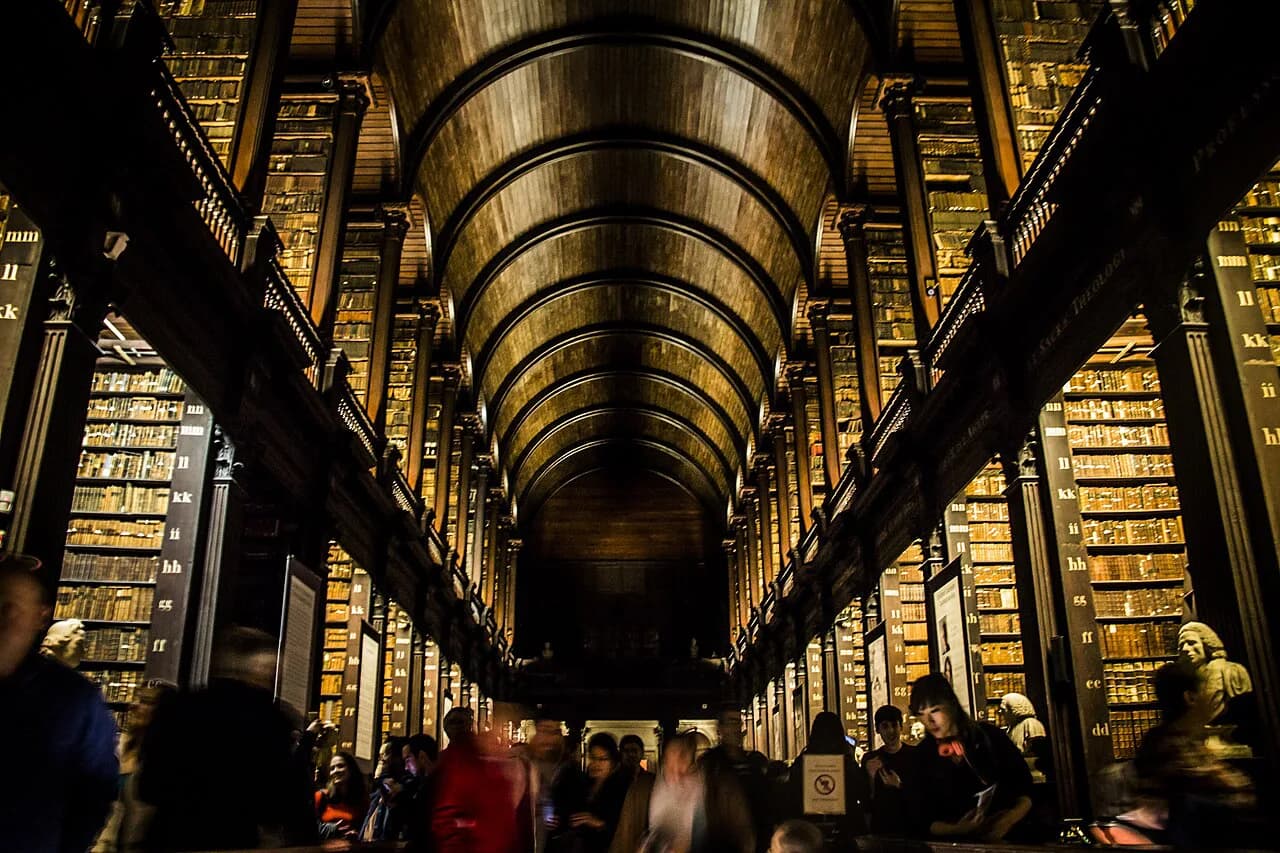
The Old Library is undergoing redevelopment, and books have been removed from the Long Room with the exception of the first four bays as you enter. A visitor expecting floor-to-ceiling shelving should adjust accordingly, and the changing exhibition means display contents are not guaranteed from one season to the next. For manuscript-focused travellers, the online resources remain the stable element.
Access is well provided for: the Old Library and the Pavilion are described as fully wheelchair accessible, with a Library Guard assisting elevator use on request. There are no toilets in the Old Library and no storage facilities on site, so plan around both before arriving with luggage.
Planning Around the Manuscript
Treat the Book of Durrow as a manuscript to study and a Trinity collection object to research, not a sight guaranteed on any Dublin itinerary. Its value lies in what its pages reveal about early Insular design, pigment use and centuries of handling, all of which are accessible through Trinity's published digital resources.
If you go to Dublin, book the Old Library visit for the Book of Kells and Long Room with clear expectations about the redevelopment and any Treasury photography limits. Comparable early medieval metalwork, such as the Tara Brooch, gives useful context for the same period of Irish craft.
Explore more Ireland guides
Frequently Asked Questions
What is the Book of Durrow?
It is an early Insular gospel book dated to about 650–700, containing the four Gospels with prefaces and decorated with carpet pages, Evangelist symbols and ornamented initials. It is held at Trinity College Dublin as MS 57 and is counted among the earliest intact gospel books to survive from Western Europe.
Where is the Book of Durrow kept today?
It belongs to the Library of Trinity College Dublin, where it is catalogued as MS 57 within the medieval manuscript collection. It is not held at Durrow in County Offaly, which gave the book its name and where it was kept until the 1660s.
Can you see the Book of Durrow in Dublin?
Not on a guarantee. Trinity's collection page lists the Durrow among Gospel manuscripts forming part of the changing Old Library exhibition, but the ticketed Book of Kells Experience does not establish it on view on any given day. The reliable alternative is Trinity's curated online story and digital collections, which reproduce and explain its pages.
How does the Book of Durrow differ from the Book of Kells?
The Durrow is earlier and more restrained, using a limited palette of red, yellow and green. It also follows the Irenaeus scheme of Evangelist symbols, with Mark as the eagle and John as the lion, whereas the Book of Kells follows the Vulgate ordering associated with St Jerome.
Who wrote the Book of Durrow?
The scribe is unknown. A colophon was altered at some point to imply St Colum Cille had written the book, and by the tenth century it was treated as a relic of the saint, but that attribution reflects later belief rather than documented authorship.
What pigments were used in the Book of Durrow?
Trinity's published non-invasive analysis identified red lead, orpiment for yellow, copper acetate for green, and iron gall for the dark inks. High-resolution imaging has also revealed construction marks, such as compass marks near the eagle's eye.
Sources
- Book of Durrow - Director's Choice Uncut - Trinity College Dublin (https://www.tcd.ie/library/exhibitions/directors-choice/durrow/)
- The Book of Durrow — Google Arts & Culture
- Book of Durrow, MS 57 - Coimbra Colls Collection
- https://www.tcd.ie/library/research-collections/subject-strengths/medieval/medieval-latin.php
- Book of Kells Experience | Trinity College Dublin | Official Site
You might also like



Continue reading
More guides you'll find useful





