
Bronze Age Ireland: Where to See the Evidence
Bronze Age Ireland ran roughly 2500 to 500 BC. Trace its metalwork, burials and monuments, and see where the evidence is displayed or still stands.
On this page
Bronze Age Ireland means roughly 2500 to 500 BC, a period defined by the arrival of metal-working and studied through hoards, burials and standing monuments. The National Museum of Ireland divides it into Early, Middle and Late phases, and those divisions rest on changes in technology and culture rather than on written records. The practical consequence for a visitor is that there is no single Bronze Age site to tick off: objects sit in museum cases, while tombs, stone rows and circles remain in the countryside.
A sensible route runs through two museums and one landscape stop. The Museum of Archaeology on Kildare Street in Dublin holds the national collection and admits visitors free; Galway City Museum devotes an exhibition to the prehistoric west; and Drombeg Stone Circle near Glandore gives the period a physical setting. Each answers a different question, and none of them alone explains the whole era.
Chronology and the Technology Story
The period opens with copper and gold, the earliest metals exploited in Ireland, and bronze, an alloy of tin and copper, only gradually became the metalworkers' preferred material because of its durability. Stone tools did not vanish overnight: flint scrapers, knives and polished stone axes stayed in use while metal replaced them slowly. Copper and tin were costly, so access to them probably belonged to elite groups, and some metalwork and pottery served to display rank.
Copper was mined within Ireland, but the tin needed to make bronze was most likely brought in from south-western England. Ireland's copper and gold resources made it a significant metal-producing region in early prehistoric Europe, and its gold-working is treated as a notable achievement in the archaeological record. The Middle Bronze Age brought better moulding techniques, and the Late Bronze Age has been characterised as a golden age of Irish archaeology.
Around the same time the climate turned wetter and colder, which the National Museum suggests may have weighed heavily on a farming economy, with bogs expanding and more of the countryside reverting to forest. Large quantities of weaponry in hoards point to raiding and warfare as regular possibilities between communities, though the source words this as interpretation rather than certainty. Read the displays with that caution in mind: these are arguments built from objects.
How the Dead Were Treated
Between roughly 2500 and 2200 BC a megalithic tomb type known as the wedge tomb was used for burial, and from about 2200 BC smaller, separate graves became the norm for the following millennium. The earliest of these were unburnt inhumations placed in a stone-lined cist, sometimes with vase- or bowl-shaped pottery that may have held food or drink. Older monuments were not abandoned altogether, since Stone Age passage tombs and court cairns were occasionally reused for burials.
In Galway the same shift took the form of single burials in stone-lined cists or pit graves, accompanied by Beaker pottery and by vases, bowls, flint knives and beads. Graves were often marked with a mound of earth or stone and were grouped into cemeteries; two concentrations of cairns, cists and barrows have been recorded along the east side of Lough Corrib and north of Clifden. Cremation later became common, with burnt bone placed inside or beside a vessel, sometimes a food vessel set upside down, and later cremations often accompanied by large ornate urns.
Hoard Deposition and the Dowris Find
Hoards are among the most characteristic discoveries of the period, and archaeologists read them in two ways at once: as votive offerings to gods, as property left for safekeeping, or as some mixture of both. Bogs have been especially productive because their anaerobic conditions preserve even organic material that would rot elsewhere. That combination of ritual ambiguity and exceptional preservation is why hoard displays repay slow looking rather than a quick pass.
One concrete example is the Dowris hoard from County Offaly, described in the National Museum's teaching resource as roughly 218 objects, among them swords, spearheads, axes, gouges, knives, razors, cauldrons, buckets, horns and crotals. The same source locates it in the Museum of Archaeology. Treat that as a starting point rather than a guarantee of what is on view on any given day, and ask staff about a specific piece before travelling for it.
Reading the Handling Box Resource Correctly
The National Museum's Bronze Age handling box material is a teaching resource written for senior primary and post-primary classes, with curriculum links, guidance on using objects in the classroom and strategies for learning through artefacts. It is not an exhibition listing, and it does not advertise public handling sessions. Visitors who encounter the PDF while researching should mine it for context and chronology, then look to the museum's visitor pages for what is actually open and on view.
The document is candid about the limits of the evidence, noting that knowledge of the past is built by interpreting material culture and that it can remain incomplete or change as research develops. That framing is useful on site as well: a case of bronzes is not a complete picture of prehistoric life, but a sample filtered by what survived and what has been excavated. What survives is skewed toward burials and hoards, which is why domestic life is harder to reconstruct than metalwork or grave goods.
The Dublin Collection Stop: Kildare Street
The Museum of Archaeology sits on Kildare Street in the centre of Dublin, and admission to all four National Museum of Ireland sites is free. Ordinary hours are Tuesday to Saturday from 10am to 5pm and Sunday and Monday from 1pm to 5pm, and the museum recommends 4.30pm as the latest sensible entry to see the galleries properly. Groups of eight or more must book in advance, while families and small social units do not require a booking.
A dated exception matters for late October 2026: the museum has posted that it will be closed on Sunday 25 and Bank Holiday Monday 26 October 2026 because of industrial action. That notice is temporary and should not be read as a permanent change to the hours above. Galleries can also close at short notice, so the museum advises phoning ahead if a particular artefact is the reason for your visit.
Practical housekeeping is worth planning: cloakroom services are currently unavailable, so suitcases, motorcycle helmets and large bags should be left behind rather than brought into the galleries. Hand-held cameras are allowed, but flash, tripods and video are not, and photographs are for personal use only. Accessible toilets are on the ground floor beyond the central rotunda, and staff at the reception desk can answer collection questions.
Galway City Museum and the Prehistoric West
Galway City Museum's Prehistoric Galway exhibition frames the region through the River Corrib, which runs from Lough Corrib through the city into Galway Bay, and notes that artefacts from the river and its surroundings indicate people in the area as early as 6000 BC. It also draws on excavations carried out ahead of M6 road construction, which uncovered sites from the first Neolithic farmers through Bronze Age burial grounds. The exhibition is a regional display with its own framing, so check its current opening arrangements separately rather than assuming they match Dublin's, and see the Galway City Museum: A Visitor Guide to Spanish Parade for the practical detail.
The exhibition is useful for connecting museum objects to places you can later find on a map. It records a collapsed megalithic tomb at Menlo in the city and, in north-western Connemara, a concentration of 38 megaliths as well as stone rows, stone pairs and single standing stones. It treats stone circles, rows and standing stones as monuments with a ceremonial function, some possibly Late Neolithic rather than Bronze Age.
For travellers heading further west, the same museum is a natural companion to other stops in the county, including the castles in county galway that later centuries left behind. Plan the museum as the orientation stop and the monuments as separate outings, because the exhibition explains what the stones mean without supplying directions or access details for each one.
Drombeg Stone Circle in the Landscape
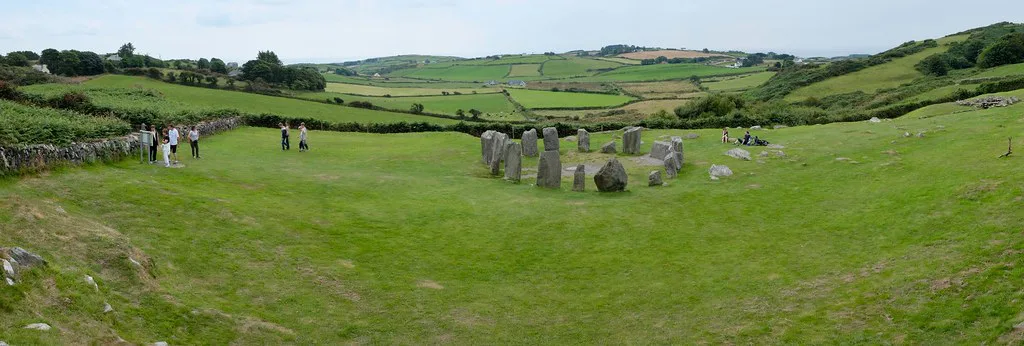
Drombeg Stone Circle, known locally as the Druid's Altar, stands on the edge of a rocky terrace above the sea about a kilometre from Glandore in County Cork. It consists of 17 standing stones, and excavation showed that an urn burial had been placed at its centre: cremated bones in a deliberately broken pot wrapped in thick cloth, buried with smashed sherds and sweepings from a pyre.
West of the stones is a hut site with a fulacht fiadh, a prehistoric cooking place whose flagged trough was used by dropping red-hot stones into water. Tests cited by the tourism body confirmed that the method could boil 70 or more gallons and keep them hot for almost three hours. That practical detail is the most tangible link on the page between the monument and everyday life in the period.
One stone's midpoint was set in line with the winter solstice sunset, seen through a conspicuous notch in distant hills, and the alignment is described as good but not perfectly precise. That wording matters: it supports deliberate orientation without turning the circle into a finely tuned astronomical instrument. The description comes from Discover Ireland, a tourism body rather than the site's operator, so treat access, parking and facilities as things to confirm locally rather than as published facts.
Combining Museums and Monuments
The two kinds of evidence do different work. Museum displays let you see metalwork and pottery close up and under label text, while standing monuments let you judge siting, sightlines and scale, which cases cannot convey. Build a trip with at least one of each, and expect the museum to explain what the monument cannot say for itself.
The broader story of how people were deposited in Irish wetlands continues beyond the Bronze Age, and the bog bodies covered in our Irish Bog Bodies guide belong to the later Iron Age rather than to this period. If that subject interests you, keep the two eras apart in your notes, since both draw on hoard and bog deposition but are separated by centuries.
Plan Your Visit
Start with the chronology, then choose one museum and one landscape stop. Kildare Street gives the national collection with free admission and predictable hours, subject to the short-notice caveats above; Galway City Museum gives the western regional picture and points toward monuments in Connemara; Drombeg gives a single monument in its setting. Confirm the museum's opening on the day and phone ahead if one object is your priority.
Allow the sources to set your expectations. The period is reconstructed from burials and hoards, the dating is approximate at the scale of centuries, and interpretations of climate, warfare and ritual are hedged for good reason. Treat every display and every stone circle as evidence under discussion rather than as settled fact.
For related reading, explore Old Croghan Man, Clonycavan Man and Iron Age Ireland.
Explore more Ireland guides
Frequently Asked Questions
When was the Bronze Age in Ireland?
Approximately 2500 to 500 BC. The National Museum of Ireland divides it into Early, Middle and Late phases based on technological and cultural changes, and the period is defined chiefly by the beginning of metal-working in Ireland.
Why was bronze important in prehistoric Ireland?
Bronze, an alloy of tin and copper, was a highly durable metal that gradually became the preferred material for tools and weapons. Copper and tin were costly, so access was probably restricted to elite groups, and metal objects and pottery could signal rank. Copper was mined in Ireland; tin was most likely imported from south-western England.
Where can I see Bronze Age objects in Ireland?
The Museum of Archaeology on Kildare Street in Dublin holds the national collection referenced by the National Museum's Bronze Age resource, including material such as the Dowris hoard from County Offaly. Because galleries can close at short notice, phone ahead if one object is your reason for going. Galway City Museum's Prehistoric Galway exhibition covers the western regional picture.
What was the Dowris hoard?
The National Museum's teaching resource describes the Dowris hoard from County Offaly as roughly 218 objects, including swords, spearheads, axes, gouges, knives, razors, cauldrons, buckets, horns and crotals. The same source places it in the Museum of Archaeology. Check with staff before travelling to see a specific piece.
What is a fulacht fiadh?
A prehistoric cooking place. At Drombeg the flagged trough was heated by dropping red-hot stones into water, and cited tests found the method could boil 70 or more gallons and hold the heat for almost three hours. The Drombeg example sits west of the stone circle beside a hut site.
Is Drombeg Stone Circle aligned to the winter solstice sunset?
In a qualified sense, yes. The midpoint of one stone was set in line with the winter solstice sunset seen through a notch in distant hills, and the alignment is described as good but not perfectly precise. It indicates deliberate orientation without proving astronomical precision.
Do I need to book the National Museum of Ireland?
Booking is not required for families, individuals and small social units, and admission is free. Groups of eight or more must arrange a booking in advance, and school or special interest groups should contact the bookings office. Cloakroom services are currently unavailable, so avoid large bags.
Sources
You might also like



Continue reading
More guides you'll find useful



