
Churches in Ireland: Historic Buildings You Can Visit
A practical guide to historic churches in Ireland you can actually visit, from Cork's Shandon bells to Galway's medieval collegiate church.
On this page
You can walk into many historic churches in Ireland, but each building sets its own terms: some publish full visitor hours, others are open mainly around worship, and a few keep their history pages separate from their visiting information. This guide covers a handpicked set of publicly accessible buildings in Cork, Limerick, Galway and Kilkenny, chosen because a cathedral, parish or tourism authority publishes reliable details about them. It is a selection, not a national inventory, and it makes no claim to rank these places against one another.
What these buildings share is that they are working places of worship rather than museums, which shapes how you should visit them. Congregations still gather in all of them, and several operators ask tourists to stand back during services. Read each building's own notes below before you build a day around it, and treat every time given here as something to reconfirm rather than a fixed promise.
Why a Church Visit Rewards Time
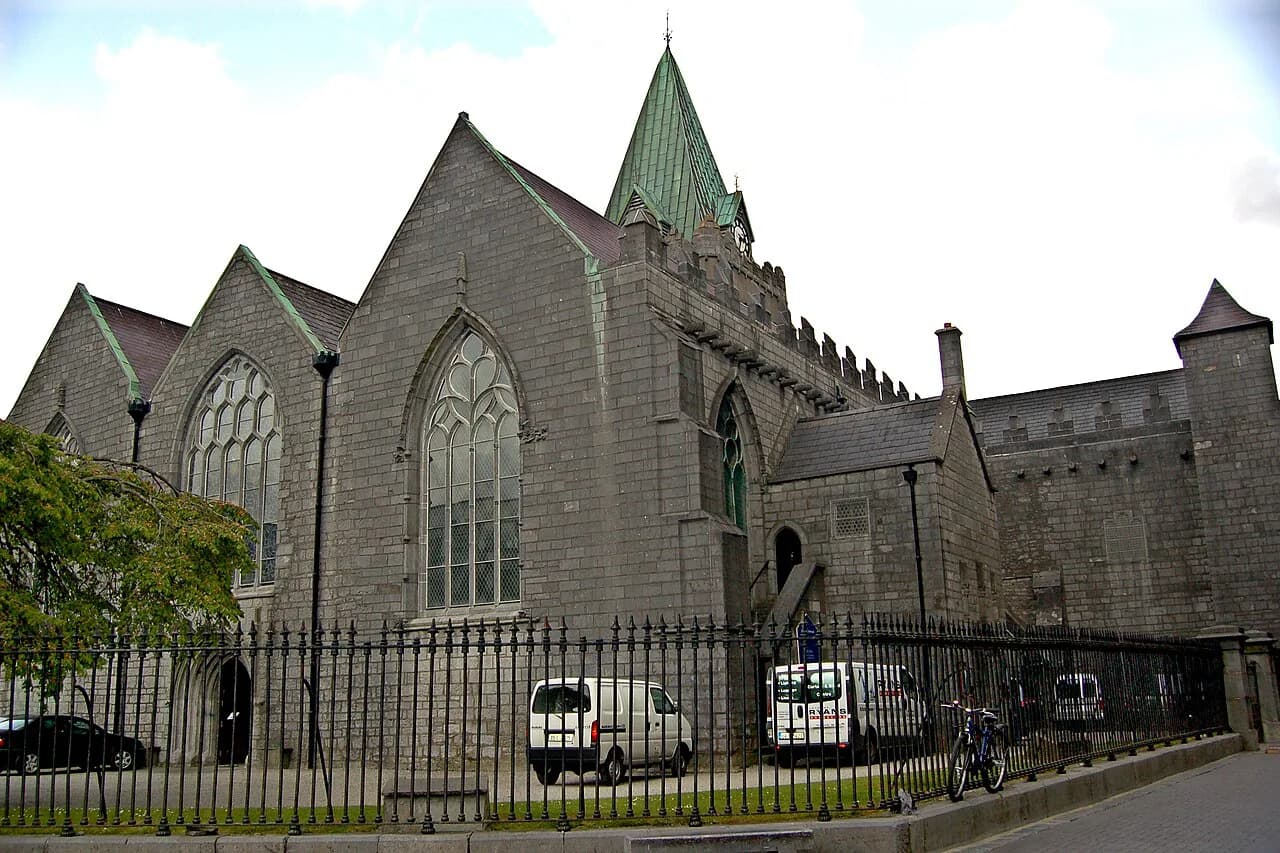
Irish church buildings compress centuries into a single visit because most stand on older worship sites and were rebuilt, extended or restored in stages. St Nicholas' Collegiate Church in Galway, for example, sits on a site used for worship before the present church was completed in 1320, so the medieval fabric you see is one layer of a longer story.
Interior craft is often the strongest reason to step inside. St Fin Barre's Cathedral in Cork pairs Cork limestone towers with an interior rich in red Cork marble and stained glass, a deliberate scheme by its architect rather than an accident of later decoration.
The trade-off is that these are not curated attractions with uniform opening. Some publish detailed hours and welcome casual visitors; others keep the doors open around worship and expect quiet and brevity. Planning two or three buildings rather than a long list usually produces a better visit than racing between many.
Visiting Etiquette: Worship Comes First
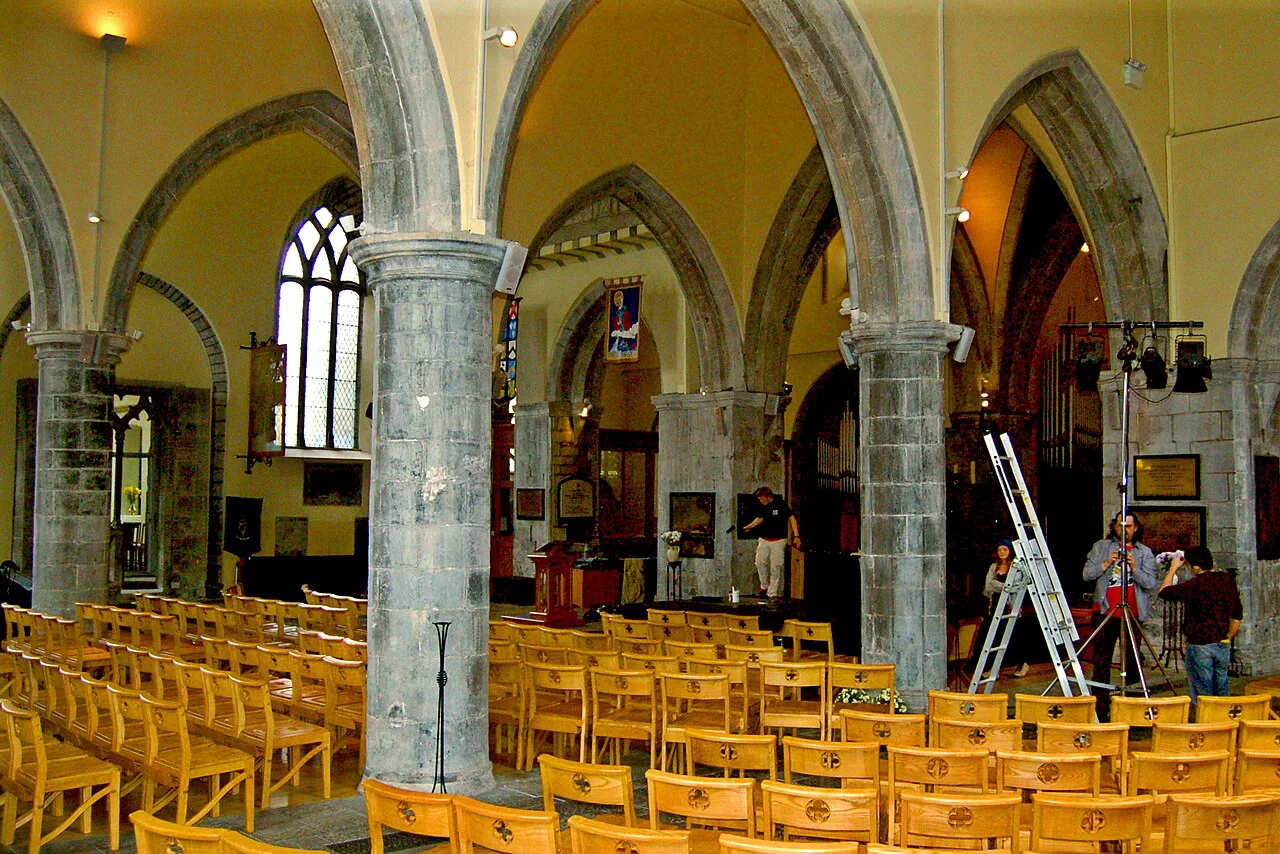
The single most useful rule is that a service takes priority over sightseeing. Galway Cathedral asks visitors not to walk around during services and not to enter during Mass unless they intend to participate, and Saint Mary's Cathedral in Limerick describes Sunday as open for service and worship rather than general visiting.
Practical etiquette follows from that: keep voices low, avoid crossing in front of people at prayer, and leave promptly if a service begins. Photography rules differ from building to building and are not published for every site here, so ask a steward or volunteer on arrival rather than assuming.
Cork: St Fin Barre's Cathedral
St Fin Barre's is a Gothic Revival landmark rather than a medieval survival, and its own cathedral website credits William Burges, appointed architect in 1862, with the design. The foundation stone was laid in 1865 and the building was consecrated on St Andrew's Day in 1870, so the fabric is Victorian even though the site's Christian worship is claimed to stretch back much further.
The materials are regional and worth noticing up close: Cork limestone forms the towers and spires, and red Cork marble appears through much of the interior. Burges's attention extended to sculpture, mosaics, furniture and metalwork, and the stained glass retains notably vivid colour. For anyone comparing this church with others in the city, it sits naturally beside the other churches in Cork that hold medieval or Georgian fabric.
The cathedral remains an active worshipping community with live-streamed services, which means visitor access can shift around the liturgical calendar. St Fin Barre's Cathedral carries an opening-hours section on its own site, so check there for the current arrangement rather than relying on a guidebook.
Cork: St Anne's Church, Shandon
St Anne's Church, Shandon describes itself as the oldest church still in continuous use in Cork City, with worship and an active congregation since 1722. It belongs to the Church of Ireland and is one of 24 parishes in the United Diocese of Cork, Cloyne and Ross, so a visit here is a visit to a working parish as much as to a monument.
The operator lists three experiences beyond the pews: playing the Shandon Bells, seeing the inner workings of the four-faced clock, and climbing the tower for a 360-degree view over Cork. It also describes self-guided tours among what visitors can do. These are offerings on the parish's own page, so confirm current arrangements for the tower and bells before you travel, since access may vary.
The building has been judged architecturally significant in its own right, with a 2001 appraisal quoted by the parish calling it one of the most important early 18th-century churches in Ireland and noting that it retains original bells. Budget time for the climb if you attempt it, and treat the tower as an add-on to the church rather than a substitute for it.
Limerick: Saint Mary's Cathedral
Saint Mary's stands above the River Shannon in Limerick's medieval core and dates its foundation to 1168, which its own website describes as making it the oldest cathedral on the Wild Atlantic Way. It serves Church of Ireland and other Christian worshippers and hosts concerts and recitals alongside regular services.
Visitor hours are published clearly here. The cathedral lists Monday to Saturday from 11.00 am to 4.00 pm with last admission at 3.30 pm, and bank holidays from 11.00 am to 3.00 pm with last admission at 2.30 pm, while Sunday is kept for service and worship. Those figures come from the cathedral's own page and are the ones to rely on rather than any older listing.
Because the building has lived through invasions, sieges and famine, its appeal is historical as much as architectural, and the cathedral presents itself as a place of quiet reflection in a busy city. If you are weighing several stops in the west, Saint Mary's Cathedral in Killarney and St Colman's Cathedral in Cobh are separate buildings with their own histories; neither shares this one's foundation date.
Galway: The Cathedral on the Corrib
Galway Cathedral is a modern Catholic building on the west bank of the River Corrib, a short way north and west of the city centre. Its visitor page states plainly that there is no admission charge but suggests a donation of €3, and asks visitors to refrain from walking around during services.
Hours are given as approximate: usually 08:00 to 20:00, with possible earlier closing on certain days including Christmas. That wording matters, because it means the times are a guide rather than a guarantee. Accessibility information is specific to this building, with a wheelchair ramp at the main entrance in the east transept facing Salmon Weir Bridge and a hearing loop operating throughout.
Parking exists in the cathedral grounds and in a city council car park immediately south at Cathedral Square, but camper vans are not permitted in the cathedral car park. Public toilets are limited, so plan accordingly if you are travelling with children or a group.
Galway: St Nicholas' Collegiate Church
St Nicholas' sits in the heart of Galway and describes itself as a living link to the city's past, with the present church completed in 1320 on a site used for worship earlier still. Its parish page notes that a college of singers was established here in 1486, and a modern choir continues that tradition.
The operator publishes weekly hours: Monday, Tuesday, Thursday, Friday and Saturday from 10 am to 5.30 pm, Wednesday from 11 am to 5.30 pm, and Sunday from 1 pm to 5.30 pm, with last entry 30 minutes before closing. Alongside ordinary visits, it advertises a self-guided Story of Galway tour, a historian-led guided version and a bell-ringing experience, so there is a real choice between independent and guided access.
These options are described by the parish rather than by a booking platform, so availability should be confirmed directly. For medieval fabric in the west, County Kerry's Romanesque Ardfert Cathedral offers a different comparison point, since it is not a functioning city parish of this kind.
Kilkenny: St Mary's Cathedral
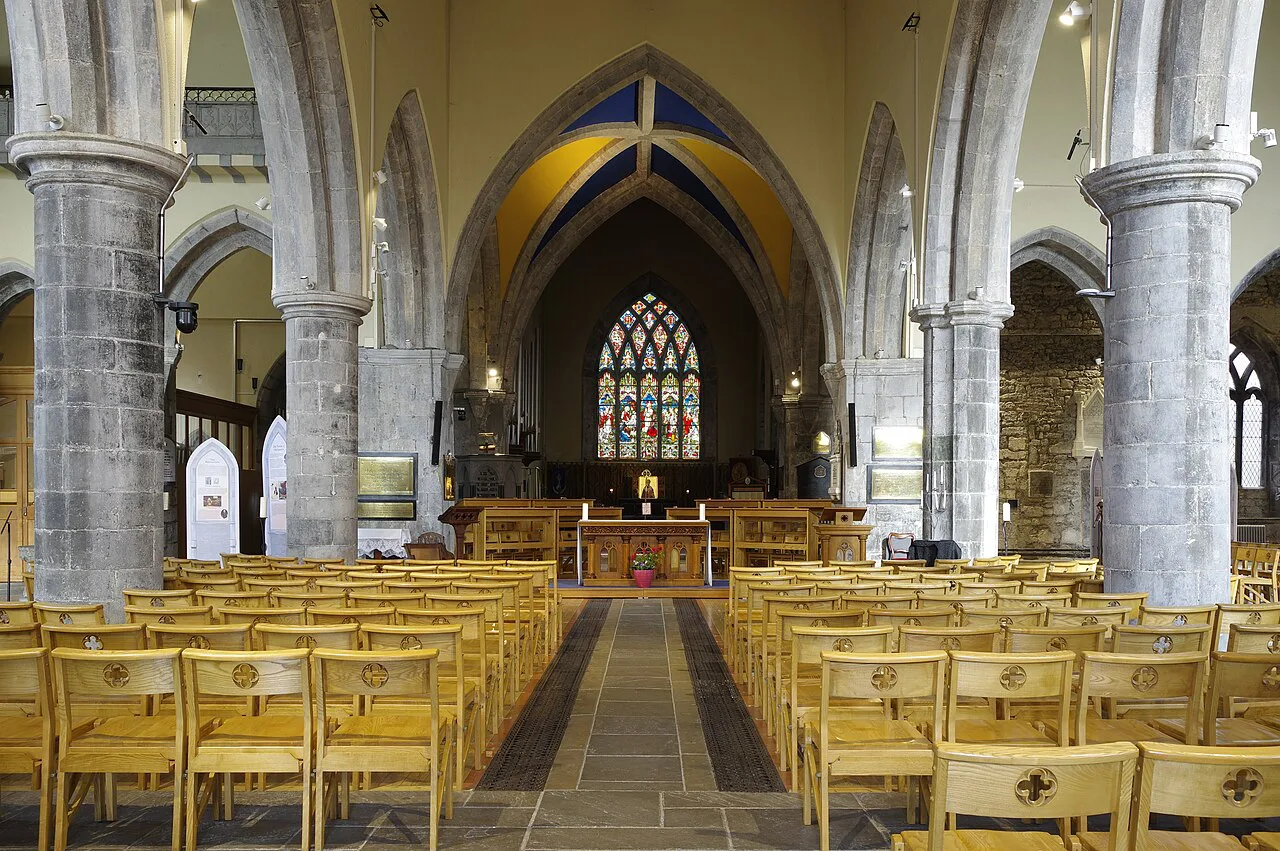
St Mary's Cathedral Kilkenny is a 19th-century Catholic cathedral with a documented building history rather than a medieval one. Its own history page records that Bishop William Kinsella announced the project in February 1842, work began in April 1843 and the foundation stone was laid that August by the bishop himself.
Construction continued under Bishop Edward Walsh through the famine years, deliberately providing local employment, and the cathedral was consecrated on 4 October 1857. The history page describes a Gothic design in chiselled limestone, and notes that the tower, now a city landmark at 186 feet, was originally drawn for St Kieran's College.
Later work reshaped the interior, including an 1899 reopening after refurbishment in which James Pearse, father of the 1916 leaders, completed marble altar rails and erected an altar to the Sacred Heart. This page documents construction and alteration only. It does not publish visitor hours, admission arrangements or tour details, so check with the cathedral before treating it as an open attraction.
Kilkenny: Black Abbey
The Black Abbey, formally the Church and Priory of the Most Blessed Trinity, was founded in 1225 for a community of Dominican friars just outside the old city walls. Discover Ireland, the national tourism authority, explains that the popular name comes from the black cappa the friars wore over white habits in the Middle Ages.
The community's history was interrupted in 1543 when Henry VIII confiscated the abbey and turned it into a courthouse, leaving the buildings in ruin before a 19th-century restoration returned them to worship. What survives spans the 13th to 16th centuries, and carved stone is the main draw: sepulchral slabs, sculpture, a figure of the Blessed Trinity and the only known wooden statue of St Dominic in Ireland.
The great Rosary Window, showing the fifteen mysteries of the Holy Rosary, is the pick of the glass, and marks said to come from Cromwellian soldiers' swords add a sharper historical edge. This detail comes from a tourism authority rather than the Dominican community, and that page does not state current opening times. Confirm with the parish before visiting.
Choosing Between Them
If you have time for only two or three, decide by what you want to look at rather than by city. For medieval fabric and carving, Black Abbey and St Nicholas' each hold substantial early material; for Victorian design and interior colour, St Fin Barre's is the obvious pick. For a building with the tower experience, Shandon is the one; for easy, published daytime hours in the west, Saint Mary's in Limerick and St Nicholas' are the simplest to plan around. For a wider field, our guide to Cathedrals in Ireland sets these buildings alongside others.
Geography then settles the rest. Cork pairs Shandon and St Fin Barre's in one day without much travel, while Kilkenny's two buildings are distinct enough to visit separately: a 19th-century Catholic cathedral and a 13th-century Dominican abbey read very differently even a short walk apart. If you are planning a day in that city, our guide to the churches in kilkenny sets out the landmarks to compare. Galway Cathedral stands on the west bank of the River Corrib, north and west of the centre, while St Nicholas' sits in the heart of the city, so doing both means a walk between the two parts of town.
Note too that only some of these pages publish the information you need. Hours are explicit for Saint Mary's Limerick, Galway Cathedral and St Nicholas'; Shandon's operator describes tours and tower options; Kilkenny's St Mary's and Black Abbey have no visitor hours on the pages cited here, while St Fin Barre's lists an opening-hours section on its own site. Treat each gap as a task rather than a closed door.
What to Confirm Before You Travel
Recheck the operator page for whichever building you plan to enter, ideally in the week before you go. Pages carry current notices, Shandon's site lists dated events into late 2026, and Galway's hours are explicitly approximate.
If you are drawn to early stonework rather than city churches, early ecclesiastical sites such as Kilmalkedar Church in County Kerry sit well beyond the Victorian, Georgian and medieval examples above and are worth checking before a visit.
Plan Your Visit
A good church itinerary in Ireland mixes scales: a Victorian cathedral in Cork, an 18th-century tower in Shandon, a medieval core in Limerick, a modern Catholic building in Galway and two very different Kilkenny sites. Each comes with its own operator page, and that page is the authority on hours, tours and etiquette for that building alone.
Build in slack for services, check the published hours for the three buildings that give them, and confirm arrangements for the buildings whose pages describe history without visitor times. The result is a day that respects the congregations and still gets you close to the stonework, glass and carving these buildings were made to show.
For another heritage guide, read about St Marys Cathedral Killarney.
Explore more Ireland guides
Frequently Asked Questions
Can you just walk into churches in Ireland?
Often yes, but not on a universal rule. Saint Mary's Cathedral Limerick, Galway Cathedral and St Nicholas' in Galway publish visitor hours, which shows they welcome casual visitors at set times. Other buildings, including Kilkenny's St Mary's and Black Abbey, have pages cited here that describe history without stating visitor hours, so contact the parish before relying on entry.
Which of these churches publish visitor opening hours?
Saint Mary's Cathedral in Limerick gives Monday to Saturday times with a last admission, plus shorter bank holiday hours, and keeps Sunday for worship. Galway Cathedral gives approximate daily hours and notes possible earlier closing. St Nicholas' in Galway lists separate weekday, Wednesday and Sunday hours. St Fin Barre's has an opening-hours section on its own site.
Is Galway Cathedral free to enter?
Galway Cathedral's visitor page states there is no admission charge but invites a donation toward upkeep. That makes the suggested contribution a voluntary offering, not a ticket price. Visitors are also asked not to walk around during services or enter during Mass unless they are taking part.
What is there to see inside Black Abbey in Kilkenny?
According to Discover Ireland, the surviving fabric spans the 13th to 16th centuries and includes sepulchral slabs, stone carvings, a figure of the Blessed Trinity and the only known wooden statue of St Dominic in Ireland. The Rosary Window, showing the fifteen mysteries, is the notable stained glass. Opening times are not listed on that page, so confirm with the parish.
What is the difference between St Mary's Cathedral and Black Abbey in Kilkenny?
They are separated by centuries. Black Abbey was founded for Dominican friars in 1225, was confiscated under Henry VIII in 1543 and later restored. St Mary's is a 19th-century Catholic cathedral, announced in 1842 and consecrated in 1857, with an 186-foot tower that began as a design for another building. Visiting them together shows two very different eras.
Do you need to book a tour at St Nicholas' in Galway?
The parish advertises both a self-guided Story of Galway tour and a historian-led guided tour, plus a bell-ringing experience, alongside its published opening hours. Booking arrangements and prices are not stated in the page text summarised here, so contact the parish directly to confirm availability and how to reserve.
Sources
You might also like



Continue reading
More guides you'll find useful





