
Kilmalkedar Church: A Guide to the Dingle Peninsula's Romanesque Site
Kilmalkedar Church is an unguided OPW national monument in the Kerry Gaeltacht, with a Romanesque church, ogham stone, sundial and alphabet stone.
On this page
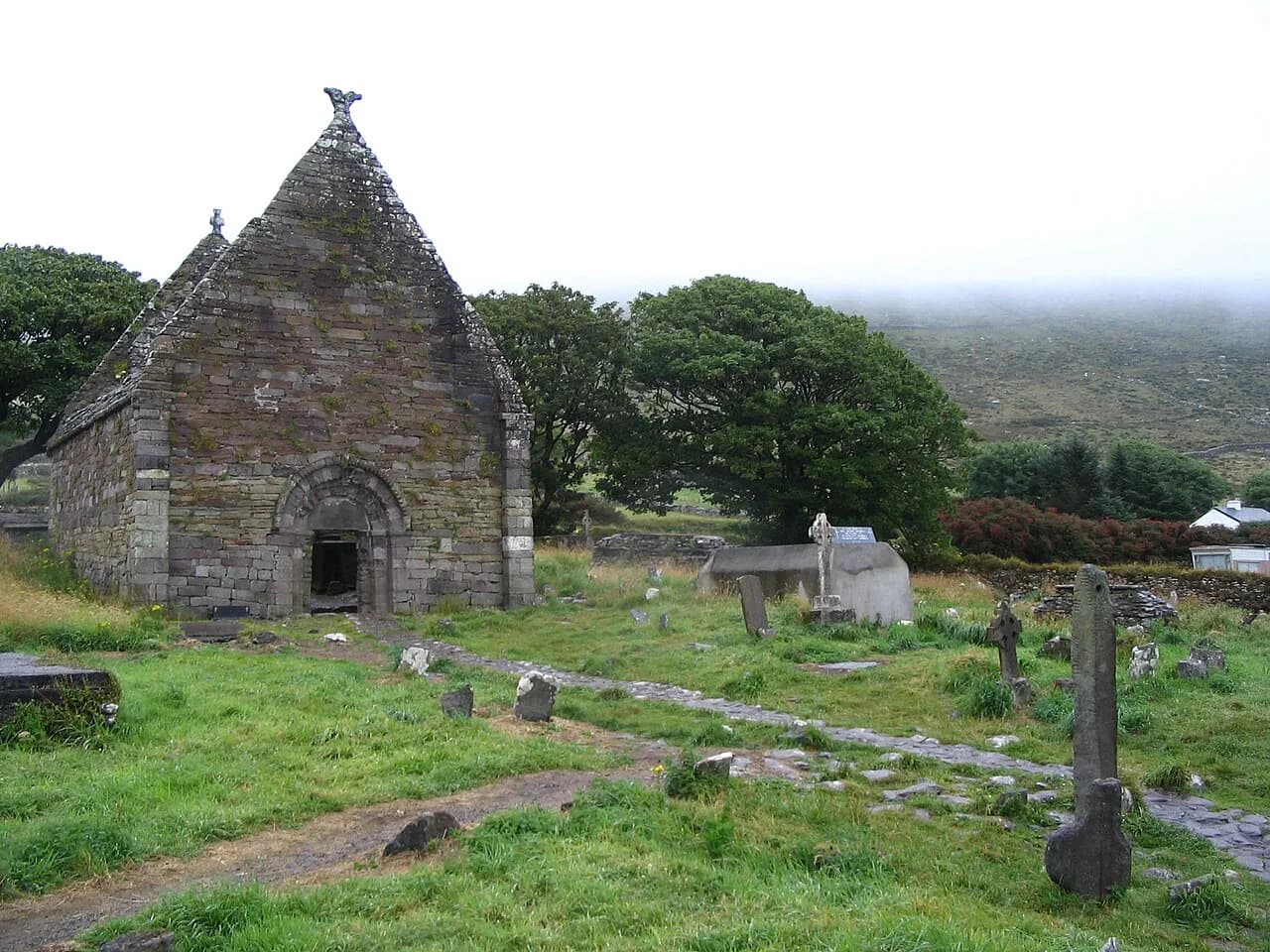
Kilmalkedar Church is a state-owned National Monument in the care of the Office of Public Works, standing in the Dingle Gaeltacht of County Kerry about 5km east of Baile an Fheirtéaraigh and looking out over Smerwick harbour. The complex spreads across more than 10 acres, so the church is one element in a wider ecclesiastical landscape rather than a single building to tick off. The OPW classifies it as an unguided site and publishes a care-and-caution notice for visitors, which sets the tone for how the place is experienced.
A visit here rewards slow looking because the site layers two distinct periods. Early Christian monuments — an ogham stone, a sundial and an alphabet stone — sit in the graveyard, while the upstanding church belongs to the Romanesque tradition of the twelfth century.
The Setting: A Ten-Acre Complex in the Dingle Gaeltacht
The official description places Kilmalkedar 5km east of Baile an Fheirtéaraigh, in the Gaeltacht of the Dingle peninsula, on ground overlooking Smerwick harbour. The complex covers over 10 acres, so the church, graveyard and carved stones form an open, dispersed site rather than a single compact building. Allow time to walk between the elements instead of treating the church as the only stop.
Because the site is unguided, you should not count on interpretative panels or on-site staff to orient you, and the Heritage Ireland listing describes no visitor facilities. Bring your own understanding of what you are looking at, or read up beforehand, since the monuments will not explain themselves on the ground. That is the main trade-off of Kilmalkedar: an uncrowded, self-directed experience in exchange for doing the reading yourself.
Saints and Origins: St Maolcethair and the St Brendan Association
Heritage Ireland names the complex in honour of its founder, St Maolcethair, who died in 636 AD, and notes that the site is commonly associated with St Brendan the Navigator. The distinction matters: the founder attribution is stated as the site's dedication, while the Brendan link is described as a common association rather than a documented fact. Treat the Brendan connection as tradition attached to the place, not as a settled historical claim.
The official account adds that Maolcethair's kinsman Fiatach Finn was king of the Ulaid, the people of what is today east Ulster, and later High King of Ireland. That genealogical detail explains why a Kerry foundation carries an Ulster connection in its founding story. For visitors, it is a reminder that early Irish monastic sites were tied into wider dynastic networks, not isolated spiritual outposts.
If the Brendan tradition interests you, County Kerry holds other ecclesiastical sites, including Ardfert Cathedral, which can be explored as a separate thread. Kilmalkedar's own evidence for the saint is associative, so build the itinerary around what each site actually documents.
Reading the Early Christian Stones: The Ogham Stone
The ogham stone at Kilmalkedar dates to about 600 AD, stands 1.8m high and carries two inscriptions cut as strokes along or across a line. Heritage Ireland gives the readings as ANM M(AI)LE INBIR MACI BROCANN and a second inscription rendered ANM or M(A)Q(I). The stone was studied as part of the Ogham in 3D project by the School of Celtic Studies at the Dublin Institute for Advanced Studies, which is the scholarly route to understanding it.
An independent travel editorial mentions an ogham stone, sun dial, stone cross and alphabet stone among the antiquities at Kilmalkedar, which helps you plan what to look for on the ground. Its architectural notes also point to the Hiberno-Romanesque doorway and blind arcading in the nave. That is useful for orientation, but the official page remains the authority on the stone's date, height and inscriptions. Read the editorial as a travel prompt, not as epigraphy.
The Graveyard Sundial and the Alphabet Stone
The sundial stands at the western edge of the graveyard: a pillar 1.2m tall with a smooth finish and a semi-circular head divided into four equal sectors. A hole once held a small projecting rod whose shadow marked the passage of time across those sectors. The official page also records an alphabet stone of about 550 AD, placing it earlier than the ogham stone and the Romanesque church by centuries.
Together these three monuments let you follow the site's chronology: the alphabet stone first, the ogham stone a few decades later, then the medieval church. That sequence is the most useful thing to carry with you, because the unguided setting offers no ordered explanation of its own.
The Romanesque Church Built Shortly After 1134
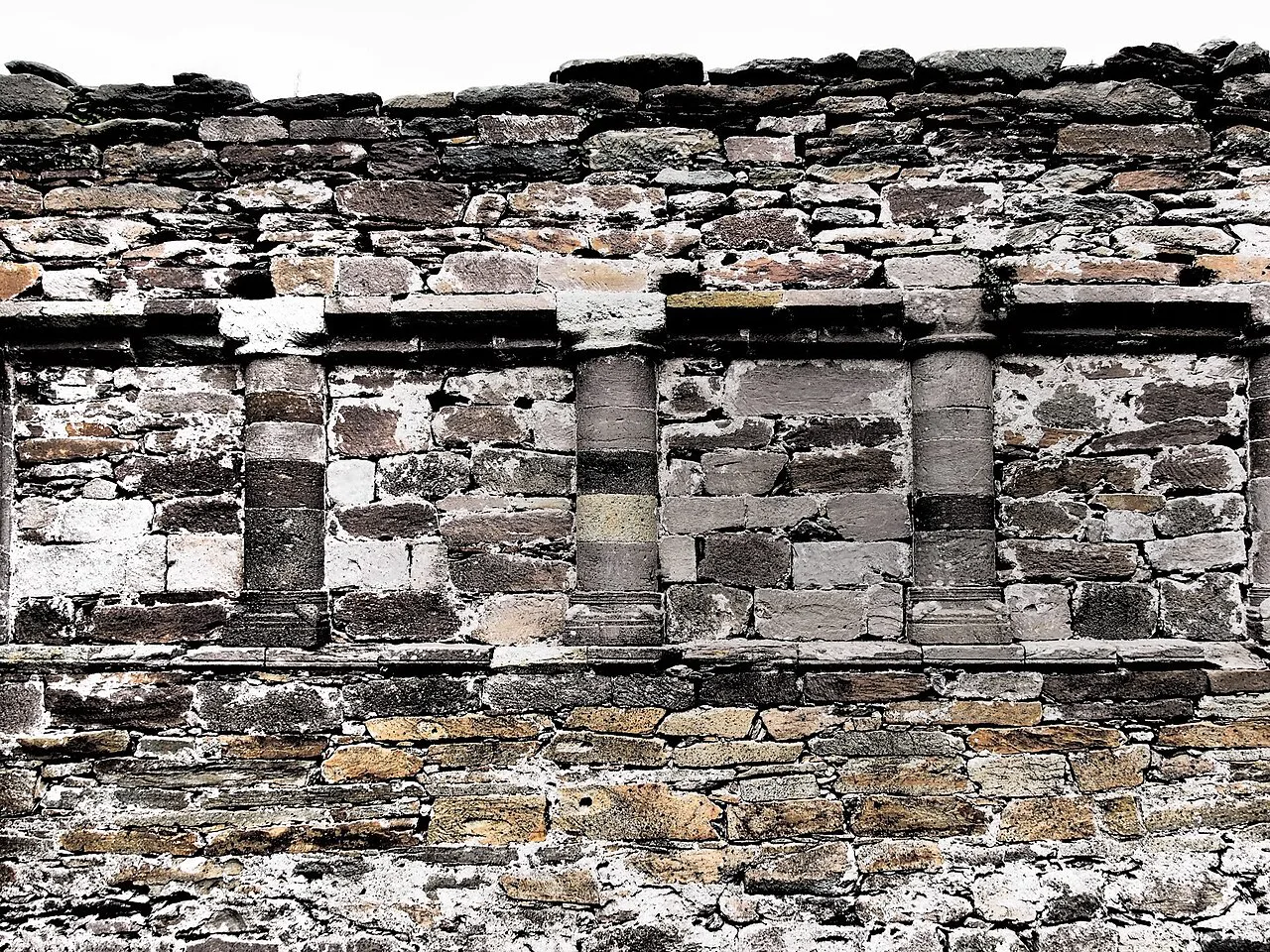
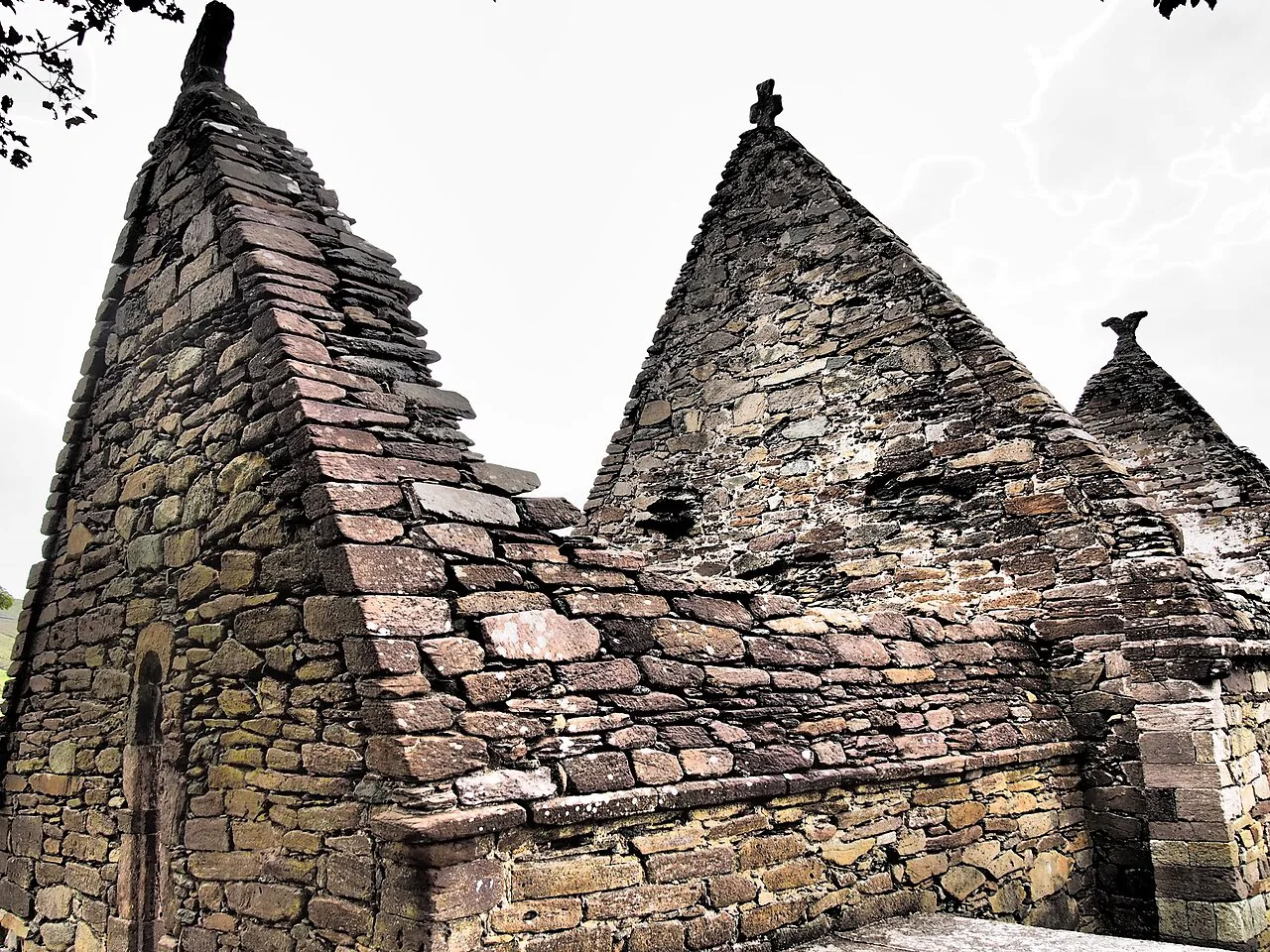
The standing church is Romanesque and was built shortly after 1134 AD, during the dynastic rivalry between the MacCarthaigs of south Munster and the Uí Briain of north Munster. It has a nave and a chancel, the two-part plan typical of the period. The nave retains its original height, and on the interior east and west gables recesses for purlins are visible, suggesting an internal support system may once have existed. These details reward close inspection from outside, where the carved masonry is clearest.
The walls are built of dressed sandstone, with a band of yellow stone visible on the west gable and returned on all sides of the nave. At eaves level, carved zoomorphic heads project outward beneath a chamfered cornice, and the round-headed west doorway has jambs of three orders with a projecting hood resting on moulded abaci and carved animal-head stops. These details reward close inspection from outside.
The Ireland Travel Kit editorial describes the doorway and blind arcading in the nave as notable features, and frames the building as an attempt to align with Romanesque models then current in mainland Europe. That reading helps explain why a small Kerry church carries such ambitious carving. It is also a reminder that Kilmalkedar was connected to wider European fashion, not built in isolation.
Architectural Context: Shared Features with Cormac's Chapel
Heritage Ireland compares Kilmalkedar with Cormac's Chapel specifically because the two share a tympanum on the west doorway, blind arcading in the nave and common ornamental motifs. Those shared features place Kilmalkedar within a recognisable Romanesque programme rather than a local idiosyncrasy. If you have seen Cormac's Chapel, the comparison gives you a mental template for what to examine here.
For a broader comparative frame, the wider story of Irish ecclesiastical building spans many centuries and many sites, from early monastic foundations to later medieval and modern cathedrals. Placing Kilmalkedar within that longer arc helps you see what is distinctive about a small twelfth-century church with early Christian monuments still in its graveyard. The cathedrals in ireland guide can serve as a starting map for that longer story, and a Dublin heritage guide extends it to the capital's own medieval churches.
What the OPW's 'Unguided Site' Classification Means
The OPW lists Kilmalkedar as an unguided site and states in a notice that a level of care and caution should be maintained during all stages of a visit, adding that the Office of Public Works will not be held responsible for any damages, injuries or losses. That is an official caution, not a reason to stay away, but it does mean you cannot expect the protections of a staffed visitor attraction. Wear suitable footwear for uneven ground and watch your footing among the graves and carved stones.
The site is protected in accordance with the National Monuments Acts 1930 to 2014, which is the legal basis for its status as a National Monument. Treat the stones and church walls as protected archaeology rather than interactive exhibits. The official page publishes no admission charge or opening hours, so confirm current conditions with the OPW before travelling rather than assuming a fixed schedule or guaranteed entry.
A dated personal blog from 2013 gives a sense of the visit's atmosphere, noting rolling hills, other churches visible in the distance and a walking route it calls the Pilgrims' Way continuing toward Mount Brandon. Those impressions are subjective and old, so use them for colour only, not as a description of present-day conditions or routes.
Pairing Kilmalkedar with Other OPW Sites in Kerry
Heritage Ireland's own nearby-sites list for Kilmalkedar includes the Blasket Centre, Ardfert Cathedral, Sceilg Mhichíl, Derrynane House, Ross Castle and Listowel Castle. These are separate monuments with their own access arrangements, so treat them as extensions of a Kerry itinerary rather than as part of a single visit. Ardfert Cathedral is the most direct architectural comparison for anyone tracing medieval ecclesiastical building in the county.
Ireland360's hidden-gems listings place the Gallarus Oratory near Kilmalkedar on the Dingle Peninsula, describing it as a remarkably intact dry-stone church shaped like an upturned boat. It offers a counterpoint to Kilmalkedar's carved masonry because it shows a very different construction tradition. Pairing the two gives a fuller picture of early Christian building on the peninsula, and both reward arriving with some prior reading.
If your interests run to broader early Christian and medieval remains, the wider collection of ancient sites in Ireland provides more contexts for the stones you see at Kilmalkedar. Travelers tracing ecclesiastical architecture across the country can continue with churches in Ireland as a companion to the cathedrals material, including Romanesque doorways and carved stonework elsewhere.
Practical Points for Your Visit
Kilmalkedar rewards preparation more than most sites: read the OPW page for the inscriptions and architectural vocabulary before you go, since the unguided setting will not explain them. The official listing publishes no opening hours, admission charges or facilities, so confirm current conditions with the Office of Public Works. Allow time to walk the full complex rather than stopping at the church.
The site's value lies in what it preserves: a documented founder from the seventh century, early Christian carved stones from around 550 to 600 AD, and a Romanesque church built shortly after 1134. Approaching it as an archaeological landscape rather than a visitor attraction will give you the most from the visit.
Explore more Ireland guides
Frequently Asked Questions
Is Kilmalkedar Church free to visit?
The official Heritage Ireland page for Kilmalkedar publishes no admission charge and no opening hours, so it does not present the site as a ticketed attraction. Because the OPW classifies it as an unguided site, check with the Office of Public Works directly for current arrangements before you travel.
What is the ogham stone at Kilmalkedar Church?
It is an early Christian monument dated to about 600 AD, standing 1.8m high and carrying two ogham inscriptions cut as strokes along or across a line. Heritage Ireland records the readings as ANM M(AI)LE INBIR MACI BROCANN and a second rendered ANM or M(A)Q(I). The stone was studied through the Ogham in 3D project by the School of Celtic Studies at the Dublin Institute for Advanced Studies.
Who founded Kilmalkedar?
Heritage Ireland names St Maolcethair, who died in 636 AD, as the founder honoured in the site's name. The site is also commonly associated with St Brendan the Navigator, but that connection is presented as an association rather than as documented fact.
How old is the Romanesque church at Kilmalkedar?
The official description dates the standing church to shortly after 1134 AD, during the rivalry between the MacCarthaigs and the Uí Briain. It has a nave and chancel and is built of dressed sandstone with a decorated west doorway and carved heads at the eaves.
Is there a guide or visitor centre at Kilmalkedar Church?
The OPW lists Kilmalkedar as an unguided site and gives no details of guides, displays or visitor facilities. Expect to interpret the monuments yourself and take care on uneven ground.
What else can I see near Kilmalkedar Church?
The OPW's nearby-sites list includes the Blasket Centre, Ardfert Cathedral, Sceilg Mhichíl, Derrynane House, Ross Castle and Listowel Castle, each with its own access arrangements. Ireland360's listings also place the Gallarus Oratory on the Dingle Peninsula, a contrasting example of early Christian stone building.
Sources
You might also like



Continue reading
More guides you'll find useful





