
The Great Irish Famine: Where to Study and Visit Its Record
Understand the Great Irish Famine through the archives that record it and the museum that interprets it, with practical access notes for independent travellers.
On this page
The Great Irish Famine was the crisis that ran across Ireland from 1845 to 1852, triggered by the failure of the potato crop and deepened by relief policy, disease and eviction. Visitors meet it in two distinct ways: through the paper trail held in public archives, and through interpretation at the National Famine Museum at Strokestown Park in County Roscommon. Deciding which of those you want is the first practical choice, because they demand different things of your time. For the venue itself, start with our National Famine Museum Ireland guide.
Archives reward preparation and patience, and some material requires an appointment or a reading-room visit rather than a browse. A museum visit gives you a structured narrative in an afternoon but cannot substitute for the documents themselves. Many travellers do both, using the museum to build a framework and the archives to follow specific places, families or questions.
Ireland Before the Blight: Population, Potatoes and the Poor Law
A short history of the famine prepared by University College Cork as a secondary-school resource sets out the pre-crisis context: Ireland's population rose sharply in the decades after the 1821 census, reaching dense settlement levels by European standards. The same account describes how the potato became the staple food for millions, making the crop's failure a direct threat to survival rather than a market problem.
The Irish Poor Law of 1838 divided the country into 130 unions, each with a workhouse funded by local rates and overseen by elected guardians. In the UCC telling, relief inside the workhouse carried a stigma that made people resist it until starvation left no alternative. That detail matters when you read workhouse registers later: admission often marked the end of a family's other options.
Cork City and County Archives' facsimile pack adds local texture, noting that by 1840 roughly two fifths of the Irish population depended on the potato as their main food. It also records that County Cork was divided into eleven poor law unions at first, later increased, each keeping minute books, rate books and registers of people entering and leaving the workhouse. Those record types are what a researcher can actually request today.
From Blight to Relief: How the State Responded
Blight was identified in Ireland in September 1845, and the UCC account traces the official response that followed: Sir Robert Peel's government authorised a Relief Commission, bought Indian corn from America and financed public works through the Board of Works. The same account is careful about outcomes, noting that the corn was hard to mill and that the works later paid by task rather than by day, penalising the weakest workers.
The National Archives of Ireland's research guide gives the Relief Commission an institutional shape: established in 1845, reorganised in January 1846, disbanded that August, then reconstituted in February 1847 under the Temporary Relief Act. Knowing that sequence helps you read its surviving papers, because the body producing them changed form more than once.
Soup kitchens followed under the 1847 Temporary Relief Act, and the Poor Law Extension Act of June 1847 shifted the cost of relief onto local ratepayers. UCC's account links that shift to widespread clearances and to the Gregory Clause, which withheld relief from people holding more than a quarter acre of land. These are policy decisions with names attached, which is why archive catalogues still use them as finding aids.
The Distress Papers at the National Archives
From 1846, government departments in Dublin Castle were flooded with letters, reports and petitions from distressed districts, and the authorities called this body of material the Distress Papers. The National Archives guide describes their contents as reports on community distress, letters about forming local relief committees, applications for funds and correspondence on relief projects. For a visitor with a place name in mind, this is the richest single entry point.
The papers are indexed in four volumes, each covering a date span and arranged alphabetically by correspondent surname, then further by area and subject, with a county index at the back. The volumes run from March 1846 through September 1847. Because the index structure is chronological, you need an approximate date as well as a name before you start.
Relief Commission material is different: 788 entries organised chronologically and searchable online under the reference RLFC/2, with hardcopy lists available in the reading room. Some personal and place names in that collection are unclear or unidentified and appear in square brackets, so a failed search does not necessarily mean nothing survives.
Planning a Reading-Room Visit
The ordering mechanics are set out plainly by the National Archives: check the alphabetical index for your correspondent, use the reference number with the D prefix to order the record, and fall back on the geographical subsections when you do not know the name. That last step is the one most useful to family historians, since a townland or parish can stand in for a person.
This is a reading-room process rather than an online ordering service, so build your visit around the indexes rather than expecting to request items remotely. The archive has not published reading-room hours in the material available here, so confirm current arrangements directly before travelling. Treat any list of documents you compile as a plan, not a guarantee of what you will be handed on the day.
County Cork: Workhouse Records and the Facsimile Pack
Cork City and County Archives has published a facsimile pack that reproduces documents relating mainly to workhouses and famine relief, including a workhouse ground plan, a page from the Cork Union board of guardians minute book recording the 1847 inmate diet, and extracts from the Midleton and Kinsale union records. It is a low-friction way to study record types before committing to a research trip.
The pack reproduces documents from the archive's own holdings and from local public libraries, and it points readers onwards to the Cork City Library, Cork County Library and Cork Public Museum for further study. Note that an appointment is required before access to original documentation, nineteenth-century publications or microfilm readers.
The same source records that government Indian meal was sold from a Cork depot at a rate of some 300 tons a week in May 1846, and that the poor nicknamed it after Peel. It describes the fever epidemics that followed hunger, with typhus and relapsing fever spread by body lice in crowded workhouses. Those details connect the shelves of a search room to the conditions that produced the papers.
Estimating the Human Cost in Cork
Local figures do not map neatly onto national narratives, and Cork shows why. The facsimile pack cites an estimate of 113,425 deaths in County Cork between 1846 and 1850, and a population drop of almost 27 per cent between 1841 and 1851. It frames these as estimates within a defined period rather than as a definitive count.
UCC's short history takes a wider view, describing over a million deaths and a further million and a quarter people fleeing the country, alongside the elimination of close to 300,000 small holdings. Different sources draw their boundaries differently, whether by county, by decade or by cause, so treat any single figure as one measurement rather than the whole story.
Emigration is the other half of the ledger, and it is where the famine's record extends far beyond Ireland. The UCC account traces the departure of a quarter of a million people in 1847 alone and continued heavy emigration for years afterwards, with Irish communities forming in Liverpool, Glasgow, Manchester and New York. For travellers, that means Irish famine history is often researched in two countries at once, and the crossings themselves left their own grim documentary trail, as this account of the Irish Coffin Ships explains.
Reading Famine Images Correctly
Photography was expensive in the famine years, so surviving visual evidence comes largely from prints, drawings and ephemera rather than from photographs of starving families. The National Library of Ireland explains that newspapers and journals of the period mostly relied on drawings and prints, and directs researchers to its Prints and Drawings and Ephemera Collections. If you arrive expecting a photographic record, you will be looking in the wrong place.
The library's practical advice is to search the online catalogue using keywords such as hunger or famine, then narrow by the 1845–1852 date range; a broader range will also surface later books and pamphlets about the period. Many collections are digitised and viewable through the catalogue, so this is research you can do before you travel.
Treat satirical and polemical images as arguments rather than as neutral records, since many were made to persuade a readership. The library's own example pairs a destitute family with a politician at leisure, which is commentary on policy, not reportage. Asking who published an image and for what audience will get you further than reading it literally.
Strokestown Park and the National Famine Museum
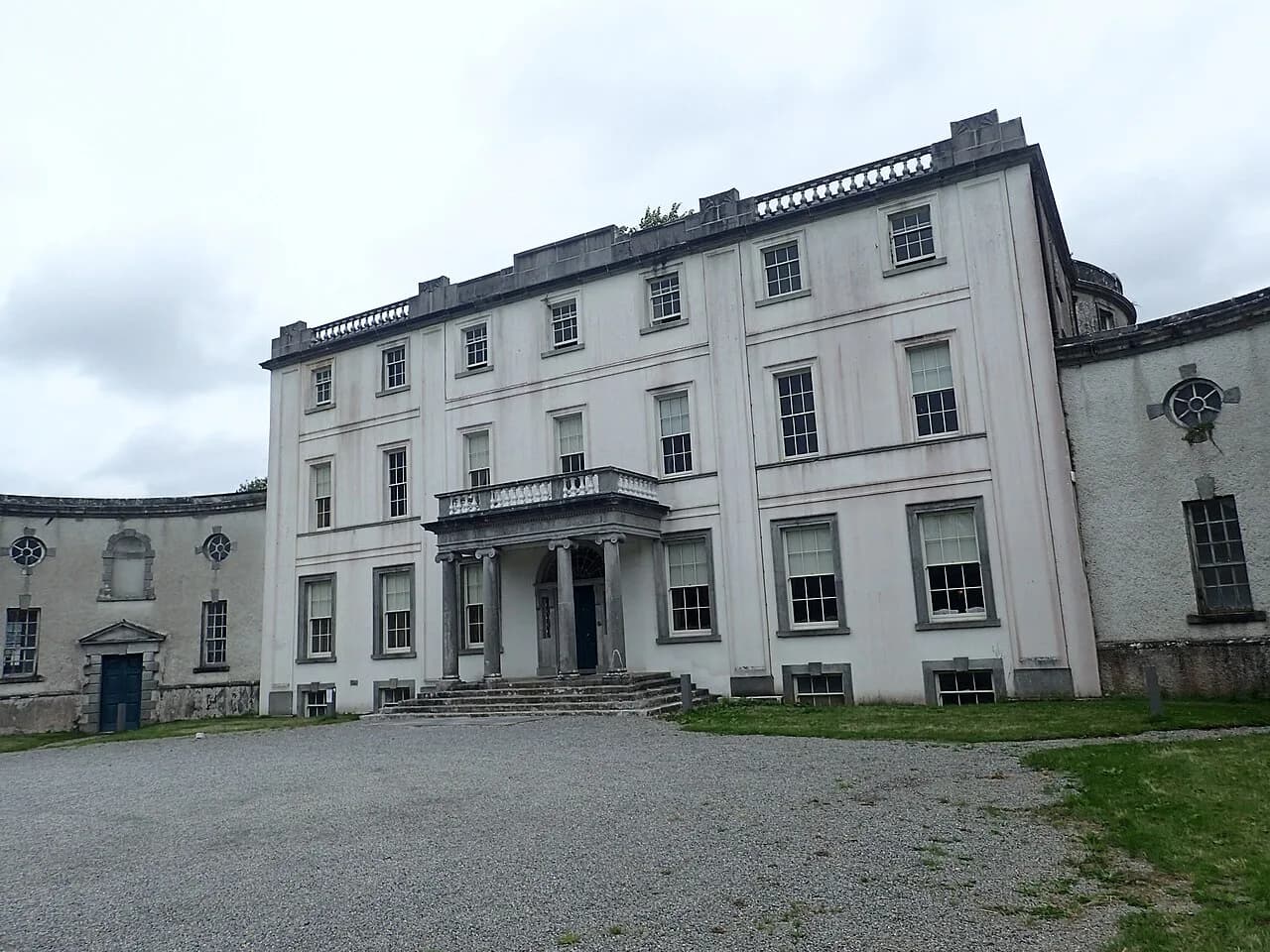
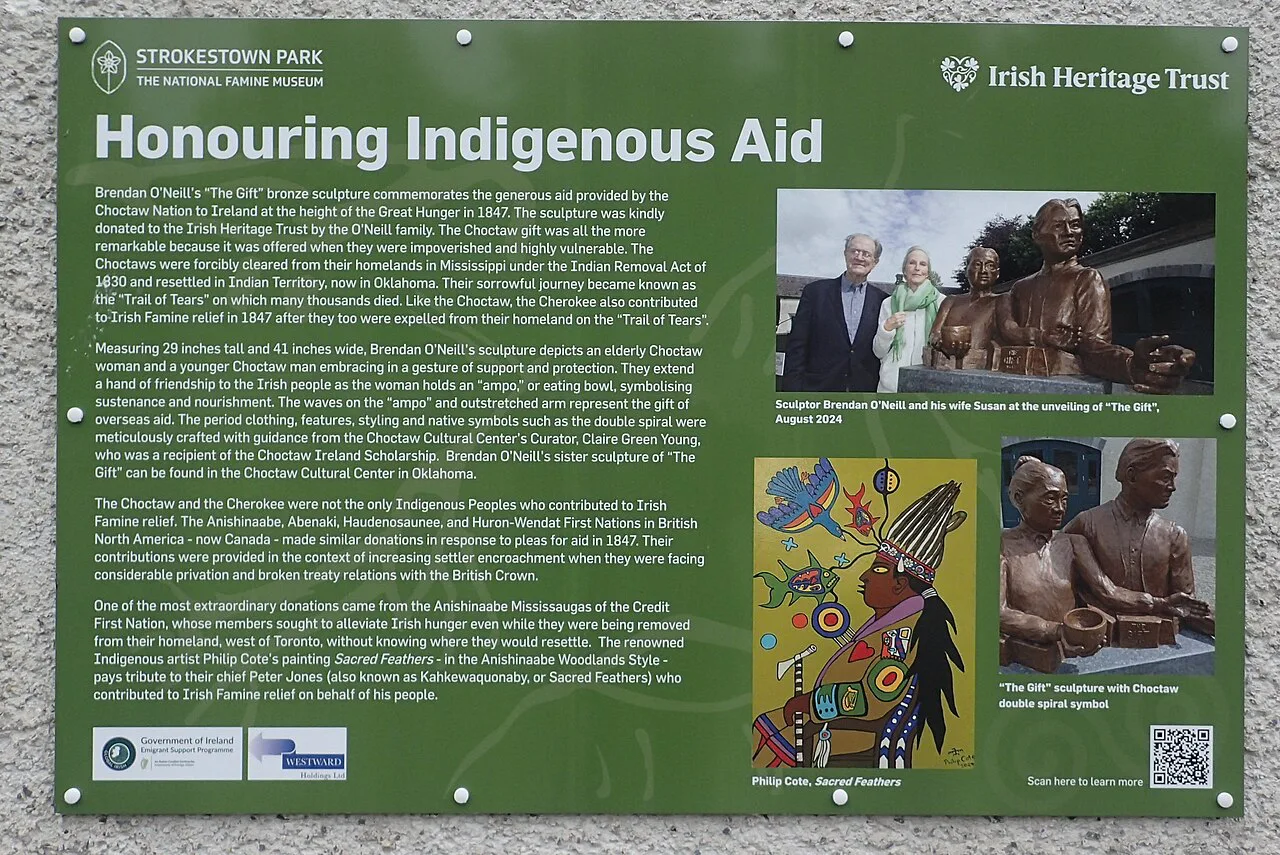
The National Famine Museum at Strokestown Park in County Roscommon is managed by the Irish Heritage Trust, and its exhibitions set landlords, tenants and cottiers against one another using the estate's own famine-era records. The archive behind those displays holds more than 55,000 original documents. That combination of a landed estate and its paperwork is what distinguishes the museum from a general history exhibition.
The house itself is a separate proposition: a guided visit that looks at household and servants' lives rather than the famine narrative. Museum access, the guided house tour and outdoor areas should be treated as distinct, since no source indicates that one covers the others. Check what each part of a visit includes when you book, and do not assume a single entry covers everything.
The National Famine Way relates to Strokestown tenants forced to leave in 1847, a reminder that this estate's story is also an emigration story. The museum's interpretation ties the documents to people who left rather than to an abstract statistic, and the wider crossings are covered in our account of the Irish Coffin Ships.
Current Access at Strokestown
The operator's own site lists the National Famine Museum and the house visit, but carries a prominent notice that the woodland is closed from 20 September while work is under way, with no firm reopening date. Plan around the museum and house rather than around a woodland walk. Because no reopening date is published, a walk should not be built into your itinerary.
The museum's displays are described as drawing on local accounts and documents, which makes a visit a useful primer before archival work rather than a replacement for it. If you want a fuller picture of the estate and its separate house tour, our guide to Strokestown Park sets out what the visit involves. Neither source gives opening hours, tour frequency or prices, so confirm those directly with the operator.
Choosing Between Archives and Interpretation
An archive asks you to arrive with a question, a name or a place, and to accept that the answer may be a single line in a minute book. A museum asks only that you turn up and follow a curated sequence. The trade-off is control against ease: documents let you test a claim yourself, while interpretation gives you a framework you would otherwise have to assemble from fragments.
A sensible pattern for a short trip is to begin with the National Famine Museum for the shape of the story, then spend a session with indexes and catalogues once you know which county or union you care about. Save reading-room time for material you cannot see any other way, and use digitised collections for everything else. That sequence keeps a research day from being consumed by orientation.
If workhouses specifically interest you, this guide to carrickmacross workhouse covers another surviving institutional site and how it can be read as a building. Comparing two workhouse sites makes the standardised Poor Law design easier to recognise. It also shows how differently the same building type survives. For a city whose union records are well documented, see our guide to Museums in Cork: City and County Collections before you plan a research visit.
Before You Travel: Two Things to Confirm
First, check the current status of the woodland at Strokestown, since the closure notice gives no reopening date and the position may change while you are planning. Second, confirm whether an appointment is needed at Cork City and County Archives if you want original documents, nineteenth-century publications or microfilm readers. Both details sit with the institutions themselves and are best taken from their own published information shortly before you go.
Neither the archives nor the museum can be reduced to a checklist, and neither should be rushed. Budget more time than you think for a first archival visit, and read the museum's interpretation with the documents you have already seen in mind. That way the two halves of a famine visit inform each other instead of running in parallel.
Plan Your Visit Around the Record
The Great Irish Famine is best approached as a subject with two doors: the archives that preserve what was written at the time, and the museum that explains why it mattered. The National Archives, Cork City and County Archives and the National Library of Ireland each hold distinct material with distinct access rules, while Strokestown Park offers interpretation built on a single estate's papers.
Decide in advance whether you want to read documents, follow a narrative or both. Bring a place name and an approximate date to any archive, expect to work through indexes rather than search boxes, and verify appointments and site conditions with the institutions themselves before booking travel. For the wider historical sequence, continue with our guide to Irish history.
Explore more Ireland guides
Frequently Asked Questions
Can I see famine documents without an appointment?
It depends on the institution and the material. At the National Archives of Ireland, the Distress Papers are consulted in the reading room, where you use the alphabetical index and order records by their D reference; Relief Commission material can be searched online under the reference RLFC/2, with hardcopy lists in the reading room. Cork City and County Archives states that an appointment is required before access to original documentation, nineteenth-century publications or microfilm readers. Many National Library of Ireland collections are digitised and viewable through its online catalogue.
Why are there so few photographs of the Great Irish Famine?
Photographic equipment was expensive at the time and largely restricted to wealthy users, and period newspapers and journals mostly illustrated their pages with drawings and prints. The National Library of Ireland therefore directs researchers to its Prints and Drawings and Ephemera Collections, where famine-era imagery survives. Search the online catalogue using keywords such as hunger or famine, narrowed to 1845–1852.
What does the National Famine Museum at Strokestown cover?
The museum contrasts the lives of landlords, tenants and cottiers using the estate's famine records, and the archive behind it holds more than 55,000 original famine-era documents. The associated house offers a separate guided visit about household and servants' lives. Museum displays, the guided house tour and outdoor areas should be treated as separate elements of a visit.
Is the house tour at Strokestown included with the museum?
No source confirms a combined arrangement, so do not assume one entry covers both. The operator lists the National Famine Museum and the house visit as distinct offerings, and the house tour is described as a separate guided look at household and servants' lives. Confirm what each booking includes directly with the operator before you travel.
How were the Distress Papers organised for researchers?
They are indexed in four volumes covering March 1846 to September 1847, arranged alphabetically by correspondent surname and further indexed by area or subject, with a county index at the back. In the reading room you check the index, order the record using its D prefix reference, and use the geographical subsections when the correspondent's name is unknown.
Is the woodland at Strokestown open?
The operator's site carries a notice that the woodland is closed from 20 September while work is under way, with no firm reopening date published. Plan a visit around the museum and the house rather than around a woodland walk, and check the operator's current notice before travelling in case the position has changed.
Sources
- Famine Records and Distress Papers | The National Archives of Ireland
- U1.ASHORTHISTORYOFTHEFAMINE.pdf
- Great Famine Facsimile Pack
- Searching for images of The Great Famine? | National Library of Ireland
- The National Famine Museum - Irish Heritage Trust
- Strokestown Park | National Famine Museum, Roscommon
You might also like



Continue reading
More guides you'll find useful





