
Georgian Houses in Ireland: Six Country Houses to Compare
Compare six Georgian-era Irish country houses, from Castletown to Belvedere, and see how house tours, parkland access and conservation differ.
On this page
The quickest answer for anyone comparing Georgian houses in Ireland is that the label covers more than one kind of building and more than one kind of visit. This guide sets six named houses side by side: Castletown in County Kildare, Russborough in County Wicklow, Newbridge in Fingal, Emo Court in County Laois, Doneraile Court in County Cork and Belvedere in County Westmeath. It is a bounded comparison of those six, not a national survey or a ranking.
At every one of them, the practical question is the same: does your ticket or your timing get you inside the house, or only into the grounds? Several publish a parkland that stays open far longer than the house, and one publishes a parkland that is free while the house is toured. Reading each property's own arrangements is more useful than assuming that an open gate means an open hall.
Reading the labels first: Palladian, neoclassical and Georgian-refurbished
Castletown is presented by Heritage Ireland as a Palladian-style country house, built around 1722 for William Conolly, speaker of the Irish House of Commons, to designs by several architects. Russborough belongs to the same broad Palladian family: the Irish Georgian Society dates its construction to 1741–1748 to designs by Richard Castle for Joseph Leeson, later First Earl of Milltown. Both are symmetrical, classical compositions rather than Victorian remodels, and both belong to a wider urban story traced in this Dublin heritage guide.
Emo Court shows why the dates matter. James Gandon began work there in 1790, after his Dublin commissions at the Custom House and the Four Courts, but Heritage Ireland notes the building standing today was not completed until some seventy years later, which places it in the neoclassical current rather than the earlier Palladian generation. Doneraile is different again: its core was built by the St Leger family around 1645 on the site of a ruined castle, and it became an outstanding Georgian example only when refurbished in the mid-eighteenth century.
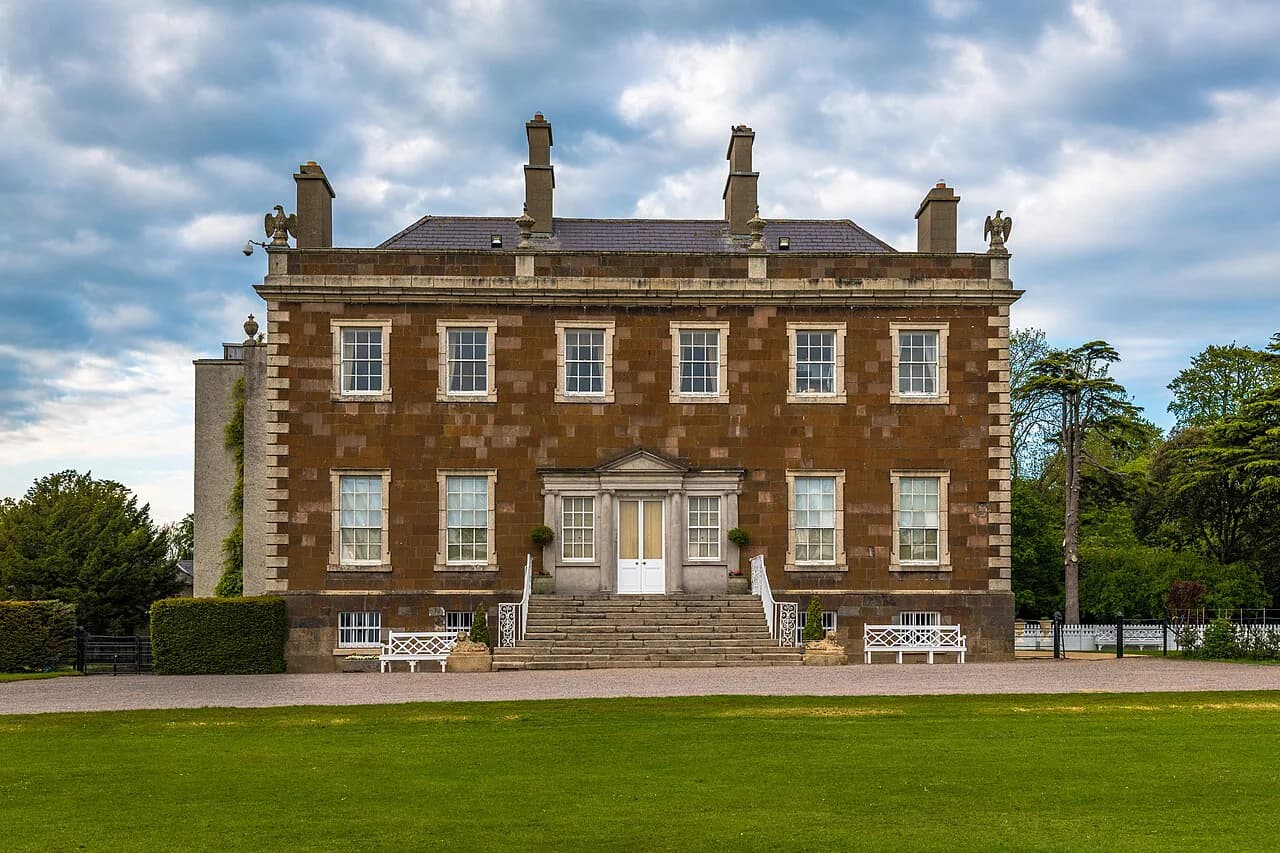
Newbridge House, at Donabate, was designed by James Gibbs, with work beginning in 1747 after Charles Cobbe commissioned the plan in 1744; Fingal County Council describes it as Gibbs's only executed work in Ireland. Belvedere, near Mullingar, is a Georgian villa designed by Richard Cassels, and its Rococo plasterwork is attributed to the stucco artist Barthelemij Cramilion around 1760. Georgian in this selection therefore means a period of building and remodelling, not one uniform style.
Castletown House and Parklands, Celbridge: collection and seasonal tours
Castletown's interest is layered: Conolly's political patronage, the estate improvements associated with his great-nephew Thomas and Lady Louisa, and a collection that includes three eighteenth-century Murano-glass chandeliers and the only fully intact eighteenth-century print room in the country, according to Heritage Ireland. The house is also described there as still the most splendid Palladian-style country house in Ireland, a judgement worth reading as the operator's own framing rather than a neutral verdict.
Access splits cleanly. The parklands open all year, with gates open from 07:00 to 20:30, while guided house tours run from 15 March to 4 November 2026, daily from 9:30 to 17:00 with the last tour at 16:00. Parkland entry does not put you in those rooms, so an off-season walk is a grounds visit, not a house visit.
For a car-free trip, Heritage Ireland lists the C4 bus from Ringsend Road via the city-centre quays to Celbridge, or the 120 towards Edenderry, alighting so the Castletown Gates are in front of you; from Hazelhatch rail station the W61 continues to Main Street. The same page carries a dated notice about car-park access via the M4, so confirm parking arrangements before relying on them rather than treating the notice as a promise either way.
Russborough House, west Wicklow: Castle's Palladian design and the Beit collection
Russborough is one of Ireland's finest Palladian houses and one of its best-preserved eighteenth-century buildings, in the Irish Georgian Society's assessment, built in 1741–1748 to Richard Castle's designs for Joseph Leeson. Sir Alfred Beit brought the Beit art collection to the house after buying it in 1951, and the Alfred Beit Foundation has owned and managed it since 1976. That combination of architecture and a named collection is why Russborough repays more than a drive-by.
Look up at the roofline. The parapet carries seventy-six ornamental urns in five different designs, probably the work of several workshops, largely in English oolitic and Portland limestone. The society documents nineteenth- and twentieth-century repairs that used inappropriate cements and corroded the iron fixings; a pilot restoration of six urns followed a survey, with further phases informed by that trial. It is a useful reminder that a country house visit is also a conservation story.
Russborough practicalities: tour times, parking and a current lift notice
House tours at Russborough run on the hour, Monday to Friday from 12pm to 3pm and Saturday and Sunday from 10am to 4pm, while public guided tours on Saturdays, Sundays and bank holidays are listed at 2.30pm, 3.30pm and 4.30pm. Parklands are open daily from 9am to 6pm, and parking is charged by coins or contactless, with the operator's page giving the current day rate. The café runs 9.30am to 5pm daily, with food served to 4.30pm, and the shop 9.30am to 5.30pm, so check these against your travel day, because a late arrival may leave only the grounds.
The operator also posts an accessibility notice: the wheelchair lift serving the house and shop is out of service, so wheelchair access to those areas is temporarily unavailable, and visitors with questions are asked to call +353 45 865 239. Treat that as a current condition to verify rather than a permanent state, and plan around the parkland and accessible outdoor routes if the house is the priority.
Newbridge House and Demesne, Donabate: an intact in-situ collection
Newbridge's distinction is an unusual arrangement rather than a single showpiece. When the Cobbe family passed the house and sold the demesne to Dublin County Council in 1985, the agreement kept the historic family pictures, furniture, chattels and documents in place while the family remained in residence. Fingal County Council notes that this leaves the interiors remarkably complete and among the best preserved in Ireland, which is the strongest argument for going inside rather than circling the demesne.
Around the house, the demesne opened as a regional park in 1986 and runs to roughly 370 acres, with woodland walks, a deer park, the ruins of Lanistown Castle and a lime kiln. The Traditional Farm shows old breeds of farm animals and machinery from earlier Irish farming, and the walled garden holds orchards of old Irish apple varieties plus two restored nineteenth-century glasshouses. These are grounds attractions in their own right and do not depend on a house tour.
Demesne hours shift month by month, opening at 8am throughout and closing between 5pm in winter and 9pm from May to August, with 7pm in October. Access is straightforward by rail to Donabate station from Connolly or Pearse Street, with the 33 bus stopping close by and signage from the M1/N1 for drivers. Because the monthly closing time governs how much walking you get, time a longer visit for the longer evenings.
Emo Court and Estate: Gandon's long build and the servants' story
Emo Court rewards attention to its construction history. Gandon started in 1790, but the house was finished only some seventy years later, so what you see is a neoclassical design carried out across a long nineteenth-century campaign. The estate was home to the earls of Portarlington until the War of Independence, later housed Jesuit trainees, and was restored in the 1960s by Major Cholmeley-Harrison, who opened the gardens and parkland before presenting the estate to the people of Ireland in 1994.
The guided house tour covers the restored ground-floor period rooms and descends to the atmospheric basement, where interpretation focuses on the working lives of the servants who kept the house running. Outside, the lake and woodland walks and gardens stand on their own, with tearooms on site. If you want the full upstairs-and-downstairs reading of the house, the tour is the reason to go.
Emo logistics: 2026 season, weather and advance contact
The house is scheduled from 17 March to 4 November 2026, daily 9:00 to 17:00. The parklands stay open all year except Christmas Day, with seasonal closing times that range from 16:30 in January to 21:00 from May to August, and lock-up begins half an hour before the stated closing time. Parking is not the only variable here; the gate times decide when you must be heading back.
Two cautions are worth acting on. Visitors who need special assistance or have mobility issues are asked to phone +353 57 862 6573 in advance, and winter opening can be disrupted by adverse weather, with a phone call advised before setting out. Dogs must be kept on leads, cycling on walkways is not allowed, and the parkland carries deep-water and uneven-terrain warnings, so footwear matters more than it might seem on a short lakeside stroll.
Doneraile Court and Estate: a seventeenth-century core made Georgian
Doneraile tells a longer story than a single building phase. The St Leger family built the house around 1645 on the site of a ruined castle, and it was refurbished in the mid-eighteenth century into an outstanding Georgian example; thirteen generations of the family lived there across three centuries. Elizabeth St Leger is recorded as the first woman Freemason in the world in 1712, one of the family particulars the operator singles out.
The parkland is designed in the naturalistic style of Capability Brown, with water features, a parterre walled garden and gardeners' cottages, and it is home to red deer, fallow deer, sika deer and Kerry cattle. Numerous paths and graded walks make it a place for slow wandering rather than a shortcut between gates. Wildlife is not guaranteed on demand, so treat a sighting as a bonus to the landscape itself.
Doneraile access: free parkland, toured house
The house opens from 20 March to 4 November 2026, 10:00 to 17:00 and until 18:00 in July and August, with tours available on the hour from 10:00. The surrounding parkland is free to visit within its published times, which run 08:00 to 20:00 in spring, summer and autumn and 08:00 to 17:00 in winter. Check the operator's page before relying on any of these times, since gate and season changes are exactly what visitors miss.
The staggered gate closures need planning rather than luck. In the winter schedule the courtyard and Phelan's Lodge gates close at 16:00, the playground and public toilets at 16:30, Fishpond Lane gate at 16:45 and the triumphal arch and main gates at 17:00. If you arrive for a late-afternoon walk, aim for the main gate rather than assuming every entrance stays open to the same minute.
Belvedere House, Gardens and Park, Mullingar: Cassels, Cramilion and follies
Belvedere is a restored Georgian villa set in a 160-acre lakeside estate on the north-east shore of Lough Ennell. Its tripartite façade has semi-circular bow ends and Diocletian windows, and the house is attributed to Richard Cassels; Belvedere's own history page calls it one of the most accomplished works by that architect. Inside, the dining room holds Rococo plasterwork attributed to Barthelemij Cramilion around 1760, featuring putti and classical figures among garlands and shells.
The family story attached to the house is unusually dramatic: Robert Rochfort, later Lord Belvedere, used it as a bolt hole from Gaulstown House and became known as the Wicked Earl after accusing his wife Mary Molesworth of an affair and confining her at Gaulstown for 31 years. Treat this as the house's own telling of its history, and let the landscape carry equal weight: a Victorian walled garden and romantic follies including the Jealous Wall, the Octagonal Gazebo and the Gothic Arch.
Belvedere practicalities: self-guided visits and seasonal closing
The house visit at Belvedere is self-guided, with an optional audio tour, which suits anyone who prefers to set their own pace through the rooms. The 160-acre estate also offers lakeshore walks, woodland trails and the walled garden, and the operator stresses that it is primarily an outdoor venue, so weather-appropriate clothing is a practical decision rather than a cliché.
Gardens and park open year-round, closing at 20:00 in May to August but at 16:30 in November to February, with last admission one hour before closing. The operator warns that the estate may close for large events and advises checking ahead; tickets are listed by adult, student or senior and child category, and car parking is free, though cycling is not permitted within the estate.
Comparing visit types: guided, self-guided or grounds only
Set the six against each other on access rather than prestige. Castletown, Emo Court and Doneraile run their houses on defined tour-based models, and in 2026 their published house seasons cluster between March and early November, which leaves winter visitors to the grounds at those sites. Russborough publishes hourly house-tour times and separate weekend public tours, Belvedere's self-guided house and Newbridge's family-collection interiors offer a different rhythm, one paced by your own reading of the rooms. Whatever the model, the house runs on its own terms, distinct from the parkland.
Then weigh what is inside. Castletown offers chandeliers and a rare intact print room; Russborough offers the Beit collection and a documented conservation programme for its parapet urns; Newbridge offers an unusually complete in-situ family collection; and Emo adds the basement servants' story to its period rooms. If you care about architecture more than contents, Emo's Gandon design and Belvedere's Cassels villa will hold your attention without a single object label.
Practical cautions across all six houses
The recurring trap is treating open grounds as an open house. At every property here, house and parkland operate on separate terms, and a free or year-round parkland does not admit you to the interiors. Where a season is published, it is a reason to plan the house for spring, summer or early autumn and save the walks for the rest of the year.
Estate rules also shape the day: dogs must be on leads at the properties that publish the rule, cycling is not allowed on Emo's walkways or anywhere within Belvedere's estate, and both Emo and Castletown warn about uneven walkways or terrain. Two further checks are worth making before travelling: current details for special assistance or lift access, and the published winter closing times, which vary widely between these estates.
Plan Your Visit
Choose by access first: if you want interiors, build the day around a published 2026 house season and tour time; if you want landscape, the parklands at Castletown, Newbridge, Emo and Doneraile stay open far beyond the house hours. For a self-paced house visit with an audio option, Belvedere is the outlier in this group.
For travellers extending a Georgian itinerary beyond these six, nearby houses such as Bantry House in County Cork show how another estate presents its collections and grounds. Farther north, the Battle of the Boyne Visitor Centre at Oldbridge Estate gives a different kind of heritage day, pairing a historic house setting with battlefield interpretation. Check each operator's own page in the week before travelling, since seasons, closures and access arrangements are exactly the details that change between planning and arrival. For another heritage guide, read about Collon House Ireland.
Explore more Ireland guides
Frequently Asked Questions
Which of these Irish Georgian houses can you visit without joining a guided tour?
Belvedere House near Mullingar offers a self-guided visit of the period house with an optional audio tour, so you can move through at your own pace. At Castletown, Emo Court and Doneraile the house is presented through tours; Russborough publishes hourly house-tour times and separate weekend public tours. Newbridge House is open to the public with its family collection in place, but its own page does not publish house-tour times, so check the arrangement before you go. Even where a house is open independently, check the house hours separately from the park hours, because grounds access alone does not admit you to the interiors.
Do parkland tickets at these houses include the house interior?
At no property in this selection should you assume that parkland or grounds access includes the house. Castletown's parklands, for example, open all year while guided house tours run in a defined season, and Doneraile's parkland is free to visit while house tours follow their own schedule. Treat the two as separate bookings and check the operator's page for what each ticket actually covers.
What is the difference between a Palladian and a neoclassical house in Ireland?
In this selection, Castletown and Russborough belong to the Palladian tradition, with Russborough built in 1741–1748 to Richard Castle's designs. Emo Court is neoclassical: James Gandon began it in 1790, but it was not completed until some seventy years later. The labels describe architectural currents and building campaigns rather than a single national style, and Doneraile shows that older houses could be refurbished into Georgian character later.
What are the 2026 house-tour seasons at these properties?
The published house seasons at Castletown (15 March–4 November 2026), Emo Court (17 March–4 November 2026) and Doneraile (20 March–4 November 2026) share an early-November end date. Russborough publishes tour times on its visitor page rather than a dated season, and Belvedere's park and gardens stay open year-round with shorter winter closing times. Confirm the current house season on the operator's own page before booking travel, especially from November to February.
Is Russborough House wheelchair accessible at present?
The operator has posted a notice that the wheelchair lift serving the house and shop is out of service, so wheelchair access to those areas is temporarily unavailable. Visitors with access questions are asked to call +353 45 865 239 before travelling. Because this is a current condition rather than a permanent one, confirm the status directly rather than relying on older reports.
Which houses are easiest to reach by public transport from Dublin?
Castletown is well served: Heritage Ireland lists the C4 and 120 buses from Dublin to Celbridge and the W61 from Hazelhatch rail station. Newbridge is reached by northbound trains from Connolly or Pearse Street to Donabate station, with the 33 bus stopping close by. For the others, check the operator's directions and plan around the published house season, since a long journey for a grounds-only visit is a poor trade.
Do any of these estates have follies or walled gardens worth seeing on their own?
Belvedere's parkland includes a Victorian walled garden and romantic follies such as the Jealous Wall, the Octagonal Gazebo and the Gothic Arch. Newbridge has a walled garden with orchards of old Irish apple varieties and two restored nineteenth-century glasshouses, plus a Traditional Farm. Doneraile has a parterre walled garden and Capability Brown-style parkland. These grounds features can justify a visit even when the house itself is not open.
Sources
- Castletown House and Parklands | Heritage Ireland
- Emo Court and Estate | Heritage Ireland
- Doneraile Court and Estate | Heritage Ireland
- Newbridge House and Farm | Fingal County Council
- The House - Belvedere House
- Visitor Information - Belvedere House
- Visit Us - Russborough House
- Russborough House | Irish Georgian Society
You might also like



Continue reading
More guides you'll find useful





