
Irish Uilleann Pipes: The Instrument, Its History and Where to Start
Irish uilleann pipes are bellows-blown bagpipes with a two-octave chanter and regulators. Learn how they developed and where to research them in Dublin.
On this page
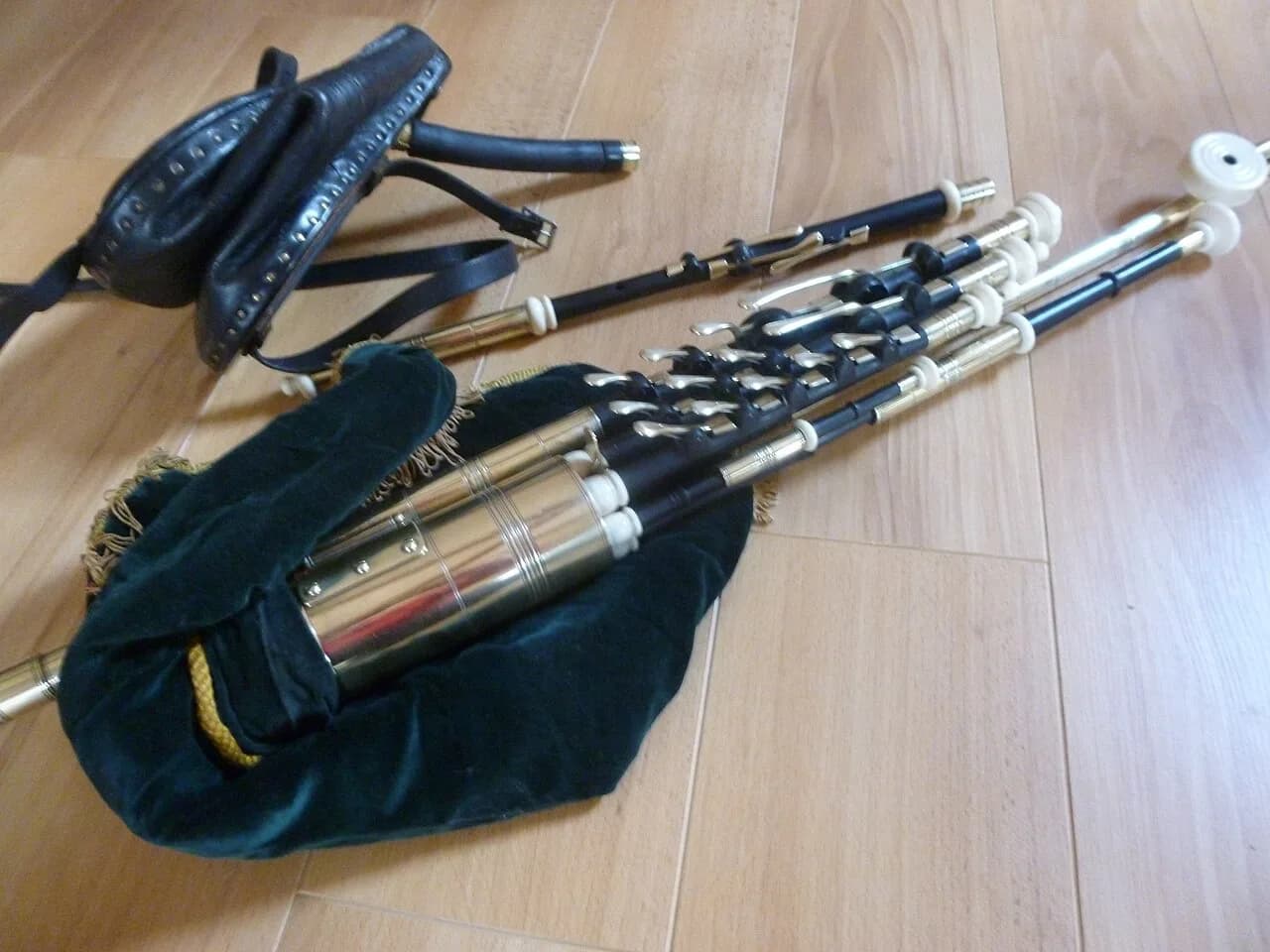
Irish uilleann pipes are the Irish form of bagpipe in which the bag is filled by bellows worked by the elbow rather than by a blowpipe. Na Píobairí Uilleann, the pipers' society founded in 1968, describes the distinguishing features as that bellows, a chanter with a range of two octaves instead of nine notes, and regulators, which are closed chanters that allow an accompaniment to the melody. These three things, rather than any single decorative detail, are what separate the instrument from older pipe types.
For a visitor, the pipes are easier to place in context than to see: they sit among the core instruments of Irish traditional music, alongside the fiddle, flute, whistle, accordion and concertina. The sounding instrument, not notation on a page, is what shaped the dance music of the 18th and 19th centuries. Understanding that helps when you meet the pipes in recordings, in session playing or in archival collections.
What Makes the Irish Pipes Different
The modern full set comprises the bag, the bellows and the chanter, plus drones and regulators. The chanter carries the melody across a range of two octaves, and the regulators are closed chanters that allow an accompaniment to the melody while the drones sound beneath.
Because the bellows fill the bag without the player's mouth, the instrument can be played seated, and that suits indoor and refined playing. Nicholas Carolan's essay for the Irish Traditional Music Archive notes that bellows pipes were adapted from mouth-blown types, that newer chanters were quieter and had an extended range, and that bellows pipes remained peripheral instruments in these islands, never played in great numbers.
How the Modern Set Accumulated Its Parts
The instrument was not designed in one moment. The tenor or small regulator was added in the last quarter of the 18th century; in 1790 it was still described as a recent addition not yet in general use. The middle and bass regulators followed in the first quarter of the 19th century, completing the regulator section familiar today.
That sequence is useful for readers who encounter antique sets or museum specimens: an older-looking instrument may simply predate part of the modern configuration. It is also the reason no single inventor can be named. Both the society's history and Carolan's essay treat the emergence of the Irish bellows pipe as a process of adaptation and experiment, not a patented invention.
Union Pipes, Uilleann Pipes: A Naming History
Before the 20th century the instrument was commonly called the union pipes, a term used in Britain, Ireland, North America and Australia. The earliest documented appearance of the phrase is a London newspaper advertisement of 5 May 1788 for a concert by Denis Courtney, an Irish piper performing there. The name therefore entered the record through an event in London, not Ireland.
Uilleann comes from the Irish for elbow, which refers to the bellows action. According to the society's history page, the term was put into circulation in 1903 by Grattan Flood, who tied it to a supposed earlier instrument and thereby gave it a false 16th-century pedigree. In other words, the naming history is not the same as the instrument's origin: Carolan's essay is explicitly about the history of the term, not a definitive account of how the instrument came into being.
Reading Earliest Pipe References Correctly
A topographical poem, Aonach Carman, an 11th-century composition preserved in the Book of Leinster, contains the earliest reference to bagpipes in Ireland, and pipe-playing is depicted on Irish High Crosses. Later 16th-century images, including a carved piper at Woodstock Castle in County Kilkenny, show pipes that the society describes as prototypes of the war pipes rather than of the uilleann pipes.
Those references and carvings document pipe-playing in Ireland at particular dates; the society presents the medieval and 16th-century instruments as earlier types or war-pipe prototypes, not as portraits of the bellows chanter and regulators, and the ITMA essay addresses wording rather than origins. Readers who want the full documented sequence can follow it on the society's history page and in Carolan's essay. This distinction belongs alongside the wider story traced in Irish music history through its instruments, where pipe, harp and fiddle each followed a different course.
Why the Design Matters to the Music
Irish traditional music is, in this tradition, a particular sound rather than a written score, and that sound was developed on the instruments in use. Dance music took shape in the 18th and 19th centuries when the pipes and the fiddle were the instruments of choice for popular music. A pipe tune is therefore built around the chanter's range and the regulators' chords, not adapted from notation.
That has a practical consequence for listeners: the same reel will sit differently on pipes than on a fiddle or flute, because the instrument's range and the regulators' capacity for punctuation constrain the setting. The AskAboutIreland portal carries recorded examples, including Johnny Doran performing reels on uilleann pipes and a fiddle set from Sliabh Luachra, which illustrate the contrast without requiring a venue visit.
Decline and Revival
Piping reached its height in pre-Famine Ireland. Afterwards, older dances gave way to quadrille-derived sets, and the pipes were displaced in popular use by the melodeon and concertina. By the late 19th century the society records that the instrument seemed fated to follow the harp into neglect, though the Gaelic League's revival, begun in 1893, brought native culture back into cultivation.
Pipers' clubs were founded in Cork in 1898 and Dublin in 1900, and competitions organised by Feis Ceoil and the Oireachtas helped surviving traditional players teach a new generation. The clubs did not outlast their first enthusiasm, though, and the decline resumed. By the 1960s very few people in Ireland played the pipes at all, which is the immediate background to the founding of Na Píobairí Uilleann in 1968.
Na Píobairí Uilleann and the Teaching Tradition
The Society of Uilleann Pipers was founded in 1968 by pipers themselves, with the aim of perpetuating the music and the making and maintenance of the instrument. Its central activity is teaching, especially to young people, because transmission through players is how the practice grows. The society also collects and preserves pipe music and researches the history of pipes and pipers.
That makes it a teaching body and a repository rather than a visitor attraction: it does not present itself as offering public tours, instrument displays or drop-in classes. Its value to a traveller is documentary and institutional, and it appears in the wider landscape of Irish musical instruments as one of the organisations that carried the tradition through its most fragile decades.
UNESCO Recognition and What It Records
On 7 December 2017, Uilleann Piping was inscribed on the UNESCO Representative List of the Intangible Cultural Heritage of Humanity, approved at the twelfth session in Jeju, South Korea. Ireland had ratified the 2003 Convention in December 2015, and this was the country's first application under it. The inscription concerns a practice, not an object: it recognises the knowledge and skills transmitted between players.
The application was led by the Department of Culture, Heritage and the Gaeltacht in partnership with Na Píobairí Uilleann, and the department's announcement names Scoil Samhraidh Willie Clancy and the Armagh Pipers Club among the contributing organisations. It also recalls pipers including Eamonn Ceannt, Willie Clancy and Seamus Ennis. The archive is a separate institution but holds related material, and the continuity of dance repertoire alongside piping is traced in Irish dance history.
A Practical Anchor: the Irish Traditional Music Archive
The Irish Traditional Music Archive at 73 Merrion Square, Dublin 2, is the most concrete stop for a visitor who wants to research the pipes rather than merely read about them. Its main reading room is open to the public five days a week, and no appointment is ordinarily needed. The catalogues and main collections are on the ground floor in the Special Collections Room. The surrounding square is itself worth a wander, as explained in this Merrion Square, Dublin: Georgian Square and Park Guide.
Reading-room hours are Monday to Friday, 10am to 1pm and 2pm to 5pm, with a lunchtime closure. The archive shuts for named annual state holidays, including the October bank holiday, and from 23 December until the first working day of the new year; on 26 October 2026, the October bank holiday, it is closed. Confirm the current listing before travelling, since hours and closures are the institution's own to set.
Wheelchair access is at the back of the building through the Fitzwilliam Place entrance, and a member of staff will help with access to the car park. Service animals are welcome in the main reading room with a permit. If you are part of a small group, have special requirements or want to speak to a particular staff member, phone ahead rather than arriving and hoping.
How to Use an Archive Visit Well
An archive visit is research, not a performance. Expect catalogues, recordings and documentary collections rather than a concert, an instrument display or a lesson; live music, instruments on show and teaching at the archive are not part of the published access arrangement. Decide in advance which question you want to answer, whether that is a piper's recordings, a tune's settings or the terminology history, and ask staff to point you to the relevant catalogue.
The terminology question is a good example: if you want to see how union pipes became uilleann pipes, the published essay is the starting point, and archive staff can help locate related material in the collections. Bring the exact name, date or recording you are chasing. Researchers who arrive with a specific query get more from a short visit than those browsing without a target.
Placing the Pipes Alongside Other Heritage
The pipes are one strand of a wider material and performance culture, and a trip built around them can be paired with the historic landscape without claiming a direct connection. Country houses and religious houses across Ireland belong to the same broad centuries as the instrument's development, and a guide to ancient sites in Ireland sets out places where that wider heritage can be seen. None of these sites displays pipes; they supply background, not a piping exhibit.
Plan Your Research Visit
Treat the uilleann pipes as an instrument to understand and a tradition to hear, not a monument to see. The starting facts are the bellows, the two-octave chanter and the regulators. The naming history is separate from the origin of the instrument. Historical milestones included the pipers' clubs of the 1890s, the founding of the pipers' society in 1968 and the UNESCO inscription of 2017.
Build any Dublin day around the archive's weekday hours, avoid the lunchtime closure, and remember the holiday shutdowns. Two checks decide whether the visit works: confirm opening hours and closures on the archive's own visit page, and phone ahead if you are bringing a group or expect to need staff help.
Explore more Ireland guides
Frequently Asked Questions
What are Irish uilleann pipes and how do they differ from other bagpipes?
They are the Irish form of bellows-blown bagpipe. The bag is filled by bellows worked by the elbow rather than a blowpipe, the chanter spans roughly two octaves, and regulators allow a chordal accompaniment to the melody. That combination, rather than any single ornament, distinguishes them from older pipe types.
Why are they called uilleann pipes rather than union pipes?
Union pipes was the common term before 1900, documented from a London concert advertisement of 1788 for the piper Denis Courtney. Uilleann comes from the Irish word for elbow, referring to the bellows action, and the pipers' society records that the term was put into circulation in 1903. The change of name is a terminology history, not evidence of when the instrument first appeared.
When did the modern full set take shape?
Gradually. The tenor regulator was added in the last quarter of the 18th century, and was still described in 1790 as a recent addition not yet in general use. The middle and bass regulators followed in the first quarter of the 19th century, completing the regulator section of the modern set. No single inventor is named.
Are the uilleann pipes recognised by UNESCO?
Yes. Uilleann Piping was inscribed on the UNESCO Representative List of the Intangible Cultural Heritage of Humanity on 7 December 2017, approved at the twelfth session in Jeju, South Korea. Ireland had ratified the 2003 Convention in December 2015, and the application was led by the Department of Culture, Heritage and the Gaeltacht with Na Píobairí Uilleann.
Can you see or hear uilleann pipes at the Irish Traditional Music Archive?
The archive is a research institution with a public reading room, not a performance venue or instrument display. What it offers is access to catalogues and collections, including documentary material relating to the tradition, so a visit suits someone with a specific question. Do not travel expecting concerts, lessons or pipes on show.
Do you need an appointment to use the ITMA reading room?
No appointment is ordinarily needed to access the archive, whose main reading room is open five days a week. Phone ahead if you are part of a small group, have special requirements or want to speak to a particular staff member. Wheelchair access is through the Fitzwilliam Place entrance at the back of the building.
Sources
- History
- 37221-ART-PDF.pdf
- UNESCO in tune with Uilleann Piping - Madigan ... Josepha Madigan TD, Minister for Culture, Heritage and the Gaeltacht is delighted today (Thursday 7 December) to announce that Uilleann Piping has been inscribed on the UNESCO Representative List of the Intangible Cultural Heritage of Humanity.
- Instruments
- ITMA — Visit (https://www.itma.ie/visit/)
You might also like



Continue reading
More guides you'll find useful





