
Irish Saints: Monastic Sites Where Their Traditions Survive
Irish saints are best understood through the monastic landscapes linked to them. See what Glendalough, Clonmacnoise, Kilmacduagh and Killamery document.
On this page
Irish saints are best encountered not as biographies but as traditions anchored to specific landscapes: a valley monastery, a Shannon foundation, a Burren tower, a carved cross near ruinous walls. The Office of Public Works cares for several of the monuments described here, and the heritage record distinguishes what survives in stone from the founding stories told about it. This guide sits within the wider set of irish pilgrimage sites worth planning around. Before you build an itinerary, note that Clonmacnoise is fully closed to visitors from 19 October until January 2027, so that stop cannot be included in the period as it stands.
How to read a founding tradition
At these sites the visitor is given two different kinds of information. One is tradition: the founder, the sign or the angel, the prayer or the reputation. The other is fabric: a leaning tower, a carved face, a line of graveslabs. Good reading of a saint site keeps the two in view without merging them, so the legend explains why people came while the stonework shows what they actually built and used.
That habit has a practical side too. Where a heritage record names an alternative account, or admits uncertainty, it is doing useful work rather than failing to decide. Treating recorded alternatives as alternatives lets you ask a better question on site: not which version is secretly true, but what each version tells you about the community that preserved it.
Glendalough and St Kevin
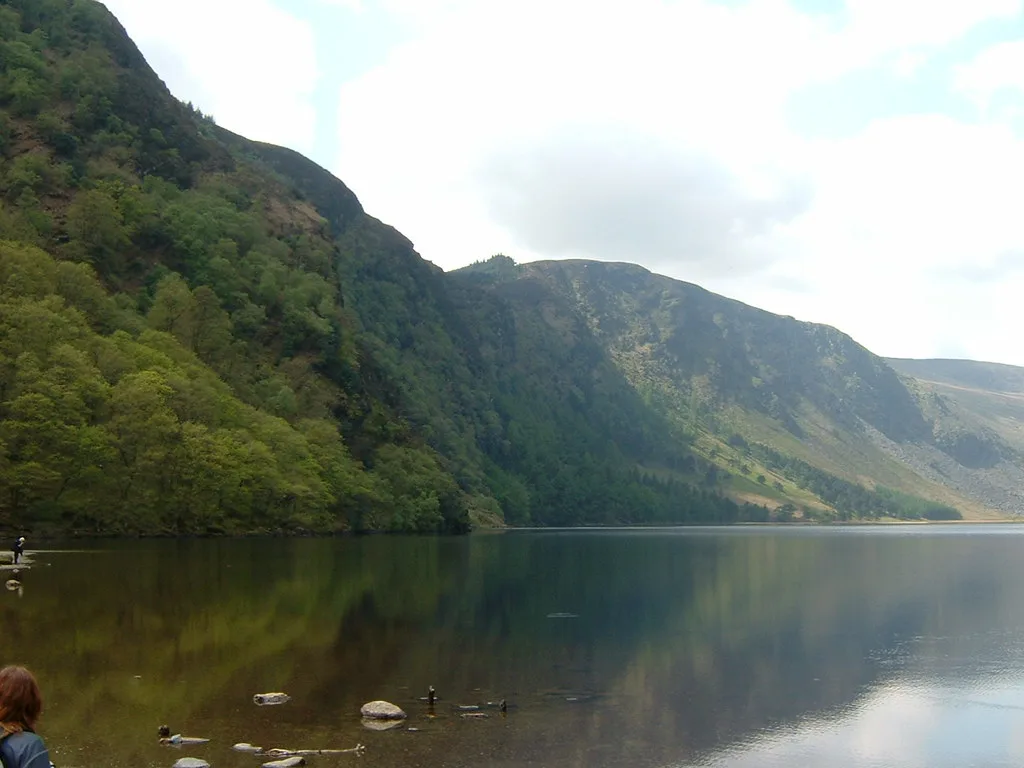
Glendalough sits in a glaciated valley in County Wicklow, where, in the sixth century, St Kevin founded a monastery that became one of Europe's most renowned religious centres. The remains of the Monastic City are dotted across the glen and include a superb round tower, several medieval stone churches and decorated crosses. Visitors expecting a single compact ruin instead meet a dispersed landscape that rewards slow movement between its parts. For a comparable carved landscape elsewhere, see Monasterboice.
St Kevin's Bed is the feature most likely to prompt a story. It is a small man-made cave in the cliff face above the Upper Lake, and the tradition that Kevin lived and prayed there is recorded alongside the suggestion that it may actually be a prehistoric burial place that far predates him. The heritage record does not present the cave as something to climb to, so treat the tradition as a story about a feature whose original purpose may be quite different.
Glendalough visitor practicalities
The interpretive centre is the logical starting point if you want the site explained before walking it: its facilities include an exhibition, museum, bookshop and guided tours. The centre is fully accessible for visitors with disabilities, but access to the graveyard is very difficult for wheelchair users, so accessibility should not be assumed for the wider site or the lake paths. Plan the order of your walk around the interpretation first.
Glendalough is open all year, with the site closed 23 to 29 December inclusive, and the recorded average visit is one to one and a half hours. During the shorter daylight season from 15 October to mid March it opens 09:30 to 17:00 daily with last admission at 16:15; from mid March to 14 October hours run 09:30 to 18:00 with last admission at 17:15. During both seasonal blocks, last admission to buildings and toilets falls 45 minutes before closing. Toilets at the Upper Lake car park are run by Wicklow County Council rather than the OPW, so their availability is separate from the visitor centre.
Clonmacnoise and St Ciarán
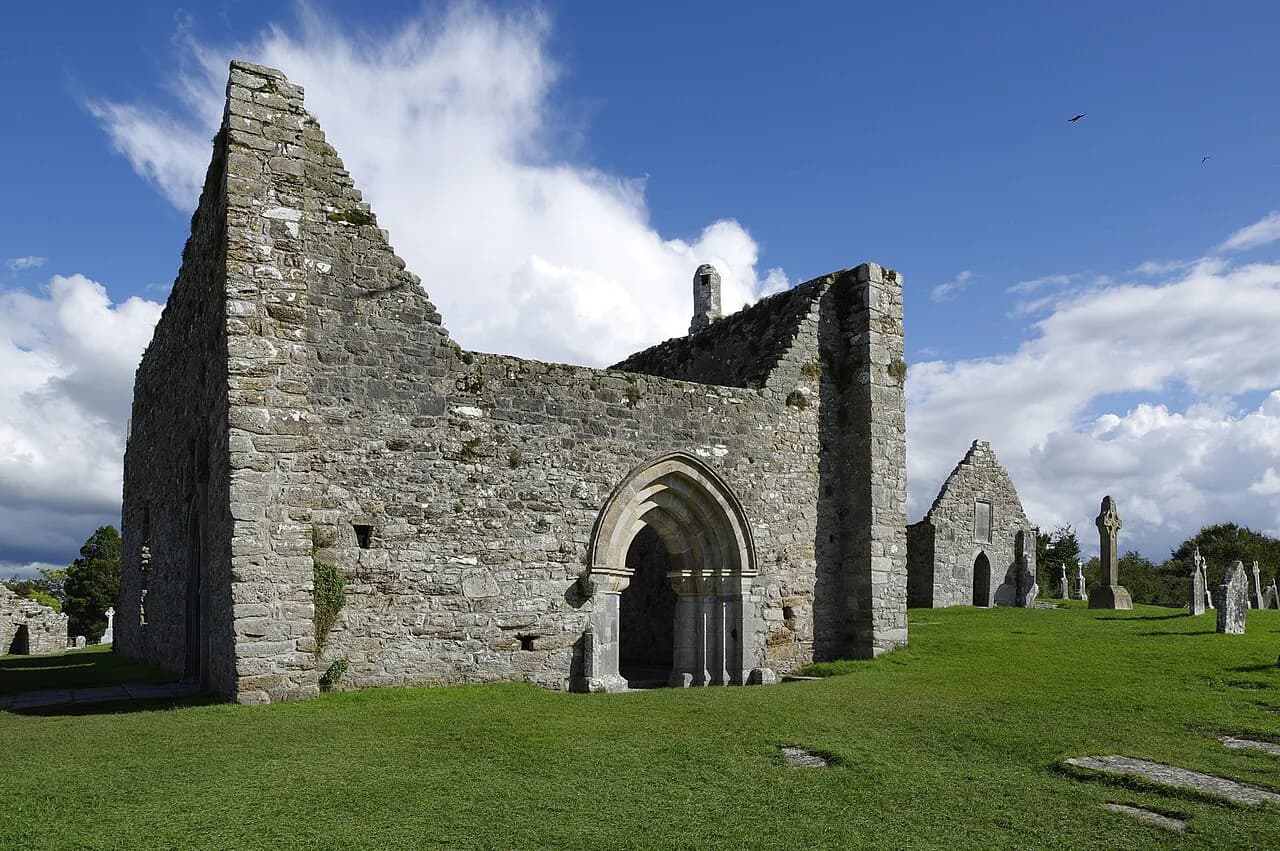
St Ciarán founded his monastery on the banks of the River Shannon in the sixth century, and it flourished into a great seat of learning that drew students from across Europe. The ruins document that scale: a cathedral, two round towers, three high crosses, nine churches and more than 700 Early Christian graveslabs. That variety means you should expect a large enclosure rather than a single celebrated building, and give the graveslabs as much attention as the towers.
The wider story of early Irish church building is easier to read once you have seen Clonmacnoise's towers and carved crosses together, so note which features belong to which period before you return when the site is accessible again.
Clonmacnoise is currently closed: check before planning
Heritage Ireland publishes a dated notice stating that Clonmacnoise Monastic Site is fully closed to visitors from 19 October until January 2027, because the contractor requires the car park to close and there will be no safe access to the site. This is not a seasonal hours adjustment, so do not treat the site as reachable during that window. Reopening should be confirmed against the notice rather than assumed for any particular day in or after January 2027.
The same source records a signed contract for a major redevelopment of the Clonmacnoise visitor centre and states that the monastic site would remain open during construction, with temporary toilets and a welcome hub in place. That earlier arrangement has since been overtaken by the dated full-closure notice above, so treat both facilities and access as things to verify immediately before travelling rather than details settled long in advance.
Where Clonmacnoise's high crosses actually are
The original high crosses, including the magnificent tenth-century Cross of the Scriptures, are displayed in a purpose-built visitor centre beside the monastic enclosure rather than left exposed outdoors on the site. If you are going to see carved stone, the crosses belong to the indoor display, and an audiovisual presentation gives context for the monastery before you walk the enclosure. That distinction matters once the site is accessible again, since the open ruins and the exhibited originals are two different parts of one visit.
Kilmacduagh: two founders, one tower
Kilmacduagh is a state-owned National Monument in the care of the Office of Public Works, founded in the seventh century, and its origin is recorded in two different accounts rather than one. In the first, St Meadoc is guided by an angel to go there to heal the King of Connaught, Guaire Mide Mac Colmáin, who then has the monastery built in his honour. In the second, Colmán Mac Duagh founded it after his belt fell to the ground and he read the fall as a sign of the chosen place. Both accounts are preserved as recorded traditions, and neither should be presented as settled history. If you are comparing monastic foundations, the same distinction between tradition and fabric applies at ancient sites in Ireland such as Glendalough and Clonmacnoise.
The seven-storey round tower is the site's most striking element at 34.3 metres, and it leans noticeably; the OPW restored it twice, in 1878 and again in 1971. Around it, the enclosed settlement comprises St John's Church, possibly twelfth-century, the abbot's house, thirteenth-century O'Heynes Church, the Cathedral, and St Mary's Church across the road, likely from the early 1200s. The site sits at the edge of the Burren and is associated with the O'Heynes and O'Shaughnessey families, and much of the fabric was damaged in the medieval battles recorded there.
Killamery High Cross and St Gobán Fionn
Killamery High Cross is a state-owned National Monument and a ninth-century work of art standing 3.65 metres tall, near monastery ruins reputedly founded by St Gobán Fionn in the early seventh century. Its value for a saint-focused visit lies in what is carved rather than what is claimed: geometric ornament and biblical scenes spread across both faces and the arms. The site also holds two cross-slabs, a stone cross, the ruins of the original church and two bullaun stones, one cross-slab carrying an incised Latin cross and inscriptions praying for the soul of Aedhán.
Read the faces in order and the cross becomes legible. The west face shows a stag hunt, a chariot procession and panels possibly depicting the Lord sanctifying the Seventh Day with Adam and Eve; the northern arm has four scenes likely from the life of St John the Baptist; the southern arm features Noah's Ark. The east face, with three marigold designs around a central boss of intertwining serpents and an open-mouthed dragon, is known as the Snake-Dragon Cross, and an inscription is interpreted as a prayer for the High King Maelsechnaill.
Patrick's Confessio: first-person text and later tradition
Patrick offers a useful control case because a text in his own voice survives. The Confessio opens with his account of being taken captive at about sixteen, and the translation notes state plainly that his exact dates are uncertain. The familiar 432 for his arrival and 461 for his death are often-used dates rather than established certainties, so treat them as labels used for convenience, not as firm anchors for a travel itinerary.
Reading a first-person account beside the founding legends at these monasteries shows how differently saint traditions behave. Patrick describes his own capture and mission, while the traditions at Glendalough, Clonmacnoise and Kilmacduagh arrive attached to places and to later communities. Nothing in the heritage records suggests Patrick founded or visited any of these monasteries, and he should not be inserted into their stories.
Guided versus unguided: matching site to expectation
The four landscapes do not offer the same kind of visit. Glendalough has a staffed visitor centre with exhibition, museum, bookshop, guided tours and toilets, which makes it the easiest place to begin if you want interpretation as well as ruins. Kilmacduagh and Killamery are unguided National Monuments, where you walk uneven ground yourself and no guides, tours, ticketing or indoor facilities are recorded, so the care you exercise is part of the visit. For the same contrast between staffed and unstaffed sites, compare the castles in county galway.
Both unguided sites carry an explicit warning that visitors should maintain care and caution, and that the OPW will not be held responsible for damage, injury or loss. Wear footwear that handles uneven ground and avoid climbing carved stone or ruinous walls. Glendalough's record specifies dogs on a lead; confirm any local rules on site rather than assuming them. If your group includes someone with limited mobility, Glendalough's accessible centre is the realistic choice among these four.
Plan Around What Each Site Allows
Choose your sites by what you want to see rather than by a single list of saint names. Carved evidence points to Kilmacduagh's leaning tower and Killamery's panels and inscription; interpretation and accessibility point to Glendalough; Clonmacnoise's crosses wait in a visitor centre that is currently unreachable under the closure notice. If your interests run to secular stonework too, keep a separate list of castles in county galway such as Athenry, Aughnanure and Portumna. Confirm hours and closures directly on Heritage Ireland before booking anything around them.
Explore more Ireland guides
Frequently Asked Questions
Where can I see places connected to Irish saints?
The heritage record documents monastic landscapes rather than biographies. Glendalough in County Wicklow and Clonmacnoise on the Shannon are linked to St Kevin and St Ciarán respectively, Kilmacduagh is linked to St Meadoch and Colmán Mac Duagh, and Killamery High Cross stands near ruins reputedly founded by St Gobán Fionn. Each site's own record explains what survives and what is tradition.
Is Clonmacnoise open to visitors now?
No. Heritage Ireland states that the site is fully closed to visitors from 19 October until January 2027, because the car park must close and there would be no safe access. The notice does not name a reopening day, so check the Clonmacnoise page before planning any visit in or after January 2027.
Why do sources give two different founders for Kilmacduagh?
The site's record preserves two accounts. One has St Meadoch guided by an angel to heal the King of Connaught, who then builds the monastery in his honour. The other has Colmán Mac Duagh founding it after his belt fell to the ground as a sign. Both are recorded traditions, not a single settled version.
Are the high crosses at Clonmacnoise outdoors?
The originals, including the tenth-century Cross of the Scriptures, are displayed in a purpose-built visitor centre beside the monastic enclosure rather than left exposed on the open site. The enclosure itself holds the cathedral, round towers, churches and graveslabs, so the crosses and the ruins form two parts of one visit.
What is St Kevin's Bed and is it what it claims to be?
It is a small man-made cave in the cliff face above the Upper Lake at Glendalough. Tradition holds that Kevin lived and prayed there, but the heritage record notes it may actually be a prehistoric burial place that predates him. Treat the saint connection as a story attached to the feature.
Can I visit Kilmacduagh and Killamery without a guide?
Yes, both are unguided National Monuments, so there is no guide, tour or indoor facility. Their records warn that visitors must maintain care and caution, and that the OPW accepts no responsibility for injury, damage or loss. Expect uneven ground and take sensible footwear.
Is Glendalough accessible for wheelchair users?
The visitor centre is described as fully accessible, but access to the graveyard is very difficult for wheelchair users. Accessibility should not be assumed for the wider site or the lakes. Toilets at the Upper Lake car park are operated by Wicklow County Council, not the OPW.
Sources
You might also like



Continue reading
More guides you'll find useful



