
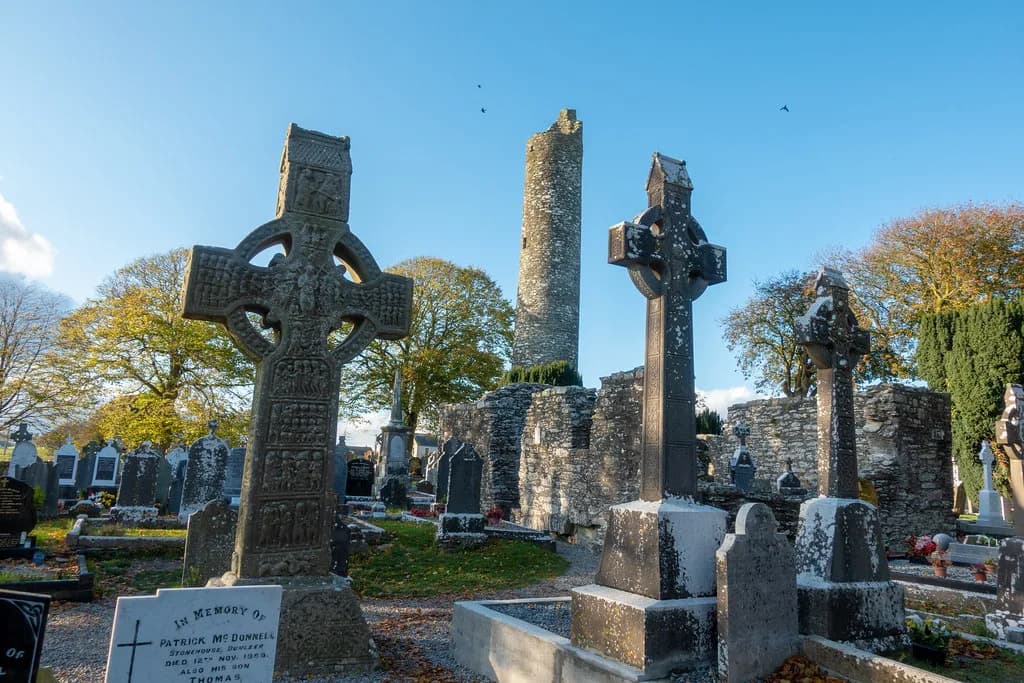
Monasterboice: High Crosses, Round Tower and Monastic Ruins
Monasterboice in County Louth holds three high crosses, a broken round tower and two church ruins. Here is how to read the stones and plan a visit.
On this page
Monasterboice is a late fifth-century monastic foundation in County Louth, set in open ground north of Drogheda and close to the M1. Its Irish name, Mainistir Bhuithe, means the monastery of Buithe, and the site is best known for three carved high crosses, a round tower and two ruined churches.
Allow more time than the size of the enclosure suggests. The crosses are outdoor sculpture rather than museum objects, and the graveyard around them is still in use, so the visit works best as a slow walk among stones that need to be read face by face.
Where Monasterboice Sits in County Louth
The site lies just west of the M1 and about eight kilometres from Drogheda, so it is easy to slot into a drive through the Boyne Valley. The monument itself stands across a minor road from the car park, and the paths around the ruins are level but gravel-covered.
That geography matters for planning. Because the ruins sit across a minor road from the car park rather than inside a visitor complex, there is no long approach walk and no separate exhibition to absorb first. You arrive, cross the road and are immediately among the stones.
For anyone assembling a wider itinerary of monastic remains and other irish pilgrimage sites, this is one node among many rather than a standalone attraction. It rewards attention to carving rather than to scale, which places it naturally alongside other early Christian and pilgrimage stops on the island.
From St Buithe to Mellifont: A Short History
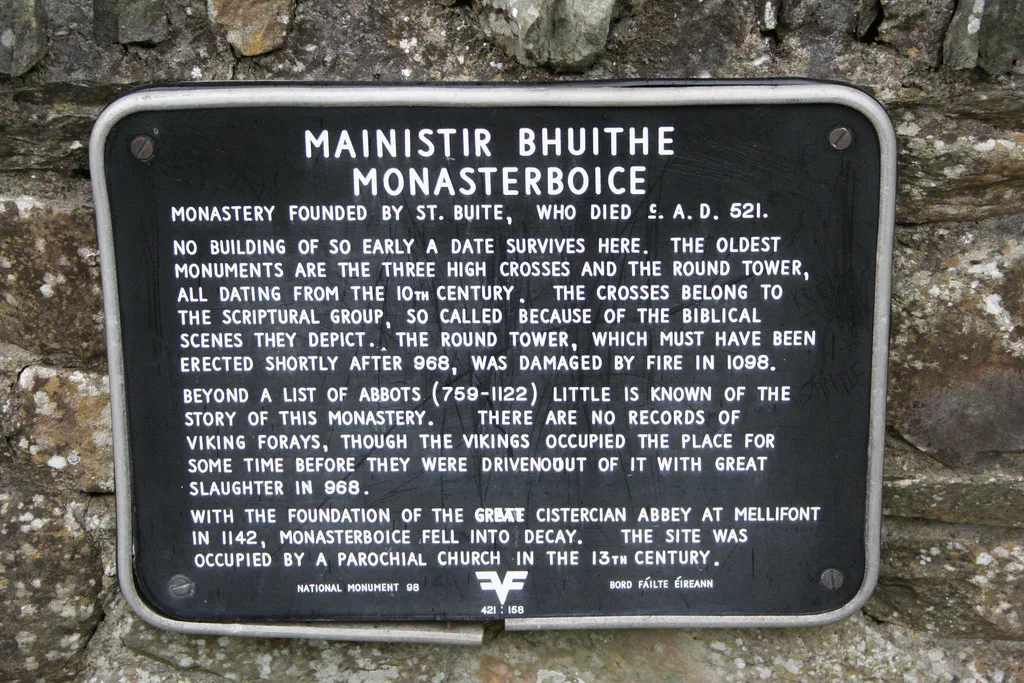
Monasterboice was founded by Saint Buithe, a follower of Saint Patrick, towards the end of the fifth century, and it grew into an important centre of religion and learning. The founding is treated as a tradition of that era rather than a dated event, so no precise year should be expected.
Vikings captured the settlement in 968, and Donal, the High King of Tara, defeated them there. The round tower is generally placed shortly after that conflict, which makes the standing tower a monument of the monastery's recovery rather than of its earliest phase.
Annals record that the tower was burned in 1097 along with the monastery's books and treasures, a detail that explains why the tower is associated with storage as well as bells. The monastery's importance then faded after Cistercian monks founded nearby Mellifont Abbey in 1142.
Buithe belongs to the wider cast of irish saints whose foundations are scattered across the country, and his site is one of the more legible places to meet that tradition on the ground. Reading the cross and tower here alongside that broader context makes the individual carvings easier to place.
A Graveyard, Not a Monument Park
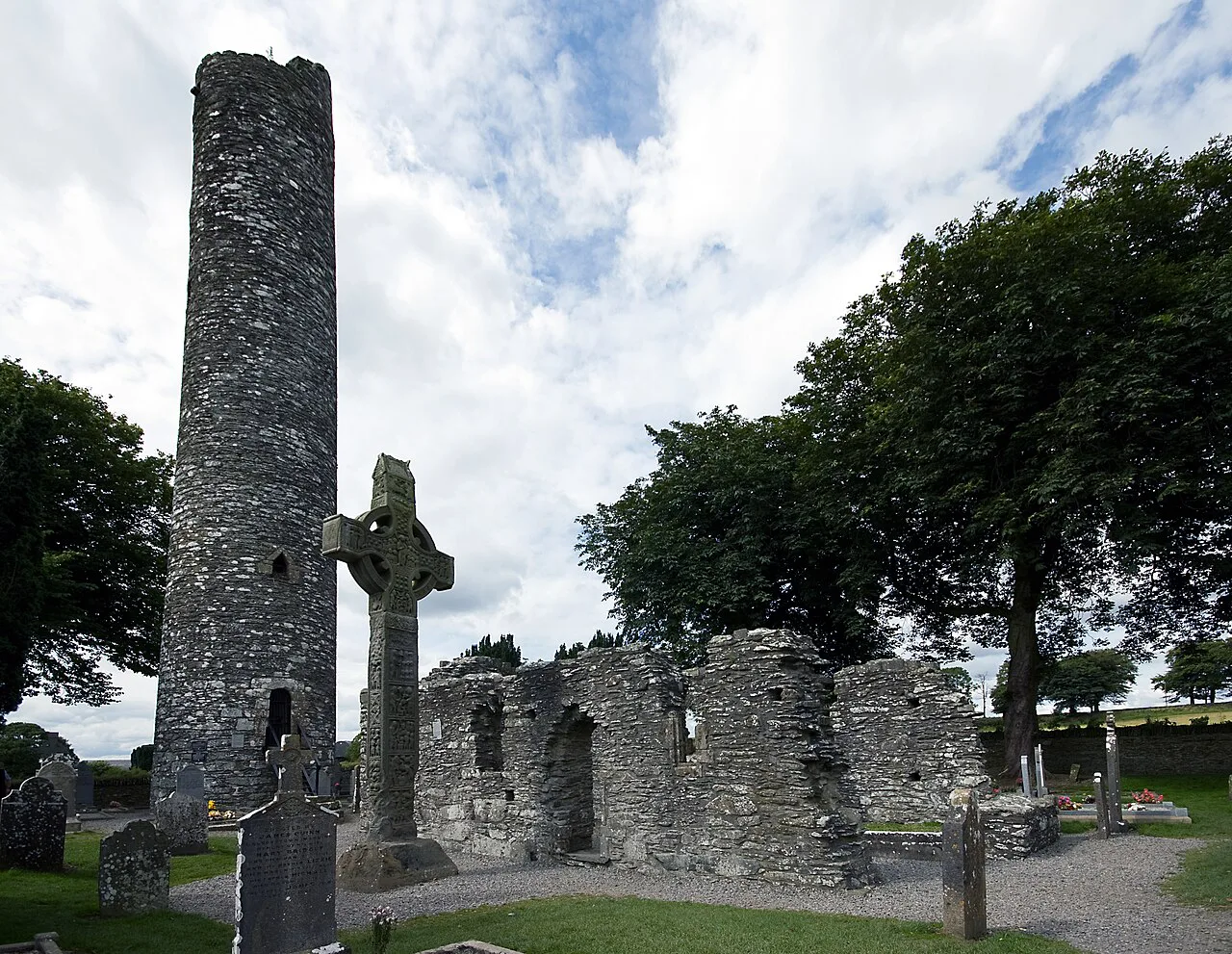
The ruins stand inside a graveyard, and that setting governs how the visit feels. Headstones crowd around the churches and crosses, and the ground is consecrated and in active use, so the site asks for quiet movement and no clambering over graves to reach carvings.
Practically, this means choosing your route with care. Paths loop around the enclosure, but the space between stones is not a viewing platform, and photographers should work from the paths rather than stepping onto grave slabs or the decorated bases of crosses.
The Round Tower: Broken Top, No Ascent
The round tower at Monasterboice is tall, though its cap is missing and its top is broken, which gives it a truncated silhouette against the sky. Its doorway faces east and sits well above ground level, reached by a ladder in early designs of this kind.
That raised entrance had a purpose: a ladder could be pulled in to make the tower harder to enter during raids. A field visitor recorded the doorway gate as padlocked, with apparently no public access to the interior, so the tower should be understood as something to look at, not to climb.
Reading it as a bell tower and secure store, rather than as a defensive castle, fits both the archaeology and the annals of the 1097 fire. Its scale is best judged from ground level, with the church ruins and a cross in the frame to give proportion. Round towers across the country follow similar logic, and comparing several sharpens the eye.
The Two Church Ruins
Two ruined churches survive. The North Church measures roughly ten by five metres, while the South Church, sometimes called the Great Church, is slightly larger at about eleven by six and a half metres, and both are aligned east-west.
Apart from outer walls, little remains of either building, so there is no interior to explore and no roof to shelter under. Visitors looking for indoor interpretation will not find it here, and the churches read best as footprints that show the layout of the monastic complex.
Dating is not uniform across sources: the churches are generally described as fourteenth-century or later, while the South Church is linked in tradition to destruction by fire in 1097. Treat the masonry as a palimpsest rather than a single building campaign.
Muiredach's Cross and Its Prayer Inscription
Muiredach's Cross is the reason many people come. Its surfaces are densely carved with scriptural scenes, and a prayer inscribed on the lower shaft asks for prayer for Muiredach, under whose auspices the cross was made. That inscription is the firmest evidence for the cross's patronage.
Which Muiredach is meant has been debated. An abbot of that name died in 923, but a king called Muiredach mac Cathail, who died around 867 and held land near the monastery, has also been proposed, so the cross should not be tied too firmly to a single patron.
Height figures differ between accounts. Tourism and travel texts give an overall height of about five and a half metres, while a measured stone description records a cross about four metres tall on a base of roughly one metre, giving a total near five metres.
Comparisons with other carved crosses, such as the killamery high cross, are useful for understanding technique rather than for ranking sites. The panels here are often described in enthusiastic terms, but the honest visitor experience is of outdoor stone whose legibility varies with light and weather.
How to Read the Panels Without Touching Stone
The carvings are didactic: they tell biblical stories to viewers who could not read, so the panels are best approached as a sequence rather than as ornament. Sources identify scenes including Adam and Eve, Cain and Abel, Moses striking the rock, the Nativity with the Magi, and the Crucifixion.
On the east face, one reading finds the Last Judgment, with Saint Michael weighing souls and a devil seizing the wicked; the west face points toward the Crucifixion. Smaller details, such as two cats on the base, reward close looking at eye level.
Keep a working distance. Touch, whether deliberate or from resting a hand while leaning in, wears carved faces over time, and the lower shaft of the Tall Cross is visibly worn, most likely from years of handling. Binoculars or a zoom lens give detail without contact.
The Tall Cross and the North Cross
The Tall Cross, also called the West Cross, is the tallest high cross in Ireland. Its measurements are given as nearly seven metres overall in one account and about six and a half metres in a measured description, so the precise figure should be treated as unsettled. For context on other carved stones, see these Irish high crosses.
Because of its size it carries more carved panels than most Irish high crosses, and its lower shaft shows heavy wear. Where Muiredach's Cross retains clear detail, the Tall Cross makes the conservation problem visible, which is part of why the pair is worth comparing side by side.
The North Cross is quieter: its carving is comparatively minimal, and it stands in a fenced area near the north-east corner of the site. Fragments nearby include part of a medieval sundial the monks used to tell the time.
For travellers working through several high crosses ireland keeps in open ground, this trio offers a compact lesson in scale and preservation. Similar comparisons appear across the country, and a smaller cross elsewhere makes an instructive counterpoint.
Access, Facilities and What to Confirm
Paths around the site are level but gravel-covered, and Tourism Ireland describes wheelchair access on those gravel paths along with a car park and toilets. Travel accounts note that some ground can still be difficult for wheelchair users, so the access statement should be read as general rather than absolute.
Facility information comes from tourism listings and from dated accounts of individual visits, so hours and on-site services should be confirmed before setting out rather than assumed. Staffed presence has varied: one 2017 account found seasonal guides available, while a later visitor saw no staff at all, so tours should not be expected.
The car park sits across a minor road from the ruins and was described by an earlier visitor as free, but that is an observation from a past trip, not a standing promise. Check current arrangements with the operator if access or parking is essential to your plan.
Stewardship and the Fragility of Carved Stone
The Office of Public Works is responsible for the site, and an information panel explains the carvings on Muiredach's Cross. Reports of vandalism against the monuments underline that these are irreplaceable objects exposed to weather and to people, with no roof or glazing to protect them.
The weathered state of the Tall Cross is the clearest argument for restraint. At other sites, crosses have been sheltered or moved indoors, a trade-off between protection and the atmosphere of seeing them in place; Monasterboice keeps its crosses outdoors.
Understanding the site as part of a wider early Christian landscape helps visitors treat it with the care it needs. The stones document a religious community rather than decorating a park, and that framing is the best guide to behaviour on the ground.
Plan Your Visit
Monasterboice suits a focused stop of about forty-five minutes to an hour, with more time if you want to study the crosses panel by panel. Prioritise Muiredach's Cross, then the round tower and the Tall Cross, and finish with the quieter North Cross and sundial fragment.
Combine it with the wider Boyne Valley rather than treating it as a destination in itself, and check current facilities before travelling. The effort of slow looking, at a respectful distance, is what the site rewards most. For another heritage guide, read about Kilmacduagh, and if your itinerary runs west, compare these monastic ruins with the castles in county galway; for earlier monuments of the same landscape, the ancient sites ireland guide covers the tombs and trackways of the Boyne area.
Explore more Ireland guides
Frequently Asked Questions
What is Monasterboice best known for?
It is best known for its three high crosses, especially Muiredach's Cross with its dense biblical carvings, together with a broken-topped round tower and two ruined churches in a graveyard setting.
Can you climb the round tower at Monasterboice?
No. The doorway is set well above ground and gated, and no public access to the interior has been recorded. The tower is an outdoor monument to view from the enclosure.
How tall is Muiredach's Cross?
Accounts differ. Tourism and travel texts give roughly five and a half metres overall, while a measured stone description records about four metres of cross on a base of roughly one metre.
Is there wheelchair access at Monasterboice?
Tourism Ireland describes wheelchair access to the gravel paths, which are level. Some visitors have found sections difficult, so it is worth checking current conditions before relying on that.
Are there toilets at Monasterboice?
Tourism Ireland lists toilets as a facility, but such details come from general listings and dated visits. Confirm on-site services before travelling if they matter to your group.
Why did Monasterboice decline after 1142?
Cistercian monks founded nearby Mellifont Abbey in 1142, and Monasterboice's importance faded as the new foundation took over the region's religious role.
Is Monasterboice still a cemetery?
Yes. The ruins stand within an active graveyard, so visitors should keep to paths, avoid stepping on graves and behave accordingly.
Sources
You might also like



Continue reading
More guides you'll find useful



