
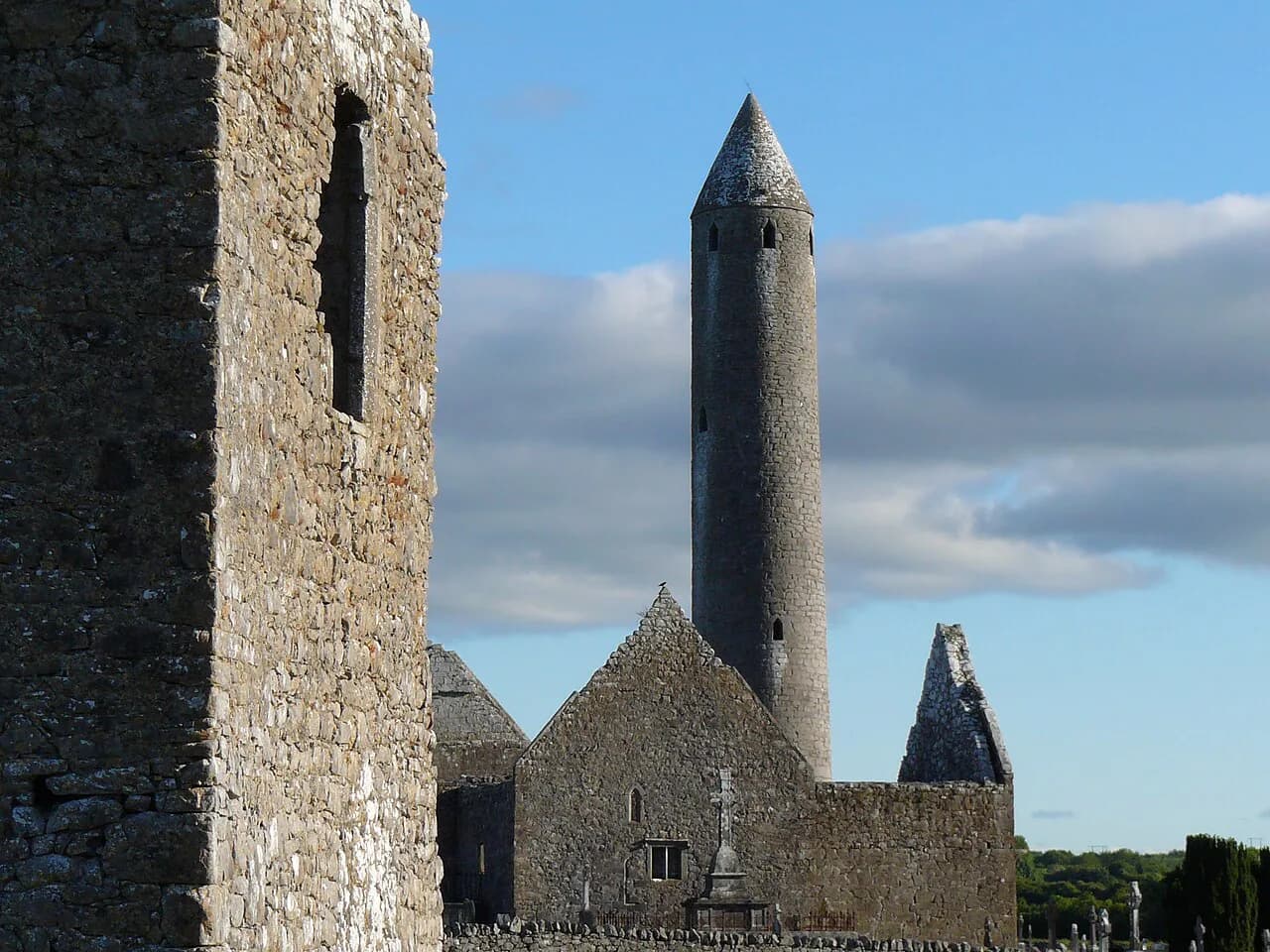
Kilmacduagh Monastic Site: Visitor Guide to the Leaning Tower
Kilmacduagh is an unguided OPW National Monument at the Burren edge. Read its leaning round tower, cathedral, churches and how to plan a careful visit.
On this page
Kilmacduagh is a state-owned National Monument in the care of the Office of Public Works, standing at the edge of the Burren in west-central Ireland. It is unguided, so a visit means walking among standing ruins and a graveyard rather than joining a museum tour, and the Office of Public Works asks visitors to take care throughout.
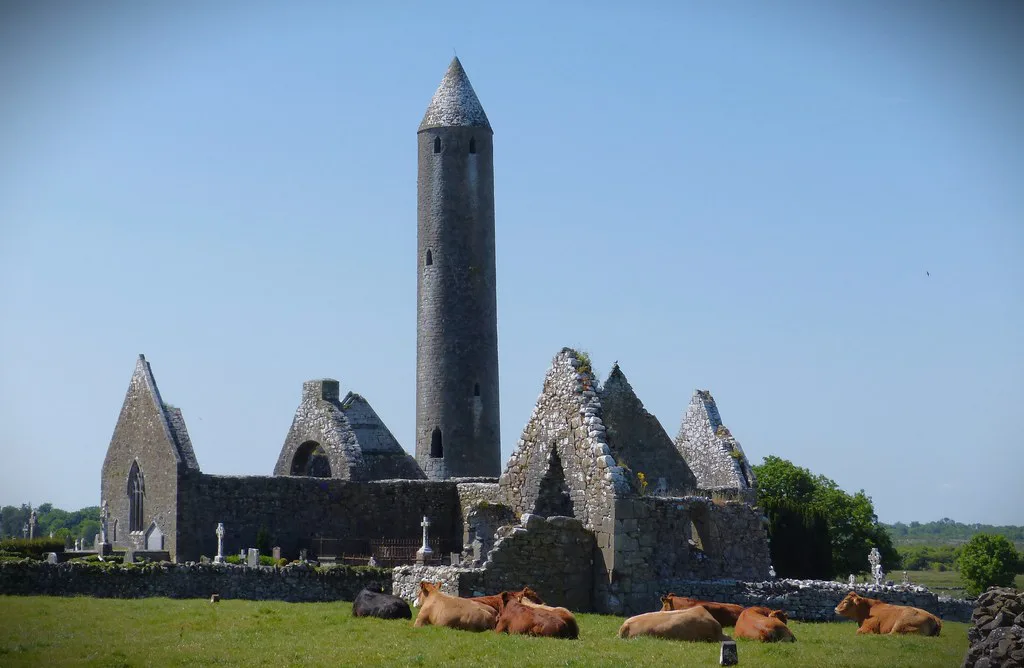
The site lies roughly halfway between Galway and Ennis and just outside the Burren, which makes it a practical stop for travellers already moving through that part of the west. The draw is the round tower and its pronounced lean, but the enclosure around it holds a cathedral, several churches and an abbot's house that repay a slower look.
What Kilmacduagh Is and Where It Sits
Heritage Ireland describes Kilmacduagh as an enclosed settlement made up of multiple buildings rather than a single ruin. That matters for planning: you are reading a small monastic landscape, not queueing for one viewpoint, and the tower is only the most conspicuous element within it. For mapped detail on the individual structures, the Historic Environment Viewer is the reference the official page points readers to.
The Burren-edge setting shapes the visit. An independent account places the site just outside the national park and reports informational signs at the car park entrance. Treat that as a reported observation rather than a guarantee of interpretation on any given day.
Because the monument is unguided, there is no staffed route through the buildings. Expect uneven ground, low walls and gravestones, and be ready to interpret the ruins yourself; the OPW notice sets that expectation clearly.
The Leaning Round Tower
Heritage Ireland gives the tower as seven storeys and 34.3 metres in height, and calls its lean significant. Other accounts put the height nearer 112 to 120 feet, so treat any single figure as approximate rather than surveyed.
The local heritage-trail page describes the lean as roughly two feet from the perpendicular. That is best repeated as an impression rather than a measured engineering value; the effect is obvious on approach and is what most visitors remember.
The tower has been repaired at least twice, in 1878 and again in 1971 according to Heritage Ireland. Comparing it with other Irish round towers helps: they share a basic form, but the surviving details and surviving tilts differ from place to place.
Reading the Enclosure Building by Building
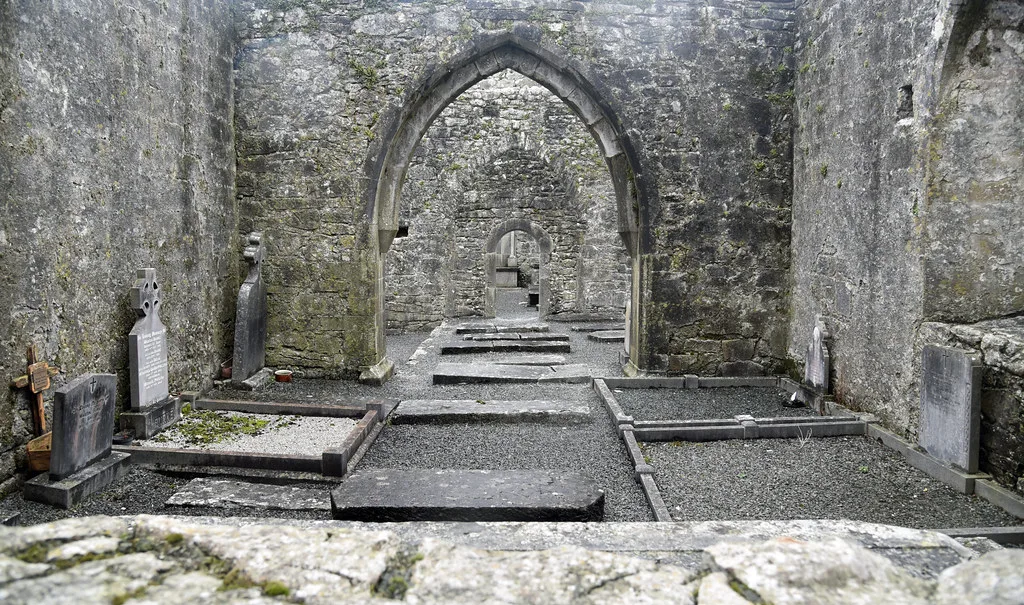
The Cathedral is the principal structure in the group. The local trail page notes that its oldest surviving portion is the west gable, with later additions including a south transept and the O'Shaughnessy Chapel. Walking the exterior walls in sequence gives a clearer sense of how the complex grew than trying to absorb it all at once.
Heritage Ireland lists St John's Church, possibly twelfth-century, O'Heynes Church from the thirteenth century, and St Mary's Church across the road, likely from the early 1200s. The abbot's house stands within the group as well, a reminder that this was an administrative as well as a devotional centre.
The trail page adds further named fragments, including Teampaill Mhuire and Teampaill Beg Mac Duach. Knowing the individual names helps you read the site as a cluster of separate buildings rather than one undifferentiated ruin.
Founding Traditions and St Colmán Mac Duagh
Heritage Ireland records two differing accounts of the monastery's origin, both presented as tradition. One tells of St Meadoc being guided by an angel to Kilmacduagh to heal the King of Connaught, Guaire Mide Mac Colmáin, who then had the monastery built in his honour.
The second credits Colmán Mac Duagh, who saw his belt fall to the ground as a sign that this was the place to build. The local trail page dates a land grant by his kinsman King Guaire to around 610 and places Colmán's death in 632, treating both as received tradition rather than documented record.
The same page sketches his early life in Aran and as a hermit in the Burren, and links him to holy wells bearing his name. For wider context on the figure and his cult, the collection on irish saints sets founders like him within the broader story of Irish monasticism.
Local Families and Thirteenth-Century Upheaval
Heritage Ireland associates Kilmacduagh with two local families, the O'Heynes and the O'Shaughnesseys, whose names recur in the buildings. Seeing the site through those families gives substance to structures that otherwise read only as stone shells.
Much of the site was damaged over the centuries in conflict, according to the official account. It describes the thirteenth-century King of Connaught, Cathal Croibhdhearg O'Conor, fighting his nephew Cathal Carrach O'Conor with Anglo-Norman allies on both sides, and Walter de Burgh, first Earl of Ulster, seizing the territory of Uí Fiachrach Aidne for his sons.
The wider early Christian landscape helps explain why a site like this mattered enough to be contested. For comparative background on how monasteries were founded, endowed and fought over, early christian Ireland is useful reading before or after a visit.
The Seven Churches Name and the Graveyard
The ruins are often called the Seven Churches locally, a popular name rather than a confirmed count of seven surviving buildings. Use it as shorthand and count the identifiable structures for yourself.
The graveyard remains part of the site's character. The trail page states that the cemetery contains the grave of St Colmán, patron of the diocese, but that identification rests on local tradition rather than archaeological verification, so treat it as a devotional attribution.
Graveyards like this sit within a wider pattern of Irish religious landscapes. The collection on irish holy wells is a helpful companion if you are following the saints' trail through the west rather than stopping at one monument.
Restoration and the Gregory Connection
The tower's modern history owes something to Sir William Gregory of Coole Park, Gort, who according to the trail page wrote from Ceylon in 1872 about restoring it and later agreed to finance the work. The Board of Works carried out restoration, including the cap and a lightning conductor, in 1878 and 1879 according to the trail page; Heritage Ireland gives the year simply as 1878.
A second repair followed in 1971, which is part of why the tower presents as a maintained monument rather than a bare ruin. That sequence of nineteenth- and twentieth-century care explains the surviving cap and much of the site's present condition.
For readers tracing early Christian building in Ireland more broadly, Monasterboice offers a useful comparison for how different sites were conserved and presented to visitors.
Planning a Self-Guided Visit
The official page frames Kilmacduagh as an unguided site where visitors should maintain care and caution, and states that the OPW accepts no responsibility for damages, injuries or losses. Plan accordingly: sturdy footwear, attention to uneven ground and low masonry, and no expectation of staff on hand.
Before setting out, check the Heritage Ireland page for current access details, since unguided sites can be affected by weather and maintenance, and reopening arrangements may not always be obvious from a blog post or an old guidebook. If the monument is your main objective, check again on the day.
Allow for a slow walk rather than a quick photograph. The tower is visible from a distance, but the cathedral, the named churches and the abbot's house only make sense when read in sequence. To build a wider route, the irish pilgrimage sites collection maps comparable places to visit, and castles in county galway covers nearby secular architecture if you want to vary the day.
A Careful Stop Worth Making
Kilmacduagh rewards travellers who arrive ready to read ruins rather than be guided through them. The leaning tower is the headline, but the cathedral, the O'Heynes and O'Shaughnessy associations and the nineteenth-century restoration give the site its depth.
Before you go, confirm current access on the official site and plan for an unguided walk over uneven ground. On that basis the monument fits naturally into a Burren-edge itinerary and offers a quieter alternative to better-known stops nearby. If you would rather spend the day indoors, our guide to museums in Galway City pairs well with this stretch of the west.
Explore more Ireland guides
Frequently Asked Questions
Where is Kilmacduagh and is it near the Burren?
Kilmacduagh lies in west-central Ireland, roughly halfway between Galway and Ennis and just outside the Burren rather than inside the national park. That makes it a practical stop for travellers already driving through the region; use a mapping service to fix the exact location before setting out, since the Heritage Ireland page gives no turn-by-turn directions.
Why does the Kilmacduagh round tower lean?
The tower leans noticeably, and local sources describe it as roughly two feet off the perpendicular. The available accounts do not explain the engineering cause, so treat the lean as a visible characteristic to observe rather than something the sources explain.
How tall is the Kilmacduagh round tower?
Heritage Ireland gives the tower as seven storeys and 34.3 metres tall, while other accounts put it around 112 to 120 feet. The figures are broadly consistent but not identical, so treat any single number as approximate.
Who founded Kilmacduagh monastery?
Heritage Ireland preserves two traditions: one credits St Meadoc, guided by an angel to heal King Guaire, and the other credits Colmán Mac Duagh, who read a sign in his falling belt. The local trail page places a land grant around 610 and his death in 632. These are received traditions, not documented facts.
What buildings survive at Kilmacduagh?
The enclosure includes the Cathedral, St John's Church, O'Heynes Church, St Mary's Church across the road and the abbot's house, according to Heritage Ireland. Local sources add further fragments including Teampaill Mhuire and Teampaill Beg Mac Duach.
Why is Kilmacduagh called the Seven Churches?
The Seven Churches is a popular local name for the ruins rather than a confirmed count of seven surviving buildings. The enclosure contains a smaller, identifiable set of structures, so the name is best understood as shorthand.
Is Kilmacduagh guided or self-guided?
Heritage Ireland presents Kilmacduagh as an unguided site, with a notice asking visitors to take care and caution throughout. Plan to interpret the ruins yourself, and check the official page before travelling, as unguided sites can be affected by weather and maintenance.
How long should you spend at Kilmacduagh?
No official visit duration is published. A slow walk taking in the tower, cathedral, named churches and graveyard will take longer than a quick stop for photographs, so allow time to read the buildings in sequence rather than treating it as a single viewpoint.
Sources
You might also like



Continue reading
More guides you'll find useful



