
Round Towers in Ireland: A Field Guide to Five Monastic Sites
Round towers in Ireland vary in height, date and access. Compare five documented monastic sites, from leaning Kilmacduagh to climbable St Canice's in Kilkenny.
On this page
Round towers in Ireland are best understood site by site, because the surviving towers differ sharply in height, date, condition and access. Kilmacduagh's seven-storey tower rises 34.3 metres and leans; Drumcliff's stands at 9 metres after its upper masonry was removed; St Canice's in Kilkenny publishes a climb to a viewing platform. No single chronology fits them all, and no single access rule applies.
The five sites below are linked by one constant: each tower belongs to a monastic settlement, and the surrounding churches, crosses and graveslabs usually explain more than the tower alone. Treat the tower as one built feature in a wider enclosure, and check the operator's own page before travelling, since access arrangements are not uniform and one site here is currently closed to visitors.
What a Round Tower Site Actually Contains
A round tower rarely stands alone. At Kilmacduagh the tower shares an enclosed settlement with a cathedral, St John's Church, a thirteenth-century O'Heynes Church, an abbot's house and St Mary's Church across the road. Visiting means reading a group of buildings rather than photographing one cylinder, and the round tower's position among them is what marks the site's early importance.
The type's date is not fixed. Kilmacduagh's foundation is placed in the seventh century; Drumcliff's tower is dated to the eleventh; a mid-ninth-century reference has been suggested for the Kilkenny tower, which its cathedral body calls the oldest standing structure in the city. If dating is what interests you, the Kilkenny heritage guide sets that tower's evidence alongside the rest of the city's monuments. Treat any single national origin date for round towers with suspicion.
Access splits the group in two. Drumcliff and the Kilmacduagh Monastic Site are unguided National Monuments with OPW caution notices, while St Canice's tower is in the care of its cathedral body and publishes climbing arrangements; Kilkenny is the only one of the five with a published climb. Assume no ticket desk, guide or toilet at an unguided site unless the operator lists one.
Kilmacduagh, County Galway: The Leaning Tower
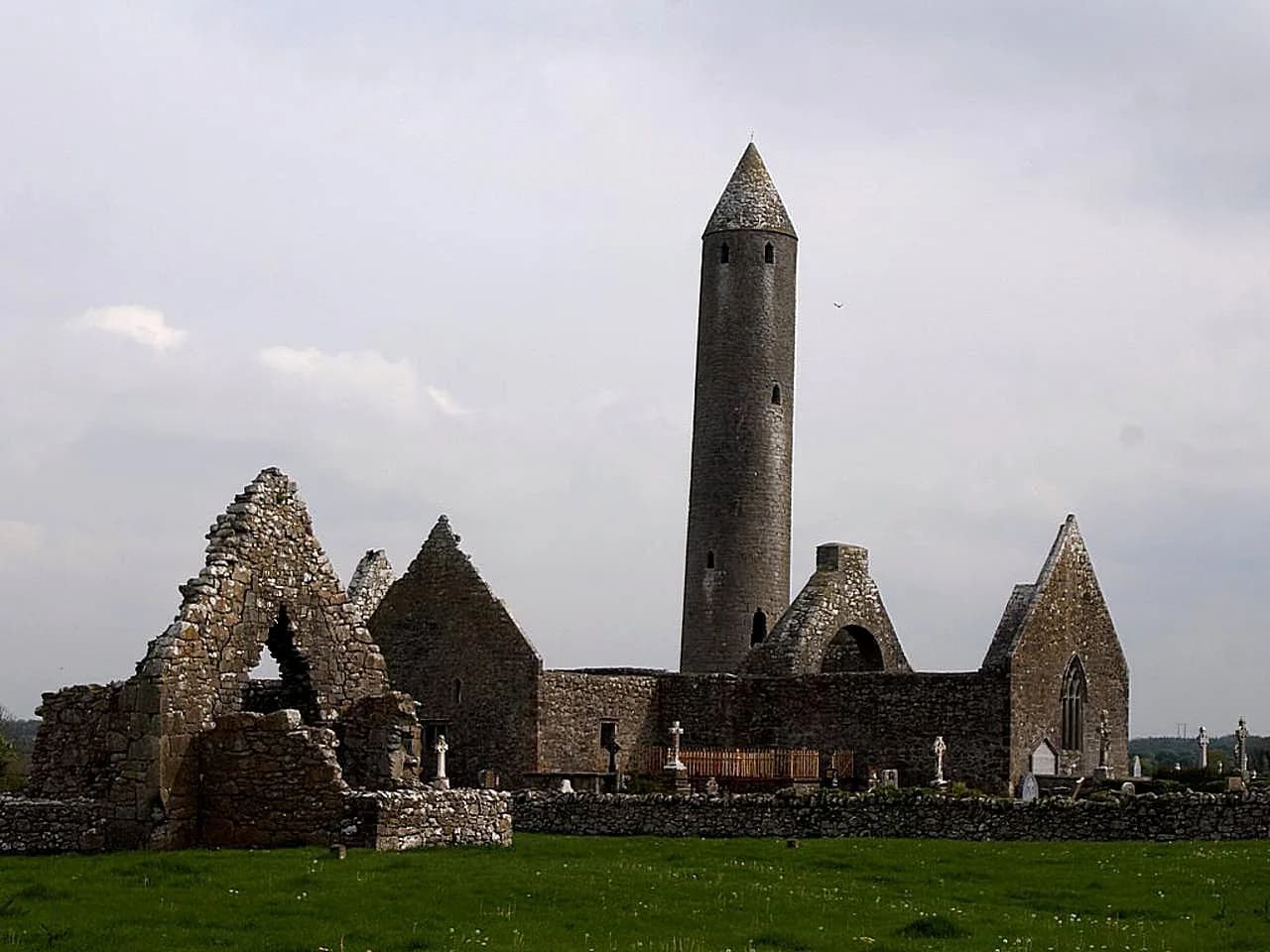
Kilmacduagh's round tower is the site's dominant feature: seven storeys, 34.3 metres high, and leaning noticeably. The Office of Public Works restored it twice, in 1878 and again in 1971, which explains why a medieval tower exposed to centuries of weather still carries its full height. Two origin accounts are recorded, one crediting Colmán Mac Duagh and another linking the foundation to the King of Connacht, Guaire Mide Mac Colmáin, who is said to have had the monastery built in his honour; the sources preserve both rather than choosing one.
The tower sits in an enclosed settlement at the edge of the Burren, and much of the site was damaged in medieval warfare, including thirteenth-century fighting between rival O'Conor claimants and a later seizure of territory by Walter de Burgh. That history is visible as fragmentary buildings rather than a tidy museum display. Allow time to walk the enclosure rather than treating the tower as a roadside stop.
Kilmacduagh is a state-owned National Monument in the care of the Office of Public Works, and it is unguided. Visitors should expect no published facilities or timings and should read the OPW page's caution notice before setting out. Plan the visit around the buildings you can see, not around facilities that are not published.
Drumcliff, County Sligo: A Truncated Tower and a Complete Cross
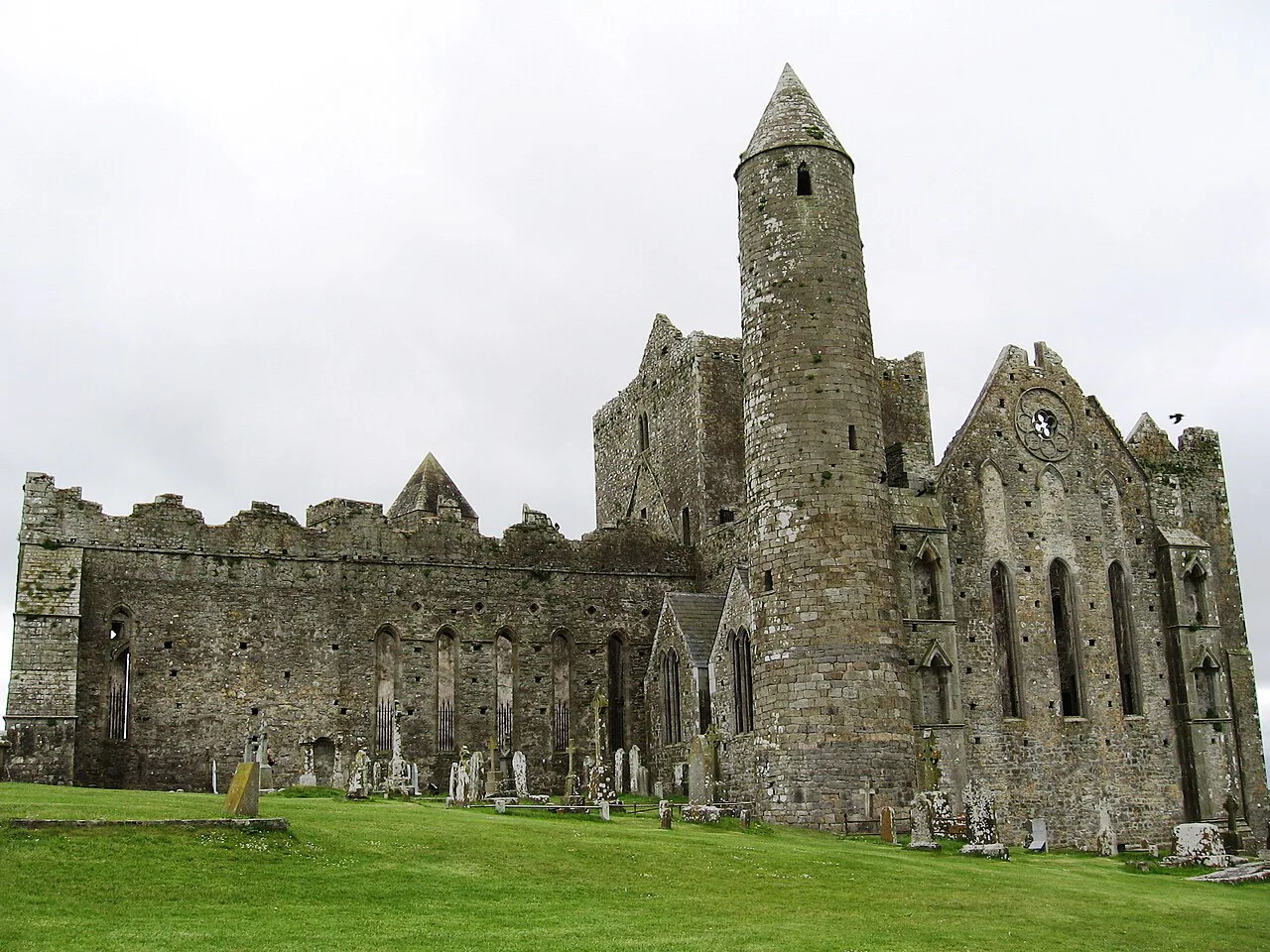
Drumcliff's monastery was founded in 574 by St Columcille on land granted by Áed mac Néill, and St Thorian served as its first abbot. The round tower itself is dated to the eleventh century and now stands 9 metres high, built of mortared stone rubble, with a doorway just under 2 metres above ground and a square-headed window at its present top. That short stump is a record of loss, not of original design.
The Annals record a lightning strike on the tower in 1396, and before 1836 a large section of the top was removed to build a nearby bridge. These entries explain why the tower's present profile differs from what a first builder would have known. When you look at the stump, you are seeing a structure that was both damaged and quarried for other work.
Drumcliff is unguided, and the enclosure sits beside a main busy road with parking across the road at Drumcliff Church. The complete high cross stands in the graveyard opposite the tower, carved with spirals, interlace and figurative panels, and it is the only known Irish high cross to show the Virgin Mary and child. Pair the tower and the cross in one visit, since each explains the other.
Clonmacnoise, County Offaly: Two Towers, Currently Closed
Clonmacnoise is fully closed to visitors from 19 October until January 2027, because a contractor requires the car park to close entirely and there would be no safe access to the site. This is the governing fact for any plan involving Clonmacnoise, and it overrides the page's earlier statement that the site would remain open during visitor-centre construction. The notice gives no reopening day beyond the January 2027 end of the closure, so check the operator's page before any journey.
What is closed is substantial. St Ciarán founded the monastery on the banks of the Shannon in the sixth century, and the ruins include a cathedral, two round towers, three high crosses, nine churches and more than 700 early Christian graveslabs. Two round towers within one complex make Clonmacnoise unusually instructive for anyone comparing tower construction, which is precisely why the closure matters for this subject.
The original high crosses, including the tenth-century Cross of the Scriptures, are described as held in the visitor centre adjacent to the monastic enclosure. Because the closure shuts the site, do not plan on seeing either the towers or the crosses during the shutdown, indoors or out. Read the complex through published descriptions for now and check the operator's notice before booking anything else in the area.
Glendalough, County Wicklow: A Tower in a Scattered Monastic City
Glendalough's monastery was founded in the sixth century by St Kevin in a glaciated valley, and its remains are spread across the glen rather than concentrated in one enclosure. The round tower is joined by medieval stone churches and decorated crosses, and the interpretive centre is the sensible first stop for orientation before walking the site. The Glendalough Monastic Site and Visitor Centre lists an average visit of one to one and a half hours if you want both.
Access comes with real trade-offs. The visitor centre is described as fully accessible, but graveyard access is very difficult for wheelchair users and the walkways are uneven. Seasonal opening blocks apply, the site closes from 23 to 29 December, and last admission to buildings and toilets falls 45 minutes before closing. Arrive earlier than you think necessary if the interpretation matters to your visit.
The glen also holds St Kevin's Bed, a small man-made cave in the cliff face above the Upper Lake. The OPW notes the tradition that Kevin lived and prayed there while also suggesting it may be a prehistoric burial place that long predates him; treat the association as legend, not as established fact. The two lakes and the valley setting supply the atmosphere that the tower alone cannot, and the wider set of Irish Saints gives the monastic context.
St Canice's, Kilkenny: The Tower You Can Climb
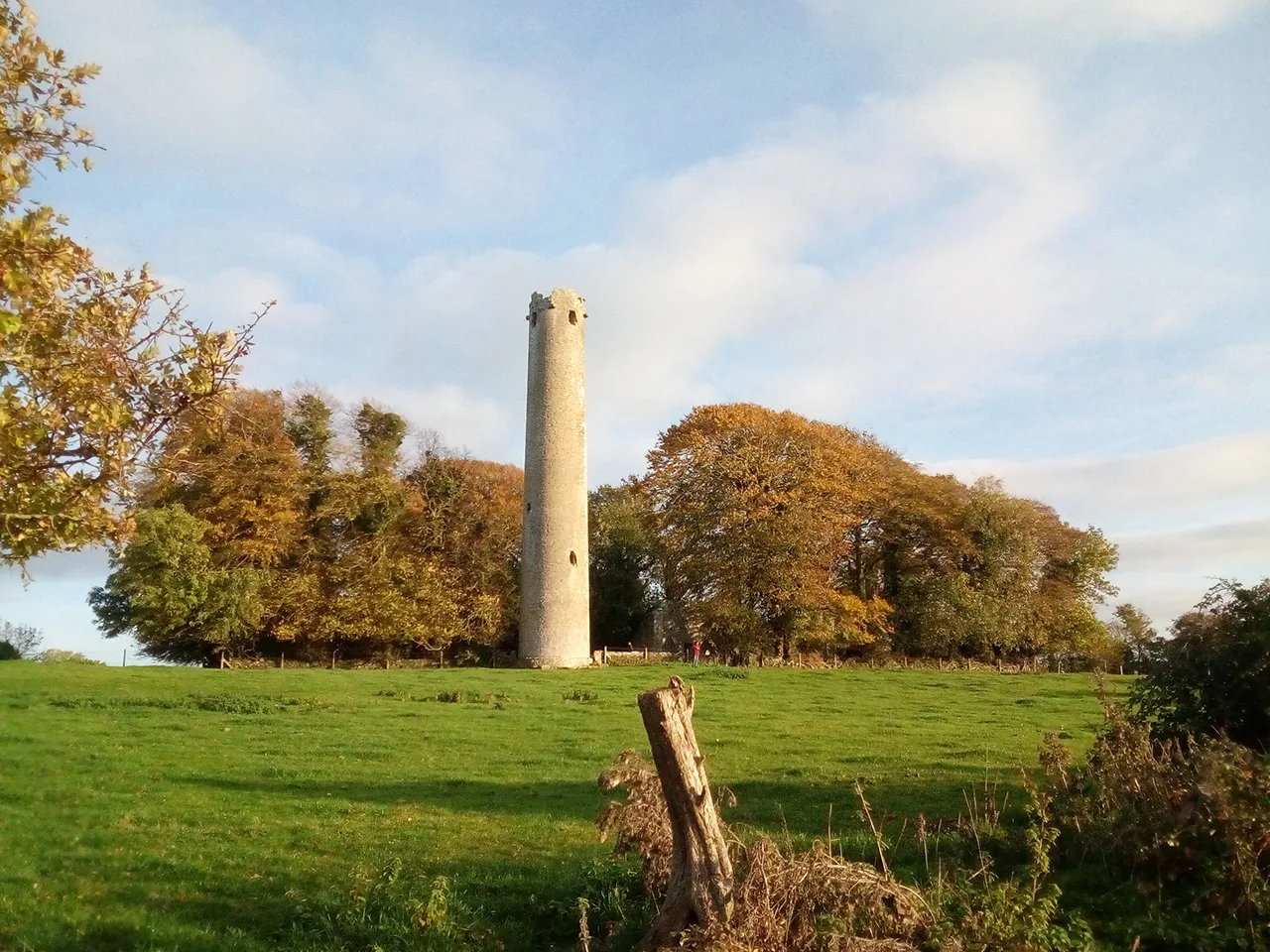
St Canice's Cathedral in Kilkenny describes its round tower as one of only two in Ireland that people may climb, and that claim should be read narrowly: it applies to this tower, not to round towers generally. The tower is 30 metres high and tapers from 4.5 metres to 3.3 metres in diameter. Its original conical top, which would have added about 5 metres, is gone, and that loss is what allows a viewing platform at the summit.
The climb is a genuine ascent: internal ladders over seven floors and 121 steps lead to the platform. Excavation at the base in 1846 and 1847 found foundations only 0.6 metres deep, plus a pavement and burials beneath it that predate the tower. The shallow footings, not the slight lean, are the more remarkable fact about how this tower has stayed standing.
The cathedral body publishes seasonal tower hours, weather permitting, with Sunday-morning closure for worship in the cathedral and a minimum height requirement for children on the climb. Those hours may change, so confirm them with the cathedral before travelling. Keep the tower distinct from the standing cathedral, which is a later Gothic building on a much older religious site with earlier churches beneath it.
Reading the Masonry: Rubble, Footings and Lean
Construction detail is site-specific, which is why broad statements about how round towers were built tend to mislead. Drumcliff's tower is described as mortared stone rubble; Kilkenny's excavation found foundations of only 0.6 metres beneath a 30-metre structure. Both facts come from a single site, and neither should be extended to Kilmacduagh or Glendalough without the operator saying so.
Lean is often treated as a national curiosity, but it has a documented history at only some sites here. Kilmacduagh's tower leans and was restored twice; Kilkenny's is recorded as slightly out of plumb. Read each lean as the product of that tower's own foundations and repairs, not as a shared characteristic of the type.
The Kilkenny cathedral body offers an explanation of round towers as places of refuge for people and treasure during Viking raids from the end of the eighth century, and as viewpoints. It is that source's account, and it is worth labelling as such rather than presenting it as settled for every tower. The towers themselves are the primary evidence; the purposes attributed to them are interpretation.
Pairing Towers With High Crosses
Some tower sites reward a second look at their carved stone. Drumcliff has a complete high cross opposite the tower, including panels depicting the Crucifixion, the Return from Egypt, Adam and Eve and David and Goliath, and its faces carry interlocking spirals and interlace. Whether the carvings read clearly on the day depends on light and weathering, so plan on looking closely rather than on photographing details.
Killamery, in County Kilkenny, has no round tower but shows the same monastic world in stone: a ninth-century high cross 3.65 metres tall, two cross-slabs, a stone cross, church ruins and two bullaun stones, all unguided. It belongs here as cross-and-ruin context, not as a tower. Use it to understand the carved tradition that often shared a site with a tower.
For a wider set of carved crosses beyond this group, Monasterboice in County Louth holds another documented collection worth comparing. Read any cross as part of its own monastic setting, since panels and condition differ from site to site.
Planning a Round Tower Visit
Sort candidate sites by access before anything else. Kilkenny is the only tower here with published climbing arrangements; Drumcliff and Kilmacduagh are unguided ruins; Clonmacnoise is closed until at least January 2027; Glendalough runs seasonal hours through an accessible visitor centre. Match the site to what your group can physically manage rather than to a list of names.
At unguided sites, assume no facilities and read the operator's caution notice in advance. At Glendalough, the gap between an accessible centre and difficult graveyard access is the key decision for anyone with mobility needs. At Kilkenny, weather and Sunday worship both affect whether the tower is open when you arrive.
If you want the wider context of Irish monastic and pilgrim landscapes, this collection of irish pilgrimage sites gathers the related places and their access notes. Plan a manageable loop that respects each site's access conditions rather than rushing a single day, since travel between them is part of the cost.
Choose by What Survives
The useful comparison is not height but survival. Kilmacduagh keeps a full leaning tower in a fragmentary enclosure, Drumcliff keeps a truncated stump beside a complete cross, Glendalough spreads its remains through a valley, Kilkenny offers a climb, and Clonmacnoise holds two towers behind a closure notice. Pick the site whose surviving fabric answers your question.
Before travelling, confirm current arrangements with the operator rather than relying on any summary, including this one. The Clonmacnoise closure in particular makes a check essential, and published tower hours at Kilkenny can change with weather and worship.
Explore more Ireland guides
Frequently Asked Questions
Can you climb round towers in Ireland?
Only in limited cases, and never as a general rule. St Canice's Cathedral in Kilkenny describes its round tower as one of only two in Ireland that people may climb, and it publishes seasonal hours, weather permitting, with a height requirement for children. The other sites described here do not publish climbing arrangements, and Clonmacnoise is currently closed to visitors altogether.
Why is Clonmacnoise closed to visitors?
A dated notice from the operator states that the car park must fully close from 19 October until January 2027 because of a contractor requirement, leaving no safe access to the site. The same notice closes the monastic site to visitors for that period. Confirm the current position on the operator's page before planning, because the notice gives no reopening day beyond that end date.
How tall are Ireland's round towers?
There is no single height. Documented figures differ by site: Kilmacduagh's seven-storey tower is described as 34.3 metres, Drumcliff's truncated tower stands at 9 metres, and St Canice's in Kilkenny is 30 metres with a taper and a missing conical cap that would once have added roughly 5 metres. Treat each figure as belonging to that tower alone.
Are round towers and high crosses found at the same sites?
Often, though not always. Drumcliff has a complete high cross opposite its round tower, and Clonmacnoise's ruins include three high crosses whose originals are held in the visitor centre. Killamery, by contrast, is a high-cross and monastic-ruin site with no round tower, useful for understanding the carved-stone tradition that often shared a monastic setting.
Is the Kilkenny round tower part of the cathedral building?
No. The round tower is a separate structure on a religious site with a much older history, and the standing cathedral is a later Gothic building raised after earlier churches on the same ground. The cathedral body calls the tower the oldest standing structure in the city, suggested by a mid-ninth-century reference, which places it well before the present cathedral fabric.
Do unguided round tower sites have facilities or guides?
Drumcliff and Kilmacduagh are state-owned National Monuments in the care of the Office of Public Works, and both carry a caution notice for unguided sites, so plan on rough ground and no visitor facilities. Drumcliff's access crosses a main busy road, with parking across the road at Drumcliff Church. Anything beyond that should be confirmed with the operator rather than assumed.
Sources
You might also like



Continue reading
More guides you'll find useful





