
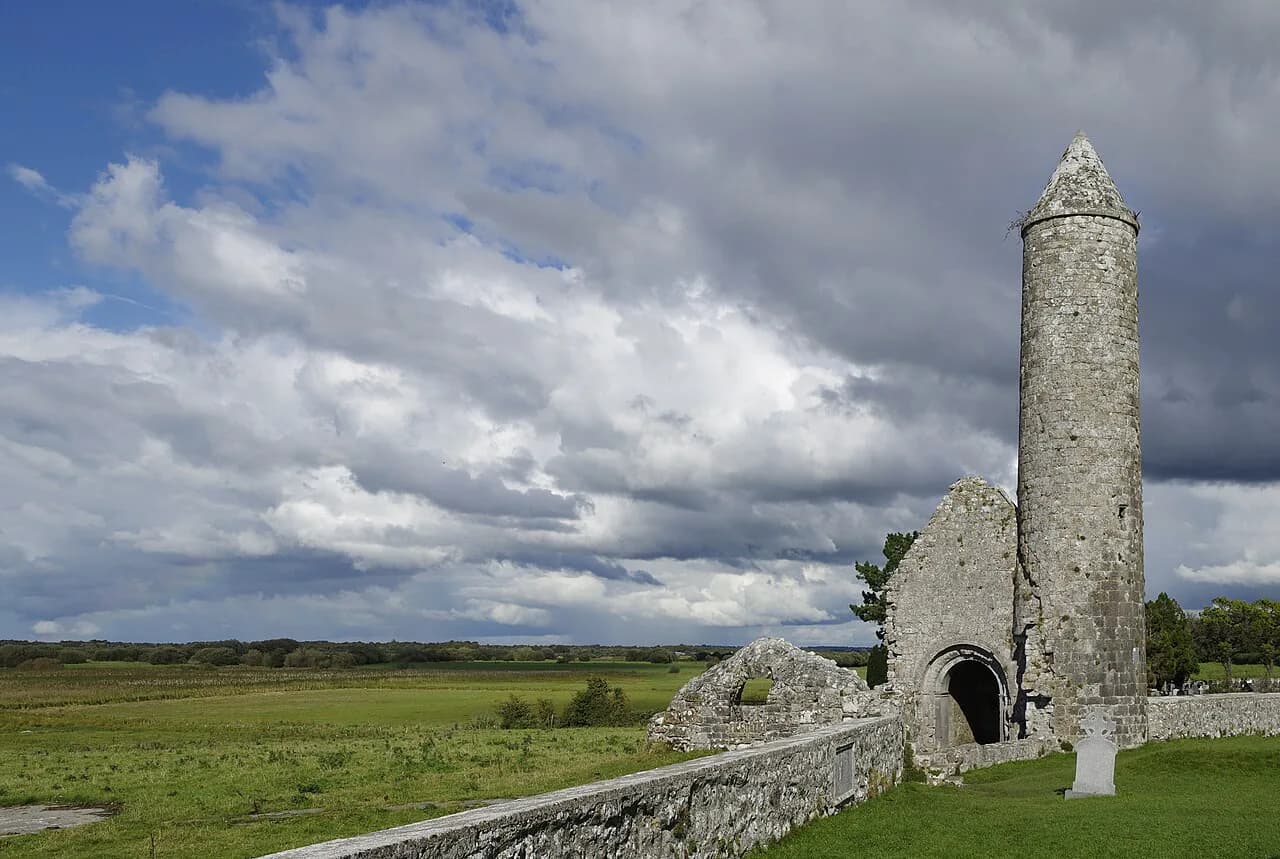
Early Christian Ireland: Monastic Sites You Can Visit
Plan a visit to early Christian Ireland at Glendalough, Kilmacduagh, Killamery, Drumcliff and St Canice's, with Clonmacnoise currently closed.
On this page
Early Christian Ireland, for a visitor, means the monastic foundations of roughly the sixth to twelfth centuries: round towers, small stone churches, carved high crosses and grave slabs, many of them National Monuments in the care of the Office of Public Works and published through Heritage Ireland. Glendalough, Clonmacnoise and Drumcliff trace their founding to the sixth century, Kilmacduagh and Killamery to the seventh, and Christian worship at St Canice's in Kilkenny to the sixth. The standing medieval cathedrals built over some of these sites are later fabric, so a visit is partly a lesson in telling one period from another. This guide covers places you can plan around now and flags where access has changed.
What You Are Actually Looking At
Round towers were raised at major religious sites from around the late eighth century, when Viking raids made protected storage and refuge valuable; St Canice's in Kilkenny describes them as places of refuge for body and treasure, and also as bell towers with a view. They are not all alike in condition, and they are certainly not all climbable, so never assume a tower can be entered. Drumcliff's tower in County Sligo, for instance, stands at about 9m with its entrance set close to ground level and a square-headed window at the top.
High crosses carry the period's sculpture: biblical scenes, interlace and geometric ornament cut into stone for a congregation that read images as well as text. At Killamery in County Tipperary the OPW records a 3.65m ninth-century cross with a west face showing a stag hunt and a chariot procession, and a north arm with scenes probably from the life of John the Baptist. Keep a respectful distance; carved surfaces are not for touching.
The enclosure matters as much as the individual monuments. Kilmacduagh Monastic Site in County Galway is an enclosed settlement containing a cathedral, St John's Church, the abbot's house and the thirteenth-century O'Heynes Church, with St Mary's Church across the road. Walking the whole group, rather than photographing the tower and leaving, is what shows how a monastic community was laid out.
Older practice sometimes sits beneath the Christian layer. At Glendalough, St Kevin's Bed is a small man-made cave in the cliff above the Upper Lake, traditionally linked to the saint but possibly a prehistoric burial place that predates him. Treat such associations as traditions the site preserves, not as settled archaeology.
Glendalough, County Wicklow
Glendalough Monastic Site and Visitor Centre is the most complete introduction for a first-time visitor: a sixth-century foundation by St Kevin in a glaciated valley, with a round tower, several medieval stone churches and decorated crosses spread across the glen. Heritage Ireland describes it as one of the most famous religious centres in Europe in its day. The interpretive centre is the sensible first stop, because it explains what you are about to walk through.
Plan on an average of one to one and a half hours, more if you walk to the Upper Lake. The visitor centre's published admission is €5 for an adult, €4 for group or senior, €3 for child or student and €13 for a family, and paying for parking at the visitor centre car park entitles you to one free visitor-centre admission. Hours are seasonal: daily 09:30–18:00 from mid-March to 14 October, then 09:30–17:00 in winter, with last admission 45 minutes before closing. The site is open all year but closed 23–29 December.
Accessibility is uneven. The visitor centre is fully accessible, but the OPW notes that access to the graveyard is very difficult for wheelchair users, and walkways around the monuments are uneven. Allow more time if anyone in your group needs firm, level ground.
Clonmacnoise, County Offaly: Closed for Now
Clonmacnoise Monastic Site is described here rather than recommended because it cannot currently be visited. Heritage Ireland's notice states that the carpark must fully close from 19 October for contractor works, and that the monastic site will be fully closed to visitors until January 2027 because there is no safe access. Check the operator page before any future planning rather than relying on older guides.
The reason it matters is the scale of what sits on the Shannon bank: St Ciarán's sixth-century monastery grew into a major seat of learning, and the remains include a cathedral, two round towers, three high crosses, nine churches and more than 700 Early Christian grave slabs. The original high crosses, among them the tenth-century Cross of the Scriptures, are kept indoors in the visitor centre beside the enclosure rather than standing in their outdoor positions. The current works are a funded redevelopment of that visitor centre; the operator notice now states that the site itself is fully closed to visitors for the duration of the carpark closure.
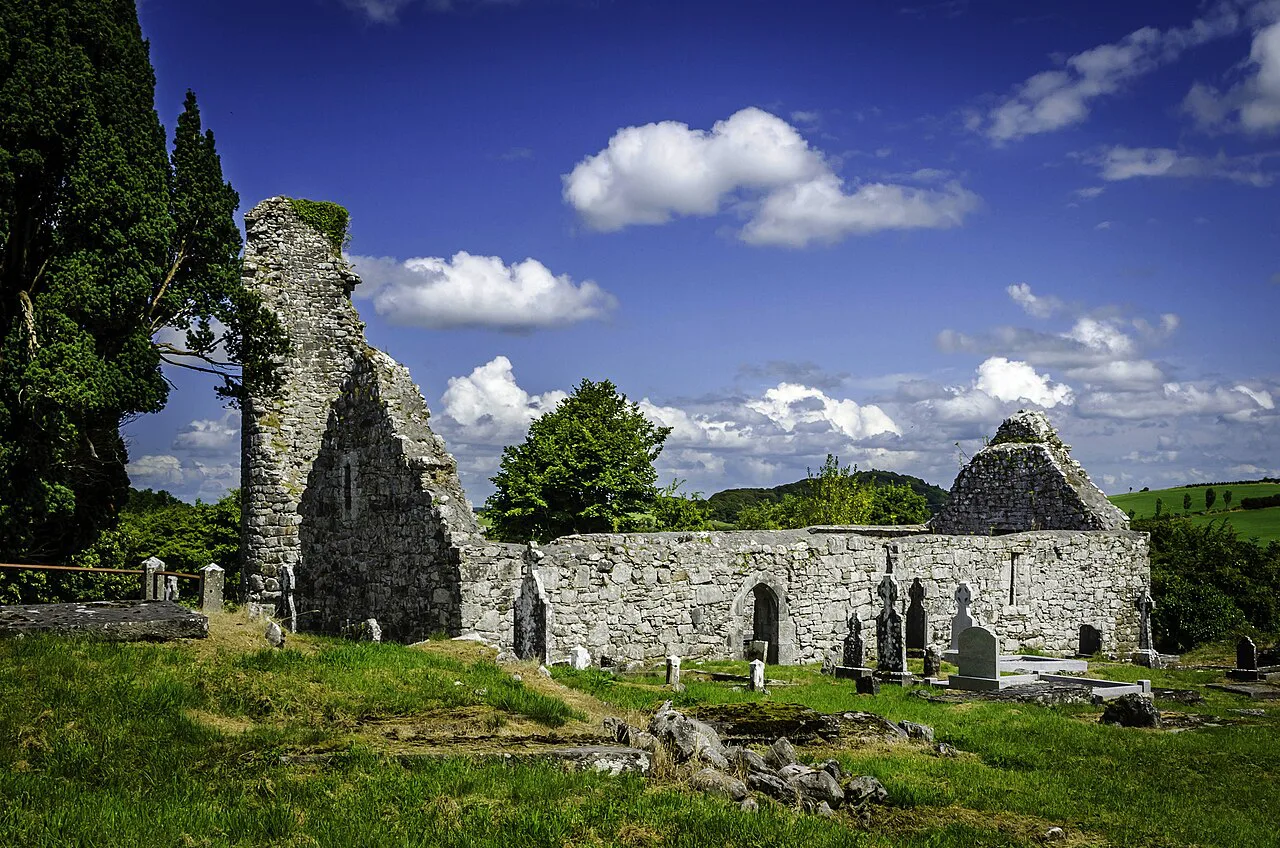
Kilmacduagh, County Galway
Kilmacduagh Monastic Site is an unguided state-owned National Monument, so there is no ticket desk and no exhibition to fall back on. The OPW records two traditions of origin: one in which an angel sent St Meadoc to heal the King of Connaught, who then had the monastery built, and another in which Colmán Mac Duagh founded it after his belt fell to the ground as a sign. Both are traditions, and the monastery is recorded as founded in the seventh century.
Its seven-storey round tower, 34.3m tall and noticeably leaning, is the signature feature and was restored twice by the OPW, in 1878 and again in 1971. The surrounding buildings span centuries: St John's Church may date to the twelfth century, O'Heynes Church to the thirteenth, and the cathedral is the largest structure in the group. Medieval warfare damaged much of the site, which is one reason the ruins read as fragments rather than a single plan.
The OPW advises care and caution at unguided monuments, and no opening hours, prices or facilities are published on the operator page for this one, so plan around daylight and expect rough ground. Nearby castles such as Athenry and Aughnanure are separately managed and should be checked on their own terms if you want to combine them.
Killamery High Cross, County Tipperary
Killamery High Cross is a single monument worth a deliberate detour: a 3.65m ninth-century cross near the reputed ruins of a monastery founded by St Gobán Fionn in the early seventh century. The OPW records an inscription read as a prayer for the High King Maelsechnaill, who reigned 846–862. The east face, with its central boss, serpents and open-mouthed dragon, earned it the nickname the Snake-Dragon Cross.
Beyond the cross itself there are two cross-slabs, a stone cross, the ruins of the original church and two bullaun stones, one slab carrying an incised Latin cross and prayers for the soul of Aedhán. This is an unguided site with no invented facilities; the OPW asks visitors to take care. The carving rewards slow looking rather than a quick photograph.
Drumcliff, County Sligo
Drumcliff pairs a 574 foundation by St Columcille, on land granted by Áed mac Néill, with an eleventh-century round tower now standing about 9m high within a small walled enclosure below Ben Bulben. Annals records include a lightning strike on the tower in 1396 and an attack that burned the abbey in 1416, killing abbot Maurice O'Coincoil. Much of the tower's upper section was removed before 1836 to build a nearby bridge.
The complete high cross in the graveyard opposite is the reason to linger: the OPW notes it as the only known Irish high cross showing the Virgin and Child, alongside the Crucifixion, Adam and Eve and David and Goliath. Access involves crossing a busy main road, with parking across the road at Drumcliff Church, so take that seriously with children. St Columba's Church, which incorporates a cross fragment in its walls, is the landmark to aim for.
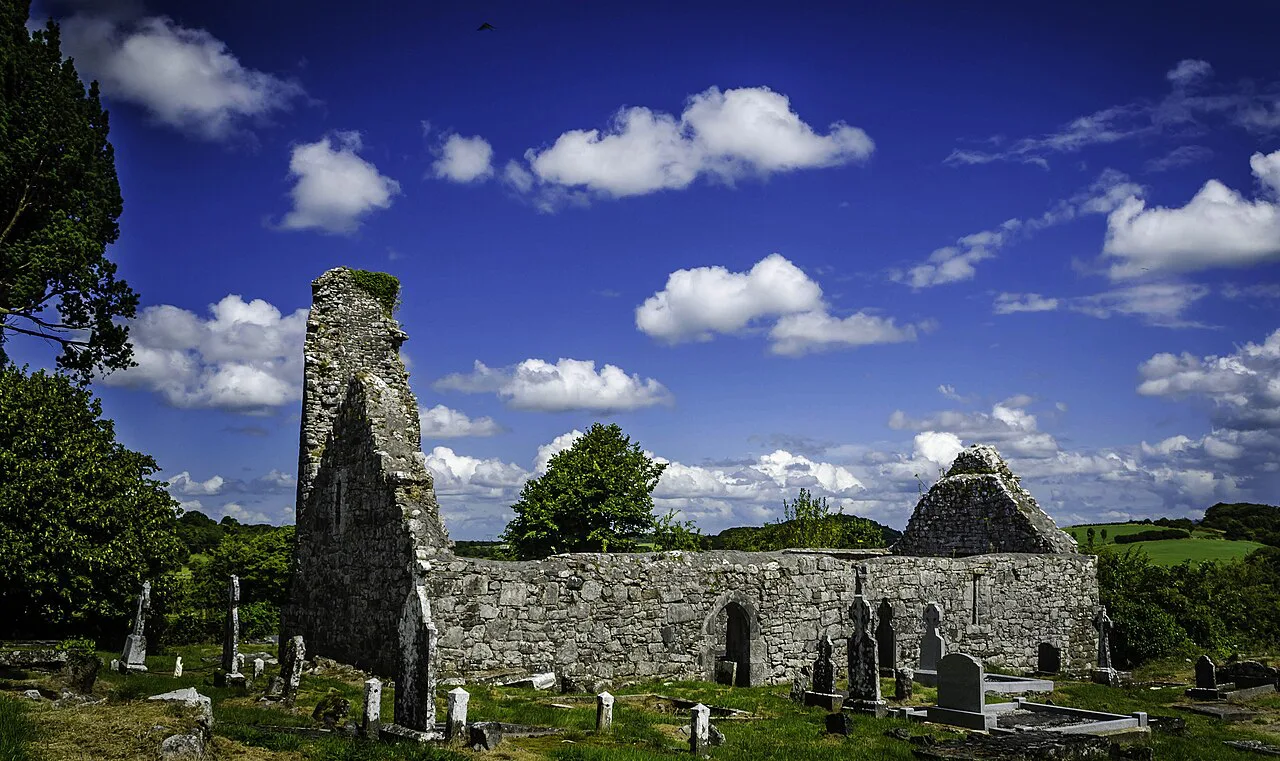
St Canice's Cathedral and Round Tower, Kilkenny
St Canice's is included with a caution: Christian worship here reaches back to the sixth century, and the round tower is the oldest standing structure in the city, with the cathedral's history citing a reference suggesting a mid-ninth-century date for it. The cathedral itself is later fabric, built in stages across the later thirteenth century, with completion often cited as 1285. After the central tower collapsed in 1332 it was rebuilt, and Cromwellian damage in 1650 left the building roofless for twelve years.
The climb is the draw: 121 steps up seven floors of internal ladders to a viewing platform on a tower 30m tall, weather permitting. The cathedral describes its tower as one of only two in the country that people may climb, a claim to read as the cathedral's own statement, and it notes the climb is busiest from 11:00 to 16:00 in summer. Hours differ by season, and the tower is closed on Sundays from October to April and on Sunday mornings in summer because of worship in the cathedral.
The cathedral publishes both a combined guided tour and tower climb and a separate tower-climb admission. The combined tour is €16 for adults, €9 for children aged 6–18 subject to a 1.4m height requirement, €13 concession and €42.40 for a family of two adults and two children, and lasts 40 minutes. The cathedral opens Monday to Saturday and is closed on Sunday.
Guided Centres Versus Unguided Monuments
The practical split is between staffed sites with interpretation and open monuments in state care. Glendalough Monastic Site and Visitor Centre has a visitor centre, exhibition, bookshop, toilets and guided tours, and St Canice's offers guided tours and a paid climb, so both suit travellers who want context delivered. Kilmacduagh, Killamery and Drumcliff are unguided National Monuments protected under the National Monuments Acts, with no invented facilities, which means bringing your own information and taking responsibility for uneven ground.
If carved stone is your main interest, one well-documented cross can carry more than a rushed circuit, and the wider tradition ranges from Drumcliff's Virgin and Child panel to the original crosses now kept indoors at Clonmacnoise. Elsewhere in Ireland, Monasterboice in County Louth offers comparable high-cross material if you want to extend a trip beyond these sites.
Saints' biographies shape how sites are presented, so reading the traditions behind Kevin, Ciarán, Columcille and Gobán Fionn before arriving makes the ruins legible without turning legend into fact.
Sequencing a Visit
Group sites by county rather than by chronology: Wicklow for Glendalough, Galway for Kilmacduagh, Tipperary for Killamery, Sligo for Drumcliff and Kilkenny for St Canice's. Decide for each whether you want interpretation or an open, unstaffed ruin, since that choice changes how much time and preparation you need.
Two points are worth checking before travelling: the Clonmacnoise closure, which runs until January 2027 under the current notice, and Glendalough's switch to winter hours from 15 October. Elsewhere, confirmed seasonal hours at St Canice's and daylight for the unguided monuments should be enough preparation. To compare surviving sites more broadly, see our guide to monasteries in Ireland.
For another heritage guide, read about Irish Pilgrimage Sites.
Explore more Ireland guides
Frequently Asked Questions
What does early Christian Ireland mean for a visitor?
It refers to the monastic foundations of roughly the sixth to twelfth centuries, visible today as round towers, small stone churches, high crosses and grave slabs. Many are National Monuments in the care of the Office of Public Works and published through Heritage Ireland. Glendalough, Clonmacnoise and Drumcliff trace their founding to the sixth century and Kilmacduagh to the seventh. Later medieval cathedrals built on the same ground, such as St Canice's in Kilkenny, belong to a different building phase and should not be mistaken for early Christian fabric.
Can you visit Clonmacnoise right now?
No. Heritage Ireland states that the carpark must fully close from 19 October for contractor works, leaving no safe access, and that the monastic site will be fully closed to visitors until January 2027. Check the operator page before planning any future trip rather than relying on older guidebooks. The wider redevelopment of the visitor centre is funded and under way.
Is Glendalough open in winter?
Yes, the site is open all year, though hours shorten from 15 October, and it closes 23–29 December. The visitor centre is fully accessible, but the graveyard is very difficult for wheelchair users and walkways are uneven. Budget one to one and a half hours on average, longer if you walk to the Upper Lake.
Can you climb the round tower at St Canice's Cathedral?
Yes, weather permitting, via 121 steps and seven floors of internal ladders to a viewing platform on the 30m tower. The cathedral describes it as one of only two round towers in the country that people may climb. The tower closes on Sundays from October to April and on Sunday mornings in summer, and the cathedral publishes both a combined guided tour and tower climb and a separate tower-climb admission.
Are Kilmacduagh, Killamery and Drumcliff guided sites?
No. All three are unguided state-owned National Monuments in the care of the Office of Public Works, and the OPW advises visitors to take care. No opening hours, prices, tours or facilities are published for them here, so plan around daylight and expect uneven ground. Drumcliff adds a road crossing, with parking across a busy main road at Drumcliff Church.
Where are the original Clonmacnoise high crosses kept?
The original high crosses, including the tenth-century Cross of the Scriptures, are displayed indoors in the visitor centre beside the monastic enclosure rather than at their outdoor positions. The site is currently closed to visitors, so confirm access before travelling.
What is the difference between a round tower and a high cross?
A round tower is a tall, tapering stone structure built at a major religious site, associated with refuge and with bells; a high cross is a carved stone cross, usually bearing biblical scenes and ornament. Both belong to the early Christian period, but they served different purposes and survive in different conditions. Not every round tower can be entered, and carved crosses should not be touched.
Sources
- Glendalough Monastic Site and Visitor Centre | Heritage Ireland
- Clonmacnoise Monastic Site | Heritage Ireland
- Kilmacduagh Monastic Site | Heritage Ireland
- Killamery High Cross | Heritage Ireland
- Drumcliff Round Tower and High Crosses | Heritage Ireland
- History of St Canice’s Cathedral | Kilkenny’s Past
- Guided Tour & Tower Climb | St Canice’s Cathedral
You might also like



Continue reading
More guides you'll find useful





