
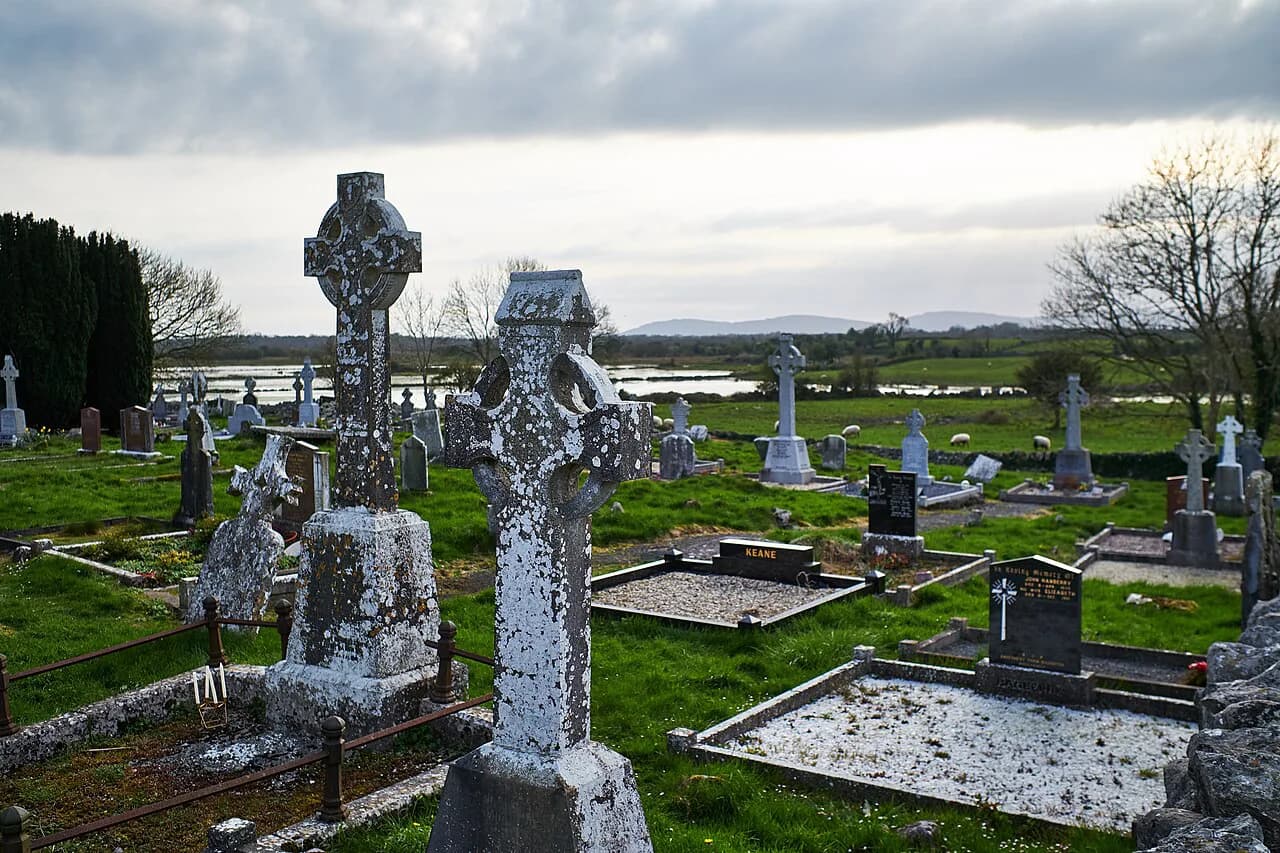
Irish Pilgrimage Sites: Monastic Ruins and St. Declan's Way
Plan a route through Irish pilgrimage sites: the unguided monastic monuments at Kilmacduagh and Killamery, and the waymarked St. Declan's Way from Cashel to Ardmore.
On this page
Irish pilgrimage sites fall into two practical groups. One is the early monastic monument in state care, usually visited on foot and interpreted largely by what you already know. The other is a waymarked long-distance walk that anchors whole days. Each demands different preparation, and Heritage Ireland presents its unguided sites with a care-and-caution notice rather than as staffed attractions.
This guide concentrates on two Office of Public Works monuments, Kilmacduagh and Killamery High Cross, and one named route, St. Declan's Way. Together they show how carved stone, monastic enclosure and formal walking route can be read as parts of the same devotional tradition without flattening them into a single experience.
Kilmacduagh Monastic Site
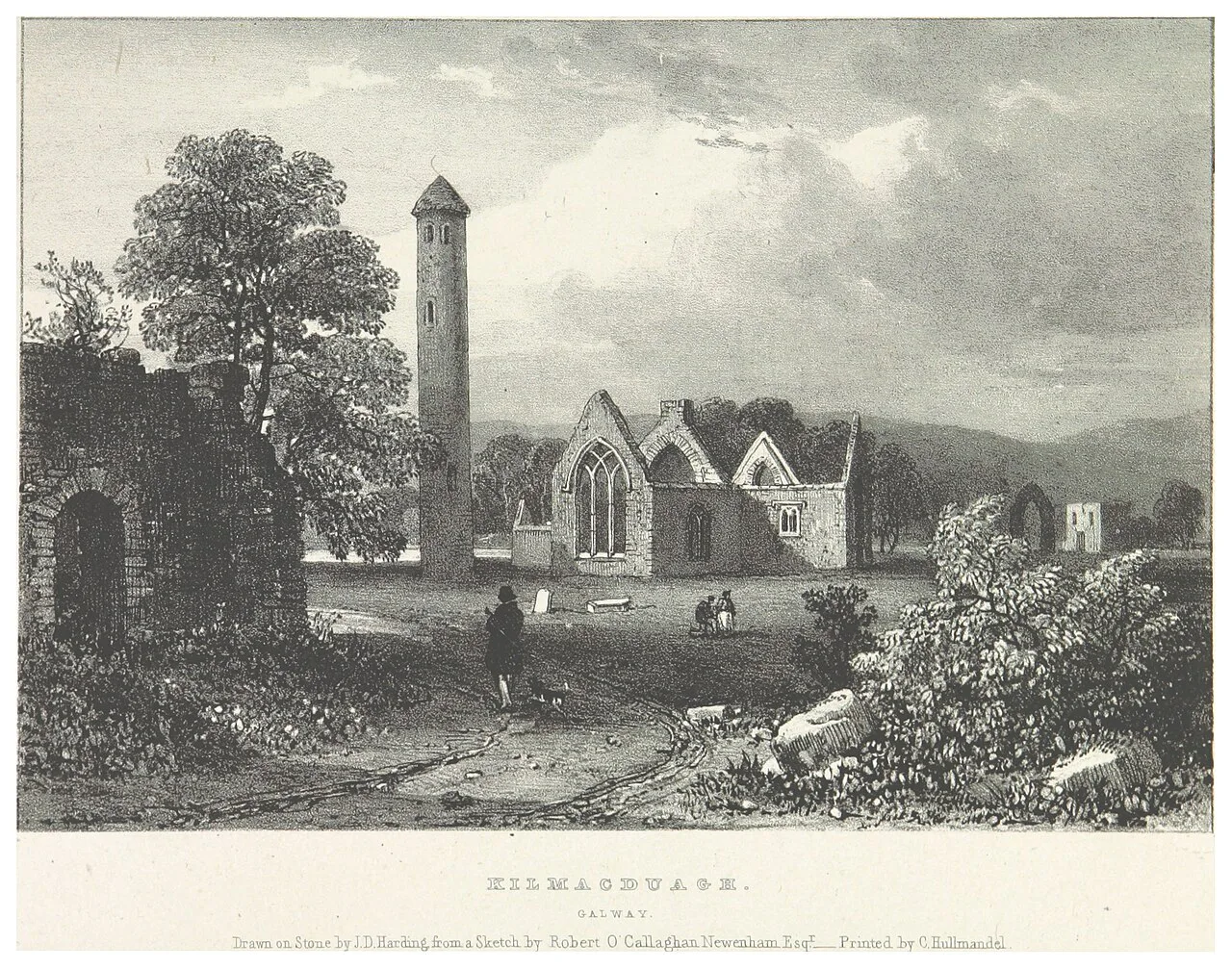
Heritage Ireland describes Kilmacduagh as a state-owned National Monument in the care of the Office of Public Works, founded in the 7th century. Two founding traditions survive, and the official page keeps them side by side: one has St. Meadoc guided by an angel to heal the King of Connaught, Guaire Mide Mac Colmáin, who then built the monastery in his honour; the other credits Colmán Mac Duagh, who read the fall of his belt as a sign of where to build. Treat both as traditions rather than settled history.
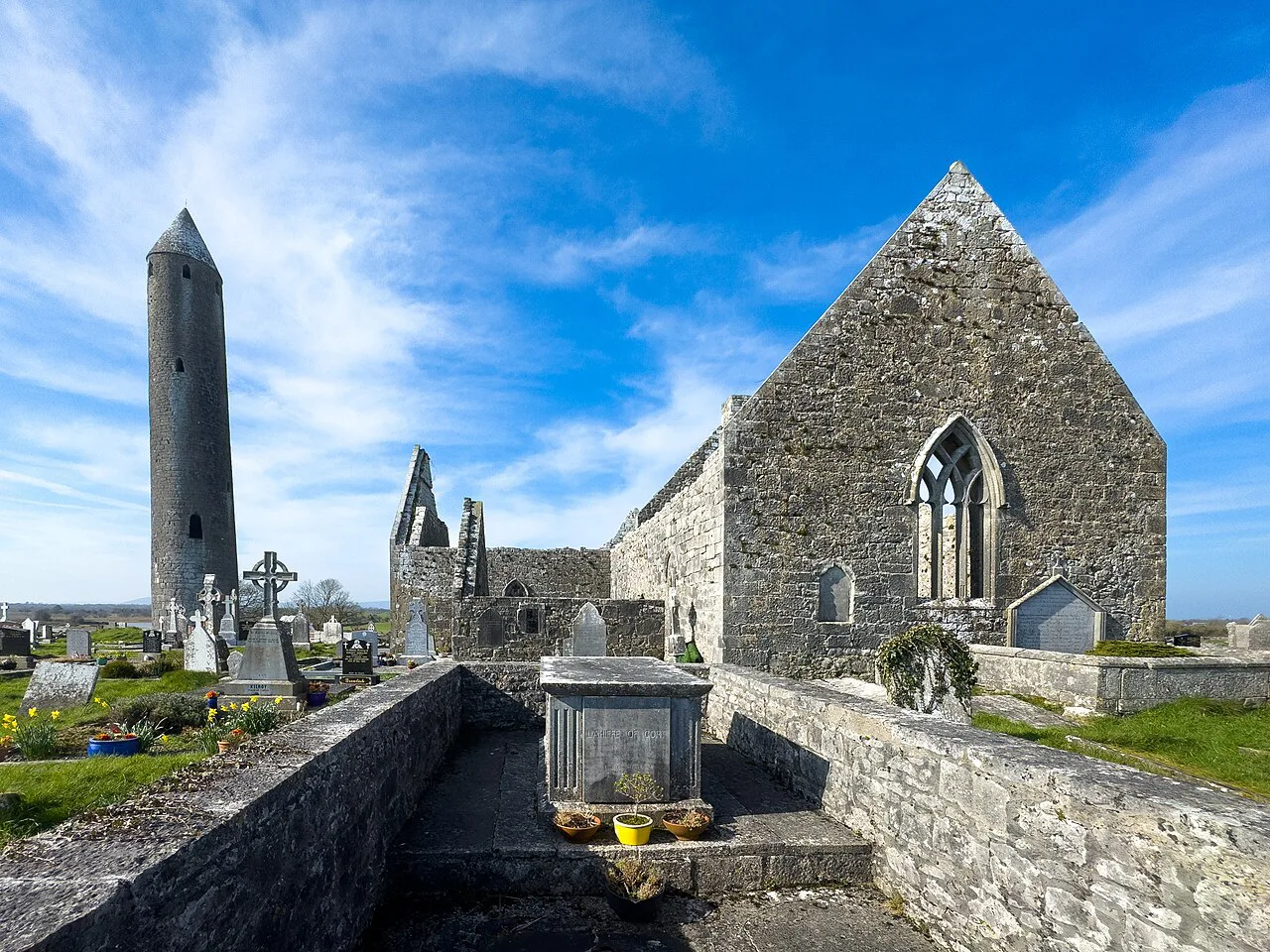
The site sits at the edge of the Burren and is an enclosed settlement rather than a single ruin. Its best-known feature is the round tower, seven storeys high at 34.3 metres and leaning noticeably, which the Office of Public Works restored twice, first in 1878 and again in 1971, as Heritage Ireland records. If you have already looked at other round towers, the lean and the sheer height make this one worth its own stop; the broader round towers ireland overview helps place it in context.
Within the enclosure the named buildings are St. John's Church, possibly 12th century, the abbot's house, O'Heynes Church of the 13th century, St. Mary's Church across the road and likely from the early 1200s, and the Cathedral. Keep those qualifiers: the official page hedges on the earliest dates. Much of the site was damaged in battles, including a 13th-century conflict between Cathal Croibhdhearg O'Conor and his nephew Cathal Carrach O'Conor, and a seizure of territory by Walter de Burgh, 1st Earl of Ulster.
Access is unguided, and Heritage Ireland carries a standing notice asking visitors to maintain care and caution at these sites. Treat the surviving fabric as exposed and plan around weather before you commit to the detour. For monument-level detail, the official page points readers to the Historic Environment Viewer, which is the sensible place to check before travelling.
If Kilmacduagh is one part of a longer westward loop, castles in county galway covers the fortified sites that belong to a different, later chapter of the same landscape. It is a useful contrast: the monastery shows devotional building, the castles show secular power. If your route instead turns east, castles in Kilkenny: a practical guide to Kilkenny Castle offers the same monastic-versus-secular contrast closer to the pilgrimage sites.
Killamery High Cross, County Kilkenny
Killamery High Cross is described by Heritage Ireland as a 9th-century work of art standing 3.65 metres tall, beside monastery ruins reputedly founded by St. Gobán Fionn in the early 7th century. Like Kilmacduagh it is a state-owned National Monument in OPW care and an unguided site. The cross is the reason to come, but the surrounding group repays a slower circuit.
Read the west face first: the official description identifies a stag hunt, a chariot procession, and panels that may show the Lord sanctifying the Seventh Day alongside Adam and Eve. The northern arm carries four scenes likely drawn from the life of St. John the Baptist, while the southern arm shows Noah's Ark. Bring binoculars or use a zoom lens, because high crosses lose their carvings quickly at ground level.
The east face is the one that earned the monument its nickname. Three marigold designs surround a central boss ringed by intertwining serpents and an open-mouthed dragon, hence Snake-Dragon Cross. An inscription is interpreted as a prayer for the High King Maelsechnaill, who reigned 846 to 862; that reading is scholarly interpretation, not certainty, and should be described as such.
Beyond the cross, the site holds two cross-slabs, a stone cross, the ruins of the original church and two bullaun stones. One cross-slab bears an intricately incised Latin cross and inscriptions praying for the soul of Aedhán. All of it is protected under the National Monuments Acts 1930 to 2014, which is the practical reason nothing should be moved, leaned on or traced.
Monasterboice in County Louth is the better-known comparison for carved high crosses, and visiting both shows how regional workshops handled similar subjects differently. If your interests lie with the people rather than the stone, irish saints gives the biographical background that the monument pages only sketch.
St. Declan's Way: Cashel to Ardmore
St. Declan's Way runs from the Rock of Cashel in County Tipperary to Ardmore in County Waterford, a route of roughly 115 kilometres divided into five or six stages, according to the route's own page. It describes the way as fully waymarked and notes that it was passed by Sport Ireland as a national walking route in 2021. That staging matters: it lets a walker treat the route as a series of day sections rather than one continuous trek.
At the Cashel end, the Rock of Cashel holds Cormac's Chapel and the Gothic Cathedral among its buildings, so the route begins inside a major ecclesiastical complex rather than at a quiet trailhead. At the Ardmore end, the route page presents Ardmore Round Tower, a 12th-century structure, as the landmark finish. Treating the two ends as fixed reference points, with stages between, is the simplest way to think about the walk.
The route page also names intermediate waypoints including Cahir Castle, the Swiss Cottage, Lady's Abbey, Mount Melleray Abbey and Lismore Castle, and describes the landscape shifting from farmland to rugged coastline. Those names are worth checking individually, since some are visitor attractions with separate arrangements and others are simply places the path passes. Treat the list as orientation, not an itinerary.
Walkers should also expect that a waymarked national route is not a serviced trail. The St. Declan's Way page presents the walk and its stages; it does not present itself as an operator of facilities at each named stop. Confirm the details for the Rock of Cashel and any site you intend to enter before you build a day around it.
Choosing Between a Monument Stop and a Staged Walk
Kilmacduagh and Killamery suit a short stop: both are unguided and both reward preparation more than time. Their value lies in reading the fabric, the lean of a tower or the panels of a cross, rather than in covering distance. If you have a spare half day between larger stops, either fits, provided you plan for uneven ground and bring whatever you need.
St. Declan's Way asks for the opposite commitment. Its roughly 115 kilometres are spread across five or six stages, so it is a multi-day plan with logistics at both ends. The trade-off is real: monuments give depth in one place, the route gives continuity across a region. Choosing one over the other is mainly a question of how many days you have and whether you want to walk or to look.
Orientation Before You Set Out
Frame both OPW monuments as unguided heritage stops rather than staffed attractions, and rely on Heritage Ireland and the Historic Environment Viewer for monument detail. Their care-and-caution notices exist because these are exposed, often uneven sites, so footwear and weather planning matter more than ticketing. A quick check of current access details on the Heritage Ireland pages before travelling is the one habit worth building into the trip.
For the walk, use the St. Declan's Way material to understand the stages and the named waypoints, then verify each place you plan to enter separately. Pilgrimage in Ireland is not a single product with a single operator, and treating it as one leads to assumptions the sources do not support.
Other Pilgrim Walks Beyond St. Declan's Way
Travellers who have read about St. Declan's Way and want to widen a heritage itinerary may wonder whether other waymarked pilgrim routes in Ireland exist. They do. According to the pilgrimage material published for the route, a number of other pilgrim walks offer the chance to explore the country's spiritual and cultural heritage, and they can all be found on PilgrimPath.ie. Among the most popular routes named are Lough Derg in Donegal, Tochar Phadraig in Mayo, Cnoc na dTobar in Kerry and St. Finbarr's Way in Cork. These are presented as a group of alternatives rather than a single recommended trail, so a reader comparing options has at least four names to look into beyond the Cashel to Ardmore route.
The same material places these routes in a long tradition: Ireland has a rich history of pilgrimage, dating back to the earliest Christian communities that settled on the island, and pilgrim walks today are described as a way to connect with this history and experience the country's natural beauty in a deeply meaningful way. That framing is useful for a heritage-led trip because it treats walking itself as the cultural activity, not simply as transport between monuments. The published account notes that pilgrim walks offer the chance to explore landscapes, historic sites and spiritual traditions together, and adds that the experience suits a seasoned walker or someone looking for a new adventure. For a traveller who has already considered a monument stop such as the round tower and churches at Kilmacduagh or a carved high cross, these longer trails are the other half of the same story: the routes that connect the sites people visit.
St. Declan's Way itself shows how a modern pilgrim route is assembled. It stretches from the Rock of Cashel in County Tipperary to the seaside town of Ardmore in County Waterford and follows in the footsteps of St. Declan, a fifth-century saint credited with bringing Christianity to the region. The route is relatively new as a waymarked trail: it was rediscovered and revitalised in recent years by a group of local enthusiasts, then taken on by the St. Declan's Way Steering Committee, and it was fully waymarked and passed by Sport Ireland as a national walking route in 2021. It covers approximately 115 km and is divided into five or six stages that can be completed over the course of several days. Along the way walkers pass sites of note including Cahir Castle, the Swiss Cottage, Lady's Abbey, Mount Melleray Abbey and Lismore Castle, and the start and finish are marked by the Rock of Cashel and Ardmore's Round Tower.
For an itinerary built around monastic ruins, the pairing of short monument visits and longer routes is straightforward. The Rock of Cashel, the starting point of St. Declan's Way, is described as an iconic medieval fortress that was the seat of the kings of Munster for hundreds of years and is home to important historic buildings including Cormac's Chapel and the Gothic Cathedral. At the other end, the Ardmore Round Tower dates back to the 12th century and is described as a testament to the early Christian history of Ireland, offering views of the surrounding coastline. A traveller adding one of the other pilgrim routes named in the St. Declan's Way material to a trip already shaped by carved crosses and round towers is therefore working within the same inheritance: early Christian communities, later medieval building, and paths that link them across the south-east and beyond.
Plan Your Pilgrimage Route
Start with what you want from the trip: a concentrated encounter with carved stone and enclosure at Kilmacduagh or Killamery, or a staged walk with the Rock of Cashel at one end and Ardmore Round Tower at the other. Both are legitimate approaches to Irish pilgrimage sites, and both are better when you know in advance that access is unguided and facilities cannot be assumed.
Check current opening and access details for each named place before you travel, and let the surviving fabric set your expectations. For a further early church site with a churchyard setting, Drumcliffe Church, County Sligo offers a comparable short stop.
Explore more Ireland guides
Frequently Asked Questions
What are the main Irish pilgrimage sites covered in this guide?
This guide covers two Office of Public Works monuments, Kilmacduagh in County Clare and Killamery High Cross in County Kilkenny, and one named long-distance route, St. Declan's Way from the Rock of Cashel to Ardmore. It does not claim to cover every pilgrimage site in Ireland.
Can you visit Kilmacduagh and Killamery without a guide?
Heritage Ireland presents both as state-owned National Monuments in OPW care and as unguided sites, with a standing care-and-caution notice, so visits are self-guided. Heritage Ireland does not publish regular staffed hours, admission charges or on-site services for these sites; check current access details on its pages before travelling and prepare for uneven ground and exposed weather.
How long is St. Declan's Way and how is it staged?
The route page describes roughly 115 kilometres divided into five or six stages between the Rock of Cashel in County Tipperary and Ardmore in County Waterford. It was fully waymarked and passed by Sport Ireland as a national walking route in 2021, according to the route's own page.
What carvings should you look for on Killamery High Cross?
On the west face, a stag hunt, a chariot procession and panels that may show Adam and Eve. The northern arm has four scenes likely from the life of St. John the Baptist, the southern arm shows Noah's Ark, and the east face carries the serpent-and-dragon design that gave the cross its nickname.
Why are early monastic monuments described as unguided?
Because the Office of Public Works protects and maintains these National Monuments but presents them as unguided sites rather than staffed attractions. The Heritage Ireland pages point to the Historic Environment Viewer for further detail and do not publish regular hours or charges, so check current access on the Heritage Ireland page for each monument before you rely on any arrangements.
Sources
You might also like



Continue reading
More guides you'll find useful





